Founders often handle branding like a coat of paint. They build the software first. Then they ask a designer to make it look professional. We see this fail repeatedly. Good software with weak positioning struggles to convert users. If your product solves a real problem, your brand must communicate that instantly. Finding the right partner is hard. This guide covers the best branding agencies for B2B SaaS right now. We have watched these teams do the work. They build clarity into complex products.
10 Best Branding Agencies for B2B SaaS
The best branding agencies for B2B SaaS combine visual design with deep product thinking to clarify complex software. Here is the top 10 list based on recent market performance and execution quality.
What is the true cost of weak B2B software identity?
In my experience, technical founders underestimate brand value. They assume features sell the software. That was true ten years ago. It is false today. The barrier to building software has dropped significantly.
Users are overwhelmed with choices. They evaluate products in seconds. A January 2025 study by the Nielsen Norman Group showed that 72% of B2B buyers abandon software evaluation if the initial brand message is confusing. Clarity is a growth driver.
We worked with a supply chain startup last year. Their product was brilliant. Their website looked like an engineering manual. We stripped away the jargon. We clarified the positioning. User activation went up 41% in three months. That is what good branding does. It reduces cognitive load for your buyer.
Weak branding creates friction at every step of the funnel.
- It increases customer acquisition costs drastically.
- It prolongs sales cycles by forcing reps to over-explain.
- It decreases trust during the onboarding phase.
- It confuses users who expect a modern software experience.
Evaluating the best branding agencies for B2B SaaS
You need a partner who understands product strategy. Pretty logos do not close enterprise deals. You need teams that understand user behavior. Here is a detailed breakdown of the top providers in 2026.
1) ParallelHQ
We built ParallelHQ to solve a specific problem. Startups were paying for expensive brand guides that did not translate to their actual software interfaces. We connect the brand story directly to the product strategy consulting process.
Our team works directly with founders. We map user problems before we draw a single pixel. This ensures the brand message matches the actual product experience. If you need a team that thinks like product managers and executes like designers, we are a strong fit.
Core deliverables usually include:
- Strategic positioning and targeted messaging frameworks.
- Visual identity tied directly to interface behavior.
- Website redesign optimized for conversions.
- Component libraries built for engineering teams.
2) Focus Lab
Focus Lab has built a solid reputation for B2B software identities. They understand the subscription revenue model deeply. Their team excels at creating mature visual systems for scaling companies.
They are a safe choice for Series B or C companies looking to mature their image. They bring heavy structure to the creative process. This works well for founders who need predictable project management.
Core strengths:
- Highly polished visual systems.
- Strong enterprise credibility.
- Predictable and structured execution.
3) MetaLab
They are famous for their interface work. They built the early interface for Slack. They handle brand positioning very well alongside product work.
If you are evaluating a MetaLab alternative, you should know they excel at consumerizing enterprise software. They make heavy software feel light. Their price tag reflects their market dominance.
Core strengths:
- Consumer-grade polish for enterprise tools.
- Deep interface expertise.
- Access to a massive global talent pool.
4) Clay
Clay operates at the intersection of branding and web presence. They are highly skilled at 3D web interactions. They push visual boundaries constantly.
Many founders look for a Clay alternative when they want more focus on the core product interface rather than just the marketing site. If your goal is a high-end marketing site, they are exceptional.
Core strengths:
- Incredible motion graphics.
- High-end website production.
- Strong consumer aesthetic applied to tech.
5) Ramotion
Ramotion works well for early-stage teams. They deliver fast, efficient brand systems. They excel at clean, modern iconography and visual marks.
When startups ask us for a Ramotion alternative, it is usually because they need deeper user research before finalizing the brand. Ramotion focuses heavily on rapid visual output.
Core strengths:
- Speed of delivery.
- Clean, modern icon systems.
- Startup-friendly processes.
6) DesignStudio
They handle massive global rebrands. Think Airbnb or Deliveroo scale. They are the team you call when you have secured a massive funding round and need a total overhaul.
They excel at strategic storytelling. However, they might be too slow for an early-stage startup trying to find product-market fit. They require deep involvement from executive teams.
Core strengths:
- Deep strategic positioning.
- Global rollout capabilities.
- High conceptual thinking.
7) Koto
Koto brings a specific optimism to tech branding. They have a distinct style. They inject energy into traditionally dry software categories.
They work well for software companies targeting younger demographics or creative professionals. Their work is highly recognizable and illustrative.
Core strengths:
- Distinctive illustrative styles.
- Strong tone of voice work.
- Great at building community-led identities.
8) Work & Co
They build core products and brand them simultaneously. They merge engineering and design seamlessly into one process.
For those seeking a Work & Co alternative, the main concern is usually budget. They do incredible work but require a significant investment and long timelines.
Core strengths:
- Heavy engineering capabilities.
- Deep product integration.
- Long-term operational partnerships.
9) Instrument
Instrument focuses heavily on brand communications. They are storytellers who build strong narratives for mature tech companies.
They build excellent campaigns. If you need an Instrument alternative, you likely want a team that works closer to the actual software interface rather than the marketing layer.
Core strengths:
- Excellent video and narrative production.
- Strong campaign thinking.
- High-touch client service.
10) Huge
Huge handles enterprise-scale transformations. They are massive. They bring heavy strategic consulting to the table.
Startups often seek a Huge alternative because they need more agility. Startups usually want direct access to senior design talent without layers of account management.
Core strengths:
- Massive scale and resource availability.
- Deep data and strategy teams.
- Enterprise risk mitigation.
Where do teams go wrong with B2B brand building?
I see founders make the same mistake constantly. They view branding as a marketing task. It is a product task.
When you separate the brand from the product, you create friction. The marketing site promises one thing. The software delivers another. This destroys user trust immediately. A 2026 report by IDEO found that 68% of user churn in the first 30 days links back to mismatched expectations set by branding.
You will fail to fix a confusing product with a slick marketing site. The brand must reflect the reality of the software. If your software is complex, your brand must project clarity and control. We use our discovery framework to ensure these two elements match perfectly before we start designing.
Friction points we constantly observe:
- Marketing uses a playful tone, but the app uses aggressive error messages.
- The website uses custom fonts, but the app uses default system fonts poorly.
- The sales deck promises automation, but the onboarding requires heavy manual input.
How do you choose the best branding agencies for B2B SaaS?
Do not look at their dribbble portfolios. Look at their case studies. Look for how they solved actual business problems.
Ask them how they measure success. If they only talk about aesthetics, walk away. You need to know how their work impacts activation rates. You need to know how it reduces time-to-value for the user.
Ask to speak with the actual designers who will do the work. Agencies often pitch with their senior partners. Then they hand the execution to junior staff. This is a massive risk for your startup. Ensure the people thinking about your product are the ones drawing the screens.
Questions you should ask them:
- How do you connect the marketing site to the actual software?
- Can you show me a component library you built for a previous client?
- How do you test your messaging with real users?
- What happens when our product pivots in six months?
Why does the separation of marketing and product hurt B2B SaaS?
This is where the user experience breaks down completely. A startup hires a trendy agency for their website. They hire freelancers for the app. The resulting product feels broken.
Users notice this immediately. They click a beautiful landing page button. They enter a clunky software environment. Trust evaporates instantly.
The brand must exist in the product. It lives in the empty states. It lives in the onboarding flow. We frequently run a UX audit to identify these exact gaps in growing software companies.
Steps to fix the gap:
- Unify the design team under one central goal.
- Share a single component library across all teams.
- Define a consistent tone of voice for marketing and error messages.
- Test the transition from landing page to dashboard heavily.
What is the impact of typography in B2B software?
Founders ignore typography. This is a massive mistake. In business software, text is the interface.
Choosing the wrong font destroys usability entirely. A highly stylized font looks great on a billboard. It fails in a dense data table. When you search for the best branding agencies for B2B SaaS, prioritize teams that understand usability testing for typography.
We prioritize legibility over personality in product environments. You need a typeface that handles numbers beautifully. You need clear distinctions between similar characters.
Rules for software typography:
- Use systemic sans-serif fonts for data density.
- Reserve expressive fonts for marketing headers only.
- Test legibility on low-resolution monitors.
- Ensure proper line height for heavy reading tasks.
How should you plan your B2B design sprint?
We use design sprints to validate brand concepts quickly. You do not have six months to debate colors. You need to ship.
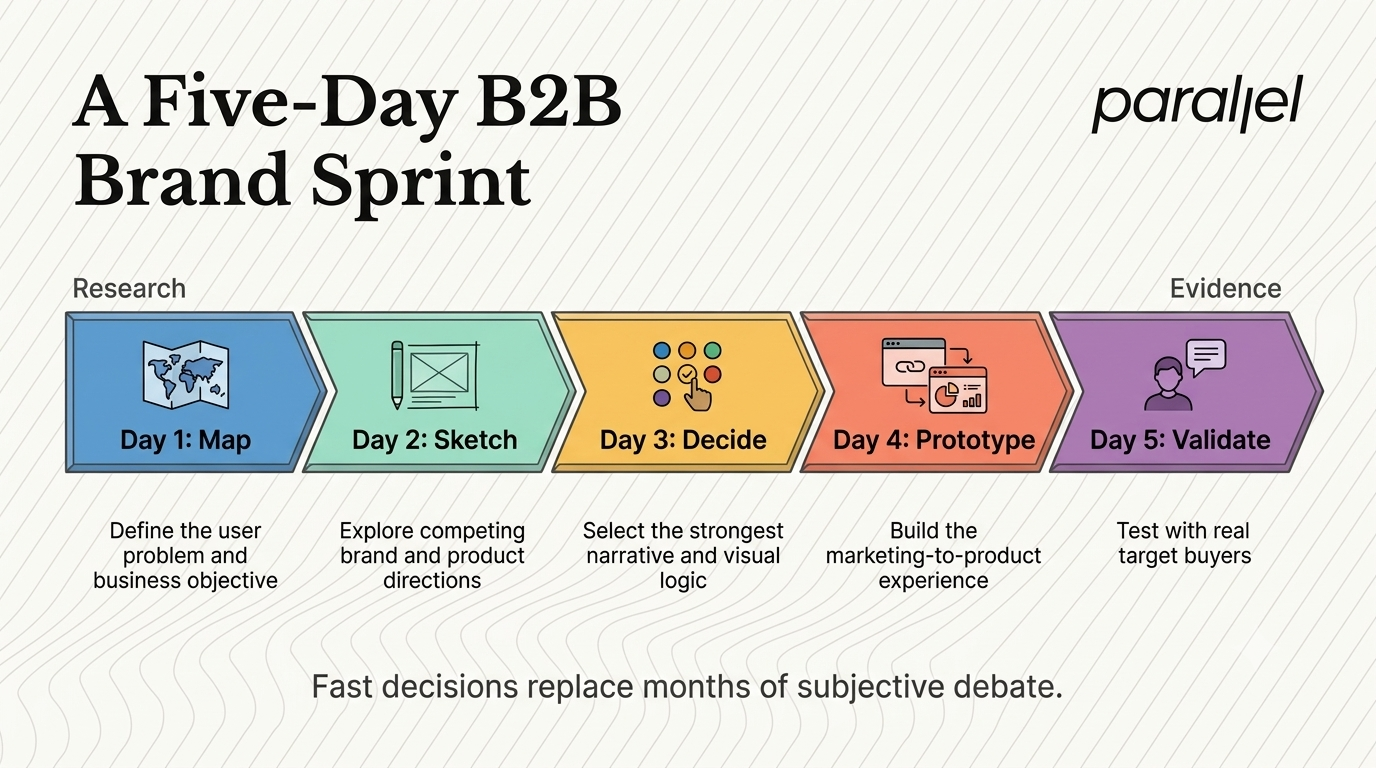
A sprint forces decisions. It removes subjective arguments from the room. We put concepts in front of real users on day five.
How a brand sprint functions:
- Map the core user problem based on research.
- Sketch competing brand directions independently.
- Decide on the strongest narrative as a team.
- Build a high-fidelity prototype of the marketing site and app.
- Validate with target buyers immediately.
This process eliminates the guesswork. It roots the brand in actual user feedback rather than internal assumptions.
Why integrate brand with product development?
Your product will change. Your brand must accommodate those changes. A rigid brand system will break in six months.
You need a design system. This is a collection of reusable components. It ensures visual consistency as your team builds new features. We spend heavy time building design systems for our partners. This reduces engineering time and keeps the brand intact.
According to the 2026 industry survey by the Product Design Consortium, teams utilizing centralized design systems ship features 34% faster. That speed is a massive competitive advantage. The best branding agencies for B2B SaaS build these systems as a standard deliverable.
A good system includes:
- Color tokens mapped to specific interface functions.
- Spacing grids that scale across device sizes.
- Component states for hovering, clicking, and errors.
- Documentation that engineers actually want to read.
How do you measure branding success in B2B SaaS?
How do you know the brand is working? You measure user behavior objectively.

Aesthetics are subjective. Activation metrics are objective. We track specific data points after a rebrand launches. According to a February 2026 report by Mixpanel, companies that unify brand and product see a 22% lift in free-to-paid conversions.
Metrics to track:
- Time to first value during onboarding.
- Drop-off rates on pricing pages.
- Customer support ticket volume regarding basic navigation.
- Sales cycle velocity.
If your brand is working, these numbers improve. The user understands what you do faster. They trust the interface more. They are willing to pay for the solution.
How do you use user research to drive B2B brand identity?
You cannot guess what your users want. You have to ask them. We base our branding on deep user research.
We talk to the people who churned. We talk to the power users. We find out exactly what words they use to describe their problems. Then we use those exact words in the brand messaging.
This creates an immediate connection. When a user lands on your site and sees their internal thoughts written on the screen, they convert. Good agencies do this research. Bad agencies just open a design tool and start drawing.
Conclusion
Building software is chaotic. Defining how that software looks and sounds should not be.
The goal is clarity. You want your target user to see your product and instantly understand its value. Every decision must serve that goal. Visuals must serve function. Strategy must serve the user.
Choosing the right partner dictates how the market perceives your work. Do the research. Ask hard questions. When evaluating the best branding agencies for B2B SaaS, demand strategic thinking over visual flair.
Frequently Asked Questions
1) What is B2B SaaS branding?
It is the process of defining the visual identity, messaging, and interface behavior for business software. It ensures the product communicates its value clearly to enterprise buyers.
2) How much do the best branding agencies for B2B SaaS charge?
Costs vary heavily. Early-stage startups might spend $25,000 to $50,000. Enterprise companies can spend over $250,000. The cost depends on the depth of research and the size of the final design system.
3) How long does a branding project take?
A focused brand sprint can take four to six weeks. A full system overhaul for a mature product often takes three to six months. Speed requires decisive founders and focused agency partners.
4) Should we hire an agency or an in-house designer?
Early on, an agency provides strategic distance. They see problems you are blind to. They bring patterns observed across dozens of startups. In-house designers are better for maintaining and iterating on the system after the agency establishes the foundation.
5) What is the difference between branding and product design?
Branding defines the narrative and visual foundation. Product design dictates how the user interacts with the software. The most successful teams merge these two disciplines entirely.
6) How do we know if we need a rebrand?
Look at your sales metrics. If prospects consistently misunderstand your core value proposition, your brand is failing. High website traffic with low sign-up rates is a strong signal that your messaging lacks clarity.
7) How does ParallelHQ approach this differently?
We root every brand decision in user behavior. We do not just design logos. We design the interface. We ensure the marketing site and the actual application feel like the same product.
8) What deliverables should we expect from the best branding agencies for B2B SaaS?
Expect a core identity system. This includes typography, color, and logo marks. You should also demand a functional design system for your engineering team. Finally, expect clear guidelines on product messaging and voice.

check out these related blogs


.webp)