As a founder, navigating the shift from seed to scale is brutal, especially when your core product relies on non-deterministic models. If you are currently hunting for the best AI UX design agencies for series a startups in 2026, you already know that traditional agency workflows just do not cut it. You cannot afford to spend months waiting on static mockups while your engineering team burns capital waiting for a clear direction. The stakes are too high, and the user interface is often the single biggest bottleneck to your activation metrics.
10 Best AI UX Design Agencies for Series A Startups
For Series A startups building AI/SaaS products, the right partner must balance rapid strategic prototyping with deep technical understanding. Here is a comparison of the top ten agencies equipped to handle non-deterministic interfaces.
The UX reckoning: Why AI UX is a different beast
In my experience, the traditional rules of interface design do not apply to machine learning products. In standard software, if a user clicks button A, they get result B every single time. It is deterministic. With AI, a prompt can yield ten different answers based on model temperature, context window, or training data changes.
A recent study by YUJ Designs revealed a number that should stop every Series A founder cold: 71% of users who abandon an AI-powered product say the AI was not the problem. The interface was. When users do not understand why an algorithm generated a specific result, they do not blame your data science team. They blame your product.
Furthermore, data shows that 58% of users distrust AI products that do not explain their recommendations. If your product is a black box, users will walk away. We have found that the core challenge of modern AI UX design is trust calibration. You must build interfaces that show model confidence, handle latency gracefully, and visually represent uncertainty.
Where Series A teams go wrong: The illusion of polish
In my experience, many founders make the mistake of hiring generalist agencies instead of searching for the best AI UX design agencies for series a startups that understand non-deterministic interfaces. They get blinded by beautiful, static Figma screens showing the ideal scenario. But digital products do not live in the ideal scenario.
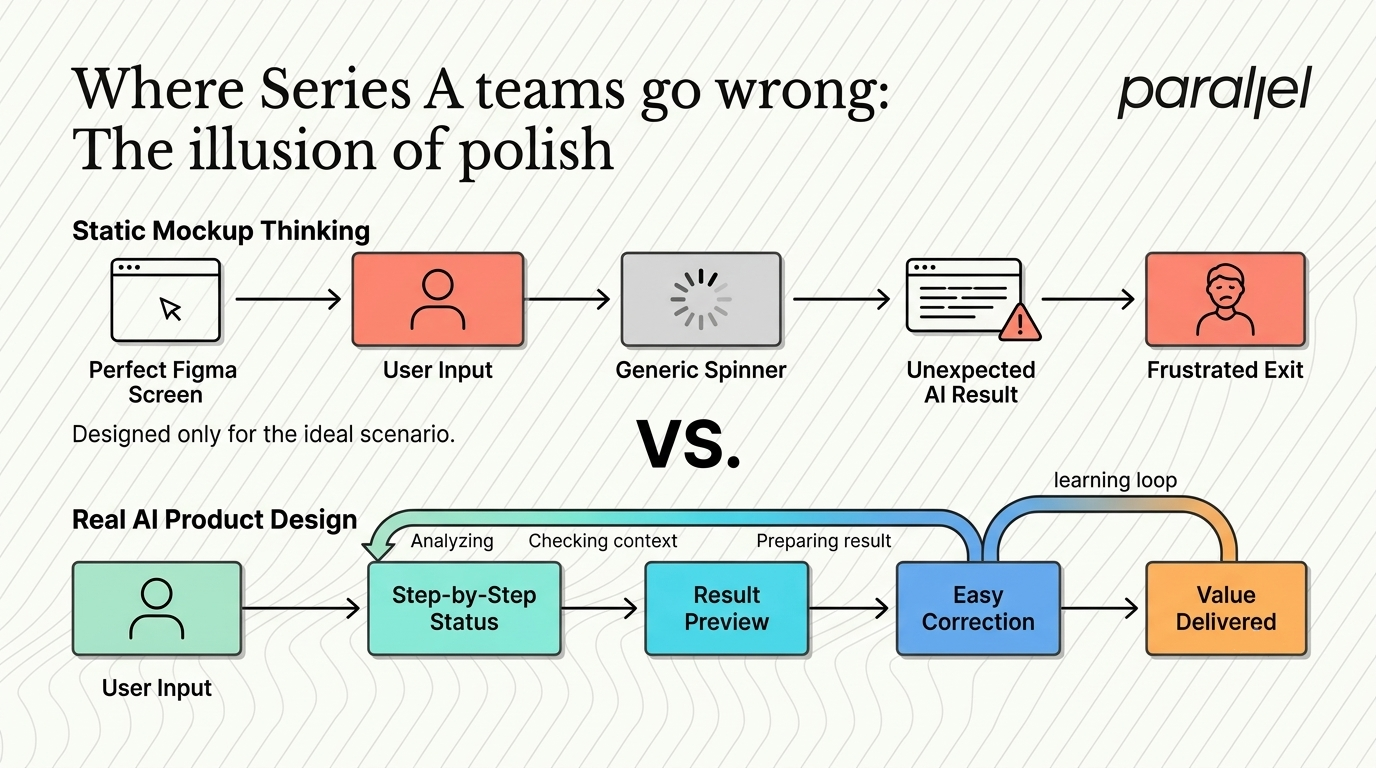
We frequently see teams ignore failure-state design. When an LLM hallucinations or API latency spikes, what does the user see? A generic loading spinner is a fast track to user frustration.
[User Input] ---> [LLM processing (5s latency)] ---> [Generic Loading Spinner] ---> [Frustrated Exit]
VS.
[User Input] ---> [Step-by-step Status Updates] ---> [Confident Result Preview] ---> [Value Delivered]
At ParallelHQ, we believe in designing for the messy, non-linear realities of AI. This means building micro-feedback loops directly into the interface so users can easily correct the model. If you do not design these feedback mechanisms, your model never learns, and your product experience decays. You can read more about this in our guide on designing interfaces for AI products.
How to evaluate AI UX partners: The three-part litmus test
Evaluating the landscape means identifying agencies with practical experience handling failure-state UX and model transparency, which is why the search for the best AI UX design agencies for series a startups is so critical. To find a partner that can actually help you scale after your Series A funding, you should put them through this three-part litmus test.
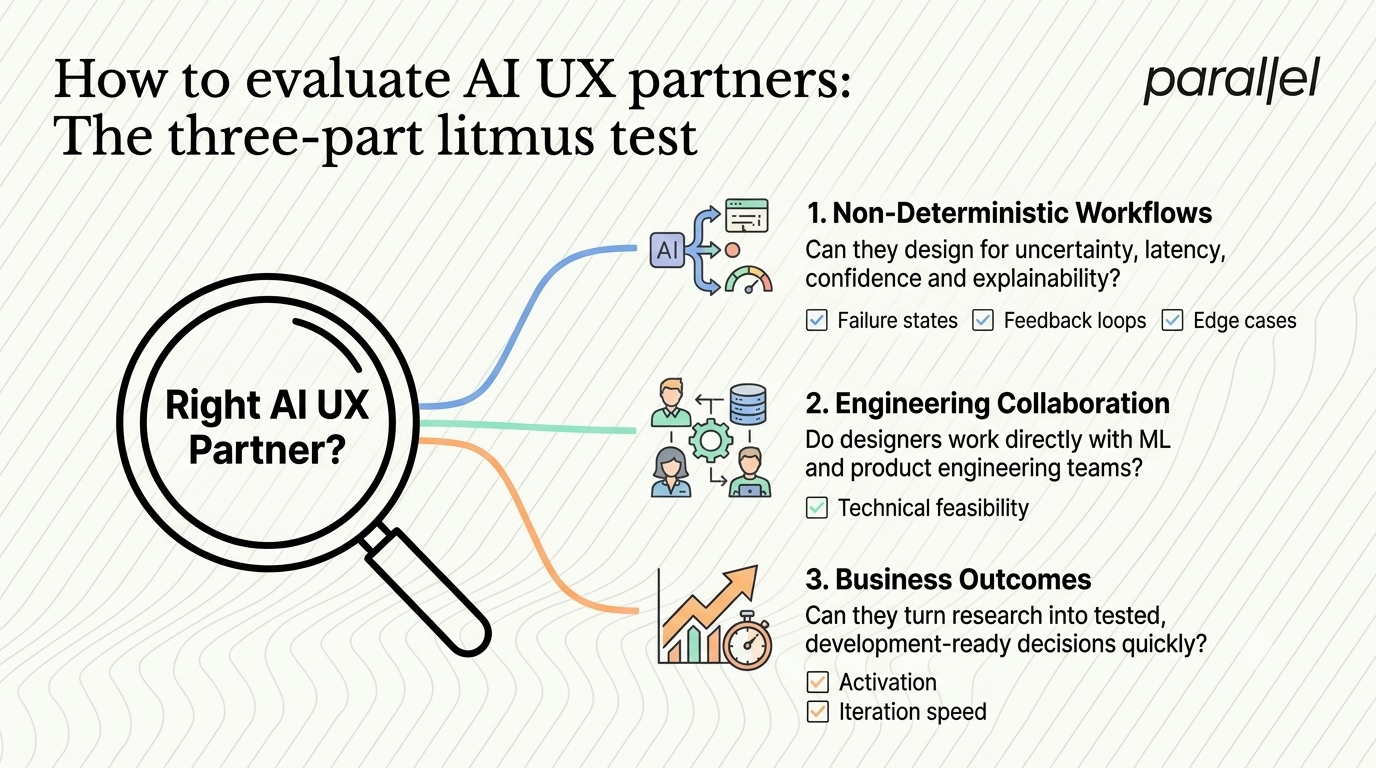
1) Do they understand non-deterministic workflows?
Ask the agency how they handle latency and model uncertainty. If they talk about pretty screens and transition animations instead of trust, explainability, and cognitive load, they are the wrong partner. A mature partner will help you map out product strategy and consulting early to define how your interface builds confidence.
2) How do they collaborate with engineering?
AI design cannot happen in a silo. Designers must work alongside your machine learning engineers to understand the capabilities and constraints of your specific model. Ask to see how their designers document edge cases, confidence scores, and feedback loops for development.
3) Do they focus on business outcomes?
Many agencies want to spend six months conducting academic research. At Series A, your runway is ticking. You need a team that can execute a structured ux audit or run a high-velocity design sprint to get a working prototype in front of users fast.
The 10 best AI UX design agencies compared
To help you make an informed decision, we have evaluated and curated this list of the best AI UX design agencies for series a startups based on actual product outcomes, model-transparency expertise, and development velocity.
1) ParallelHQ
We built ParallelHQ to bridge the gap between abstract ML models and clear, high-converting interfaces, positioning us as one of the best AI UX design agencies for series a startups. We do not believe in agency fluff, slow academic frameworks, or design for the sake of design. We partner closely with fast-growing teams to simplify complex product decisions and accelerate activation.
- Core Expertise: UI/UX design for complex AI applications, SaaS onboarding optimization, and rapid strategic prototyping.
- Our Approach: We utilize our proprietary discovery framework to align product, design, and machine learning teams within days, not months. We turn complex data structures into clean, digestible visual hierarchies.
- Case in Point: We worked with Sarvam AI, helping them design accessible conversational layers for complex language models. By simplifying user inputs and introducing contextual feedback mechanisms, we helped make the technology usable for thousands of non-technical users.
- Best For: Series A teams that need to ship complex, trust-reliant products quickly and require direct, strategic product thinking.
2) Metalab
Metalab is a highly respected design agency known for crafting polished, consumer-grade digital experiences. They have worked on legendary tech products like Slack and Coinbase, helping to establish the visual standards of the modern web.
- Core Expertise: High-fidelity interface design, brand systems, and consumer product strategy.
- Our Approach: They focus on premium aesthetics and beautiful visual flows. They are excellent if you have significant capital and need a marquee design to raise your next round.
- Best For: Well-funded startups that prioritize visual prestige and consumer-facing elegance.
3) Clay
Based in San Francisco, Clay is a premium branding and UX agency. While they work with larger tech companies, they are often highlighted among the best AI UX design agencies for series a startups that have substantial budgets.
- Core Expertise: Brand identity, interactive web experiences, and mobile app design.
- Our Approach: Clay integrates web development and high-end animations to create visually striking brand sites.
- Best For: Startups where brand presentation and marketing-led product design are the primary growth drivers.
4) Frog Design
Frog is a classic global design consultancy with decades of experience spanning industrial design and physical-digital product ecosystems.
- Core Expertise: Service design, customer experience strategy, and industrial IoT.
- Our Approach: Frog uses a comprehensive, research-heavy methodology to map out complex multi-channel user journeys.
- Best For: Startups building hybrid hardware-software AI systems or navigating highly regulated enterprise landscapes.
5) Ramotion
Ramotion is a structured agency focusing on visual brand identity and functional UI/UX design systems for growing software businesses.
- Core Expertise: Design systems, corporate website design, and mobile application UI.
- Our Approach: They emphasize consistency, helping engineering teams implement clean, reusable component libraries.
- Best For: B2B SaaS startups that need to transition from a chaotic early-stage UI to a mature, predictable design system.
6) Work & Co
Work & Co focuses entirely on product development and digital experiences, operating with a highly collaborative, engineer-friendly model.
- Core Expertise: Large-scale digital platforms, agile product delivery, and engineering integration.
- Our Approach: They bypass pitch decks and focus directly on shipping functional software prototypes alongside your internal developers.
- Best For: Teams needing deep technical integration where design decisions are closely tied to database and architecture limitations.
7) R/GA
R/GA is a massive, award-winning agency that blends digital product design with global brand advertising and creative marketing.
- Core Expertise: Creative campaigns, digital transformation, and marketing-led product launches.
- Our Approach: They focus on highly conceptual, story-driven digital products designed to capture consumer attention.
- Best For: Consumer-facing AI brands that need a unified partner for both global marketing campaigns and digital interfaces.
8) Huge
Huge uses a data-driven approach to design commercial experiences, web portals, and commerce systems for global brands.
- Core Expertise: User research, growth marketing design, and digital commerce.
- Our Approach: They leverage comprehensive user testing data to optimize complex conversion funnels.
- Best For: E-commerce or marketplace startups that need to design complex purchasing journeys.
9) Method
Method focuses on service design and systems thinking, helping teams organize complex workflows into logical digital structures.
- Core Expertise: Workflow optimization, information architecture, and software usability.
- Our Approach: They focus on the functional relationships between different system components, making them ideal for complex, multi-tenant software.
- Best For: Startups building enterprise-grade tools with deep, multi-persona user permissions and massive data tables.
10) Ustwo
Ustwo is an independent digital product studio famous for designing highly immersive experiences, including the hit game Monument Valley.
- Core Expertise: Immersive digital products, gamification, and interactive storytelling.
- Our Approach: They place a heavy emphasis on emotional design and human-centered research to build products that foster deep empathy.
- Best For: Startups looking to bring consumer gamification, mental health tech, or interactive education to life.
Navigating the trade-offs: Speed versus academic research
At the Series A stage, you cannot afford to act like a Fortune 500 company. We have seen startups spend $250,000 on generalist agencies that deliver hundreds of pages of research but zero functional insights.
According to data compiled by Maze on 2026 UX design statistics, organizations that invest in continuous UX testing can improve revenue retention by up to 10.8% over three years. The key word is continuous. You do not need a massive, one-time research project. You need an iterative partner.
Traditional Agencies: [3 Months Research] ---> [3 Months Design] ---> [Massive Handover]
ParallelHQ: [1-Week Sprint] ---> [Test] ---> [Iterate] ---> [Development-Ready UI]
We recommend using highly structured usability testing and iterative design sprints to validate assumptions. By testing with five real users every week, you identify 85% of usability issues before writing a single line of code. This is how you protect your runway and build a product that actually activates users.
Conclusion
Choosing from the best AI UX design agencies for series a startups is not about finding the team that can make the prettiest Figma mockup. It is about finding a strategic partner that understands trust calibration, manages model uncertainty, and prioritizes your commercial growth metrics.
If you are building an AI product and want to clarify your interface decisions, let us help you build a clean, high-activation user experience.
Frequently asked questions
1) What is AI UX design and why does it matter?
AI UX design focuses on creating interfaces for products powered by machine learning and large language models. It matters because AI is non-deterministic, meaning the system can produce different outputs for the same input. Traditional design principles fail to handle this uncertainty, leading to user confusion and product abandonment.
2) How do you design for AI latency and system lag?
We design for AI latency by replacing generic loading indicators with context-rich, step-by-step progress states. Showing the user what the AI is thinking, step-by-step, dramatically reduces perceived wait times and keeps users engaged.
3) What is trust calibration in AI product design?
Trust calibration means helping the user understand when to trust the AI and when to double-check its output. We achieve this by introducing visual confidence scores, displaying the sources of data used by the model, and providing easy correction mechanisms.
4) How does designing for failure states help AI software?
AI models inevitably hallucinate, make incorrect suggestions, or experience API timeouts. Designing specific failure states ensures that when these errors happen, the interface gracefully guides the user to a solution instead of showing a blank screen.
5) How much do the best AI UX design agencies for series a startups typically cost?
Pricing varies widely based on the agency scale. Elite global consultancies can cost upwards of $300,000 for a single engagement, while agile, outcome-focused partners like ParallelHQ offer modular, high-velocity sprints tailored to startup runways.
6) Should we build an in-house design team or hire an AI UX agency?
At Series A, hiring an in-house team of specialized AI UX designers is slow and expensive. Hiring an agency allows you to access immediate, experienced product strategists to establish your product foundations while you take your time recruiting the right in-house talent.
7) How do designers collaborate with machine learning engineers?
Designers must understand model limitations, API response times, and fallback states. At ParallelHQ, our design process involves close alignment with your technical team during early mapping sessions to ensure our interface designs are technically feasible.
8) Why is ParallelHQ a strong alternative to larger creative agencies?
Unlike large agencies that focus on visual trends and presentation decks, ParallelHQ acts as a strategic product partner. We focus entirely on simplifying complex user experiences, accelerating onboarding, and driving real-world business outcomes.

check out these related blogs