Most fintech products fail because they confuse a slick interface with actual trust. I see teams endlessly debate gradients and animations when their users just want to know if their money is safe. Finding the right partner to solve this is hard. If you are looking for the best fintech design agencies for fintech, you need teams that understand regulation, cognitive load, and human behavior. We compiled this guide based on years of fixing overcomplicated financial apps to help you make a better decision. Let us break down who actually delivers clarity.
10 Best Fintech Design Agencies for Startups
The right agency prioritizes structural clarity over visual trends. The top choices combine deep product thinking with financial domain expertise to lower user anxiety and drive activation. Here is the comparison of the best fintech design agencies for fintech.
Why most financial products fail at design
People do not want their banking app to look like a social media feed. They want it to work. We have observed a recurring pattern where early-stage founders prioritize aesthetics over structural clarity. This usually backfires. You do not need a redesign. You need better product thinking.

The trust deficit in digital finance
Financial anxiety is real. When users hand over their bank credentials or social security numbers, their cognitive load spikes. A 2025 study by the Nielsen Norman Group highlights that users abandon financial onboarding flows at a rate of 68% when they encounter ambiguous terminology or unexpected data requests.
We see teams try to solve this abandonment with prettier illustrations. That is the wrong approach. Trust is built through progressive disclosure. You build trust by explaining exactly why you need a piece of data right before you ask for it.
Where product teams go wrong
In my experience, product decisions go wrong in three specific areas.
- Overcomplicating the core loop: Teams try to pack every feature into the dashboard. Users get paralyzed by choice.
- Ignoring edge cases: Financial data is messy. Designing only for the happy path leaves users stranded when a transaction fails or a balance goes negative.
- Treating onboarding like marketing: Onboarding in finance is a compliance necessity. Masking KYC (Know Your Customer) requirements behind quirky copy damages credibility.
How to think about it correctly
We approach financial design by mapping the anxiety curve. We identify the exact moments a user might feel confused or hesitant. We then design structural interventions at those precise points. A 2026 product strategy report by Forrester shows that financial apps with simplified, anxiety-reducing architecture see a 40% increase in 30-day retention. You have to design for clarity first.
What separates the best fintech design agencies for fintech from the rest
Designing for money requires a completely different methodology than designing a standard SaaS tool. When evaluating partners, we look closely at how they handle inherent complexity. Do they map the entire system before drawing screens? Do they test with real users to measure cognitive load? Agencies that treat finance like a standard consumer application miss the mark entirely.
Deep domain expertise over visual trends
The strongest partners understand the regulatory environment. They know that a button placement might be dictated by compliance laws just as much as by usability heuristics. They do not fight these constraints. They use them to build better guardrails for the user.
A focus on prototyping and validation
You cannot guess how a user will react to a new wealth management dashboard. You have to test it. We rely heavily on design sprints to validate assumptions before a single line of code is written. By putting high-fidelity prototypes in front of real users, we uncover behavioral insights that analytics alone will never show.
Systemic product thinking
Great agencies look at the whole board. They do not just design a checkout screen. They look at the email receipts, the push notifications, and the error states. They build comprehensive design systems that ensure consistency across every touchpoint. Consistency breeds familiarity, and familiarity breeds trust.
The 10 best fintech design agencies for startups in 2026
Finding a partner that aligns with your specific stage and problem is critical. Here is our breakdown of the top performers in the space based on our experience in the industry.
1) ParallelHQ
We built ParallelHQ because we saw too many teams struggling with design decisions that should have been simpler. We act as a product design and strategy partner for early-stage startups and established teams. Our focus is absolute clarity in thinking. We do not just hand over static files. We run structured discovery frameworks to map the actual user journey and validate assumptions.
We have helped companies like AU Bank and Gullak simplify their complex financial experiences. We focus heavily on lowering cognitive load and driving user activation. If you want to fix weak onboarding or validate a new financial product, we can help.
Core strengths:
- Rapid validation and prototyping.
- Simplifying complex product architecture.
- Actionable user research.
- Deep expertise in fintech design services.
2) MetaLab
MetaLab is known for shaping some of the most recognizable tech products in the world. They excel at building highly polished consumer-facing applications. Their work is visually distinct and highly refined. They are a strong choice if you have a massive budget and need a flagship consumer interface that commands attention immediately.
Their process is highly rigorous and leans toward large-scale visual overhauls. If you need a more embedded, strategy-first partner for an early-stage product, you might look for a MetaLab alternative that operates with more agility.
Core strengths:
- Premium visual execution.
- Consumer-facing product design.
- High-profile brand positioning.
3) Clay
Clay operates out of San Francisco and focuses intensely on brand and UX design. They are very good at creating motion-heavy, modern brand identities for tech companies. Their work stands out visually in crowded markets. We respect their visual execution and their ability to make financial products feel modern and fresh.
They are heavily focused on the intersection of brand and interface. Teams looking for deep behavioral research or complex B2B systems architecture might need to pair them with a specialized research firm. You can also explore a Clay alternative if your focus is strictly on functional product strategy over brand motion.
Core strengths:
- Web and digital brand identity.
- Motion design and interactions.
- Modernizing legacy aesthetics.
4) Ramotion
Ramotion works closely with growing startups to unify brand identity and product design. They have a strong portfolio in web3 and modern consumer finance. Their approach is very structured around creating scalable visual identities and component libraries. They are reliable for teams needing a complete visual overhaul that scales easily as the engineering team grows.
They deliver excellent UI kits and digital branding guidelines. If your main challenge is simplifying a highly complex, data-heavy legacy architecture, you might consider a Ramotion alternative that specializes strictly in UX psychology.
Core strengths:
- Brand identity systems.
- Scalable UI component libraries.
- Web3 and crypto interfaces.
5) Work & Co
Work & Co builds digital products for massive enterprise scale. They are highly disciplined and focus on shipping working software quickly. They integrate tightly with engineering teams to ensure designs actually make it to production exactly as intended. They are best suited for large financial institutions needing massive digital transformation across multiple platforms.
Their working model is intense and requires high commitment from technical stakeholders. Startups or scale-ups looking for quick strategic pivots might find their process heavy and seek a Work & Co alternative geared toward rapid iteration.
Core strengths:
- Engineering-driven design.
- Large-scale digital transformation.
- Cross-platform consistency.
6) Huge
Huge is a massive global experience agency. They tackle sprawling, multi-channel problems for legacy banks and multinational financial corporations. They have incredible resources, data capabilities, and a global footprint. Their approach is highly strategic and leans heavily into marketing and overarching customer experience.
They are perfect for fortune 500 companies that need to align their marketing, product, and retail experiences. Early-stage founders often get lost in their scale. Smaller teams usually look for a Huge alternative to get more direct, senior-level collaboration.
Core strengths:
- Omnichannel experience design.
- Data-driven marketing integration.
- Global enterprise scale.
7) Ustwo
Ustwo brings a playful, highly engaging approach to digital products. They are excellent at gamifying experiences and making finance feel less intimidating. Their work is very human-centric and focuses heavily on emotional resonance. They are a great fit for consumer finance apps targeting younger demographics or products focused on personal financial education.
Their visual style is highly distinct and vibrant. Teams building dense B2B financial tools or institutional trading platforms might prefer a more utilitarian approach or seek an Ustwo alternative that specializes in data density.
Core strengths:
- Emotional and engaging UI.
- Gamification of complex tasks.
- Consumer financial wellness apps.
8) Instrument
Instrument sits precisely at the intersection of brand narrative and digital product. They build highly immersive digital experiences. Their true strength lies in storytelling and connecting the overarching brand narrative directly to the product interface. They are a solid choice for wealth management firms looking to rebrand and modernize their market position.
They lean heavily on brand storytelling and visual immersion. Purely functional product teams focused solely on conversion metrics might look elsewhere or at an Instrument alternative for a more metric-driven engagement.
Core strengths:
- Brand storytelling.
- Immersive web experiences.
- Strategic market positioning.
9) Neuron
Neuron specializes strictly in B2B product design. They excel at enterprise software and complex dashboards. They understand how to organize dense data sets into usable, scannable formats. They are one of the best fintech design agencies for fintech when dealing with internal tools or complex trading platforms. They do not get distracted by flashy consumer trends.
They are highly focused on utility and task completion. Teams building consumer-facing apps requiring high emotional engagement might find their work too utilitarian. For those consumer projects, a Neuron alternative might be a better fit.
Core strengths:
- Complex B2B dashboards.
- High data density environments.
- Enterprise UX architecture.
10) Method
Method approaches design from a deep business consulting and service design angle. They focus heavily on mapping out the entire customer ecosystem rather than just the digital screen. They are excellent for companies that need to align physical retail banking experiences with their digital counterparts.
Their engagements are deep, research-heavy, and highly strategic. They solve foundational business problems through design. You might consider a Method alternative if you already have product-market fit and simply need to ship a specific digital feature quickly.
Core strengths:
- Service design mapping.
- Business strategy alignment.
- Ecosystem research.
How to choose the right partner for your stage
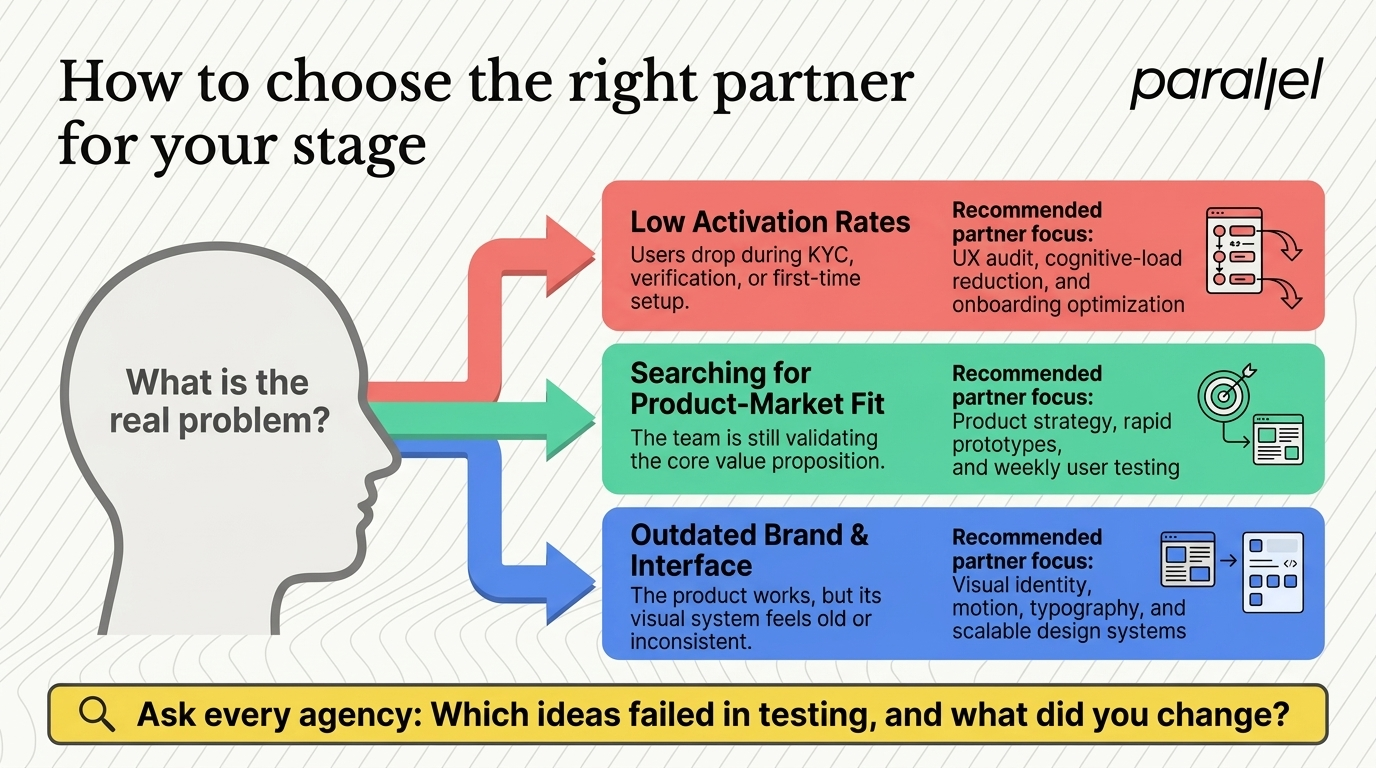
Choosing from the best fintech design agencies for fintech comes down to your current friction point. You have to diagnose your actual problem before you hire someone to solve it.
If you have low activation rates
If users are downloading your app but dropping off during KYC, you do not need a visual rebrand. You need a partner focused on cognitive psychology and onboarding flows. Look for teams that can run a comprehensive UX audit before prescribing a solution. The goal here is friction reduction, not aesthetic enhancement.
If you are searching for product-market fit
Early-stage teams need speed and validation. Engaging a massive enterprise agency will drain your runway and slow you down. You need a partner that uses product strategy consulting to help you define the core value proposition. Focus on agencies that prototype rapidly and test with real users every single week.
If your brand feels outdated
Sometimes the product functions well, but the visual language feels like it was built in 2012. In this scenario, you need a visual powerhouse. You need an agency with strong capabilities in motion design, typography, and component library construction. Ensure they know how to build a usable Figma design system so your internal team can maintain the quality after the agency leaves.
The one question you must ask
We always advise founders to ask prospective agencies about their failure rates. A strong partner will tell you exactly which design decisions failed during usability testing and how they corrected them. If an agency claims every idea they had worked perfectly on the first try, they are either lying or they are not testing rigorously enough.
Conclusion
Great product design in finance is invisible. The user should not notice the interface. Your button styling should not impress them. They should only notice how easy it was to move their money, understand their portfolio, or secure a loan.
The best fintech design agencies for fintech strip away the unnecessary. They remove the noise. They leave only what is absolutely critical for the user to make an informed, confident decision. When you focus on building structural clarity and reducing anxiety, the business metrics naturally follow. Choose a partner that understands this fundamental truth.
Frequently Asked Questions
1) What makes a fintech design agency different?
Generalist agencies focus on engagement and time-in-app. Financial agencies focus on trust, clarity, and task completion. Designing for finance requires a deep understanding of regulatory compliance, data security visualization, and cognitive load management. A generalist will make your app look good. A specialist will make your app feel safe.
2) How do you measure the success of a fintech redesign?
We never measure success by how pretty the screens look. We track specific behavioral metrics. We look at activation rates during onboarding, task completion success rates for core flows like money transfers, and the reduction in customer support tickets regarding confusing UI elements. A successful redesign always moves a hard business metric.
3) Should we hire an in-house team or an agency for our financial app?
It depends entirely on your stage and speed requirements. Building an in-house team gives you long-term control but takes months to hire and align. Hiring an agency injects immediate velocity and outside perspective. Many successful startups use an agency to establish the foundational UI/UX design and design system, then transition the daily maintenance to an in-house team.
4) What is the typical timeline for redesigning a financial product?
A surface-level visual refresh can take a few weeks, but we strongly advise against that approach for finance. A proper strategic redesign involving user research, structural UX changes, and rigorous testing usually takes between 8 to 16 weeks. Rushing this process leads to costly engineering mistakes down the line.
5) How do the best fintech design agencies for fintech handle regulatory constraints?
They treat compliance as a design constraint, not a roadblock. Experienced partners collaborate directly with your legal and compliance teams early in the discovery phase. They map out mandatory disclosures and KYC requirements first, then design smooth user experiences around those hard requirements rather than trying to shoehorn them in at the end.
6) Is our startup too early to hire a specialized design partner?
If you have raised initial funding and are building your MVP, you are at the perfect stage. Engaging a partner for MVP development ensures you build the right architecture from day one. Fixing a broken user experience after you have thousands of frustrated users and a massive codebase is significantly more expensive than designing it correctly the first time.
7) How does ParallelHQ approach complex financial products?
We start by mapping out the entire system using our opportunity mapping framework. We identify where users experience the highest cognitive load. We then run rapid design sprints to prototype solutions and test them with real users. We do not guess. We rely on observed behavior to simplify the product architecture before we touch the visual design.
8) What is the biggest mistake founders make when choosing the best fintech design agencies for fintech?
The biggest mistake is prioritizing a flashy portfolio over strategic thinking. Founders often get seduced by beautiful dribbble-style animations that are impossible to build and terrible for usability. The second biggest mistake is failing to check if the agency has a concrete methodology for usability testing. If they do not test with real users, they are just guessing with your money.

check out these related blogs