Every founder I talk to asks the same question before building: "What is this actually going to cost me?" The honest answer is that MVP design cost is not a fixed number, it's a range shaped by your scope, your team structure, and how clearly you've defined what you're testing. This guide gives you real numbers, a phase-by-phase breakdown, and the decision logic to budget without guesswork. Whether you're pre-seed or just closed a round, what follows is everything you need to set a realistic design budget.
TL;DR
- MVP design cost in 2026 runs from $5,000 (bootstrapped freelancer) to $50,000+ (specialist agency, full scope)
- The biggest cost driver is not aesthetics, it's screen count, user roles, and research depth
- Lean scope + a focused design partner consistently outperforms cheap + chaotic
- Skipping UX research early is the most expensive mistake you can make later
How Much Does MVP Design Cost in 2026?
The range is real and wide. The MVP design cost can range from $5,000 to $25,000, covering wireframes, user testing to validate designs, competitive analysis, and crafting the final UI. That's design alone, not development, not QA, not infrastructure. UI/UX design prices range from $5,000 to $150,000+ depending on scope, team type, and research depth. A properly scoped mobile app MVP with 15–25 screens typically costs $15,000–$40,000.
Here's how those numbers break down by hiring model:
Hourly rates run from $25 (offshore junior) to $250 (senior US agency). The rate is only meaningful alongside scope, a senior designer at $200/hour who completes the work in 80 focused hours is less expensive than a junior at $50/hour burning 300 hours and requiring extensive revision cycles. One thing I've seen derail budgets at ParallelHQ repeatedly: founders optimize for the hourly rate, not the total cost.
An inexperienced team will be cheaper by the hour and take three times as long to complete a project, ending up costing a whole lot more. The strategic question is not "what is the lowest cost?" It is "what is the cost of getting this wrong?" For an AI or SaaS startup heading into seed fundraising, a weak MVP design signals weak product thinking to every investor in the room.
MVP Design Cost Breakdown for Early-Stage Startups
MVP design is not a single deliverable. It's a sequence of phases, each with its own cost signature. Here's how a well-structured engagement breaks down:
At ParallelHQ, we run wireframing and prototyping as a continuous loop, not two separate phases. The reason: decisions made during wireframing directly shape what you test in Figma, and testing findings feed back into the wireframes. Separating them artificially inflates both time and cost.
The activities that actually determine whether a product works rarely get headline treatment in a proposal: research, stakeholder workshops, usability testing, accessibility validation, and design system planning. These are the things that separate a $40,000 quote from a $90,000 one for what looks like the same brief.
What Factors Affect MVP Design Pricing?
Nine out of ten founders ask about cost before they've answered the questions that actually determine cost. Here's the real list of drivers:
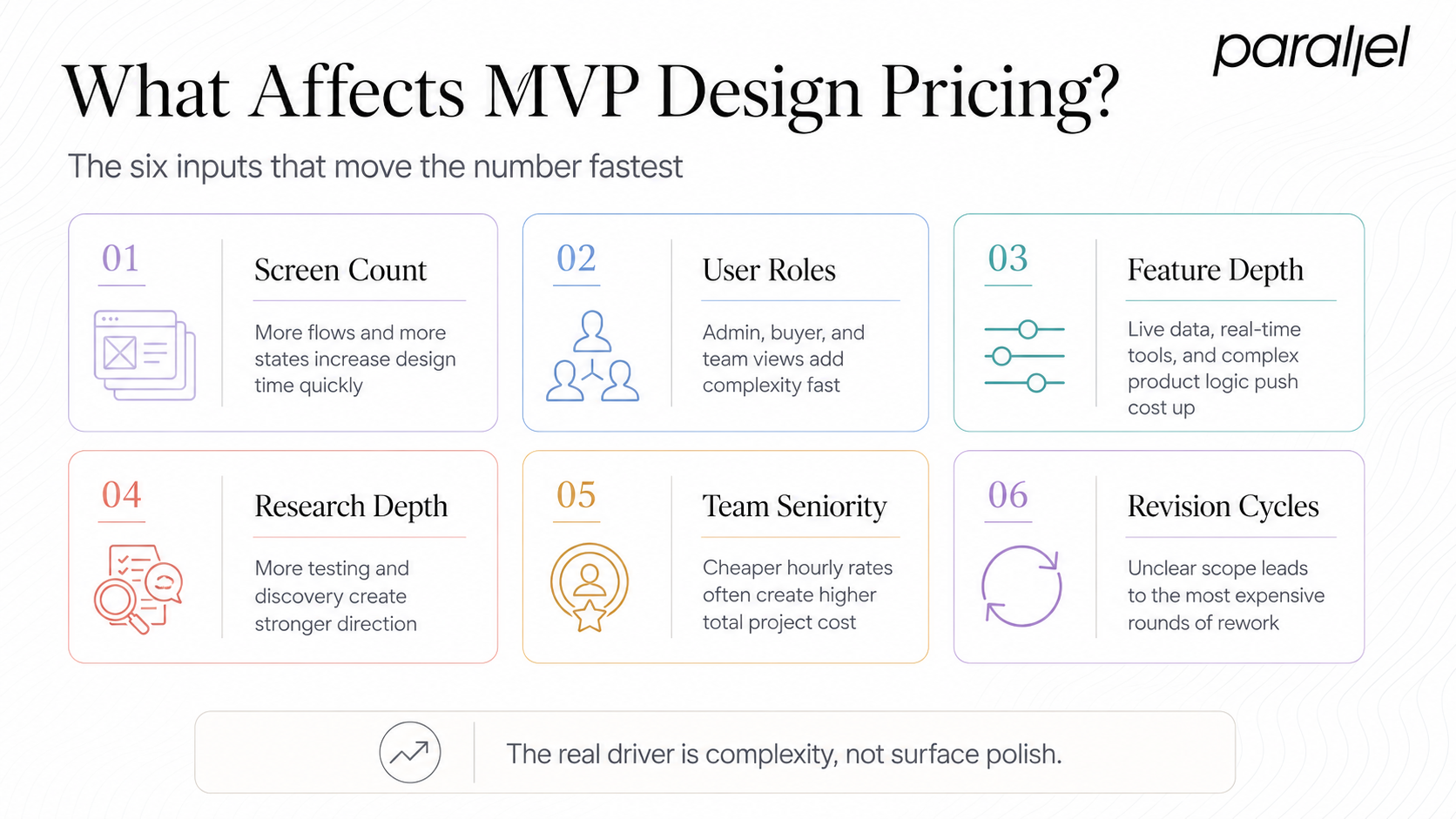
- Screen count and user roles: UI/UX design costs from $1,500 to $100,000+ if estimated by complexity, which is one of the biggest price drivers. This includes how many screens you need, how many user journeys exist, how many edge cases must be handled, and how much logic sits behind the interface.
- Feature complexity: Features such as AI, machine learning algorithms, real-time chatting, GPS tracking, or third-party API integrations can inflate the price due to much more extensive development hours and more specialized expertise.
- Platform choice: A web-first MVP designed in Figma for a single breakpoint costs a fraction of a native iOS/Android split scope. Our mobile app design engagements consistently show that platform choice is the single fastest way to shrink or expand budget.
- Research depth: Light usability feedback versus structured UX research with synthesis sessions. MVPs may rely on light usability feedback, while enterprise products require structured usability testing and documentation.
- Agency location and seniority: US/EU agencies charge $150–$300/hour, while quality offshore agencies charge $50–$100/hour.
- Revision cycles: Multiple iterations can add more costs to the project budget. A fixed-price contract might include 2–3 rounds of revisions on wireframes and mockups. If the client requests additional revision rounds beyond the agreed scope, it often incurs extra hourly charges or an added fee per round.
MVP Design vs. Full Product Design: What's the Cost Difference?
This is one of the most practically important questions founders ask, and the answer requires honesty about what "MVP" actually means in design terms.
An MVP design engagement covers:
- Core user flows only (the 3–5 journeys that prove your hypothesis)
- A component library sufficient to build those flows consistently
- One platform, one breakpoint (usually)
- Enough polish to be credible, not pixel-perfect
A full product design engagement adds:
- Complete design system via Atomic Design methodology
- Edge cases, empty states, error states across all flows
- Multi-platform responsive delivery
- Accessibility audit and WCAG compliance
- Design tokens for engineering handoff
A $15,000 MVP and a $250,000 enterprise system solve very different problems. The key difference is coverage, not quality. A lean MVP should still be well-crafted within its defined scope. Cheap and lean are not synonyms.
At ParallelHQ, our UI/UX design process for early-stage SaaS startups is deliberately scoped to the flows that matter for product-market fit validation, nothing more. We build a light but extensible design system from day one so the foundation doesn't need to be ripped out in Series A when the product scales.
The most expensive design decision is the one you make at launch that you have to undo six months later during a fundraise.
Cheap MVP Design Options for Bootstrapped Founders
If you're pre-revenue, pre-traction, or post-accelerator with a tight runway, the goal is to get a credible, testable design without draining your runway. Here are practical approaches ranked by effectiveness:
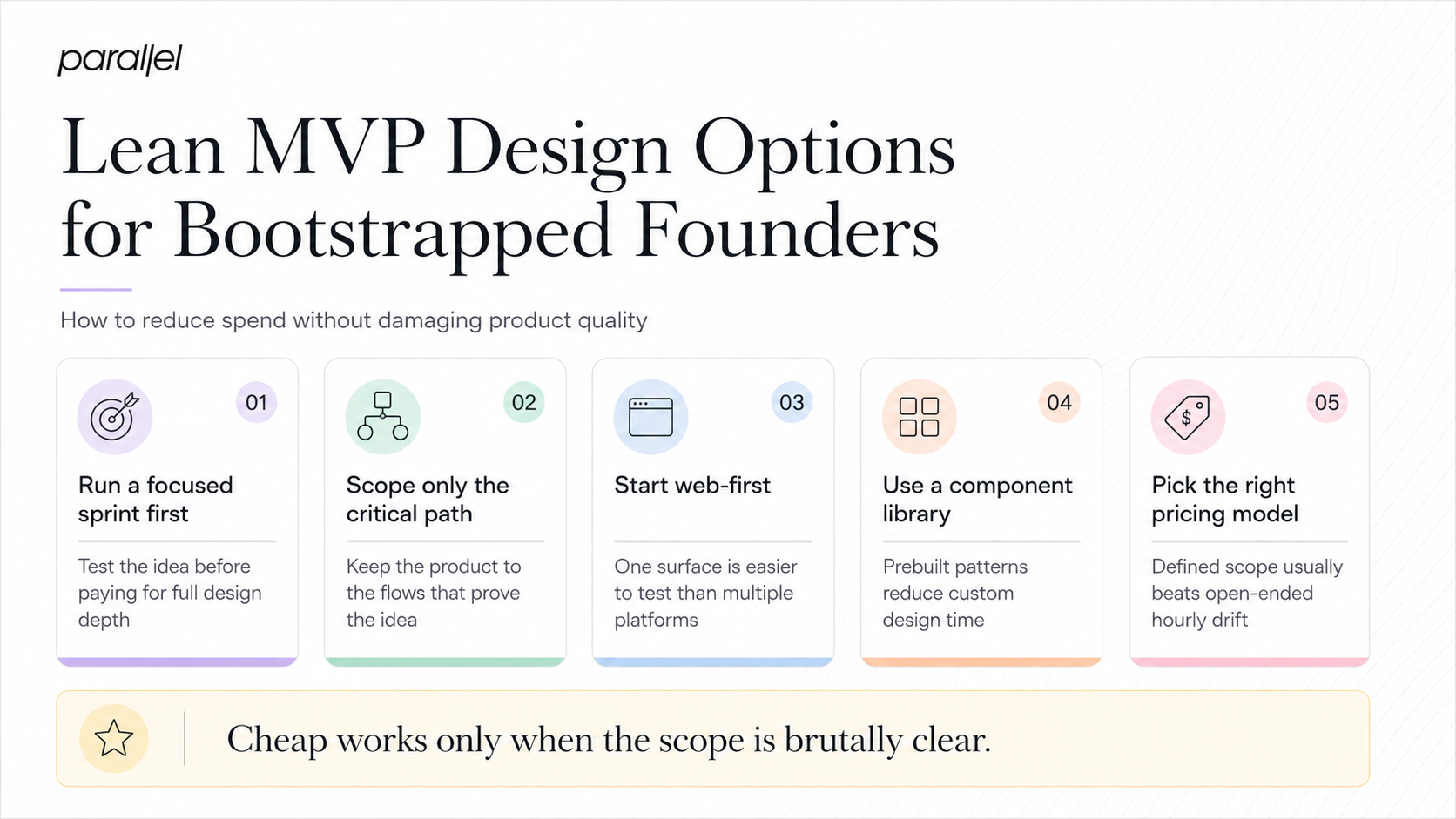
- Run a Design Sprint first: A focused Design Sprint (4–5 days) produces a realistic prototype for usability testing at a fraction of full MVP design cost. For many founders at Y Combinator-stage, a Sprint deliverable is enough to validate the core hypothesis and de-risk the larger investment.
- Scope aggressively with User Story Mapping: Define your must-have, should-have, and won't-have before a single pixel is touched. This discipline, rooted in Lean Startup Methodology, prevents scope creep from tripling your invoice.
- Use Figma component libraries: Design systems like Material UI or Radix reduce custom component design time significantly. Employing design systems, templates, or frameworks like Material UI can help keep costs down while still maintaining user-friendliness.
- Start web-first, mobile second: A web-first MVP lets you validate faster and at lower design cost before committing to native.
- Choose the right pricing model: Focusing on secondary features later can reduce initial cost by 20 to 30%.
- Avoid hourly-only engagements for defined scope: Using the wrong model often inflates cost. Running a six-month hourly engagement for a defined MVP is usually more expensive than a fixed quote.
A bootstrapped SaaS founder with a clear brief, a defined scope, and the right partner can get a credible MVP design for $8,000–$15,000. The "right partner" part matters as much as the budget number.
How to Reduce MVP Design Costs Without Sacrificing Quality
The levers that actually work, without cutting corners that bite you later:
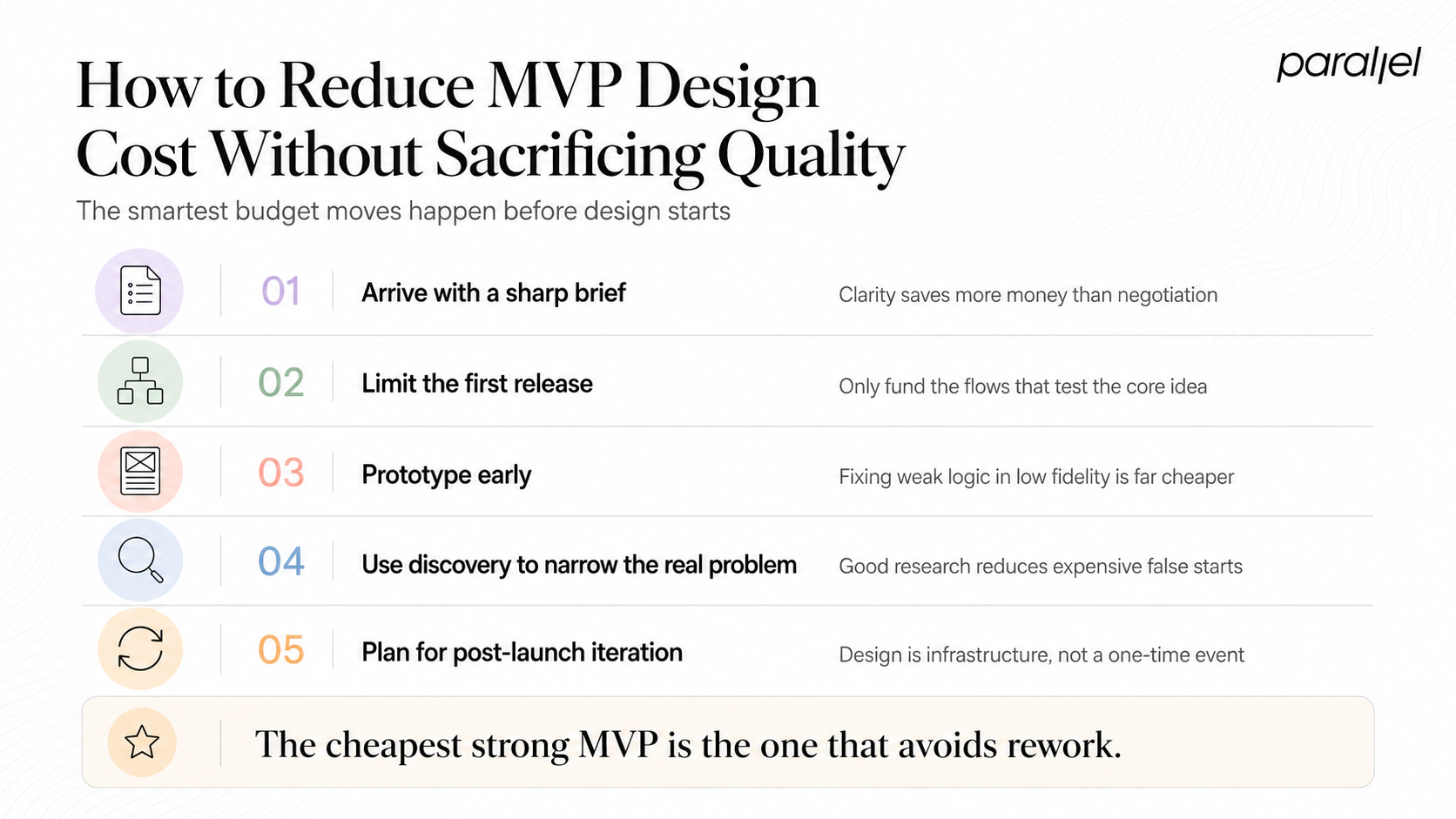
- Arrive with a brief, not a blank slate. Every hour an agency spends extracting requirements from you is billed. Come with your target persona, your core jobs-to-be-done, and three competitor products annotated with what you like and dislike. This alone can compress discovery time significantly.
- Limit your MVP to the critical path. The Lean Startup Methodology is explicit here: build only what tests the hypothesis. Every screen added outside the critical path is budget risk, not product value.
- Invest in a UX audit or discovery framework before full design. A focused pre-work engagement surfaces the real problem before you pay for a full design cycle built on wrong assumptions.
- Prototype before you design. Use InVision or Figma's prototyping features to test interaction logic before investing in high-fidelity UI. Usability problems found in lo-fi prototyping cost a fraction of problems found post-development.
- Plan for maintenance. A common rule is budgeting 15–20% of the initial build per year for post-launch design maintenance. Under-budgeting here results in stagnation at the worst possible time, when you're trying to grow.
- Fix scope at the start. The most consistent source of friction in fixed-fee engagements is scope left ambiguous at the start: a feature not in the original brief, additional rounds of stakeholder feedback that reopen settled decisions, or a user role that was not in the research plan.
Our product strategy consulting engagements exist specifically to solve the problem upstream, so founders don't arrive at MVP design with a brief that's still essentially a guess.
Conclusion
- MVP design cost in 2026 runs $5,000–$50,000 for most early-stage startups, shaped by scope, research depth, and team structure
- The cheapest option is rarely the lowest total cost, seniority and process efficiency change the math
- Budget 15–20% of your MVP design spend annually for post-launch iterations and maintenance
- Scope-control, clear briefs, and the right engagement model are the three highest-leverage cost variables
If you're trying to figure out the right budget for your specific product, the best first step is our MVP development service, or a focused Design Sprint to validate before you commit.
Frequently Asked Questions
Q1: What is the average cost to design an MVP in 2026?
For most early-stage startups, the MVP design cost ranges from $5,000 to $25,000 , covering wireframes, UI design, prototyping, and usability testing. SaaS products with multiple user roles or AI-driven flows sit at the higher end of this range.
Q2: How much should I budget for MVP design if I'm bootstrapped?
A bootstrapped founder with a clear scope can expect to spend $8,000–$15,000 working with a boutique agency or experienced freelancer. Prioritize a Design Sprint or discovery phase first, it reduces risk before you commit the full budget.
Q3: What's included in MVP design but not full product design?
MVP design covers core user flows, a minimal component library, and one platform. Full product design adds a complete design system, edge-state coverage, multi-platform delivery, accessibility auditing, and design tokens for engineering handoff.
Q4: Does running a Design Sprint reduce overall MVP design cost?
Yes. A Design Sprint validates the core concept with a realistic prototype in 4–5 days. Discovering a flawed assumption in a Sprint costs far less than discovering it after six weeks of full MVP design work.
Q5: What is the difference in cost between a freelancer and a design agency for MVP design?
A senior freelancer at $150/hr who delivers everything in 5 focused weeks costs around $30,000. An agency billing $120/hr might assign a junior designer, route all communication through an account manager, and take 10 weeks, coming in at $48,000. Hourly rate comparisons are misleading, compare total project cost and seniority of the person doing the actual work.
Q6: How does Agile Development affect MVP design cost and timeline?
Agile Development aligns well with MVP design: short sprints, frequent feedback, and iterative releases reduce the risk of building the wrong thing at full cost. The trade-off is that time-and-materials pricing under Agile can make total cost harder to predict. For a defined MVP scope, a fixed-price engagement often gives better budget control while still allowing for structured iteration.

check out these related blogs