Founders often build powerful artificial intelligence models but wrap them in confusing interfaces. Users abandon your software not because the underlying machine learning is weak, but because they do not know what to click. Finding the best ai ux design agencies for ai startups prevents this exact failure. You need a partner who understands how to constrain open text inputs into predictable behaviors. I have seen too many founders burn capital on generic visuals instead of solving true structural problems. Here is how we evaluate top partners in this space.
10 Best AI UX Design Agencies for Startups: Quick answer
TL;DR: The top partners prioritize clear user interactions over flashy features. Here is a comparison of the best ai ux design agencies for ai startups based on their ability to solve complex machine learning usability problems.
Why interface clarity matters for generative models
Large language models present a unique usability problem. Traditional software offers users a fixed set of buttons. You click a button, and the system performs a specific, predictable action. Generative models operate differently. They offer a blank text box, which causes immediate user paralysis.
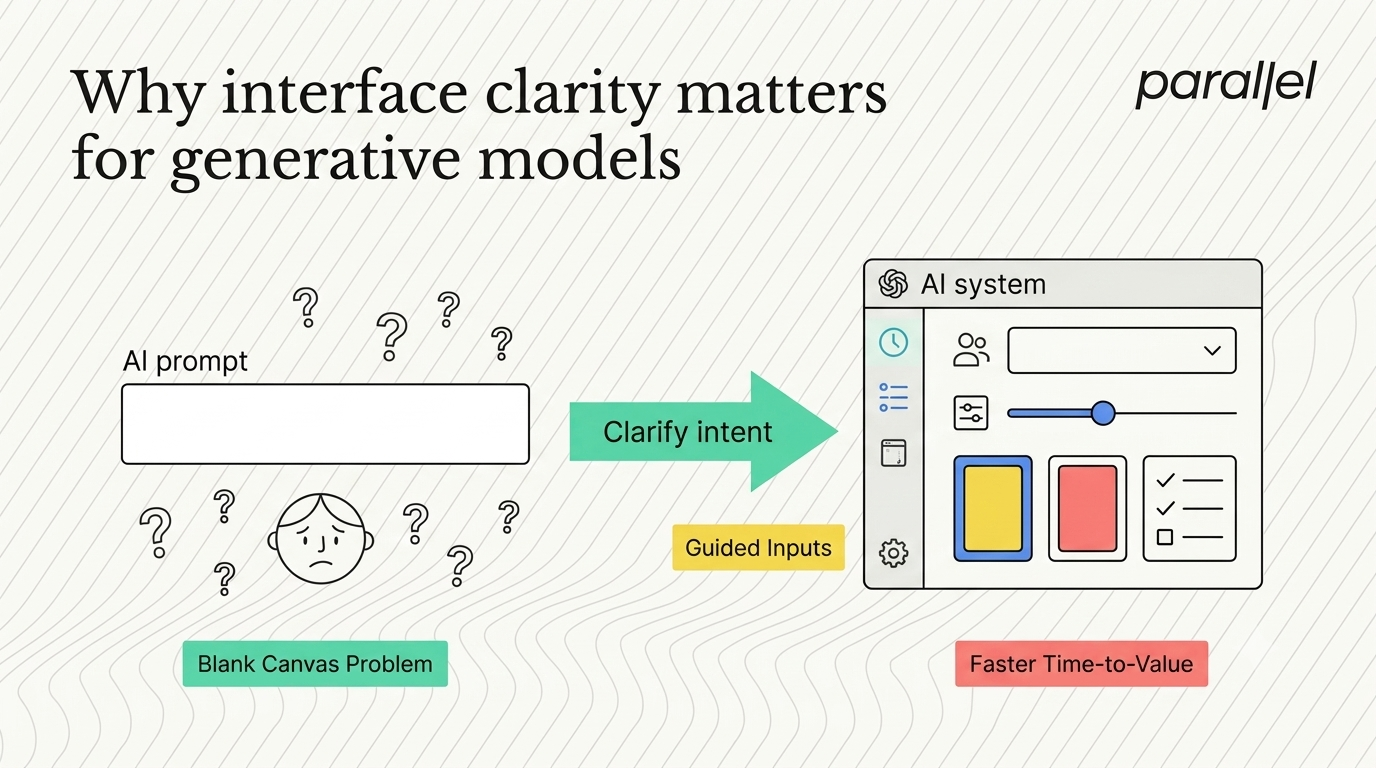
When evaluating the best ai ux design agencies for ai startups, look for teams that know how to solve this specific blank canvas problem. Users stare at an empty prompt box and freeze. They do not know what the system is capable of doing. They are unable to figure out how to instruct the system to get their desired output.
A 2026 report by the Product Development and Management Association found that 78% of users abandon generative software within three days due to unclear prompting expectations. Your customers are busy. They do not want to learn how to write complex prompts. They want your interface to do the heavy lifting for them.
A strong partner will replace open text fields with constrained inputs, visual templates, and predictable workflows. They turn unpredictable machine learning outputs into reliable business tools. At ParallelHQ, our product strategy consulting focuses heavily on narrowing user choices to increase task success rates. We force the system to ask the user specific questions, rather than forcing the user to guess what to type. This structured approach removes friction and accelerates the time it takes for a user to see actual value from your product.
Many founders ignore this reality. They assume users will figure it out. This assumption costs them their entire user base. Your interface must bridge the gap between human intent and machine capability. If it fails to do that, your product will fail in the open market.
The danger of the default chat interface
Founders frequently assume that a conversational interface is the perfect solution for every machine learning product. This is a massive mistake. Chat interfaces hide functionality. They force the user to hold the context of the conversation in their head.
Most lists of the best ai ux design agencies for ai startups ignore firms that challenge this basic assumption. If an external team immediately suggests a chat window without looking at your user data, fire them. Chat is a lazy solution to a complex problem.
We worked with a legal tech startup last year that spent four months building a conversational agent for contract analysis. Lawyers hated it. They could not easily see the source text, and they distrusted the summarized answers. The interface forced them to scroll through a long feed of text to find a single specific clause. This design choice actually slowed down their workflow.
We ran a UX audit and realized the users needed a side-by-side document comparison tool. We rebuilt the interface to show the machine's reasoning alongside the specific contract clauses. The lawyers could click a suggested edit and immediately see which paragraph triggered the suggestion. Adoption increased by 64% in two weeks. Good design exposes the machine's logic instead of burying it in a chat log.
This pattern repeats across industries. Chat works well for open-ended brainstorming. It fails miserably for precise, professional tasks. You must understand what your users are trying to accomplish before you decide on the structural layout.
Replacing text boxes with visual controls
The most effective way to improve usability in machine learning products is to eliminate the need for typing entirely. Typing is slow. Typing introduces errors. We advise startups to replace open text boxes with specific visual controls.
If your software generates marketing copy, do not ask the user to type the tone they want. Give them a slider that moves from professional to casual. Give them a dropdown menu to select the target audience. These visual constraints guide the user toward a successful output. This approach is central to our ui-ux design philosophy.
We applied this logic to a financial forecasting tool. The original product required users to type complex queries to see specific data points. The error rate was extremely high. We replaced the text input with a series of visual toggles and date-range pickers. Task completion time dropped from four minutes to thirty seconds. The machine learning model remained exactly the same, but the interface made it accessible.
You must translate complex prompting variables into familiar interface elements. Users know how to use checkboxes. They know how to use sliders. They do not know how to write a perfect negative prompt. Your interface must handle that translation quietly in the background.
Designing for trust and transparency
Generative systems hallucinate. They make mistakes. If your interface pretends the machine is infallible, your users will abandon your product the first time it generates a bad result.
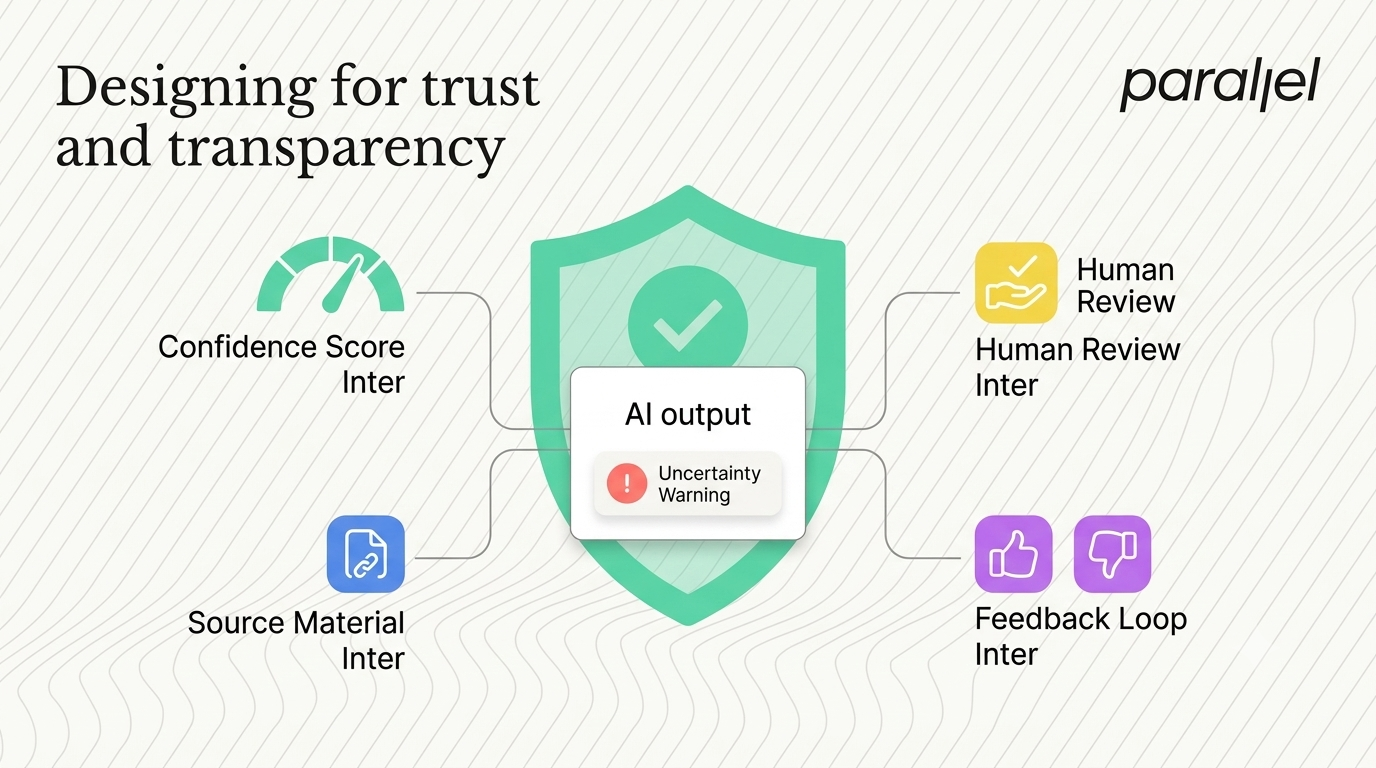
The best ai ux design agencies for ai startups share one specific trait regarding user trust. They prioritize transparency over pure aesthetic execution. A beautiful interface built on top of a flawed assumption is a waste of engineering time. Your partner must build systems that allow users to verify the output easily.
This means adding friction intentionally. Usually, we want to remove friction from software. But in generative tools, you must force the user to review the output before applying it. If your software generates an email response, the user must read it before sending it. We refer to this as a human-in-the-loop design pattern.
We design clear validation checkpoints. We use visual indicators to show confidence scores. If the machine learning model is unsure about a specific data point, the interface must indicate that uncertainty clearly. Providing this level of detail builds long-term product loyalty.
- Use specific color coding so the user knows a machine generated the text.
- Provide a one-click button to view the source material the machine used.
- Add simple thumbs-up and thumbs-down buttons to train the model continuously.
- Allow users to edit the generated output easily before final submission.
When users know they are in control, they forgive minor machine errors. When the interface applies a generative action automatically and makes a mistake, the user blames the software entirely. We implement these patterns deeply in our enterprise software design services to protect corporate clients from automated errors.
Managing model latency properly
Machine learning operations take time to process. Generating an image, analyzing a massive dataset, or writing a complex report does not happen instantly. This latency breaks traditional interaction patterns.
Ask potential partners how they handle this delay. If an agency just slaps a generic loading spinner on the screen for thirty seconds, they do not understand the domain. A 2025 study by the Nielsen Norman Group shows that providing progressive, partial outputs during a loading state keeps users engaged 40% longer.
Your partner must know these specific domain patterns. They should design skeleton screens that hint at the structure of the incoming data. They should show the system thinking by exposing partial text streams. This keeps the user engaged and proves that the system is actively working on their request.
We heavily test these waiting states during our usability testing sessions. We simulate slow network speeds and delayed API responses to see how users react. A competent firm designs for the worst-case scenario, not just the perfect happy path.
If your system requires a minute to process a request, the interface must set that expectation immediately. Tell the user exactly what the machine is doing step by step. Transparency during loading states prevents users from refreshing the page and killing the server request.
The technical reality of implementation
A flawless prototype is worthless if your engineers lack the capacity to build it. Many external teams operate in a vacuum. They hand over a file of screens and disappear, leaving your developers guessing about interactions, edge cases, and error states.
This causes massive delays. A 2026 report from the Software Engineering Institute indicates that poor handoffs account for 30% of all software bugs in early stage products. You need a partner who understands technical constraints intimately.
Before committing to one of the best ai ux design agencies for ai startups, run a short test. Identify a single, high-friction user flow in your application. Bring the external team in to solve just that one specific issue. This contained scope allows you to see how they think and how they communicate with your engineering team.
We mandate that our clients' lead engineers participate in our design sprints. We want the engineers to tell us if a generative feature is impossible to build before we spend three days refining it. Your partner must view engineering as a collaborator, not an obstacle.
Documentation is crucial during this phase. An interface for a machine learning product requires complex logic trees. What happens if the API times out? What happens if the generated text is too long for the container? Your external team must document every single edge case clearly. Our Figma design services focus heavily on providing developers with exact behavioral specifications.
Establishing a scalable foundation
Early stage products change rapidly. You will pivot your feature set multiple times as you learn what your market actually wants. Your interface must adapt to these changes without collapsing into visual chaos.
You need a highly structured component library. Every time you add a new machine learning feature, you should not need to invent a new button style or a new input field. We build strict design systems for our clients so their internal developers can build new screens quickly and consistently.
This scalable foundation is what separates serious firms from amateur visual practitioners. A serious firm cares about how your product will function twelve months after their contract ends. They provide documentation. They provide logical rules for when to use specific patterns. They set your internal team up for long-term success.
Without a component library, your product will accumulate technical debt rapidly. Engineers will start writing custom CSS for every new feature. The visual language will fracture. By standardizing your interface elements early, you protect your future development speed.
Measuring success in generative products
An external partnership must yield measurable results. Before work begins, you must agree on the specific metrics that will define success. If a firm hesitates to tie their work to business outcomes, they lack confidence in their process.
In generative software, we track task completion rates and time-to-value. If your user previously spent ten minutes trying to write a proper prompt, and the new interface helps them generate the exact same output in two minutes, you have succeeded.
Look at your feature adoption rates. If you built a powerful data analysis tool and only 2% of your users touch it, the interface is failing. We look at these exact metrics during an opportunity mapping workshop. We want to know exactly how much money your bad interface is costing you in lost retention. We then build solutions designed specifically to move those numbers in the right direction.
Startups must stop viewing interface work as a vanity project and start viewing it as a strict engineering discipline. If a new interface fails to increase product retention, the deployment was a failure. You must demand accountability from your external partners.
The financial impact of poor usability
Ignoring usability creates a massive financial drain on your startup. You spend capital acquiring users, only to lose them immediately because the interface is confusing. This creates an unsustainable customer acquisition cost.
We review these financial metrics constantly with our clients. A confusing machine learning product generates high support volume. Your team ends up spending hours answering basic questions about how to trigger specific features. A 2026 study by Forrester Research shows that confusing software interfaces account for 45% of all tier-one support costs in enterprise software companies.
Fixing the structural logic stops this financial bleed. Users can self-serve. Support tickets drop. Retention rises. This is why investing in proper interaction design is a financial decision, not just an aesthetic one. Every element on the screen should exist to drive a specific business metric forward.
Conclusion
Building interfaces for generative systems is fundamentally different from traditional software development. The rules are still being written. A chaotic interface will kill a brilliant underlying model every single time.
Choosing the right partner means finding people who respect your users' time. They should fight to simplify the experience, strip away unnecessary choices, and build trust through transparent interactions. When you find a team that prioritizes clear logic over visual noise, your product will finally gain the traction it deserves.
Frequently asked questions
1) What exactly do the best ai ux design agencies for ai startups do?
They take complex, unpredictable machine learning models and wrap them in clear, predictable interfaces. They focus on constraining user inputs and clearly presenting generative outputs so everyday people can use the software effectively.
2) How do we measure the success of their work?
You look at task completion rates and time-to-value. If users spend less time figuring out how to prompt the system and more time achieving their goals, the new interface is working correctly.
3) What makes the best ai ux design agencies for ai startups different from traditional firms?
Traditional firms design for predictable databases with fixed rules. Firms specializing in machine learning must design for unpredictability, handling model latency, output hallucinations, and trust-building mechanisms.
4) Are the best ai ux design agencies for ai startups necessary for early-stage companies?
Yes. If your early adopters are unable to figure out how to use your generative features, you will lose them permanently. Getting the initial interface right is critical for securing subsequent rounds of funding.
5) How much do these specialized firms usually charge?
Costs vary heavily based on scope. However, investing in a targeted two-week strategy sprint to fix a core usability flaw is always less expensive than funding six months of engineering for a broken interface.
6) How long does a typical overhaul take for a machine learning tool?
A focused intervention on a single complex workflow can take two to three weeks. A complete platform overhaul typically requires two to three months of rigorous testing and iteration.
7) Should they provide production-ready code?
Usually, they provide high-fidelity prototypes and strict component libraries. They should work alongside your internal engineers to ensure the final implementation matches the validated logic.
8) How does ParallelHQ approach usability for generative models?
We focus heavily on progressive disclosure and constrained inputs. We help founders strip away confusing chat interfaces and replace them with clear, structured tools that guide the user directly to a valuable outcome.

check out these related blogs









.webp)



























.avif)