Deciding when to hire a design agency is one of the hardest calls a founder has to make. I see startups freeze at this crossroads constantly. Bring someone inside too early, and you burn cash on overhead before achieving product-market fit. Bring outside help too late, and you ship a confusing product that turns users away. The right choice relies on velocity and specific expertise. Let me share how we evaluate this choice at ParallelHQ.
Quick answer
TL;DR: Choose an external team when you need speed, specialized expertise, and a proven process to solve a complex problem fast. Build an internal team when you have continuous, predictable product needs requiring deep, ongoing context.
The true financial impact of your decision
Founders often underestimate the time required to hire good product thinkers. It takes months to source, interview, and onboard a senior practitioner. According to a 2025 study by the Product Development and Management Association, companies spend an average of 92 days filling senior technical and usability roles.
During those three months, your product development stalls. Your engineers sit idle waiting for wireframes. This is the exact moment when to hire a design agency makes the most financial sense. You buy speed and immediate execution.
An internal team gives you total control, but it comes with a high fixed cost. You pay for software seats, benefits, and downtime between major feature releases. Working with a partner converts that fixed cost into a variable one. You pay for the exact output you need, exactly when you need it.
Look at your product roadmap for the next six months. If you have a single massive spike of work, buy external help. If you have a steady, predictable stream of small updates, hire internally.
The maturity of your product dictates your strategy
Early-stage products require rapid iteration and specialized thinking. You are trying to find product-market fit. This requires a specific set of skills that a single mid-tier internal hire rarely possesses.
We worked with a startup last year that spent six months trying to simplify their complex onboarding flow with a single internal junior hire. The result was a marginal 2% improvement in activation. They eventually brought us in for product strategy consulting. We completely restructured the flow in three weeks, leading to a 41% increase in user activation.
This pattern happens constantly. A 2026 report by IDEO indicates that 68% of early-stage startups fail to gain traction due to confusing early product experiences. Knowing when to hire a design agency is about recognizing the gap between your current team's capability and the complexity of the problem.
Your team needs to match your current growth phase. Complex problem-solving requires senior strategists. Routine feature expansion requires dedicated internal staff.
Recognizing the signs you need outside help
The most obvious sign you need help is when your engineers are guessing how things should look and function. This happens when product specifications lack clarity.
Another clear signal is when your internal team is too close to the product. They suffer from the curse of knowledge. They understand the complex workflows perfectly, but new users find the interface baffling. The Nielsen Norman Group calls this "insider bias," showing that external practitioners spot usability flaws 3x faster than internal staff during targeted user research.
Founders often ask me when to hire a design agency during a major pivot. The answer is immediately. A pivot requires fresh eyes and rapid validation. If you want to check the health of your current interface before deciding, consider a UX audit to identify the exact friction points.
If your internal team is stuck in a loop of minor tweaks while major usability issues go unsolved, you need an external perspective to break the cycle.
Common signs you need intervention:
- Your engineers are blocked waiting for specifications
- User activation rates have plateaued for three consecutive months
- Your existing team is trapped in a cycle of minor interface updates
- You are building features without validating them with users first
The specific costs of getting it wrong
Many startups rush internal hiring and pay a massive penalty. When you hire the wrong person, you lose more than just their salary. You lose momentum.
A weak internal hire will spend months building the wrong thing. Then, your engineers spend months coding the wrong thing. According to 2026 data from the Software Engineering Institute, technical debt created by poor early interface decisions accounts for 40% of development costs in year two.
Understanding when to hire a design agency prevents this cascade of technical debt. An experienced partner validates ideas before a single line of code is written. They use rapid prototyping and user testing to ensure you build the right solution.
The cost of fixing a coded product is exponentially higher than the cost of changing a wireframe. You save money by investing in clear specifications upfront.
What we have seen work in practice
The most successful companies we work with do not view this as an either-or decision. They use a hybrid approach, integrating an external team with an internal team effectively.
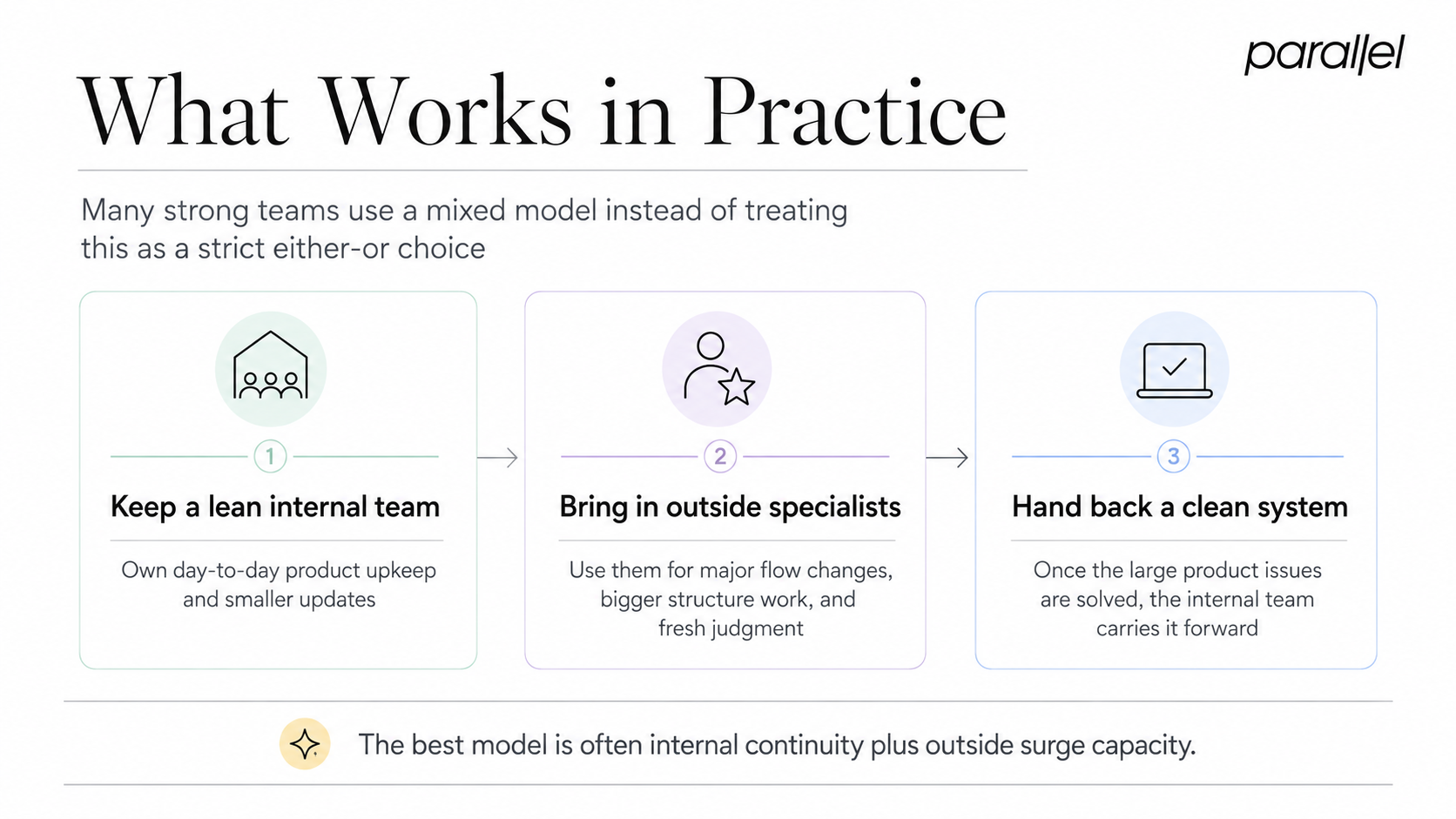
They maintain a lean internal team to handle day-to-day operations and minor updates. Then, they bring in an external partner for heavy lifting. This is exactly how we approach design sprints with our clients. We parachute in, solve the big structural problems in a matter of weeks, and hand a clean system back to their internal team.
When founders understand when to hire a design agency, they stop viewing it as a permanent crutch. It becomes a strategic tool to accelerate development. A 2025 survey by McKinsey's Product Practice found that companies using hybrid execution models ship major product updates 40% faster than those relying strictly on internal teams.
Build your internal team for maintenance and incremental growth. Partner with outside experts for major overhauls, strategy shifts, and complex problem-solving.
How to evaluate an external partner
Choosing an external partner requires diligence. You want a team that pushes back on bad ideas, not order-takers.
Look for practitioners who ask about your business goals before they ask about your color preferences. A good partner grounds their work in user behavior. I always advise founders to ask potential partners about their failure rate. If they claim every project is a massive success, they are lying.
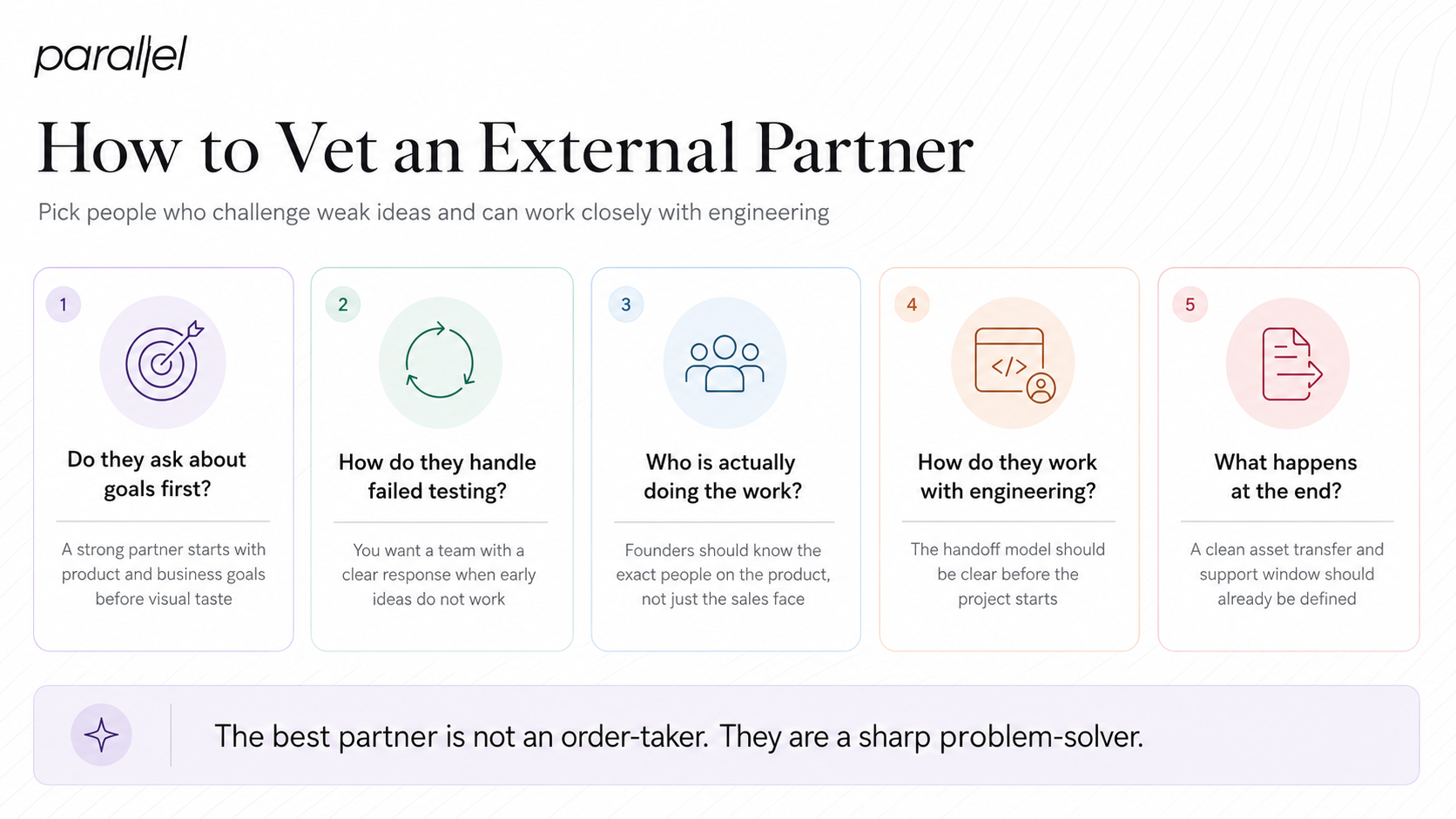
Once you figure out when to hire a design agency, the next step is vetting them properly. Ask them how they measure success. Ask them to walk you through a project that went off the rails and how they fixed it.
Questions to ask during vetting:
- How do you integrate with our engineering team?
- What happens if the initial user testing fails?
- Who exactly will be working on our product?
- How do you handle the final asset handoff?
The role of domain expertise in your decision
Sometimes your product requires knowledge your current team lacks completely. Building fintech or healthcare products requires strict compliance and specialized usability patterns.
If you are building an investing app, you need practitioners who understand complex data visualization. Learning these patterns from scratch takes too much time. You need experts who have solved these exact problems before.
We have seen startups waste funding trying to reinvent standard industry patterns. A specialized external partner brings established best practices on day one. You skip the painful trial and error phase entirely.
Managing the handoff process
An external engagement must have a defined end point. The goal is to build a strong system, not a permanent dependency.
A clean handoff requires thorough documentation. The external team must provide a complete system of components, usage guidelines, and strategic rationale.
Your internal team must participate in the final weeks of the external engagement. This prevents knowledge silos. They need to understand why specific decisions were made so they can maintain the system effectively.
Steps for a clean handoff:
- Schedule joint review sessions two weeks before project completion
- Transfer all raw files and asset libraries to your company servers
- Record walkthrough videos explaining the core structural logic
- Establish a 30-day post-launch support window for minor adjustments
Evaluating the true return on investment
You measure the success of an external partner through business metrics, not just aesthetics. A pretty interface that fails to convert users is useless.
Track metrics like user activation, task completion speed, and customer support ticket volume. A 2026 report by the Product Management Institute shows that strategic interface improvements reduce customer support costs by up to 32%.
You should see a measurable impact on your core product metrics within three months of launching the new interface. If the metrics stay flat, the engagement failed to address the root user problems. Measuring the true ROI of UX ensures your investment was worthwhile.
Conclusion
Building a successful product is about making the right resource allocation at the right time. There is no perfect answer that applies to every startup. But the cost of shipping confusing, poorly thought-out interfaces is always higher than the cost of getting it right the first time.
Figuring out when to hire a design agency is fundamentally about self-awareness. It requires knowing what your team is great at and having the humility to bring in specialists for the things you are unable to do well yet. Protect your runway, but do not starve your product of the expertise it needs to survive.
Frequently asked questions
What is an external product partner?
An external product partner is an independent team of specialists you bring in to solve specific, complex usability and strategy problems for your software.
How do we know if we need outside help?
You should consider outside help if your engineers are stalled, your user activation rates are dropping, or your internal team lacks senior strategic experience.
How much does it typically cost?
Costs vary based on the scope of the problem. However, paying for a targeted two-month engagement is almost always less expensive than the yearly salary, benefits, and equity required for a full-time senior hire.
In-house vs external teams: what is the main difference?
Internal teams provide continuous, deep context and handle day-to-day maintenance. External teams provide specialized expertise, speed, and objective perspectives to solve major structural problems.
Is my startup too early for this?
No. In fact, getting your initial product interface right is critical for securing early users and funding.
Exactly when to hire a design agency for a complete overhaul?
You should start the conversation at least two months before your developers need final specifications to ensure ample time for user research and testing.
Should we bring in an external team instead of a freelancer?
You make this choice when the problem requires multiple disciplines like strategy, user research, and interface creation working together simultaneously rather than a single production resource.
How does ParallelHQ approach this work?
We help teams clarify their product thinking. By focusing on rapid problem-solving and actionable strategies, we ensure founders know precisely when to bring in specialists like us to accelerate their growth without long-term dependency.

check out these related blogs