I've seen it happen more times than I care to count. A founder spends weeks evaluating agencies, picks the one with the sharpest portfolio, signs the contract, and six months later they're staring at unusable wireframes, a blown timeline, and a dev team rebuilding everything from scratch. The design agency red flags were there from day one. This guide is my attempt to make sure you see them before you sign, not after.
TL;DR
- Skipping discovery, vague process descriptions, and portfolios with no measurable outcomes are the three most reliable predictors of a bad agency engagement.
- Intellectual property rights, revision cycle limits, and project scope definitions must be explicit in the contract before you sign.
- An agency that agrees to everything in the first call is prioritizing the sale, not your product.
- Vet the actual designer assigned to your work, not just the agency's senior pitch team.
The Biggest Design Agency Red Flags to Watch Out For Right Now
The agency landscape in 2026 is noisier than ever. Everyone sounds the same, the websites are slick, the buzzwords are flying, and the promises are big. For early-stage AI and SaaS founders, that noise is expensive. Picking wrong doesn't just cost you the retainer; a misaligned partner can delay your product launch by months, force your engineering team to rework components three times, and leave your users confused enough to churn in the first session.
Here are the signals I tell every founder to watch for before committing:
- No documented UX design process: Creativity without a framework is just chaos. UI/UX design agency risks skyrocket when there isn't a documented process, without a roadmap, you are guaranteed to face scope creep, missed deadlines, and a ballooning budget.
- Aesthetic-only design portfolio: A portfolio filled exclusively with high-fidelity, polished "eye candy" often hides a lack of depth; it doesn't tell you if the product actually worked.
- Generic discovery questions: If the discovery feels scripted, generic questions about timelines and budgets with no real curiosity about what you're building or who your users are, it probably was copy-pasted from their last five clients.
- Cookie-cutter proposals: Agencies that pitch the exact same package to every client aren't customizing anything, whether you're a therapist or a tech startup, they recommend the same features and approach, and cookie-cutter solutions rarely address your specific challenges.
- Vague ownership language: Vague answers about ownership or login credentials are a definitive warning sign, if you cannot get a clear "yes" when you ask whether you will own everything after final payment, walk away.
The pattern is consistent: the warning signs founders describe after the fact are almost always the same ones that were visible in the initial sales call. The difference is knowing what to look for.
What Are the Red Flags When Hiring a Design Agency During the Discovery Call?
The discovery call is the agency at their most motivated and most rehearsed. What happens there is a preview of what the working relationship will feel like once the contract is signed. If the sales experience is off, the service will almost always be worse, the call is the agency at their most motivated, and it only gets harder to communicate once the contract is signed.
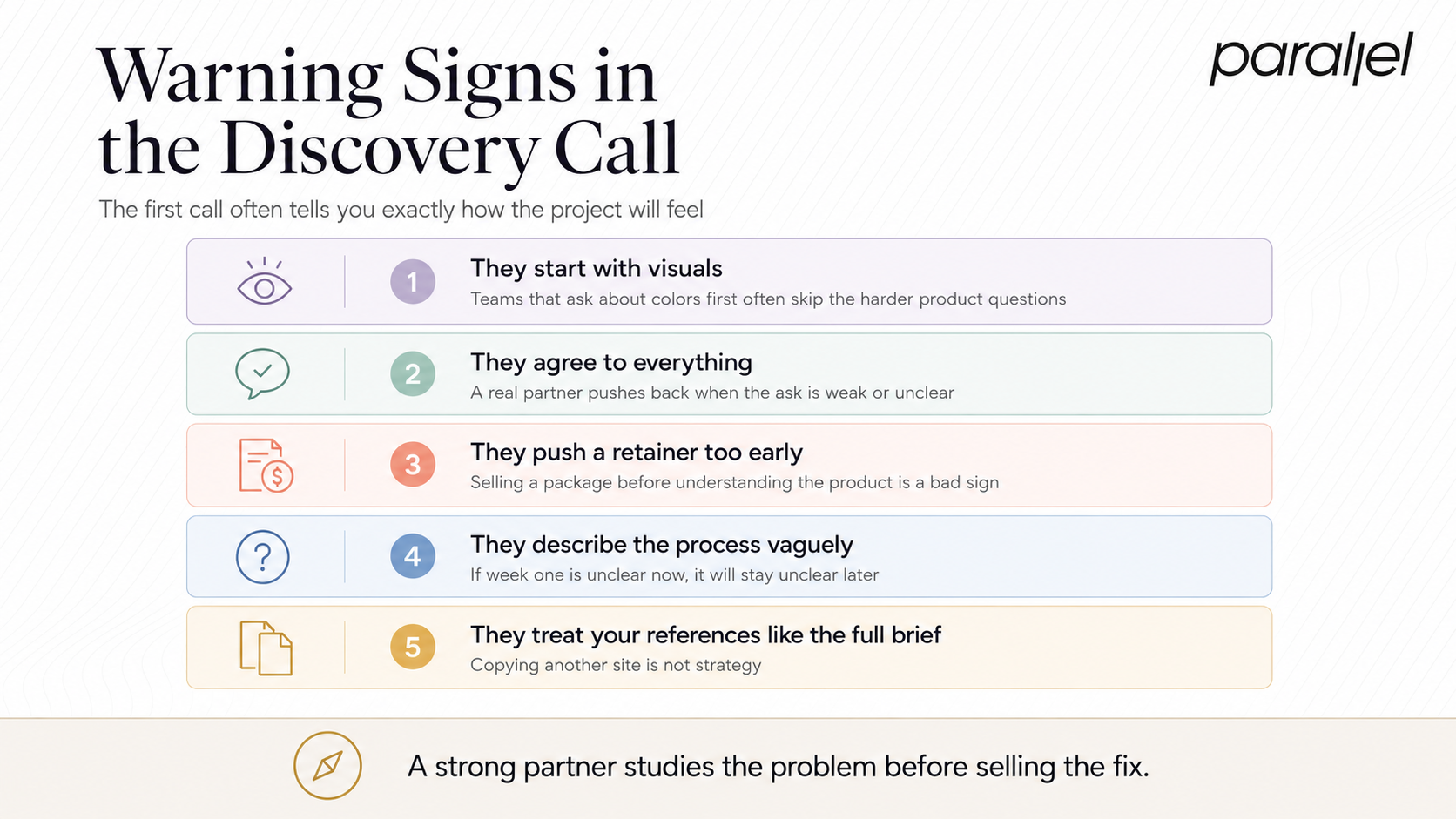
Watch for these specific behaviors during any discovery call:
- They open with aesthetics, not problems. Agencies that open every call by asking about colors and fonts rather than your business goals and retention metrics are likely selling execution, not strategy.
- They agree to everything without friction. Real product development involves trade-offs, technical constraints, and user friction points. If an agency agrees to everything you say without blinking, they are acting as "order takers," not strategic partners, and they are likely prioritizing the sale over the reality of the project.
- They push a retainer before understanding your product. Package-first selling and scripted discovery are the biggest warning signs, if they push a retainer before understanding your product, they are optimizing for close rate, not fit.
- They can't describe their process plainly. "We take a holistic, human-centered approach" means nothing, if they can't describe what week one looks like in plain language, that vagueness doesn't disappear after you sign.
- They treat your reference examples as brief. Any studio that treats your references as a brief will produce work that looks like someone else's work with your logo on it.
A good [design agency] does not start sketching wireframes on the first call, they begin with discovery: understanding your business, audience, competitors, conversion goals, and technical constraints. If they skip this step or treat it as a quick formality, the design will be guesswork., Moburst, 2026
How Do I Know If a Design Agency Is Bad? Signs Hidden in the Portfolio
A beautiful design portfolio is the agency's best sales tool. It's also where the most important design agency red flags hide in plain sight. The right question to ask when reviewing any portfolio isn't "does this look good?" It's "did this work?" A sharp portfolio is a good starting point, but plenty of agencies can build something beautiful, fewer can connect that beauty to strategy, storytelling, and measurable ROI.
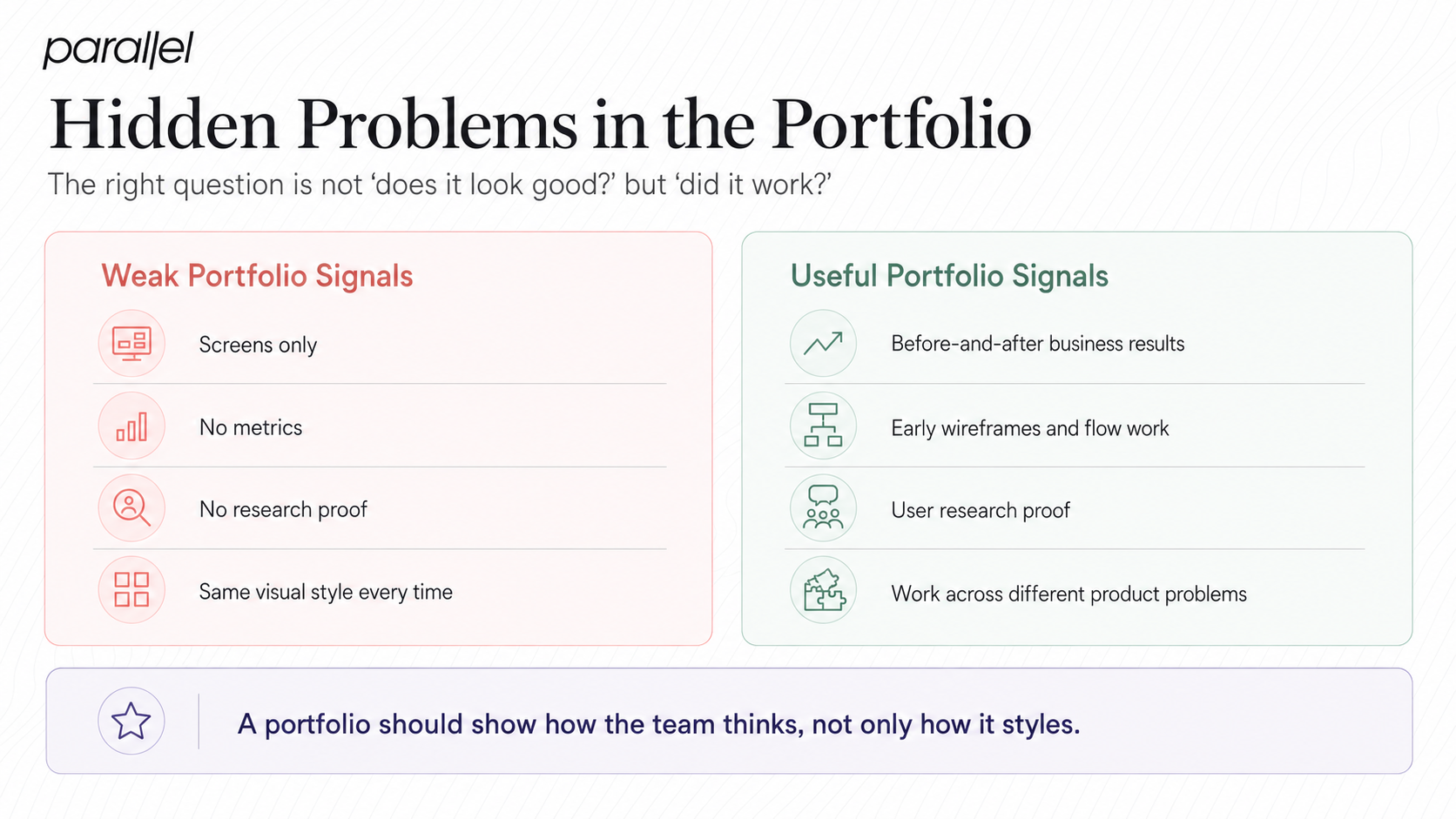
When evaluating a design portfolio, push for:
- Case studies with before-and-after metrics: Portfolios filled with pretty screenshots tell you almost nothing, ask for case studies that include before-and-after metrics like organic traffic, conversion rate, time on page, or revenue impact, because agencies that build for performance will have these numbers ready.
- Evidence of user research and wireframing: Ask to see the early-stage artifacts, the information architecture diagrams, the low-fidelity wireframes from Figma, the user research synthesis documents. Ask them to show you the ugly stuff: the messy whiteboard sketches, the wireframes that got thrown in the trash, and the user flows, you need to see how they think, not just how well they can use design software.
- Startup-specific experience: An agency comfortable with startup constraints will expect requirements to change halfway through a sprint and adapt, not panic.
- Range across problem types: A portfolio where every project shares the same visual aesthetic suggests a house style, not genuine design thinking. This is the question that separates studios with genuine creative range from studios with a repeating house aesthetic.
A portfolio without measurable outcomes, user research artifacts, or startup-relevant work is a concrete signal that the agency's value ends at aesthetics. For early-stage products where every pixel affects activation and retention, that's not a trade-off worth making.
Red Flags in Design Agency Proposals You Should Never Ignore
The proposal is where vague intentions get formalized into binding commitments, or stay vague on purpose. Most founders review proposals for price and timeline. The higher-leverage read is elsewhere.
The most important section of any agency contract is the scope of work, it defines exactly what the agency will do, and just as importantly, what they won't.
Watch for these specific design agency red flags in any proposal document:
The biggest design agency red flags are skipping discovery to jump straight to mockups, offering vague project timelines with no milestones, pricing everything as a single lump sum, and presenting portfolios with no measurable outcomes. Pay particular attention to revision cycle language. Either extreme is a red flag, "we'll redo everything until you're happy" (no boundaries, no process) or "deliverables are defined in the contract, changes are billed separately" with no flexibility built in.
Also scrutinize intellectual property rights language with care. A red flag is language like "you own the designs but we retain the source files" or any variation where the agency holds files you need to make changes, this creates lock-in and is a reason to walk away.
Warning Signs a Design Agency Will Miss Deadlines
Missed deadlines are rarely a surprise. The signals show up weeks before the first deliverable slips. By the time your launch is delayed, you've already lived through several of them without acting. The structural causes of deadline failure are almost always established during the proposal and kickoff phases.
A mature design firm should be able to hand you a document that outlines every single phase, Discovery, Research, Prototyping, Testing, and Handoff, and they should know exactly what happens on Day 1 and Day 90.
Deadline risk indicators to probe actively:
- No named project lead: It's common for senior leaders to pitch the project, only to disappear once the contract is signed, during the vetting process, asking to meet the day-to-day leads and get a feel for how they work, communicate, and collaborate.
- Designers spread across too many accounts: Ask who the designer is, what their background is, and ask if they'll be on other projects simultaneously, "a senior designer and a strategist" is not an answer.
- No stakeholder communication cadence defined: If the proposal doesn't specify how often you'll receive updates, from whom, and through what channel, communication will default to reactive. In a design sprint or active build phase, reactive is too slow.
- Scope defined too loosely: "We'll manage your digital presence" is not a scope definition, if the contract is vague about project scope, push for specifics.
- Pressure to sign quickly: Pressure to sign before you have all the answers is a warning sign, reputable agencies expect you to compare options, and anyone rushing you toward a deposit is solving for their cash flow, not your project.
An agency that can't demonstrate reliable stakeholder communication during the sales process won't suddenly develop that discipline once the engagement begins. Design deliverables, brand identity decisions, and design system handoffs all depend on clear, timely communication to ship on time.
What Makes a Design Agency Untrustworthy: Process and People Problems
Trust in a design agency is built (or broken) along two axes: their process and the people actually doing the work. Both can be assessed before you sign.
On process:
Check the agency's process page or ask them to walk you through a recent project, if the answer involves phrases like "we collaborate closely with you to bring your vision to life," that's a flag. A genuine process description names specific deliverables: a stakeholder interview, a competitive audit, a heuristic review, a component library handoff. Vagueness at the process level means vagueness at the delivery level too.
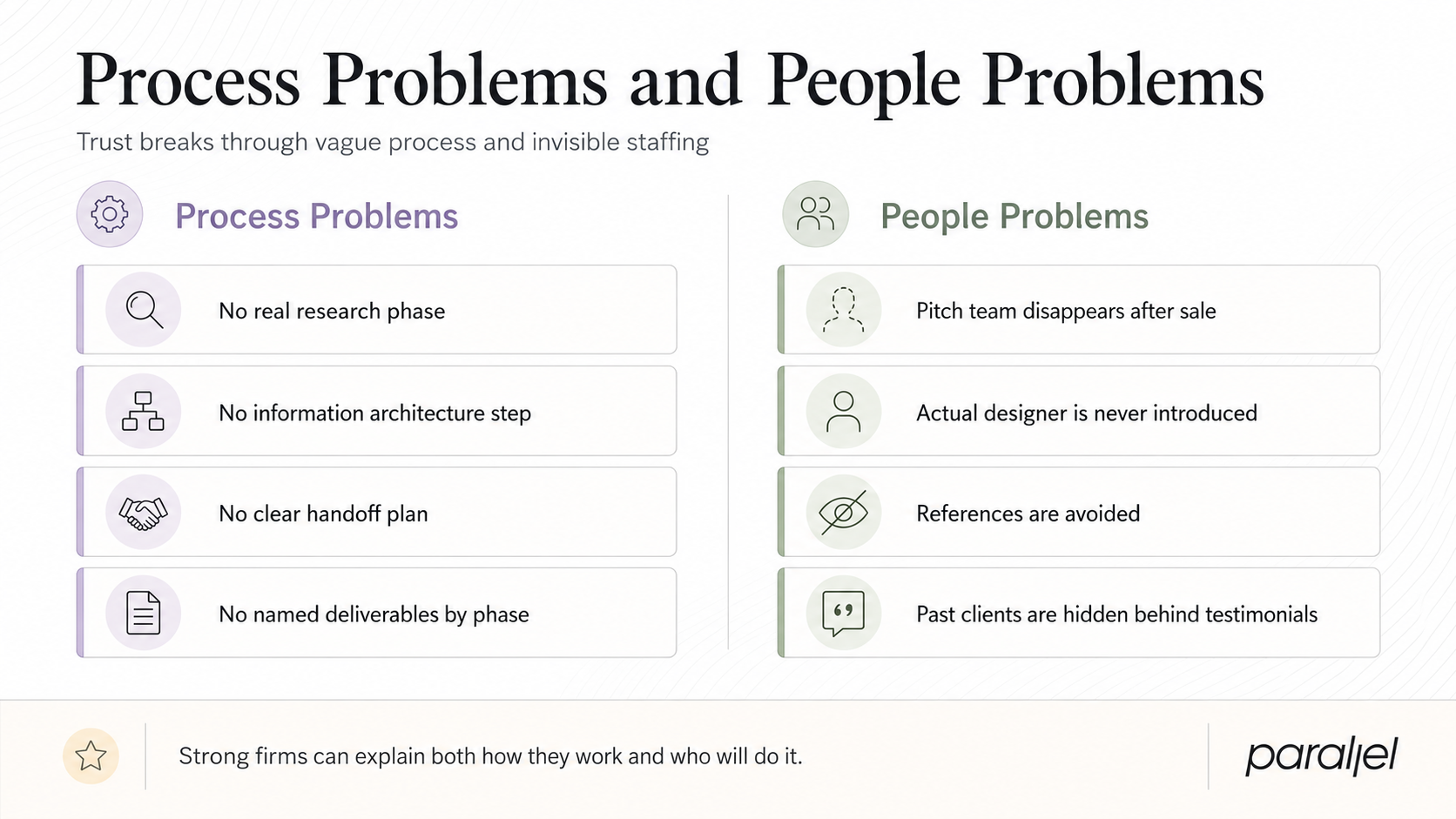
For a product design engagement, a trustworthy process should explicitly include user research, information architecture, wireframing, and a Figma design services handoff to development that includes a proper design system and style guide, not just static screens.
On people: Ask to meet the specific designer assigned to your account before signing, review their individual portfolio, not just the agency portfolio. If the agency presents senior work in pitches but can't tell you which specific person will execute your project, assume the work goes to whoever is available, regardless of level.
On references: Contact at least two, ideally three references, and call them rather than asking for written testimonials, ask specifically about timeline adherence, how disputes were handled, and whether they'd hire the agency again. Hesitation to connect you with past clients is a definitive warning sign, high-performing agencies rely on their reputation and are proud to make direct introductions to previous partners.
How to Vet a Design Agency Before Signing a Contract
Vetting well takes less than a week if you follow a structured approach. Here is the sequence I recommend to founders considering a UI/UX design or product strategy partner:
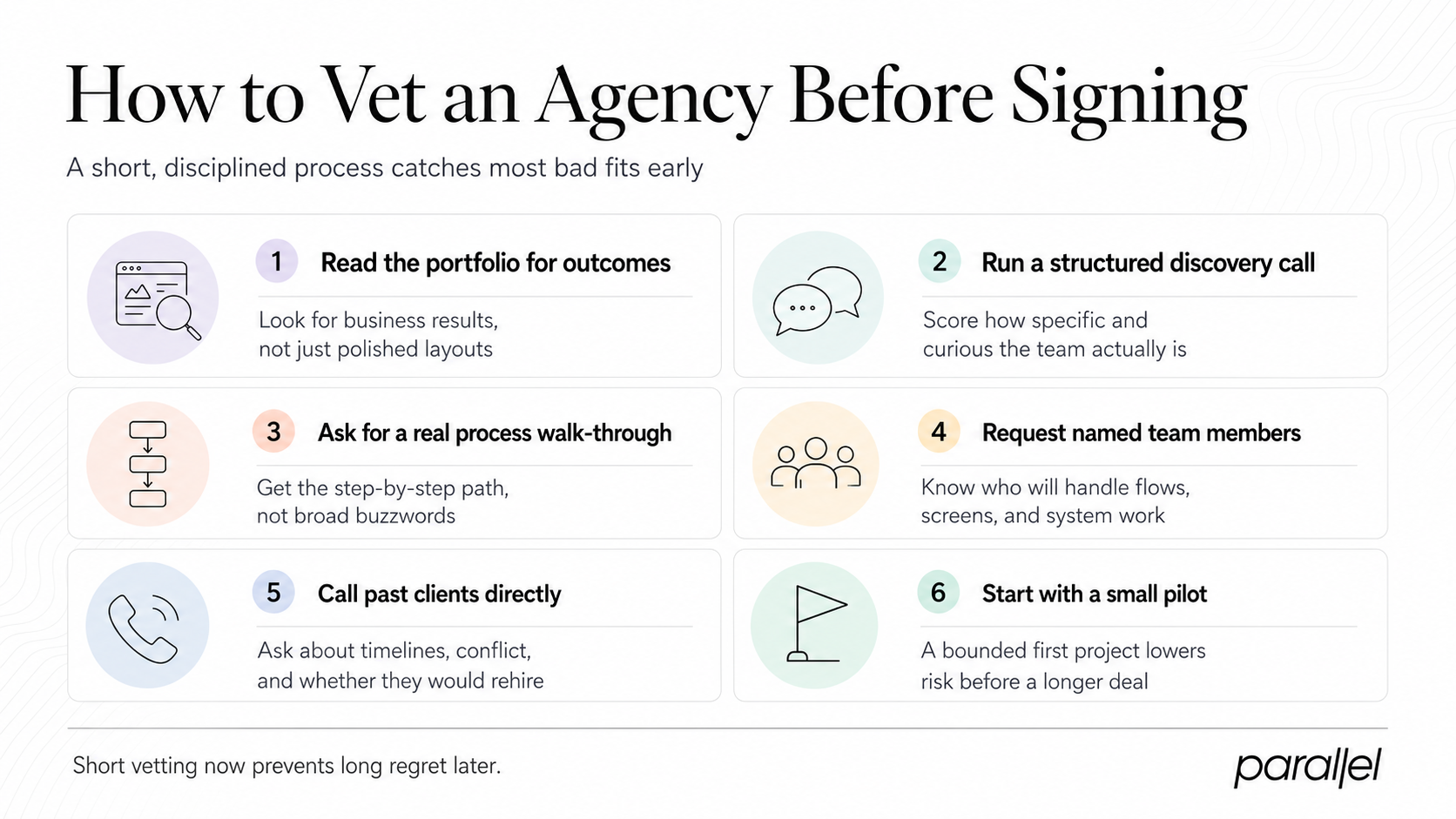
- Review the portfolio for outcomes, not aesthetics. Look for case studies with before/after metrics, startup-stage work, and evidence of user research. A UX audit or usability testing history in their portfolio is a strong positive signal.
- Run a structured discovery call. Watch for the red flags listed in the section above. Score the call on specificity: did they ask about your business model, your users, your technical constraints?
- Request a process walkthrough on a live project. Ask them to walk you through a recent project step by step, if they can't, the process is a marketing artifact, not a real system.
- Ask for named team members and individual portfolios. Confirm who will handle wireframing, prototyping, and design system work.
- Call at least two references directly. A 15-minute phone call with a genuine client will tell you more than six glowing written reviews.
- Audit the contract for IP, scope, and exit terms. The client should own the source files, including Figma files, assets, and all final deliverables. Any language involving licensing, ongoing fees for file access, or vague references to "proprietary tools" is a reason to push back, and file ownership should be spelled out explicitly before you sign.
- Start with a bounded pilot. Before committing to a multi-month relationship, start with a smaller project. It's the best way to test fit, process, and results without going all-in from day one.
Consider running a discovery framework or a design sprint as your pilot engagement. Both have defined timeboxes, clear deliverables, and low enough scope that you'll learn everything you need to know about how an agency operates under real conditions, without betting your launch timeline on it.
At Parallel HQ, our first engagement with most founders is deliberately bounded, a UX audit, an AI readiness design scorecard, or a structured discovery session. You should be able to evaluate us the same way we evaluate your product: with real data, not promises.
Conclusion
The design agency red flags that derail startup product launches are almost never invisible. They show up during the discovery call, in the proposal language, in the portfolio review, and in the contract terms. The founders who get burned aren't less intelligent, they just didn't have a structured framework for what to look for before the ink dried.
Key takeaways:
- Require a documented UX design process with named deliverables before you engage.
- Never accept a design portfolio without measurable outcomes and user research artifacts.
- Verify intellectual property rights and file ownership explicitly in contract terms.
- Pilot with a bounded engagement before committing to a long retainer.
- The agency's behavior during the sales process is your clearest signal of what working with them will actually feel like.
Frequently Asked Questions
Q1: What is the single biggest design agency red flag for early-stage startups?
Skipping the discovery phase to jump straight to mockups. An agency that doesn't invest time in user research and stakeholder communication before opening Figma doesn't understand your users, it's designing for aesthetics, not outcomes. For startups, that distinction directly affects activation and retention.
Q2: How do I know if an agency's proposal is trustworthy?
Look for specificity: named deliverables per phase, milestone-based timelines, defined revision cycles, and explicit intellectual property rights language. A proposal that uses phrases like "comprehensive design support" without listing actual design deliverables is telling you exactly how they'll communicate once the project starts.
Q3: Should I run a pilot project before signing a full retainer?
Yes. A design sprint or bounded discovery engagement is the most reliable way to evaluate an agency's real process, communication cadence, and output quality. A reputable agency will welcome this. An agency that resists it is a red flag in itself.
Q4: What questions should I ask an agency's references?
Ask three things specifically: did they hit their timeline, how did they handle scope disagreements, and would they hire the agency again? Written testimonials are nearly useless. A 15-minute phone call with a real past client will tell you more than a five-star Clutch review.
Q5: Who should I expect to be doing the actual design work?
The named senior designer is shown in the pitch. Before signing, ask to meet the specific person assigned to your account and review their individual portfolio. It's a known agency pattern: sales call with a senior designer, work done by juniors. Clarify this upfront, in writing.
Q6: What contract terms are non-negotiable when hiring a design agency?
Three are absolute: full intellectual property rights transfer upon final payment (including Figma source files), a defined project scope with specific deliverables, and a reasonable exit clause with no multi-year lock-in. Most contract terms are negotiable, a professional agency will expect questions and be willing to clarify, and resistance to basic questions about ownership or exit terms is itself a warning sign.

check out these related blogs