Most enterprise software is a mess of features with poor user retention. We constantly see founders overcomplicate their products because they prioritize looking good over working well. Fixing this requires strategic design thinking. Finding the right partner is critical to surviving early growth stages. If you are looking for the best enterprise UX agencies for B2B SaaS, you need teams that understand complex user behaviors. Let me show you how to choose one.
10 Best Enterprise UX Agencies for B2B SaaS
The best enterprise UX agencies for B2B SaaS focus on workflow clarity over flashy visuals. I reviewed the top ten providers helping teams build usable software. Here is the comparison table to guide your decision.
Why workflow clarity matters in enterprise software
Founders often build features their users never touch. This happens when product decisions lack grounding in actual user problems. A 2025 Nielsen Norman Group report on enterprise tools shows that 68% of enterprise users abandon workflows that take more than three steps. We see this constantly. Teams spend months shipping a feature that confuses the end user and drives up support tickets.
The solution is radical simplification. You must cut down the cognitive load. Complex tools fail when they force users to think too much about how to use them. Our discovery framework helps teams strip away the noise. We identify exactly what users need to achieve and build the shortest path to get them there.
In my experience, enterprise software should get out of the user's way. The interface should disappear. When users log into a B2B platform, they want to accomplish a specific task and get back to their day. They do not want to admire your dashboard graphics.
If your core workflows are confusing, your churn rate will skyrocket. Competitors will steal your customers by offering a simpler alternative. This is why investing in clear product thinking is mandatory, not optional.
Where product teams go wrong
I have watched countless product leaders hire traditional agencies to solve software problems. These agencies often focus on surface aesthetics. They deliver beautiful screens but fail to fix the underlying user flows. This approach leads to low activation rates and frustrated internal teams.
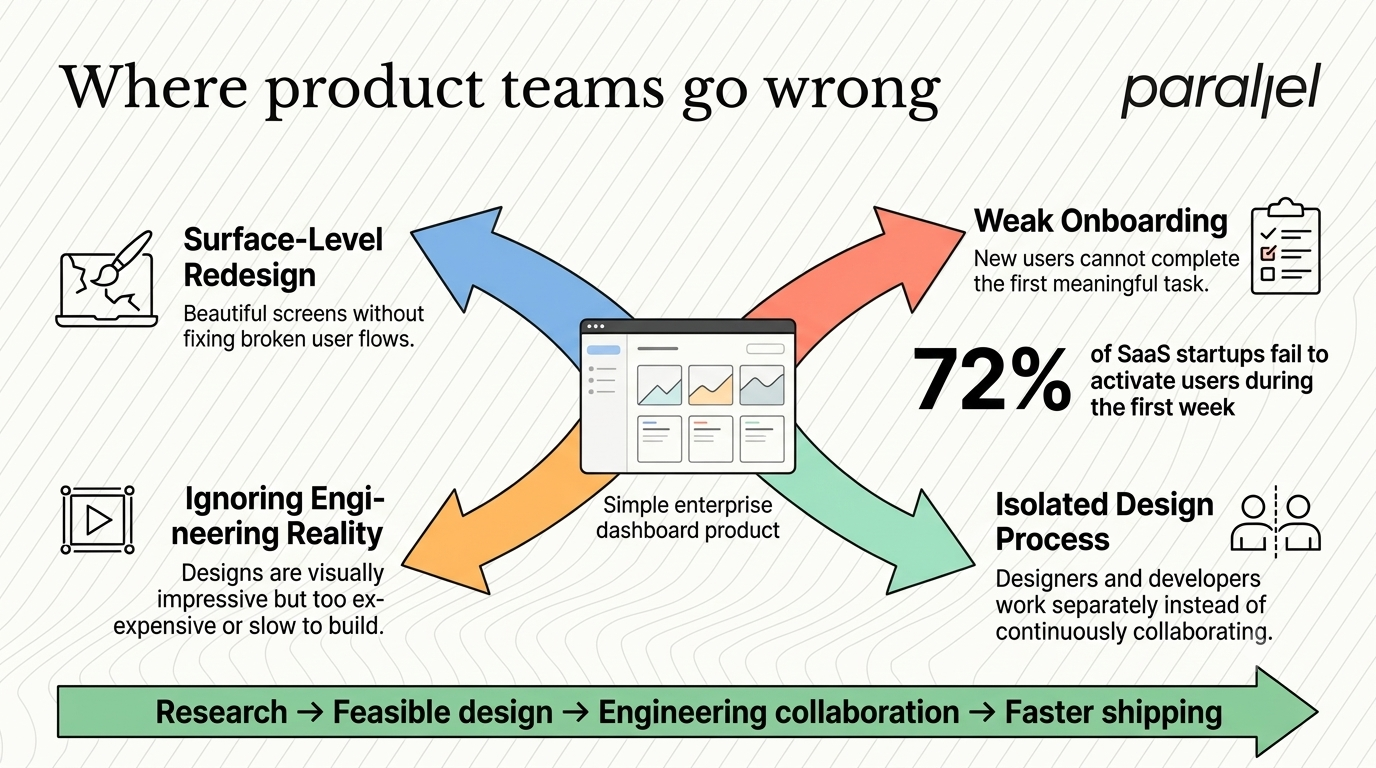
A 2026 Forrester study found that 72% of SaaS startups fail to activate new users within the first week due to poor onboarding. Beautiful buttons do not save a confusing onboarding flow. You need practitioners who understand SaaS onboarding teardowns and user psychology. The best enterprise UX agencies for B2B SaaS dig into data to see where users drop off. They do not just paint over the cracks.
Another common mistake is ignoring the engineering realities. Product designers must design for feasibility. If an agency creates a complex animation that takes engineers three months to build, that is bad design. Good design ships quickly.
We always embed closely with engineering teams. We ensure every decision maps to realistic technical timelines. Teams go wrong when they treat design as an isolated phase rather than an ongoing conversation with developers.
The 10 best enterprise UX agencies for B2B SaaS
1) ParallelHQ
We built ParallelHQ to help founders and product managers build clear and usable software. We focus on rapid problem solving and deep strategic thinking. We do not waste months on fluff. Our team embeds with your engineers to ensure fast execution and measurable results.
We rely on product strategy consulting to simplify your core flows. When we worked on Digilocker, we streamlined the entire experience to serve millions of citizens without confusion. Our approach prioritizes usability testing over guesswork. We build prototypes and put them in front of real users immediately.
Our focus is squarely on early-stage startups and teams needing clarity. We offer comprehensive SaaS design services that cut through ambiguity. We are not just an outsourced vendor. We act as your strategic product partners to ensure what we design actually drives adoption.
2) MetaLab
MetaLab has a massive reputation for shipping high-quality interfaces. They work well with well-funded startups that need exceptional polish. They build interfaces that look incredible and function smoothly. Their portfolio includes some of the biggest names in tech.
However, their process can be slow and expensive for early-stage startups. They require massive budgets and long timelines. If you need a more agile partner, you might look for a MetaLab alternative focused on faster iterations. MetaLab works best when you already have total product clarity and just need flawless execution.
They shine in consumer-like enterprise tools. If your B2B tool needs to feel like a premium consumer app, they have the talent to execute that vision. Just prepare for a lengthy engagement process.
3) Clay
Clay merges brand identity with software design very well. They excel at making tools feel distinct. They work with established tech companies to modernize legacy systems while retaining brand recognition. Their work is highly conceptual.
Their focus leans heavily toward branding over pure utility. If your core problem is workflow efficiency rather than visual identity, they might not be the exact fit. Many teams seek a Clay alternative when they need deep workflow restructuring rather than a brand refresh.
They do exceptional work in defining how a brand expresses itself through software components. They are a great fit if your enterprise tool looks generic and needs a strong visual voice.
4) Frog
Frog brings massive scale to their projects. They handle deep technical constraints well. They often partner with legacy corporations updating old software that runs entire supply chains. They think in systems.
They operate like a massive consultancy. Early-stage founders might find their processes too heavy and bureaucratic. Startups usually prefer a Frog alternative that moves at startup speed. Frog is built for multi-year corporate transformation projects.
Their research capabilities are vast. They can deploy researchers globally to understand user behavior across different markets. This makes them ideal for Fortune 500 companies looking to overhaul their entire digital infrastructure.
5) Ramotion
Ramotion connects marketing sites with the actual software product. They ensure visual consistency across all touchpoints. This helps companies build trust instantly from the moment a user lands on the website to the moment they log in.
They focus heavily on aesthetics and brand consistency. If you need intense user research to figure out your product features, you may want a Ramotion alternative. They are great executors of an existing vision rather than product strategists.
They work well for startups that have reached product-market fit and need to clean up their visual presentation. Their UI work is sharp and modern.
6) R/GA
R/GA is a giant in the agency world. They handle complex global software rollouts for massive brands. They bring huge teams to tackle complex, global problems. They offer a very wide range of services.
This scale is their biggest asset and their biggest drawback. Startups often get lost in their massive operations and layered management structures. A smaller R/GA alternative usually provides more direct access to senior practitioners.
They are best suited for enterprise clients who need a safe choice for a board-approved project. They have the resources to handle everything from advertising to core software development.
7) Huge
Huge builds portals and corporate tools for large organizations. They understand the politics of massive companies. They deliver solid corporate software that meets strict compliance and accessibility guidelines. They know how to navigate stakeholders.
Their work is highly structured and heavily documented. Fast-moving teams might find this restrictive. Finding a Huge alternative makes sense for teams aiming to ship a minimum viable product quickly.
They excel at stakeholder management. If your project requires getting buy-in from twenty different executives, Huge has the process to handle that.
8) Method
Method excels in financial software and data-heavy interfaces. They simplify complex dashboards well. They bring structural thinking to massive data sets and enterprise reporting tools. They make data readable.
They are highly specialized in data visualization. If your product requires emotional engagement or community features, they might not be the primary choice. You can find a Method alternative for more consumer-centric SaaS tools.
For fintech and analytics platforms, they offer deep expertise. They understand how to present numbers without overwhelming the user.
9) ustwo
ustwo creates exceptional mobile-first experiences. They build products that feel playful and highly interactive. They dominate the mobile product space and have a strong background in gaming mechanics.
Many B2B tools require dense desktop dashboards. While ustwo is brilliant, desktop-heavy tools might require a different partner. Startups often look for an ustwo alternative for complex web applications that do not translate well to mobile screens.
They are perfect if your B2B product relies heavily on a field workforce using iPads or mobile phones. They understand touch interfaces perfectly.
10) Instrument
Instrument weaves narrative into software. They make corporate tools feel less dry and more engaging. They excel at internal communication platforms and employee portals. They bring a storytelling aspect to digital tools.
They operate at the intersection of advertising and product. If you need hardcore data table optimization, they are not the typical choice. A specific Instrument alternative might be better for purely technical software aimed at engineers or analysts.
They are fantastic for HR tech or internal training software. They know how to make internal tools feel like premium products.
How to evaluate product partners
Choosing the right partner means asking difficult questions. I always advise founders to ask about the agency's failure rate. How many of their designs actually get built by engineers? The best enterprise UX agencies for B2B SaaS will gladly share their engineering handoff process. They should pride themselves on feasibility.

According to 2025 research from IDEO, design projects fail most often during implementation. Your partner must speak the language of your developers. They should offer structured design systems to speed up coding. If they only deliver static screens without interaction specs, walk away immediately.
You should also look for practitioners who challenge your assumptions. If an agency agrees with every feature you suggest, they are just taking orders. You want a partner who will push back when a feature adds unnecessary complexity. They should protect the user experience from feature bloat.
Look closely at how they test their work. A good partner will insist on talking to your users. They will run qualitative tests to validate their assumptions. If they skip research to jump straight into visual design, you will end up with a product that looks good but fails to convert.
The ROI of practical product thinking
We measure success by user adoption and retention. Good design must move business metrics. A clear product reduces support tickets and increases self-serve upgrades. When users can accomplish their goals quickly, they stay loyal to your software.
Investing in structural design pays off quickly. Your sales team can close deals faster when the product demos well. Your users stay longer when they understand the tool immediately. We use user research to prove these metrics before writing a single line of code. This mitigates the financial risk of building the wrong features.
A 2026 McKinsey report on software design highlights that companies prioritizing user-centric workflows see a 32% increase in net retention rates. You cannot afford to ignore the business impact of a confusing interface. Good design is a growth engine for B2B SaaS companies.
Conclusion
Product decisions should always come back to the user. I have spent years helping teams simplify their software because complexity kills adoption. The best enterprise UX agencies for B2B SaaS know how to say no to bad feature ideas. They help you focus on what truly matters to your customers. Stop building for aesthetics and start building for clarity.
FAQ
1) What is B2B SaaS product design?
It is the practice of designing software for business users. It focuses on task efficiency and clear workflows. It prioritizes function over pure visual flair, ensuring users can complete their work quickly.
2) How do I choose the best enterprise UX agencies for B2B SaaS?
Look for teams with a track record of simplifying complex systems. Ask to see their research process and engineering handoff documentation. Ensure they have deep experience with enterprise software design services.
3) Why is onboarding so critical for software products?
Users judge your tool within the first few minutes. If they fail to figure out how to complete a core task quickly, they will abandon the product. Strong onboarding drives long-term retention and reduces churn.
4) How does ParallelHQ differ from traditional agencies?
We function as an extension of your product team. We focus heavily on opportunity mapping and rapid problem solving. We skip the agency fluff to deliver actionable, feasible designs faster.
5) Should we hire an in-house designer or an agency?
In-house designers are great for maintenance and incremental updates. Agencies bring fresh perspectives and specialized frameworks for major overhauls. We often partner directly with in-house teams to speed up their work.
6) What makes the best enterprise UX agencies for B2B SaaS worth the investment?
They prevent you from building the wrong things. They validate ideas with users before you spend money on development. This saves months of wasted engineering effort and protects your runway.
7) How long does a typical redesign project take?
A focused redesign of a core flow takes a few weeks. Full platform overhauls take several months. We use rapid design sprints to compress months of discovery work into days.
8) Is this the right time for my startup to hire the best enterprise UX agencies for B2B SaaS?
If your users complain about complexity, or if your onboarding metrics are dropping, it is time. Do not wait until you lose major accounts to fix usability problems. Address the friction early.

check out these related blogs