I've sat across from hundreds of founders and PMs who hand over vague one-pagers and then wonder why the first concepts miss the mark. Knowing how to brief a design agency is the single most leveraged investment you can make before any pixel gets pushed. A strong brief doesn't constrain creativity, it focuses it. Here's everything you need to get it right.
TL;DR
- The quality of work a design agency produces is directly connected to the quality of the brief they receive. A vague brief produces guesswork dressed up as creativity. A precise brief gives a skilled agency everything it needs to do its best work, faster, with fewer revisions, and with a result that actually solves the right problem.
- A complete brief covers: business context, problem statement, audience, scope, budget, and timeline.
- Specific numbers, named constraints, and real user data beat fluffy adjectives every time.
- The brief is a living document, update it as discovery evolves.
What Should I Include in a Design Brief?
A design brief is a foundational document that outlines the core details, goals, and expectations of a design project, serving as a shared roadmap between clients and designers. At ParallelHQ, we treat it as the cheapest risk-management tool in the startup toolkit. Miss a section, and you pay for it in revision rounds. Design briefs introduce project specs, including key goals and background, target audience, design requirements, timelines, and budget. For AI and SaaS startups specifically, I'd add one more layer: the product context, what's already been built, what the tech constraints are, and what happens after the design is handed off.
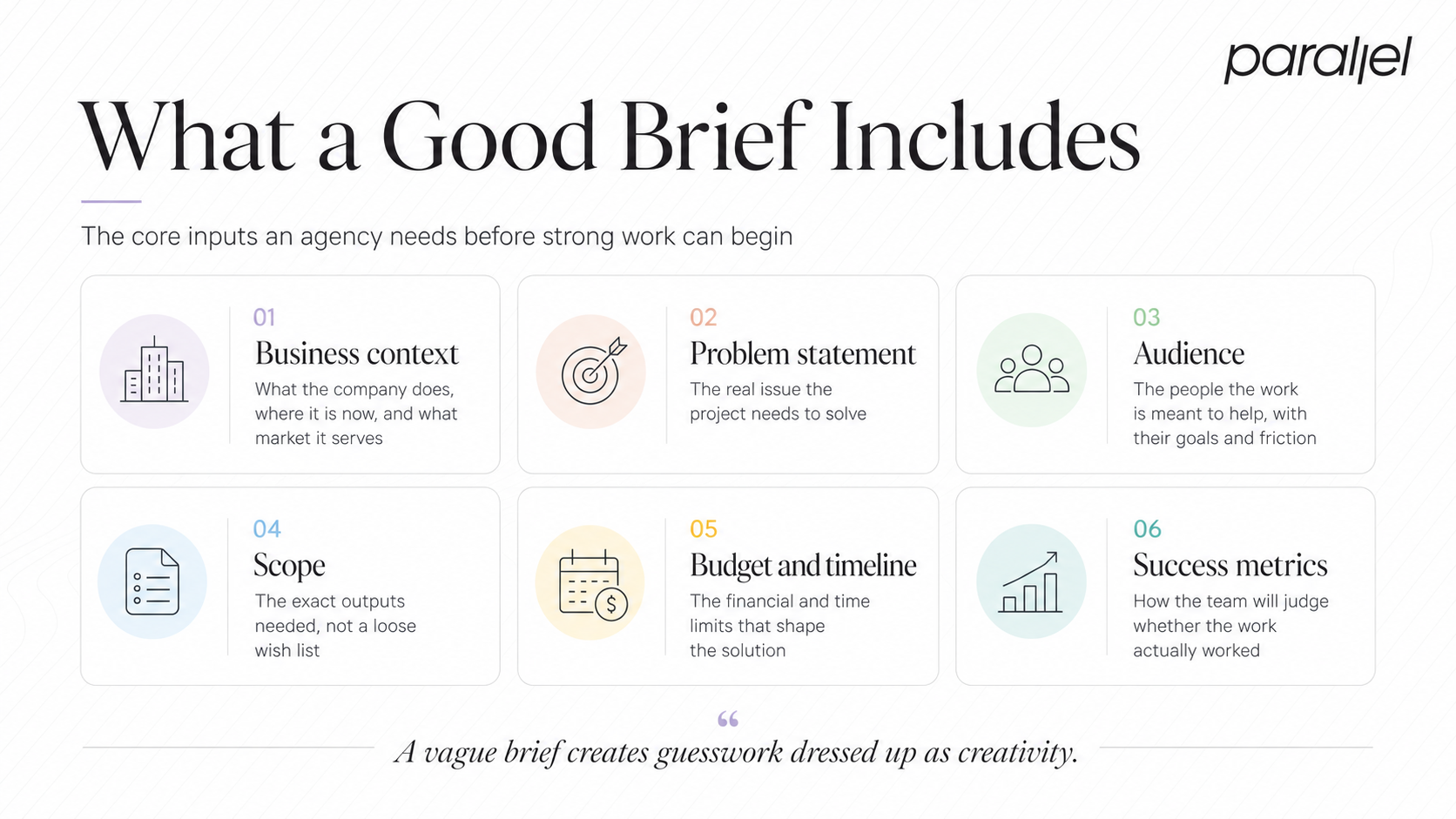
Here's what every complete brief must include:
- Business context: What the company does, what stage it's at, and what market it operates in. An agency designing for a Series A-funded B2B SaaS company makes different choices than one designing for a consumer lifestyle brand, even if the deliverables are identical.
- Problem statement: The specific, named problem you're solving. "We need a new website" is not a problem statement. "Our current site doesn't reflect the quality of our work and is losing us credibility with enterprise clients" is a problem statement.
- User personas: Who the design is for, their goals, and their friction points. This feeds directly into information architecture and UX research decisions.
- Brand guidelines: Share brand identity guidance and specs for logos, colors, fonts, styles, and images. If your design system is already in Figma, share the file link.
- Scope and project deliverables: List the specific deliverables you expect from the agency. For instance, if it's a website design, mention if you need wireframes, mockups, or a fully developed site.
- Budget range: Be transparent. A ballpark figure helps the agency recommend the most suitable package or approach.
- Timeline and milestones: Aiming for a site to go live "as soon as possible" is rarely helpful. Provide specifics where you can.
- Success metrics: Define what "done well" looks like, conversion rate, task completion time, NPS, or whatever your product team tracks.
How to Write a Design Brief for an Agency: A Step-by-Step Process
Knowing how to brief a design agency properly means thinking like a product manager, not a marketing director. Follow this sequence:
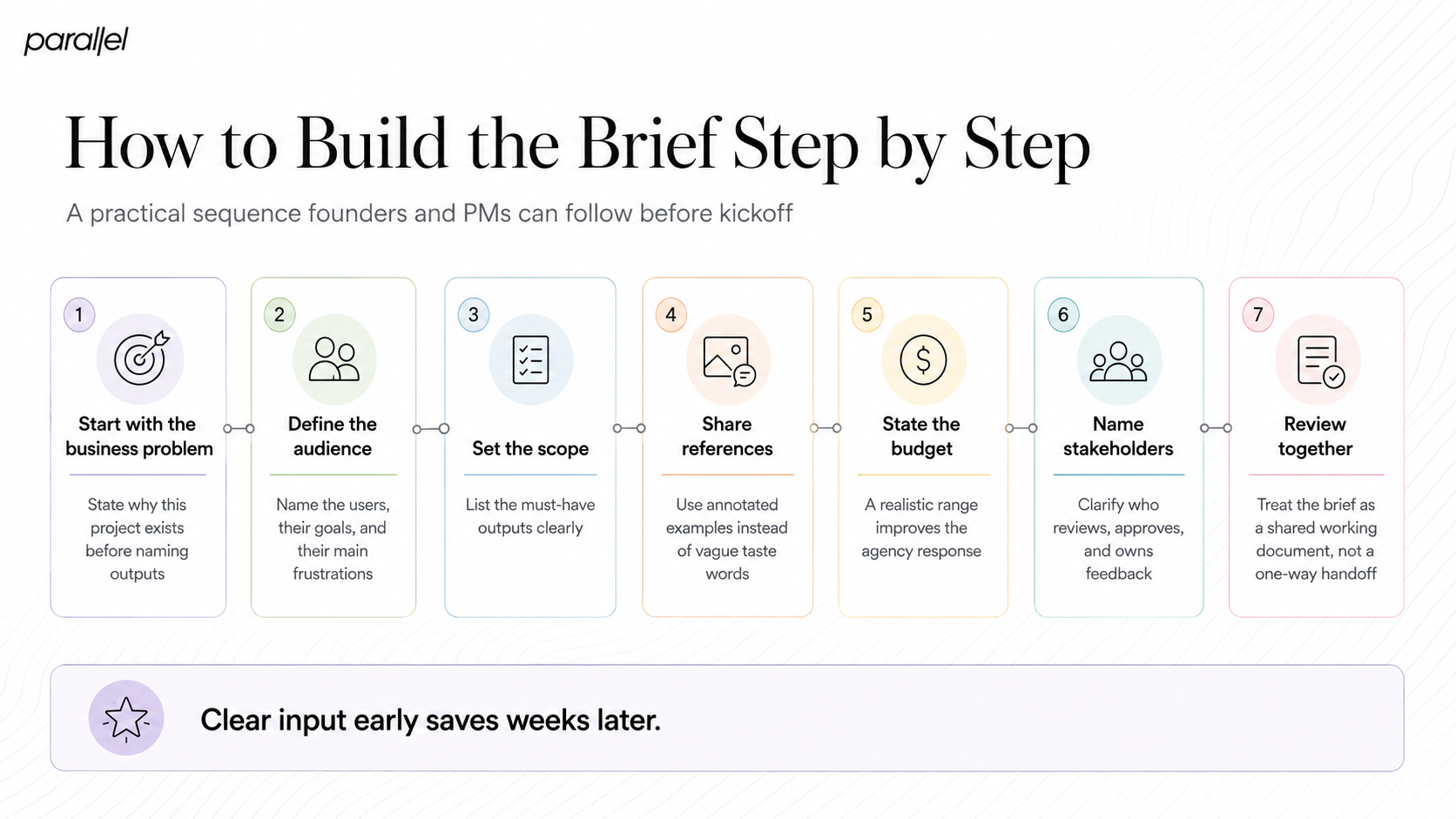
- Start with the business problem, not the deliverable. Write one paragraph describing why this project exists and what business outcome it needs to move.
- Define your user personas. Name them, give them a job title, a key goal, and their single biggest frustration with your current product or site.
- Set the project scope explicitly. List any must-have features early in your brief. Providing functionality requirements upfront ensures the agency can quote accurately and prevents scope creep later.
- Share brand guidelines and visual references. Including mood boards in your creative brief is essential for conveying the aesthetic and emotional vibe you envision. These boards combine images, color palettes, typography, and other visual inspirations that define the desired look and feel. Providing these visual references allows you to set a clear direction while fostering creativity within defined parameters.
- State your budget range. Even a rough band eliminates 80% of proposal mismatches before they happen.
- Name your key stakeholders. Identify the key stakeholders involved in the project and clearly define their roles and responsibilities. Who approves design? Who has veto power? Who's the single point of contact?
- Attach competitive references. Show three competitors and annotate what works and what doesn't. That annotation is worth ten mood board images.
Once written, collaborative briefs where both parties contribute to a shared document combine business knowledge with design expertise for the most thorough results. Both parties should review and approve the final document before work begins.
Design Agency Brief Template: A Fill-in Framework
Use this template as your starting structure. Every field matters, leave none blank.
Creative work moves quickly, and some project leaders mistakenly think their creative brief must be rigid to support fast-moving teams. In reality, it's a living document. Until you start executing on the work, it should always be open to conversations and edits.
For startups moving through a discovery framework or a design sprint, I recommend treating the brief as a working document pinned to your shared workspace, not a PDF you email and forget.
What Information Does a Design Agency Need from You?
Beyond the template above, there's a layer of context that separates average briefs from great ones. After working with dozens of early-stage AI and SaaS startups at ParallelHQ, I've noticed the following inputs consistently produce better creative direction:
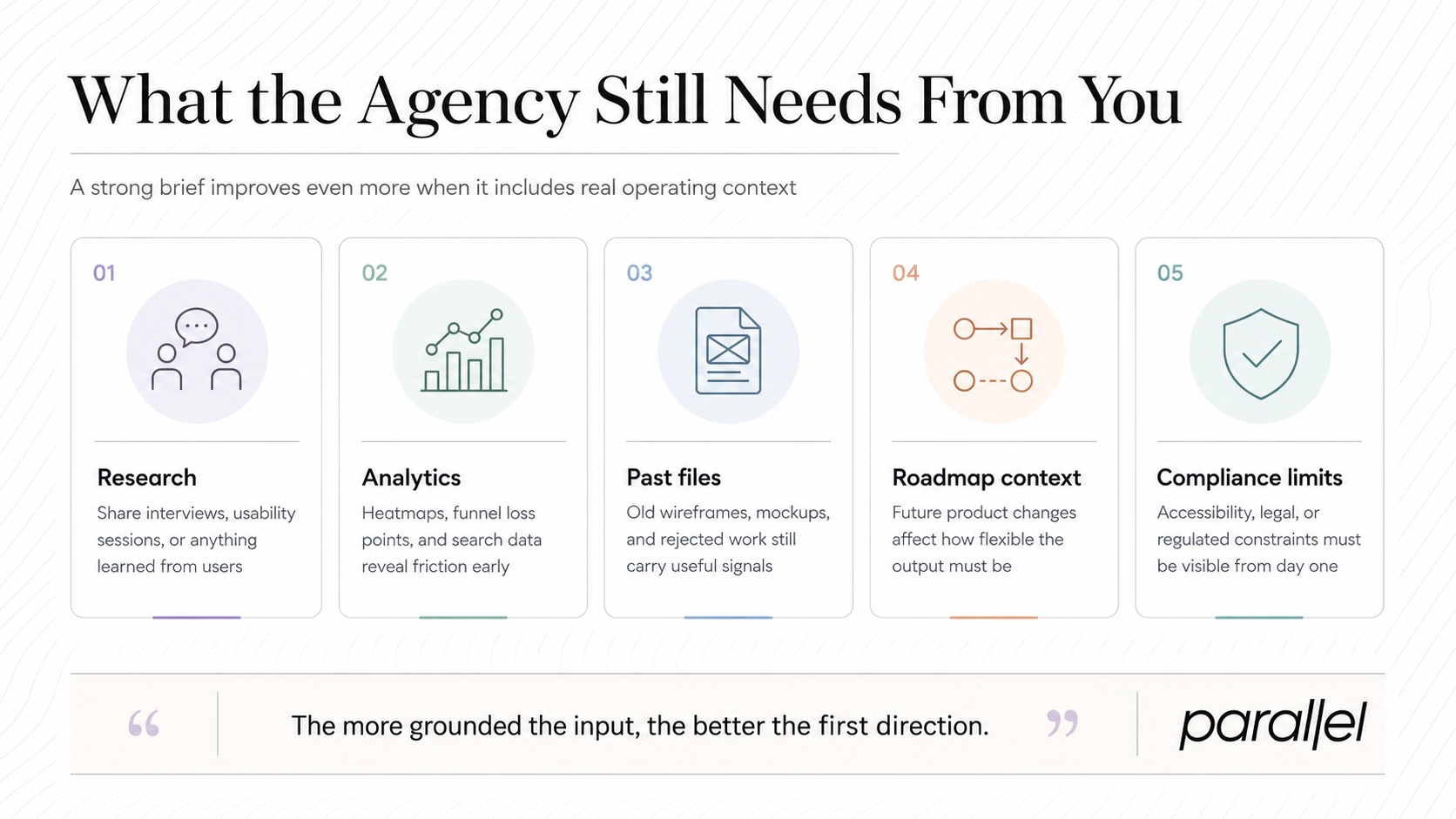
- Existing UX research: If you've run usability testing, share the session recordings or a summary. If you haven't, flag it, a strong agency will recommend starting with user research before any interface work begins.
- Analytics data: Heatmaps, funnel drop-off rates, and search queries tell an agency where users struggle. This data shapes information architecture decisions before a single wireframe is drawn.
- Past design artifacts: Include links to relevant design files, such as wireframes, mockups, and prototypes. Even failed explorations carry signals.
- Product roadmap context: What features are coming in the next two quarters? A design system built for today's MVP will become a liability if it can't scale to next quarter's feature set.
- Regulatory or accessibility requirements: For fintech, healthtech, or enterprise products, compliance constraints are non-negotiable inputs. They must appear in the brief, not surface as surprises mid-project.
Clear and detailed briefs equip designers with the background, foundation, and insight to create the final product, and set out the client's expectations, taste, and branding requirements for designers.
How to Communicate Your Vision to a Design Agency
The gap between what a founder sees in their head and what a designer produces is almost always a communication failure, not a creative one. Here's how to close it.
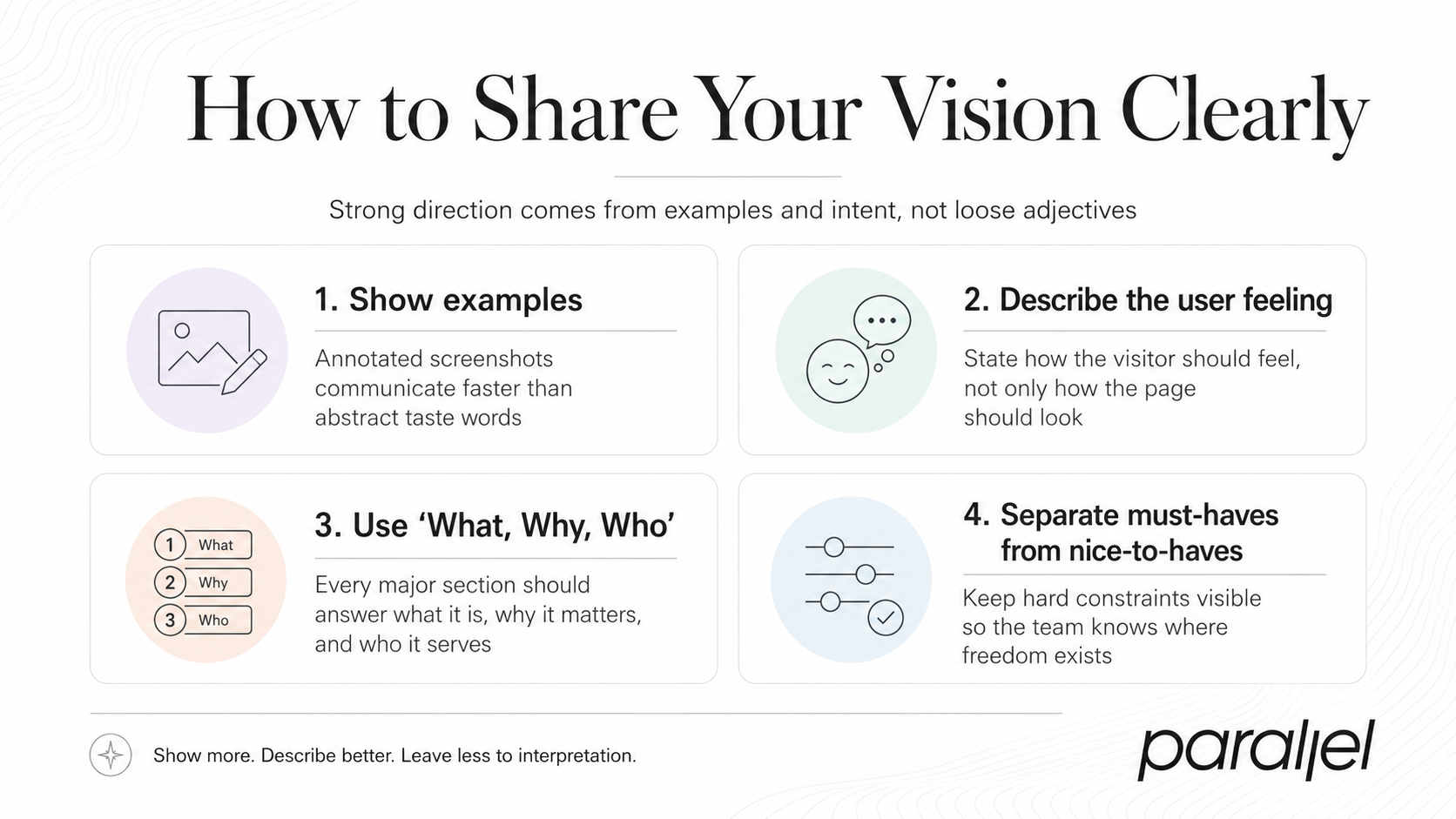
- Show, don't tell. One of the most effective ways to communicate your vision to a web design agency is by sharing examples. Show your agency what your competitors are doing well, or poorly. Annotated screenshots communicate ten times more than adjectives like "clean" or "modern."
- Describe the user feeling, not the visual style. Explain how you want users to feel when they land on your site, this helps the design team understand your brand personality and make cohesive creative decisions.
- Use the "What / Why / Who" structure. Every section of your brief should answer: what is this for, why does it need to exist, and who will use it. Any statement that can't answer at least two of those three questions is probably noise.
- Separate must-haves from nice-to-haves. Mandatory constraints (brand colors, legal disclaimers, specific flows) belong in their own section. Creative latitude should be explicitly granted, not assumed.
- Align internally before sharing externally. Whether you're an agency or an in-house team, have an initial meeting with your client to fill out the creative brief together and clarify points as needed.
At ParallelHQ, we often find that the act of writing the brief surfaces internal misalignment between founders and PMs, better to find that before kickoff than after the first presentation.
For startups that aren't sure where their product experience stands before briefing an agency, running a UX audit or an AI Readiness Design Scorecard first gives you a defensible baseline to write from.
Design Brief Examples: What Good Looks Like for Branding Projects
A brief for a SaaS rebrand looks structurally different from a brief for a new mobile app. Here's how the key sections shift across project types:
Different projects require different information based on their participants, scope, and size. A website creative brief would focus on the website's purpose, target audience, desired functionality, and overall aesthetic. It would include details such as sitemaps, wireframes, and design inspiration.
For branding projects specifically, also attach your brand archetype, tone-of-voice guide, and any brand equity you want to preserve. Agencies building a brand identity from scratch need more room to explore, your brief should grant that latitude explicitly.
Common Mistakes When Briefing a Design Agency
After reviewing hundreds of briefs, the failure patterns are remarkably consistent. Here's what to avoid:
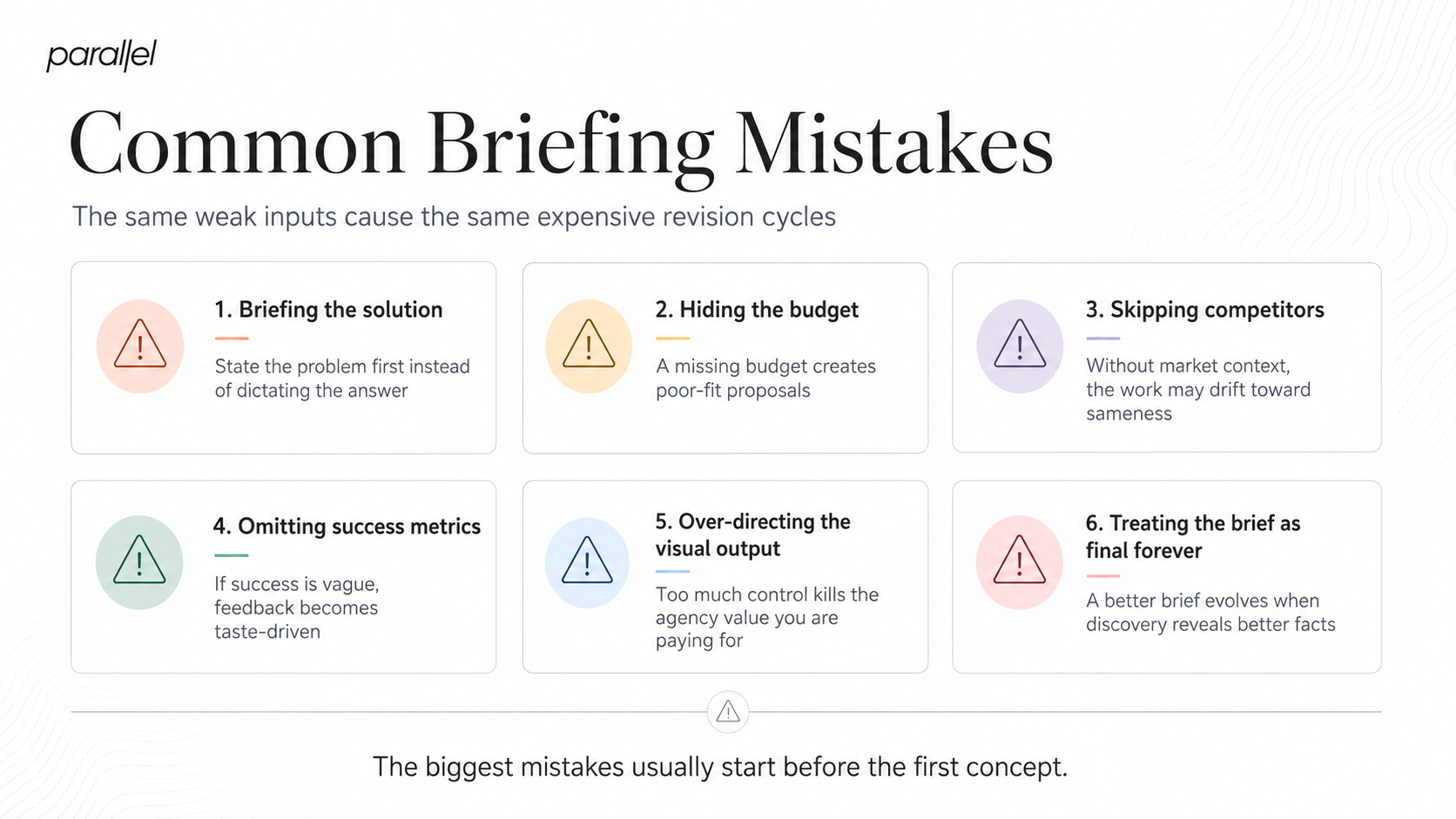
1. Describing the solution, not the problem. "We need a dashboard redesign" is a solution. "Users can't find their core metric within 10 seconds of logging in" is a problem. Brief the problem. Let the agency propose the solution.
2. Leaving the budget unstated. Be clear about your project timeline and budget. Unrealistic expectations and misalignment can lead to disappointment and rushed work, and it can strain relationships.
3. Skipping competitive analysis. Understanding your competitors helps the creative agency produce work that stands out. Provide key insights into what others in your industry are doing.
4. Omitting success metrics. Include criteria for success and how the project's effectiveness will be measured. This ensures that both you and the agency have a clear understanding of what constitutes a pass mark.
5. Over-directing the creative. Trust the agency's process, don't micromanage every pixel. A brief that prescribes every visual decision removes the agency's ability to do the thing you hired them for.
6. Sending a document to fill out alone. The thing you want to avoid is sending a document to the client to fill out on their own. The best briefs are built collaboratively in a kickoff meeting, not asynchronously.
7. Treating the brief as a one-time artifact. When the brief is incomplete, the agency fills the gaps with assumptions. Some assumptions are reasonable. Others aren't. And by the time the misalignment surfaces, the project has already spent time and budget moving in the wrong direction.
How Detailed Should a Design Brief Be?
This is the question I get most often. The honest answer: detailed enough that the agency could begin discovery without a phone call, but not so detailed that it foreclosed creative thinking. A one-page document may be sufficient for something simple, like a logo design or brochure. If you are looking for an advertising campaign or website redesign, you will likely need a longer and more detailed creative brief to set up the framework.
In practice, here's a sensible word-count guide by project type:
A brief that runs beyond seven pages without Figma links or supporting research docs is usually a brief with a scope problem, not a detail problem. Trim the scope first. Creative briefs are not long or complex documents. In a page or two, you should be able to summarize your project parameters and distill your approach into key concepts.
For more complex products, like a full SaaS product design or a mobile app design engagement, the brief is augmented by a Statement of Work or a Request for Proposal, not replaced by one. The more valuable information you put in, the fewer questions you'll get later.
A well-scoped, well-researched brief is the fastest path to great design. At ParallelHQ, our product strategy consulting process always begins by helping founders pressure-test their brief before we ever open a Figma file.
Conclusion
Learning how to brief a design agency properly is a strategic skill, not a formality. A complete brief produces better work faster, reduces revision cycles, and forces the clarity your product team needs anyway.
Key takeaways:
- Name the problem, not the solution, agencies design solutions best when given real problems.
- Include all nine core sections: context, problem, audience, deliverables, brand guidelines, references, constraints, budget, and success metrics.
- Calibrate length to project complexity, a one-page brief for a logo, five pages for a full SaaS product design.
- Treat the brief as a living document, not a handoff artifact.
- Build it collaboratively, the best briefs are written with your agency, not before you talk to them.
Frequently Asked Questions
Q1: Who should write the design brief, me or the agency?
Either party can initiate, but the best outcomes come from collaboration. Designer-led briefs work well when clients aren't sure what information to include. At ParallelHQ, we run a structured kickoff session where we build the brief together, the client brings business context, we bring design and product thinking.
Q2: Can I brief a design agency without a formal document?
Yes, for very small projects. A design brief is not an absolute necessity to start working with a designer. Many successful collaborations begin without a formal brief, particularly when working with experienced designers or agencies who are adept at extracting essential project details through initial consultations. For anything beyond a single screen, a written brief prevents costly misalignment.
Q3: How do I communicate a brand vision I can't fully articulate yet?
Start with what you don't want. Anti-examples and annotated competitor screenshots communicate taste faster than descriptive words. Mood boards that combine images, color palettes, typography, and other visual inspirations define the desired look and feel and give designers a concrete starting point even when language falls short.
Q4: Should I include a budget in my brief?
Always. Your timeline and cost expectations are key elements of any agency brief. Honest communication here avoids delays or misunderstandings later. You don't need a precise number, a realistic range is enough for the agency to propose the right approach.
Q5: What's the difference between a design brief and a creative brief?
A design brief handles more of the preproduction and business side of the project, while the creative brief tackles the innovative execution. Think of the design brief as the brief's business case, and the creative brief as its creative direction document. For most startup projects, you'll need both.
Q6: How do I know when my brief is ready to send?
Apply this test: could a competent designer begin a discovery session with only this document in hand? The agencies that do the best work ask the most questions before they start, because they know that clarity at the brief stage is worth more than any revision process after it. If your brief generates more questions than it answers, it needs another pass.

check out these related blogs


































































.webp)