Every founder I talk to asks the same thing before committing to a sprint: "What's this actually going to cost me?" The honest answer is that design sprint cost ranges from a few thousand dollars to well over $30,000, depending on who runs it, what's included, and how mature your product thinking already is. This guide breaks down the real numbers, the pricing logic behind them, and how to decide what level of investment your startup actually needs right now.
TL;DR
- Agency-run design sprint cost typically falls between $15,000 and $30,000 for a full 5-day engagement.
- Seed-stage startups should budget $10,000–$20,000 for a sprint scoped to a single validated problem.
- A sprint costs far less than a wasted engineering sprint or a failed MVP rebuild.
- What you pay for is decision compression, not deliverables.
How Much Does a Design Sprint Cost? The Full Range
The design sprint cost you'll encounter in 2026 spans a surprisingly wide band. The format, facilitator experience, and deliverables included each push the number in different directions. Depending on the number of designers involved, you will need a budget between $25,000 and $30,000 for a complete 5-day design sprint from a specialist agency. That's the premium tier, reflecting senior facilitation and a full deliverable package. This package includes preparation, prototype, user tests and videos, intellectual property rights, and signing an NDA.
At the mid-market tier, boutique studios working with early-stage AI and SaaS startups typically price 5-day sprints in the $12,000–$20,000 range. For a seed-stage startup building a first mobile product, $15,000 to $35,000 is the realistic floor for an engagement that includes real UX thinking. At the internal/DIY end, teams running sprints themselves bear only opportunity cost. Using the standard 5-day design sprint process as prescribed by Jake Knapp, a full sprint means 5 full days, or roughly 40 hours, of work from your core team. That time has real dollar value, especially for a lean seed-stage team.
Here's how the tiers stack up:
The number you see on a proposal is rarely the whole picture. Pre-sprint discovery work, user recruiting for usability testing, and post-sprint UX research synthesis can each add $2,000–$5,000 if they're scoped separately.
Design Sprint Pricing Breakdown: What You're Actually Paying For
Understanding what drives design sprint cost helps you evaluate proposals intelligently rather than just anchoring on the total number.
A design sprint team is typically made up of seven people who provide diverse and critical perspectives on the project, including a facilitator, decider, sponsor, and some mix of experts, prototypers, designers, and product and tech leads.
When you hire an agency, you're paying for all of those roles to be covered professionally.
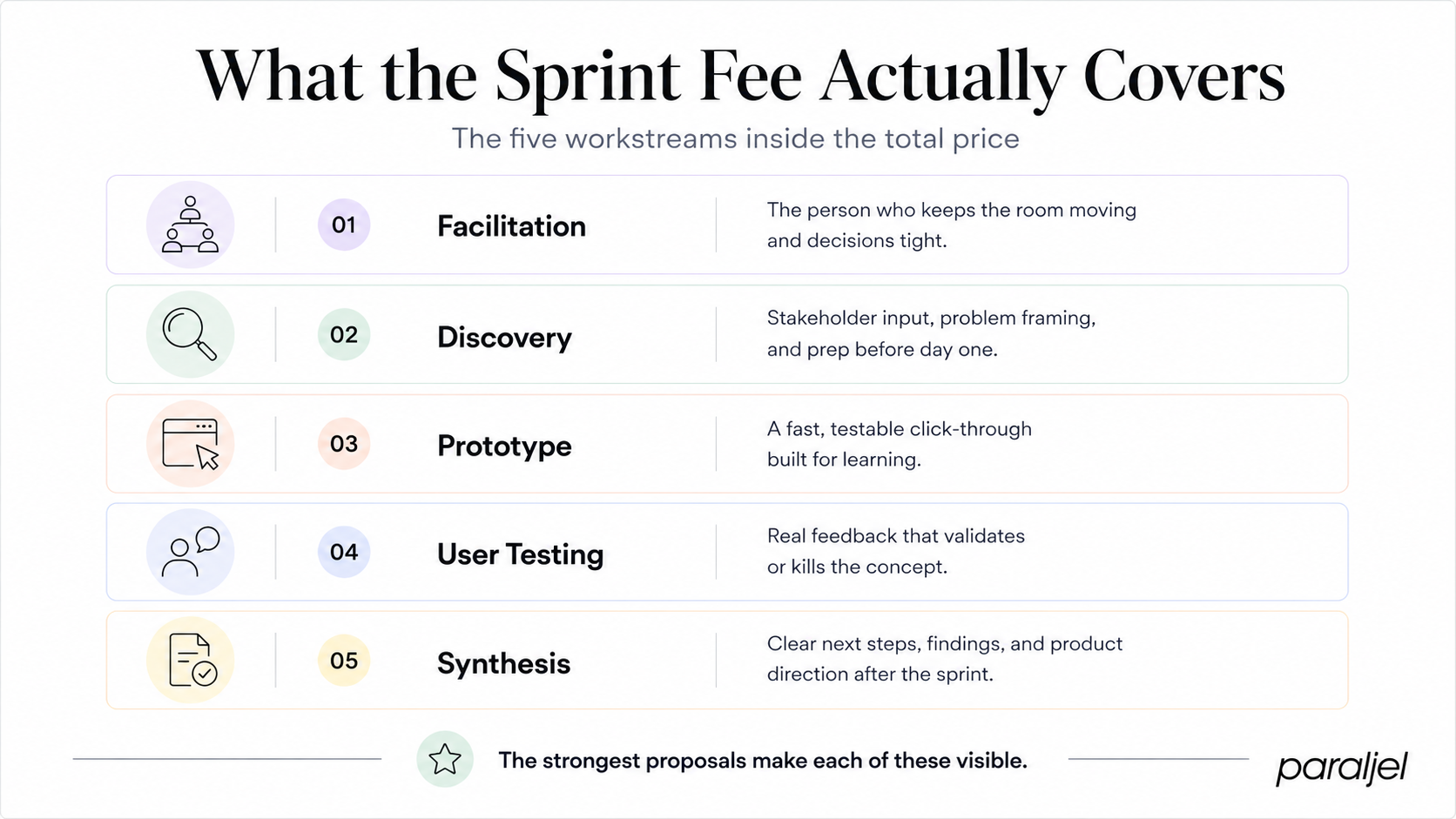
The cost breaks down across five components:
- Facilitation: The sprint lead who owns the agenda, resolves divergence, and keeps the room moving. This is the highest-leverage cost and the biggest differentiator between agencies.
- UX research and user recruiting: Identifying and scheduling 5–8 real users for usability testing at the end of the sprint. Recruiting alone can cost $1,500–$3,000 depending on how niche your user segment is.
- Prototyping: High-fidelity Figma prototypes built in 1–2 days are realistic with skilled interaction design work. This is where startup studios with a strong wireframing and prototyping practice earn their fee.
- Synthesis and reporting: Sprint report, user story mapping outputs, and prioritized next steps, typically delivered in Notion or Miro within 48 hours of the sprint ending.
- Pre-sprint discovery: Stakeholder interviews, competitive review, and problem framing. The complexity and impact of the project is also a key factor in overall cost, redesigning an existing piece of product functionality is more straightforward than conceptualizing net-new functionality from the ground up, and therefore requires less planning, time, and resources.
A sprint with no user testing at the end is not a GV Design Sprint. It's a workshop. Make sure usability testing is explicitly included before you sign anything. Some agencies offer price reductions of up to 20% for environmental projects or early-stage startups at pre-seed or seed. Always ask.
Typical Design Sprint Budget for a Seed-Stage Startup
Seed-stage is where I see the most budget confusion. Founders either over-invest expecting a sprint to do the job of a full product strategy engagement, or they under-invest and get a template-run workshop that produces pretty slides but no validated learning.
At the seed stage, your startup runway is the frame. If you're 18 months from your next raise and burning $60,000/month, a $15,000 sprint that eliminates three months of wrong-direction engineering is a clear win. If you're 6 months from running out of money, that same $15,000 deserves harder scrutiny. The right sprint scope for seed stage typically covers one clearly defined product-market fit hypothesis, not an entire product.
Here's a realistic budget model for a seed-stage AI or SaaS startup:
The $12,000 scenario assumes an experienced boutique partner, a tightly scoped problem, and users you can recruit yourself. The $27,000 scenario covers a full-service engagement including pre-sprint stakeholder interviews and post-sprint MVP development roadmapping.
At Parallel HQ, most seed-stage design sprint engagements fall in the $14,000–$20,000 range, scoped lean, but never cutting the user testing that makes sprint outputs trustworthy.
What Do Companies Charge for Design Sprints? Agency Pricing Compared
It's worth understanding the market honestly so you can evaluate proposals without being taken in by brand name or surprised by scope gaps. The strongest agencies are vetted on solid frameworks, skilled facilitators, rigorous research, and momentum beyond day five, and the practical aspects, whether they work in your industry, can effectively train your team, and are transparent about costs and results.
One thing most agencies don't disclose upfront: travel and accommodation for in-person sprints can add $3,000–$8,000. Remote sprints using tools like Miro and Figma eliminate this entirely and are now the default format for startup engagements.
Consider bringing in an expert facilitator when dealing with big or sensitive topics, they offer a non-biased opinion, are removed from office politics, and their role is to increase engagement and positivity, helping to break patterns and promote productivity.
One meaningful differentiator: agencies that run product discovery work before the sprint produce tighter problem frames, which consistently yields better sprint outputs. Skipping discovery to save cost usually costs more in sprint days wasted on misaligned problem statements.
Is a Design Sprint Worth the Cost for Early-Stage Startups?
This is the question I'd want someone to answer honestly rather than optimistically. The short version: yes, if the timing is right and the problem is real. No, if you're sprinting because it sounds rigorous rather than because you have a specific decision to make.
Design sprints help answer important business questions and solve big challenges through design, prototyping, and testing ideas directly with users. Benefits include team alignment, less risk, and the ability to compress months of time into a single week.
The sprint ROI case is clearest when:
- You have a defined user problem but are unsure which solution direction to pursue.
- Engineering has capacity to build in 4–6 weeks and you need to de-risk the decision now.
- You're preparing for venture capital funding conversations and need a credible, tested prototype.
- Your team is misaligned on what to build and the debate is consuming planning cycles.
Catching big user experience blunders before you code, through rapid prototyping and user tests, helps you avoid expensive reworks and make budget-friendly design calls.
A $15,000 sprint that kills a bad idea before your team spends three months building it is a deal. The same sprint that confirms what you already knew is money you could have spent on MVP development.
The sprint is not the right tool when:
- You don't yet know who your user is. Do user research first.
- The problem requires months of domain research to understand.
- You have no resources to act on sprint outputs within 60 days.
Apply the Google HEART Framework lens: if you can't define success metrics (Happiness, Engagement, Adoption, Retention, Task success) for what the sprint is meant to validate, the problem isn't scoped tightly enough to sprint on yet.
Design Sprint Cost vs. Hiring a Full-Time Designer
This comparison comes up constantly from early-stage founders deciding whether to hire or engage a sprint partner. The framing is usually wrong, sprints and full-time designers aren't substitutes, but it's worth making the math visible.
In the U.S., the full-time salary for a UX designer is about $124,941 per year, according to job-posting data on Indeed. With benefits, equipment, and employer taxes, hiring an in-house designer comes with additional costs, computers, tablets, insurance, taxes, and employee benefits, which often add 20–30% on top of the base salary. That puts the real annual cost of one full-time mid-level designer at $150,000–$165,000.
Freelancers are perfect for startups and visual refreshes, while agencies provide depth and polish, ideal for full-scale redesigns or brand-heavy work, though they come at a premium. The sprint-only model makes the most sense at pre-seed and seed, when problems are discrete and the runway is tight. A retainer with embedded UI/UX design capacity makes more sense post-Series A, when the product surface area grows and iteration cycles are continuous. Most founders I work with combine a sprint to set direction with a retainer to execute, this prevents the sprint from becoming a deliverable that sits in a Notion doc and never ships.
Conclusion
- Design sprint cost in 2026 runs $12,000–$30,000 for a fully facilitated agency engagement, with seed-stage budgets typically landing in the $14,000–$20,000 range.
- What you're paying for is compressed decision-making and validated prototypes, not screen counts.
- A sprint only earns its cost when a specific product-market fit hypothesis is on the table and you have the capacity to act on sprint outputs quickly.
- Comparing sprint cost to full-time hiring misses the point, the right model depends on your product stage, not just the price tag.
If you're a founder or PM trying to decide whether a sprint is the right next move, Parallel HQ's design sprint service is built specifically for early-stage AI and SaaS startups. We scope lean, we test with real users, and we never bill you for a workshop dressed up as a sprint.
Frequently Asked Questions
1) What is the average design sprint cost for a seed-stage startup in 2026?
Most seed-stage startups should budget $12,000–$20,000 for a fully facilitated 5-day sprint that includes problem framing, Figma prototyping, and usability testing with real users. Engagements below $10,000 rarely include meaningful user research.
2) What's included in standard design sprint agency pricing?
A properly scoped sprint includes pre-sprint discovery, facilitation across all five days, high-fidelity Figma prototyping, user research and usability testing, and a synthesis report with next steps. Travel costs and user recruiting are sometimes scoped separately.
3) How long does a design sprint take, and does length affect cost?
A design sprint focuses solely on rapid ideation, prototyping, and user testing to validate concepts, usually over a single, uninterrupted five-day period. Compressed 3-day versions cost 20–30% less but sacrifice research depth. Extended 10-day sprints for complex product problems can run $25,000–$45,000.
4) Can a startup run a design sprint without hiring an agency?
Yes. Teams can run design sprints on their own if there is a neutral leader in the group who is well-versed in the process and facilitation. Internal sprints reduce direct cost but require real sprint literacy, using tools like Miro, Figma, and Notion doesn't replace experienced facilitation on high-stakes problems.
5) How does design sprint cost compare to building the wrong feature?
The comparison isn't sprint vs. no sprint, it's sprint vs. wasted engineering. The most expensive design decision a startup makes is shipping too fast without user research, then rebuilding 40% of the product 6 months later when activation rates don't move. A $15,000 sprint is cheap insurance against that outcome.
6) When should a startup choose a sprint partner over a full-time hire?
At pre-seed and seed stage, when you have a discrete problem to validate and a limited runway, a sprint partner delivers faster, focused output without the $150,000+ annual overhead of a senior in-house hire. Post-Series A, when the product surface area requires continuous iteration, a retainer or full-time designer becomes the better investment.

check out these related blogs








.avif)














































































.webp)