I've spent years partnering exclusively with early-stage AI and SaaS startups at Parallel HQ. One pattern is painfully consistent: founders burn runway on the wrong design partner because every agency list optimizes for breadth, not fit. This guide cuts through that. Below, I've mapped the best ai ux design agencies for seed startups against the criteria that actually matter at your stage, speed, AI-specific UX competency, and a process that survives pivots.
Top AI UX Design Agencies for Seed Startups: A Comparison
The best ai ux design agencies for seed startups aren't the biggest names. They are the teams that have shipped production AI systems where model outputs affect real user decisions. Here is a focused comparison of agencies that have demonstrated genuine AI UX competency, alongside where Parallel HQ fits as a specialist in this space.
Goji Labs focuses on turning AI concepts into production-ready products and MVPs, combining strategy, UX design, and engineering. Its AI work includes conversational interfaces, AI assistants, workflow automation, and retrieval-based systems that integrate proprietary data. The firm emphasizes building AI products aligned to measurable business outcomes early in the product lifecycle rather than polishing interfaces after the model works.
Startup-accessible agencies like 925Studios, Adam Fard, and Fuselab typically start at $15,000–$40,000 for a focused engagement. Premium agencies like Clay and Punchcut start at $80,000 and scale into enterprise contracts. For seed-stage teams, the Ramotion and Clay tier is rarely the right call. The likely trade-off is budget: Ramotion is not the first agency to call for a tiny validation sprint or a scrappy pre-seed prototype.
What Makes an AI UX Design Agency Different From a Standard SaaS Shop?
Most founders shortlist agencies based on visual portfolios. That is the wrong filter for an AI product. Standard SaaS design thinking breaks down when the system's output is probabilistic, when users cannot predict what will happen next, or when trust is the primary conversion metric rather than feature discovery.
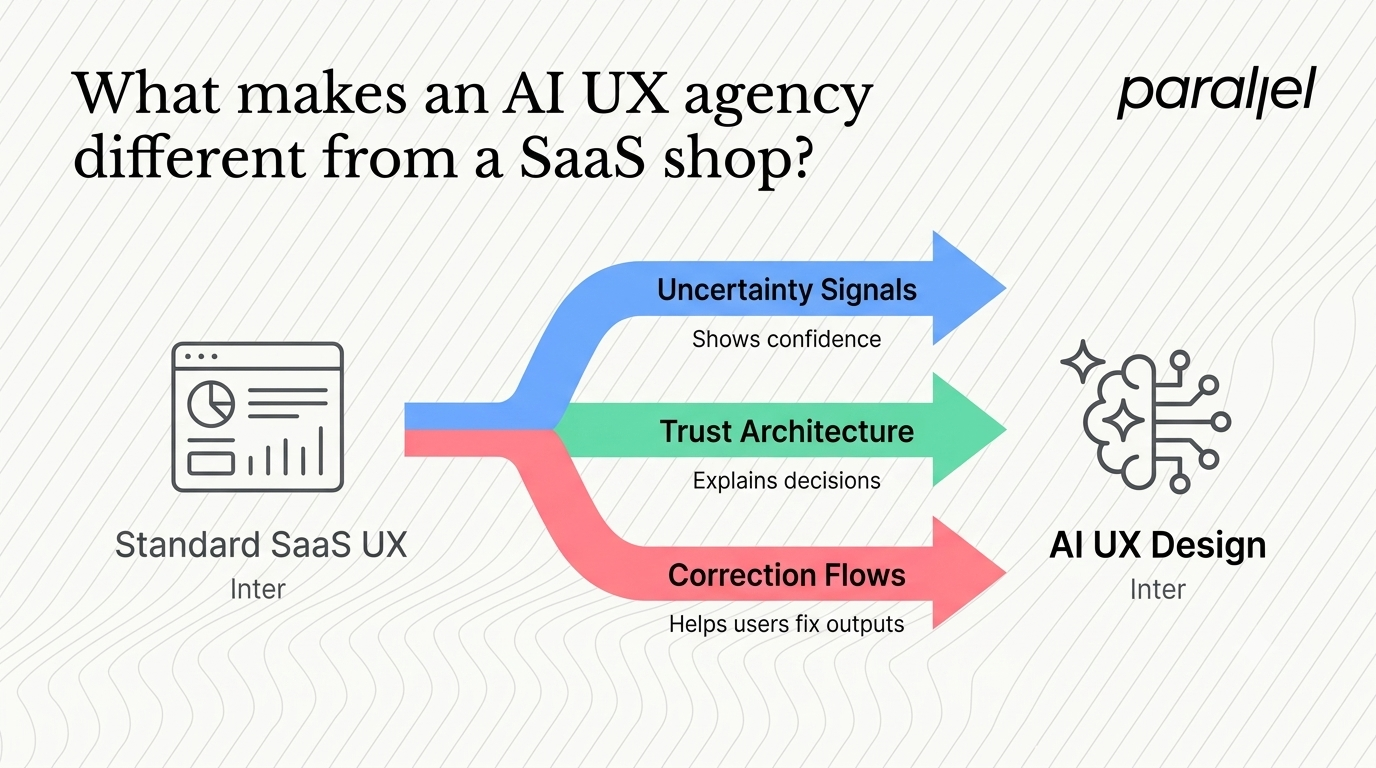
AI products have probabilistic outputs, meaning the quality of what they produce varies. Designing for this requires uncertainty communication, confidence signals, error state architecture, and feedback loop design, disciplines that don't exist in traditional SaaS design.
Think about what that means practically for your product. If a button doesn't work in a SaaS product, the user knows it's broken. If an AI agent produces a wrong output, the user doesn't know whether to blame themselves, the data, or the system. That's a UX problem, not an engineering problem.
When evaluating any agency, ask them three specific questions drawn from real AI UX practice:
- How do you design for uncertainty and low-confidence outputs?
- Can you show a flow where the system explains its reasoning to the user?
- How do you architect correction flows so users can improve AI outputs?
A strong agency should answer these questions with process detail, not generic confidence. The best AI ux design agencies for seed startups will also understand that AI interface design requires designing for probabilistic outputs, uncertain system behavior, and autonomous actions that traditional UX never accounts for. In standard software, a button click produces a predictable result. In AI-powered systems, outputs vary, confidence fluctuates, and errors are statistical rather than binary. The interface must communicate this difference honestly without overwhelming the user.
Most generalist design agencies predictably fail AI startups. They approach AI products as slightly modified dashboards, focusing only on the ideal scenario, where the AI produces the right answer, and treating uncertainty, error states, and low-confidence outputs as afterthoughts.
The distinction between a UI shop and a genuine AI UX partner is this: does their process have a documented method for trust architecture, or did they just add an "AI" section to their website after ChatGPT launched?
What Should a Seed Startup Look For in a UX Design Agency?
Startups need speed, product judgement, lean research, and the discipline to avoid polishing the wrong thing. Every criteria below flows from that reality.
AI product case studies: Not AI-assisted design workflows. Not chatbot UI overlays added to an existing SaaS product. Actual case studies where the core product is an AI system, an agent, a copilot, a prediction engine, or a generative tool, and where the agency designed the full interaction model from input to output to feedback.
Stage fit: If you're pre-seed or seed, pick agencies that move fast and skip the heavy enterprise discovery. An eight-week discovery phase before a single wireframe is an enterprise process misapplied to a startup context.
Engineering handoff quality: Figma-only handoffs to disconnected developers are how products end up feeling disjointed. Ask whether they deliver a design system alongside the UI, or just screens.
Pivot tolerance: Ask how they handle scope changes and pivots. Startups change direction quickly. Your agency should embrace this, not penalise you for it.
Measurable outcomes: Validate designs through user testing, not just intuition. Ask for activation rates, conversion impact, or retention data from prior seed-stage clients, not just screenshots.
Vertical specificity: SaaS, AI, fintech, healthtech, and devtools all have their own design playbooks. Pick an agency that's shipped your type of product, not just your tech stack.
At Parallel HQ, our AI software design services are built around exactly these filters. Our discovery framework is purpose-built for seed-stage velocity, not enterprise-grade process theater.
How to Find the Best AI UX Design Agencies for Seed Startups (Without Getting Burned)
The market is noisy. Most "top 10 UI UX design agency" lists on Google in 2026 fall into two buckets: directories ranking by review count (which tells you nothing about real results), or agencies putting themselves at the top of their own lists. Neither helps founders make smart choices.
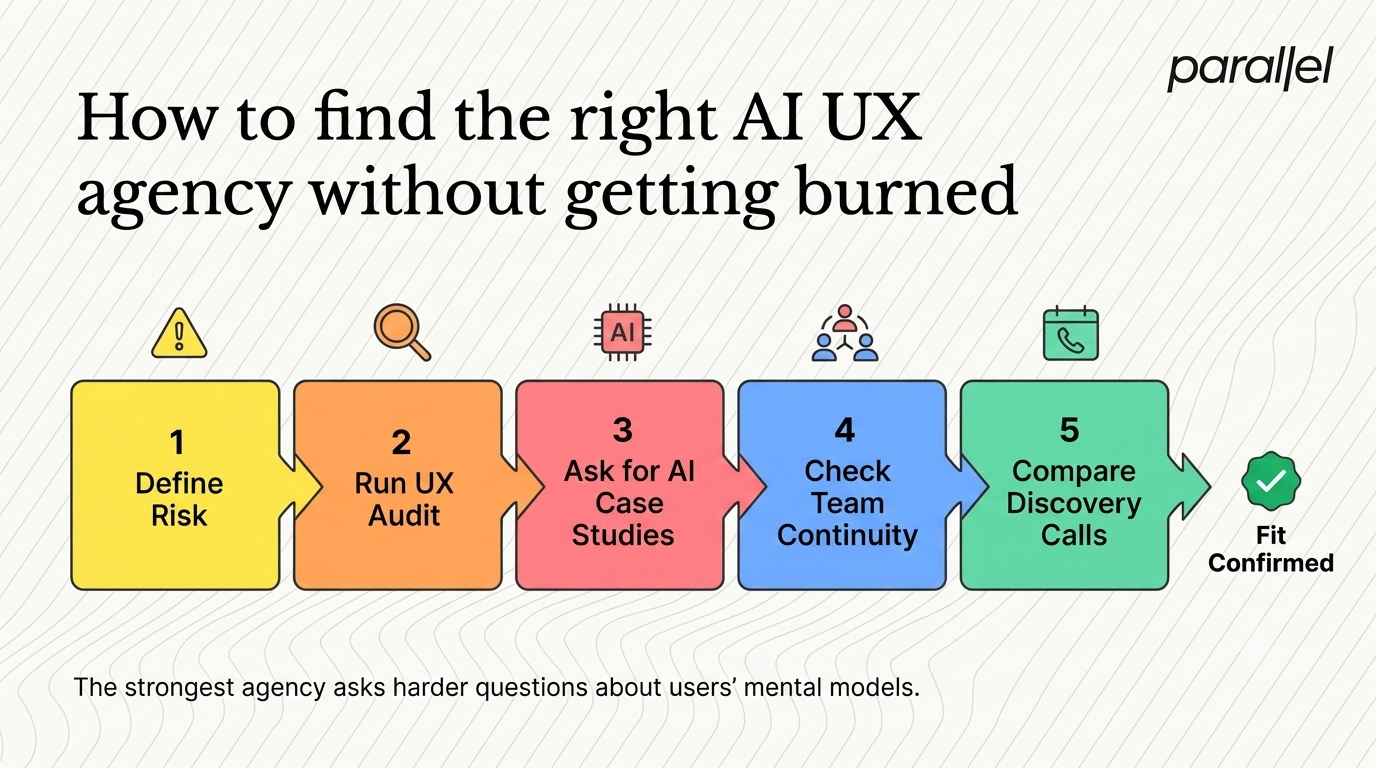
Here is the evaluation process I recommend for any seed-stage founder:
- Define your primary risk first. Are you validating product-market fit, designing for trust in an AI agent, or preparing for a fundraise? The answer changes who you should call.
- Run a UX audit before your first agency call. It makes every conversation sharper and protects you from agencies who will diagnose problems they already planned to sell you solutions for.
- Ask for AI-specific case studies. Request examples involving uncertainty states, error recovery, and human override flows, the exact patterns that separate genuine AI UX expertise from retrofitted SaaS work.
- Check team continuity. Senior team continuity matters. Agencies should have public team pages, named designers, and proof that senior people actually do the work.
- Run three discovery calls in the same week. Pick based on team fit and how they think, not just their slides. The first call tells you more than any proposal.
- Evaluate process detail on uncertainty. When you ask about designing for AI error states, a strong agency answers with a documented method. A weak agency answers with confidence and no specifics.
Seed-stage founders often mistake polish for competence. The agency that asks the harder questions about your users' mental models is more valuable than the one with the most beautiful portfolio deck.
For teams building AI copilots or LLM interfaces, our AI readiness design scorecard surfaces the exact gaps before you start a design engagement.
Agencies vs. Freelancers for Seed Startups: Which Is Right for Your AI Product?
This question comes up constantly. The honest answer depends on your current stage and what you are actually building.
For most seed-stage AI startups, a focused agency sprint delivers more than a single freelancer because you get a system rather than just screens. Strong agencies deliver a production-ready design system alongside the UI, meaning your engineering team can build faster and iterate without returning to design for every new component.
A skilled freelancer works well for an MVP with tightly scoped requirements. Once you have users and need to move at product speed across multiple surfaces, a small agency team consistently outperforms a solo designer operating without a research or systems layer.
Use a freelancer for narrow tasks, an in-house designer for long-term product ownership, and an agency when you need a structured team with research, UX, UI, strategy, and delivery support. For AI products specifically, the agency model carries a structural advantage:
AI products introduce uncertainty, automation, model behaviour, and trust challenges that normal UX processes may not fully address. A good AI UX agency can help users understand what the system is doing, when to trust it, and how to correct it when it is wrong.
A solo freelancer rarely has a pre-built methodology for this. Our usability testing and wireframing and prototyping services are specifically designed to compress this cycle for seed-stage teams.
Budgeting for the Best AI UX Design Agencies for Seed Startups in 2026
Budget clarity protects the runway. Here is what the market actually looks like for seed-stage AI products in 2026. AI product design agency costs range from $15,000 to $150,000 or more depending on scope and agency tier.
As a general rule, 10–20% of your initial development budget should be allocated to design and research to avoid expensive code rewrites later. Research and discovery usually run 2–4 weeks. Design sprints take 6–12 weeks. Full product redesigns with engineering integration extend to 3–5 months. The important nuance for AI products: budget for iteration.
Early-stage products rarely fail because the idea is weak. They fail because users can't figure out how to get value fast enough. At the MVP stage, every interaction either confirms your hypothesis or exposes friction you didn't anticipate.
A phased approach works best at seed: begin with a design sprint to validate the core AI interaction model, then move to full product design once the primary user flow holds up under real early adopter feedback. This compresses cost while protecting you from building the wrong thing at full fidelity.
For SaaS founders specifically, our SaaS onboarding teardown is a fast, low-cost way to identify where your AI product is leaking activation before committing to a larger engagement.
Conclusion
Here is what this guide distills to:
- The best ai ux design agencies for seed startups are not the most famous. They are the most specifically fit for AI interaction challenges at your stage.
- Evaluate agencies on AI case study depth, not portfolio aesthetics, look for uncertainty design, trust architecture, and correction flows.
- Budget $15K–$50K for a seed-appropriate engagement, with a phased approach that starts at sprint velocity.
- Freelancers work for narrow MVP scopes; agencies outperform once you need a system, not just screens.
- Parallel HQ is purpose-built for exactly this context: early-stage AI and SaaS startups building experiences that have to earn user trust from first interaction.
Frequently Asked Questions
Q1: What are the best AI UX design agencies for seed startups in 2026?
The strongest fits for seed-stage AI startups in 2026 are agencies with documented AI interaction design methodology, covering uncertainty states, trust architecture, and correction flows. Parallel HQ, Goji Labs, and 925Studios are consistently cited for seed-to-Series-B AI products at accessible price points. Prioritize case studies over Clutch ratings.
Q2: How much should a seed startup budget for a UX design agency?
AI product design agency costs range from $15,000 to $150,000+ depending on scope and tier. Startup-accessible agencies typically start at $15,000–$40,000 for a focused engagement. A phased sprint-first approach protects the runway while validating your core AI interaction model before full build.
Q3: What is the difference between AI UX design and regular SaaS UX design?
AI products require designing for probabilistic, variable outputs rather than deterministic button-click behaviors. The core additional disciplines are uncertainty communication, confidence signaling, error-state architecture, and feedback loop design, none of which appear in standard SaaS UX methodology.
Q4: When should a seed-stage AI startup hire a UX agency vs. a freelancer?
Hire a freelancer for a narrowly scoped MVP with stable requirements. Hire an agency when you need a structured team covering research, user research, UI, interaction design, and systems, especially if your AI product has multiple surfaces or requires trust-first onboarding design.
Q5: How do I evaluate whether an agency genuinely understands AI product UX?
Ask three specific questions: How do you design for uncertain or low-confidence AI outputs? Can you show a case study with error recovery and human override flows? What methodology do you use for usability testing on AI-generated content? A strong agency answers with process detail, not generic confidence.
Q6: Is a design sprint a good starting point for seed-stage AI startups?
Yes, a design sprint is the most capital-efficient way to validate your AI product's core interaction model before committing to full-fidelity design. A dedicated MVP design sprint usually takes 4–8 weeks, based on complexity. It surfaces friction in your AI flows early, when fixes cost hours rather than months of engineering time.

check out these related blogs