When a founder or PM asks "how much does a product design agency cost?" The honest answer is: it depends on four things you can actually control. This guide on product design pricing: agency cost benchmarks cuts through the noise and gives you the numbers, models, and signals you need to budget without surprises. Whether you're scoping an MVP, a full product redesign, or a one-week Design Sprint, every major variable is covered here.
TL;DR
- Product design agency costs typically range from $5,000 to $300,000, depending on complexity, scope, and depth of execution.
- Agencies charge via hourly rates ($75–$500/hr), flat project fees ($5,000–$150,000+), or monthly retainers ($3,000–$15,000+/month).
- US agencies command the highest rates; boutique startup-focused studios offer comparable quality at lower overhead.
- Scope clarity, not team size, is the single biggest lever on your final invoice.
How Much Do Product Design Agencies Charge in 2026?
The most-searched question in this space deserves a direct answer. Product design agency costs typically range from $5,000 to $300,000, depending on complexity, scope, and depth of execution. That wide band isn't a dodge, it reflects genuinely different types of work.
For basic app designs, businesses can expect to spend $5,000 to $30,000, while complex digital products that include custom UI/UX, animations, and design for both iOS and Android platforms may reach $50,000 to $150,000.
For project-level benchmarks by phase, here's what the data shows:
Research, wireframes, prototypes, visual design, and user testing each carry their own cost, with typical ranges running from $1,500 to $10,000 and visual design often priced at $1,000 per screen. The tier you land in is determined almost entirely by product complexity and research depth, not by how many slides are in a deck.
Costs rise because nothing exists yet when you're building something new. The agency must define the problem, explore solutions, test assumptions, and build everything from the ground up. More uncertainty equals more design time. More design time equals higher cost.
At ParallelHQ, we work exclusively with early-stage AI and SaaS startups, which means we know exactly which phases are non-negotiable for your stage, and which ones you can rightsize later. Our product design services are scoped around outcome milestones, not hour counts.
Product Design Agency Pricing Models Explained
Agencies usually charge in three ways: fixed project fee, hourly billing, or value-based pricing. Each fits a different stage of product maturity.
- Fixed Price (Statement of Work): The agency defines the scope, deliverables, and timeline before the project begins, and provides one total fee covering the entire engagement. This structure works best when the product requirements are clearly defined. Typical cost: $5,000–$50,000 for basic to mid-complexity projects.
- Time and Materials (Hourly): Hourly pricing is common for ongoing UX optimization, product enhancements, and complex discovery phases. US agencies charge $100–$250/hour, with Eastern Europe agencies charging $40–$80/hour, offering a strong mix of quality and affordability.
- Retainer Model: For companies that need design on a rolling basis, agencies often recommend retainers ranging from $5k to $50k+ per month depending on team size, scope, and workload. Enterprises rely on this model for consistent support for ongoing campaigns, product updates, and creative needs. For early-stage startups, startups typically budget $699–$2,000/month using subscription services, while SMBs with more complex needs budget $3,000–$15,000/month for agency retainers.
- Value-Based Pricing: Value-based pricing is structured around business outcomes rather than time or deliverables. The agency evaluates the product's strategic importance and prices based on potential ROI. This model is used for high-impact projects, such as enterprise platforms expected to generate significant revenue, and the fee reflects the expected contribution to growth, user acquisition, or market positioning.
The right model is a function of your team's ability to define scope. If you're still in discovery, a time-and-materials or retainer protects you from a fixed-fee scope dispute later.
What Factors Drive Product Design Agency Pricing Up or Down?
Six main factors drive design agency pricing up or down: project scope and complexity, custom design versus templates, team seniority and location, timeline pressure, integrations required, and revision rounds.
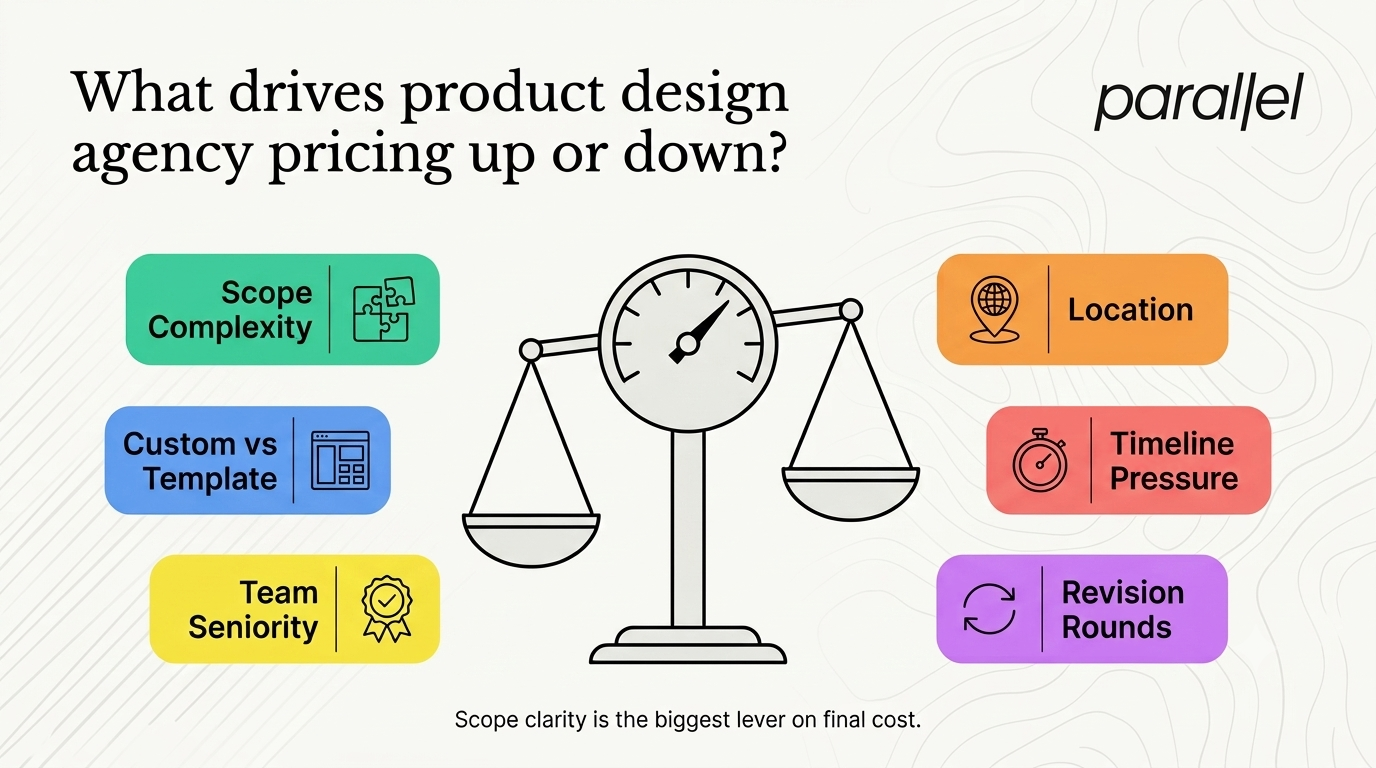
Breaking these down:
- Complexity: The more complex your project, the higher the cost. A simple app wouldn't cost as much as a sophisticated medical app, complexity requires more research, more expertise, and more iterations.
- Seniority: A junior designer might charge $50–$100 per hour, while a top-tier design expert could demand $250–$500 per hour.
- Location: US agencies charge $100–$250/hour and are known for high expertise, advanced processes, and strong portfolios, but at a premium price.
South Asian agencies charge $25–$50/hour, making them the most cost-effective option, though quality varies depending on the agency's experience and track record.
- Agency size: Bigger agencies with 50+ staff generally charge more due to higher overhead costs, larger teams, and structured processes. Boutique studios are usually more flexible and budget-friendly, for many startups, a smaller agency can deliver the same quality at a lower price.
- Revision rounds and scope drift: The complexity of the product will be the main driver of cost. A project that needs a large team and cutting-edge resources will cost more than one that requires a simple approach.
One variable most founders underestimate: Design Debt. Systems built without a proper Design System or Agile UX process accumulate hidden rework costs. Frameworks like the Double Diamond Framework and JTBD Framework, used properly up front, reduce total engagement cost even when they increase initial scoping time.
Hourly Rate vs. Fixed Price: Which Model Is Right for Your Startup?
The hourly vs. fixed-price debate comes down to one question: how well-defined is your product scope?
Hourly pricing is flexible and useful when the scope is uncertain, it can work well for ongoing UX support, design systems, product discovery, or embedded design work. The risk is weak budget control, so ask for weekly reporting, burn-rate visibility, and decision checkpoints.
Fixed pricing works well when the scope is clear and is common for audits, landing pages, redesigns, and defined research sprints. The risk is that unclear assumptions become change requests, so ask what is included, what is excluded, and how revisions are handled.
For most early-stage SaaS founders I work with at ParallelHQ, the best structure is a phased approach: a fixed-fee discovery framework engagement first, followed by a time-capped retainer for iteration. This gives you budget certainty where it matters most and flexibility where the product is still learning.
A vague proposal with premium language and no specifics is usually overpriced. A fair proposal explains exactly where each dollar is going, Manypixels, 2026.
Typical Cost Benchmarks for Specific Product Design Services
This is the section most guides skip. Aggregate ranges don't help you budget a specific sprint or UX audit. Here are service-level benchmarks drawn from current market data.
Based on reviews on Clutch, the average cost for a UX agency project is $84,973.08, the typical timeline for a UX project is 10 months, and the average monthly cost of UX projects is $8,895.10.
For SaaS design services specifically, projects trending toward the higher end of the MVP range typically include multi-role flows, onboarding sequences, and dashboard complexity, all of which compound research and iteration time. For AI UX design, expect additional cost for non-deterministic UI states and novel interaction patterns.
How Much Does a Design Sprint Cost, and Is It Worth It?
The Design Sprint, originally codified at Google Ventures using the Double Diamond Framework, is the highest-leverage short engagement in product design.
Design Sprints help answer important business questions and solve big challenges through design, prototyping, and testing ideas directly with users, with benefits including team alignment, reduced risk, and the ability to compress months of work into a single week.
On cost: typical fixed-fee sprint prices in 2026 run $8,000–$25,000 for a single-focus sprint with a senior practitioner. Larger specialist sprint firms charge $25,000–$30,000 for a complete 5-day Design Sprint, which includes preparation, prototype, user tests and videos, intellectual property, and signing the NDA.
What moves the price:
- Number of senior designers and researchers assigned
- Whether user recruitment is included (adds $2,000–$5,000)
- Remote vs. on-site facilitation
- Prototype fidelity (clickable Figma vs. InVision-level interactive)
- Post-sprint synthesis and roadmap output
For time-and-materials sprint engagements in 2026, typical rates for senior technical talent run $150–$350/hour for US-based work and $75–$175/hour for high-quality EU or nearshore work.
At ParallelHQ, our Design Sprint is scoped specifically for AI and SaaS startups, five focused days that move you from problem to tested prototype. The sprint is structured so that stakeholder alignment, Figma prototyping, and user validation happen in sequence without redundant handoffs. For founders pre-Series A, this is usually where product design pricing: agency cost benchmarks start to make real, tangible sense.
How to Compare Product Design Agency Costs Without Getting Burned
The number on a proposal is almost never the whole picture. Hidden fees are a major red flag, extra charges that appear mid-project can quickly blow your budget, and these often happen when agencies don't clearly list what's included in a package.
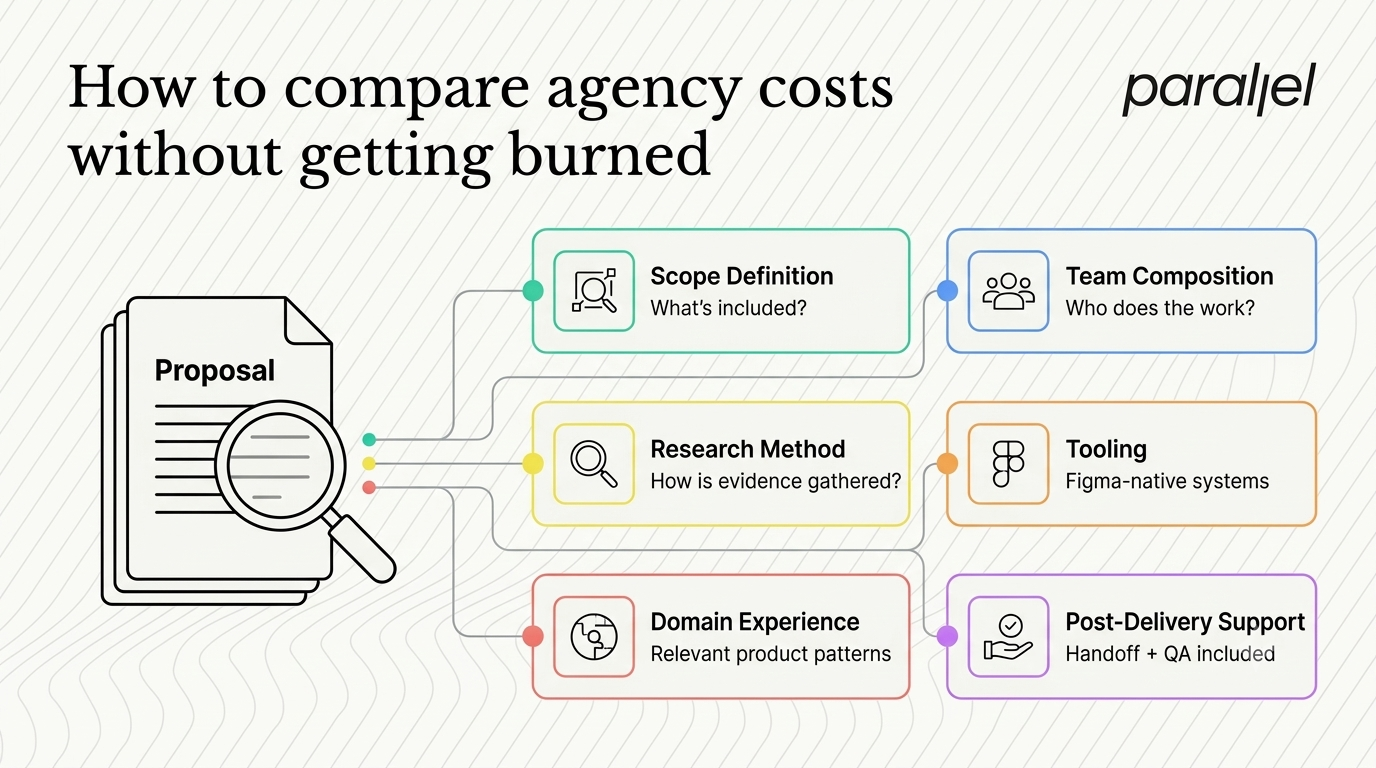
Here's what to evaluate beyond the headline price:
- Scope definition: Does the Statement of Work (SoW) list specific deliverables, file formats, and revision rounds? Vague deliverables create disputes.
- Team composition: Who actually does the work? Senior partner or junior execution? Ask for named team members.
- Research methodology: Does the agency reference Nielsen Norman Group standards, the UX Maturity Model, or cite Forrester Research and Gartner Magic Quadrant benchmarks in their process? Methodology signals rigor.
- Tooling: Figma-native agencies with structured component libraries are faster and generate less design debt than those working across fragmented tools.
- Domain experience: An agency that has shipped fintech design services or healthtech design services carries implicit regulatory and UX pattern knowledge that reduces your research budget.
- Post-delivery support: Are handoff, developer specs, and one round of QA included? Or are those billed separately?
The key distinction is that you're buying deliverables, not hours. Focusing on hours can lead to inefficiency, while focusing solely on deliverables can compromise quality. The better question to ask a potential agency is: "What decision will this engagement help us make, and what evidence will I have at the end?"
Firms like IDEO, Frog Design, and McKinsey Design sit at the premium tier and price accordingly. Boutique startup-focused studios, including ParallelHQ alternatives, typically offer the same strategic rigor at materially lower overhead because they don't carry the account management layers of a 500-person firm.
Conclusion
Product design pricing: agency cost benchmarks exist on a spectrum that rewards clarity. The key takeaways:
- Product design agency costs typically range from $5,000 to $300,000, scope, complexity, and research depth move the number far more than brand name.
- Fixed fees give budget certainty; retainers give iteration flexibility. Early-stage startups usually need both in sequence.
- Hourly rates for US agencies run $100–$250/hour; a full-featured MVP typically lands between $30,000–$80,000.
- The cheapest proposal rarely delivers the lowest total cost, Design Debt and rework compound quickly.
If you're an AI or SaaS founder ready to align budget to outcomes, ParallelHQ's product design services are built for exactly this stage.
Frequently Asked Questions
Q1: What is the average cost of hiring a product design agency?
Based on Clutch reviews, the average cost for a UX agency project is $84,973.08. However, early-stage startups should expect to budget $15,000–$60,000 for a well-scoped MVP engagement with a specialist boutique studio.
Q2: How do agencies price UX and product design projects?
Agencies charge in three ways: fixed project fee, hourly billing, or value-based pricing. Retainers are common for ongoing work. The right model depends on how clearly your product scope is defined at the start of the engagement.
Q3: What should I budget for a product design agency as a SaaS startup?
For a pre-launch SaaS product, budget $15,000–$50,000 for MVP design including discovery, wireframing, and high-fidelity UI. Many agencies offer flexible pricing models for startups, with basic product designs starting from $5,000 to $15,000 to launch an MVP with professional design.
Q4: How much does a Design Sprint cost with an agency?
Typical fixed-fee sprint prices in 2026 run $8,000–$25,000 for a single-focus sprint with a senior practitioner. Full-service firms with user recruitment and video testing included can charge up to $30,000 for a five-day sprint.
Q5: Is hourly or fixed-price better for a startup engaging a design agency?
It depends on scope clarity. Fixed price is safer when requirements are locked. Hourly pricing is flexible and useful when the scope is uncertain, it works well for ongoing UX support, design systems, product discovery, or embedded design work. Most startups benefit from a fixed discovery phase followed by an hourly or retainer-based build phase.
Q6: What factors most affect product design agency pricing?
Six main factors drive pricing: project scope and complexity, custom design versus templates, team seniority and location, timeline pressure, integrations required, and revision rounds. Of these, scope clarity and team seniority are the two variables you can most directly control in negotiations.

check out these related blogs