Every investor sitting across from you has heard a hundred great ideas this quarter. What stops them from funding yours is doubt, and doubt is a design problem. Understanding how a vision prototype helps you raise your next round is the fastest way to eliminate that doubt before it kills the deal. At ParallelHQ, we work with early-stage AI and SaaS founders who need to compress credibility into a 30-minute meeting. The vision prototype is the most precise tool we know for doing exactly that.
TL;DR
- A vision prototype is a high-fidelity, clickable mockup that communicates your product vision without requiring working code.
- It closes the gap between your investor pitch deck and a real product, reducing perceived risk at the seed and Series A stage.
- It costs a fraction of an MVP, ships in weeks, and consistently moves investor conversations from "interesting" to "what are your terms?"
- Build the story first, then design the flows, then make it clickable.
What Is a Vision Prototype for Fundraising?
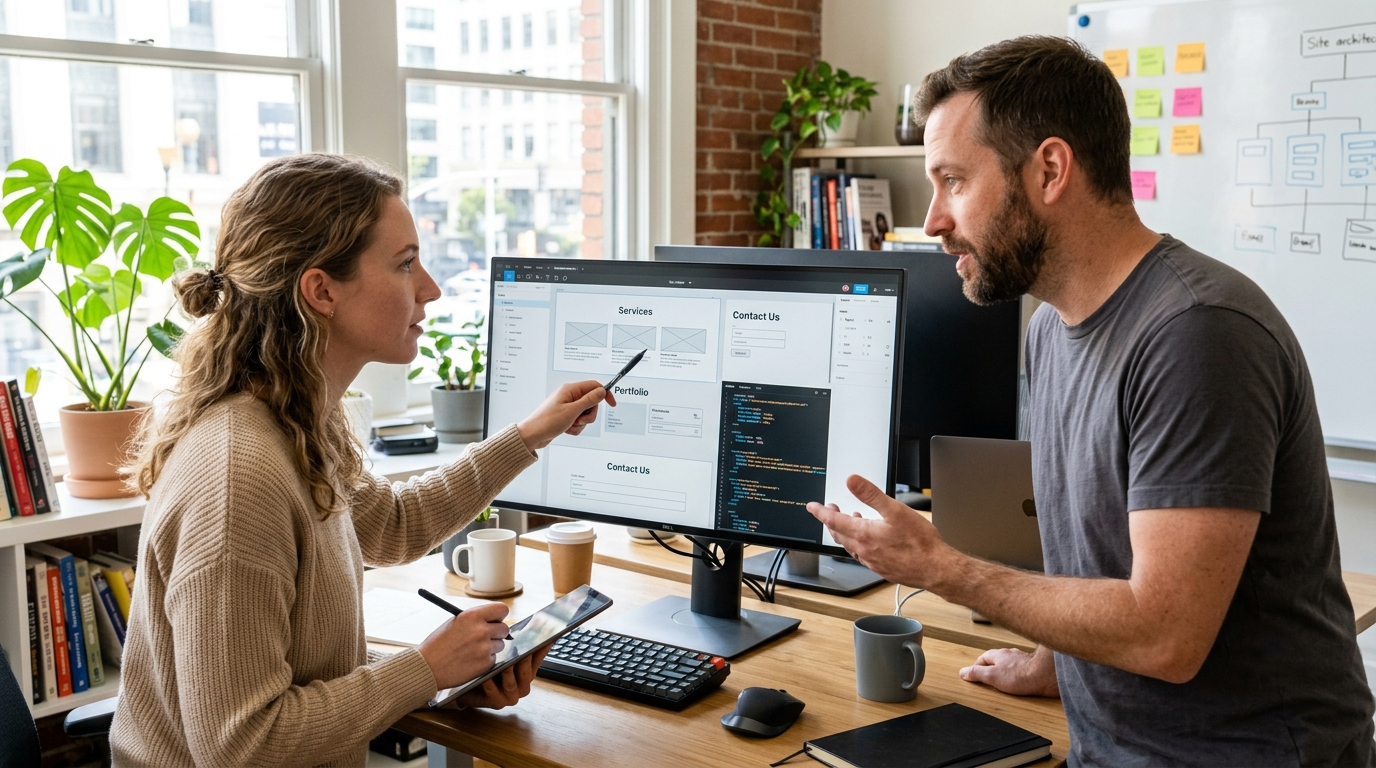
A vision prototype is a high-fidelity, interactive prototype built in Figma or a comparable tool that shows investors exactly how your product will work, feel, and behave, without a single line of production code behind it. It is not a wireframe. It is not a rough sketch. It is a clickable mockup polished enough to walk an investor through a complete user journey from onboarding to core value delivery.
This distinction matters. A prototype is a visual representation of a product used for testing design concepts, while an MVP is a functional product with essential features launched to validate market demand. A vision prototype lives at the high end of that first category: designed with the fidelity of a shipped product but built at the speed and cost of a design sprint.
For fundraising specifically, the vision prototype serves one primary function: it makes your product vision tangible and transferable. Investors cannot fund a concept they cannot picture. The moment you put a clickable interface in front of them, the conversation shifts from "is this real?" to "how big can this get?" That is the shift you need to close a round.
Investors want proof that your idea can grow into a real, scalable product, and that proof starts with an interactive prototype. In 2025, showing real progress gives founders a serious edge by reducing uncertainty and building investor confidence.
At the pre-seed and seed stage, this is especially powerful because the bar is set on vision and founder credibility, not revenue. Pre-seed decks emphasize vision, founder-market fit, and early product demos over revenue metrics. Most successful startups at this stage don't have meaningful traction yet, and investors know that.
A well-constructed vision prototype also functions as a forcing function internally. Building it requires your team to commit to a user journey, a visual language, and a core value proposition before engineering touches anything. That clarity alone prevents the scope creep that kills most early builds. Our wireframing and prototyping service at ParallelHQ starts exactly here, turning an ambiguous product idea into a decisive, navigable experience.
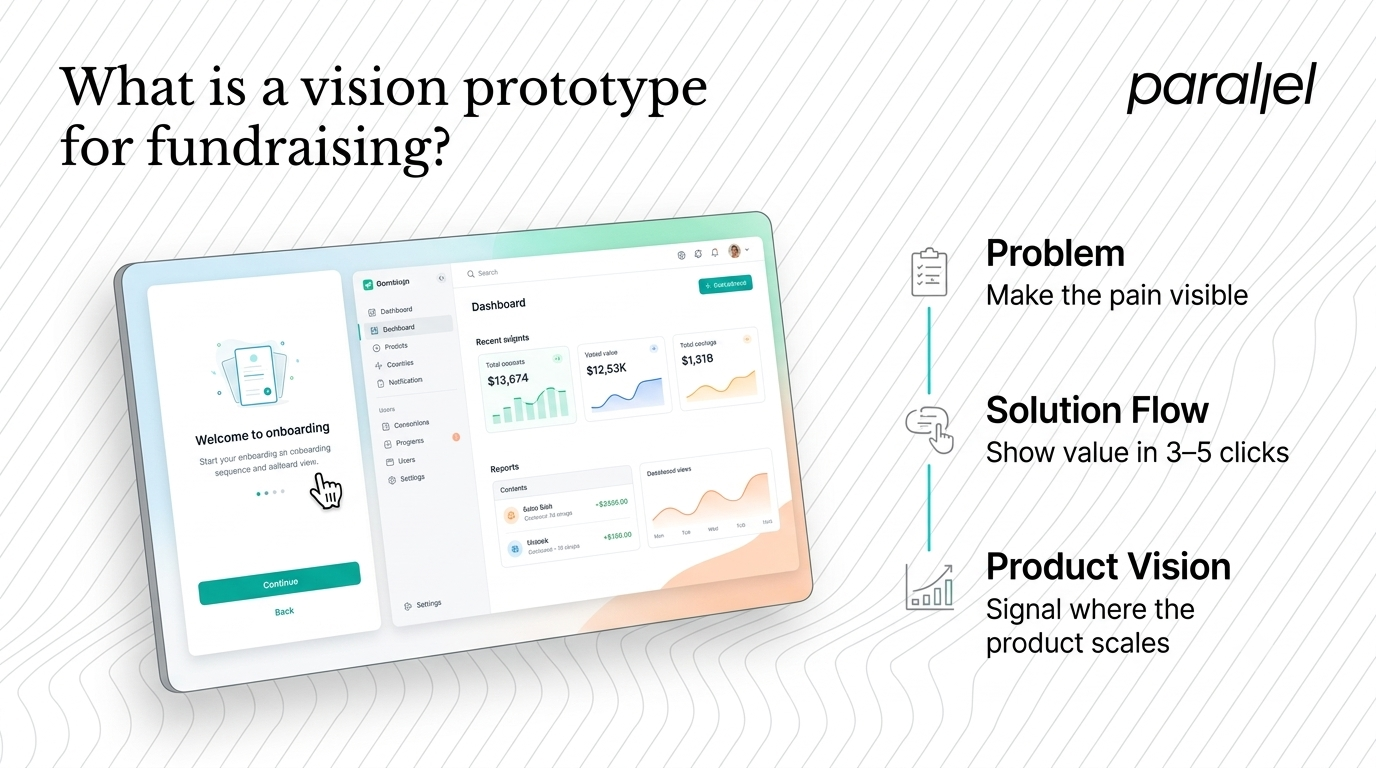
The three elements every vision prototype must communicate:
- The problem: The first screen should make an investor feel the pain your user feels.
- The solution flow: Walk through the key user journey in three to five clicks.
- The product vision: The final state should signal where this product is going at scale, not just where it starts.
How Does a Vision Prototype Help You Raise Funding?
The mechanism is psychological before it is logical. From the perspective of an investor, a demo is a proof of concept, a risk mitigator, and a confidence builder. When an investor can click through your product, their brain stops asking "can they build this?" and starts asking "how do I get a piece of this?" That cognitive shift is how rounds get done.
There are four concrete ways a vision prototype moves the fundraising needle:
- It reduces abstraction risk. A pitch deck describes. A prototype demonstrates. Investors who interact with your flows build their own internal conviction rather than waiting for you to convince them.
- It signals execution capability. Demo-first compresses the "show don't tell" requirement. A working prototype, even if it is not the product yet, proves technical capability more than any architecture diagram.
- It accelerates due diligence. Design decisions in a prototype reveal product thinking. Investors and their teams can assess your UX research assumptions, your user journey mapping logic, and your grasp of the problem space without scheduling additional calls.
- It creates stakeholder alignment. With prototyping, people of interest such as investors and owners are more involved in the development process and more committed to the project.
Early-stage investors often focus on reducing risks, and having a prototype lowers both technical and market risks. Venture capitalists and angel investors have reported that they prefer companies with at least a working prototype because it signals the startup is closer to commercialization.
The fundraising climate in 2026 makes this even more urgent. The Series A market in 2025 showed an 18% decline in deal volume year-over-year, with total capital invested down 23%. The median valuation sits at $47.9 million, and the average time between seed and Series A has stretched to around 616 days.
In a market where investors are more selective and timelines are longer, a vision prototype is not a nice-to-have, it is a competitive differentiator.
Vision Prototype vs. MVP for an Investor Pitch
Founders consistently conflate these two, and the confusion is expensive. Here is the clean distinction:
Choose a prototype when you need to visualize your idea, refine UI/UX, secure early-stage funding, or gather feedback before development begins.
Conversely, if you are raising substantial funding, investors expect traction including users, engagement metrics, and even early revenue. An MVP gives you real-world data to back up your story. It shows your product has market demand and potential for growth by being a fully functional version with minimal features.
The practical implication: use a vision prototype to get to a seed round; use an MVP to bridge from seed to Series A. Trying to build an MVP before you have seed capital is a common and costly mistake.
Founders who skip the right validation step end up building the wrong features. This delays their launch, delays revenue, and delays fundraising. A vision prototype gets you into the room. An MVP earns you the next room. Use each tool at the right stage. Our MVP development service is designed for exactly this handoff, taking a validated vision prototype and turning it into a shippable product with no wasted architecture.
How to Create a Vision Prototype That Attracts Investors
This is a process, not a single artifact. Follow it in sequence.
- Run a problem framing session. Before opening Figma, spend one to two days defining the exact user pain you are solving. Use our user research process to validate that the pain is real and felt acutely enough to drive behavior change.
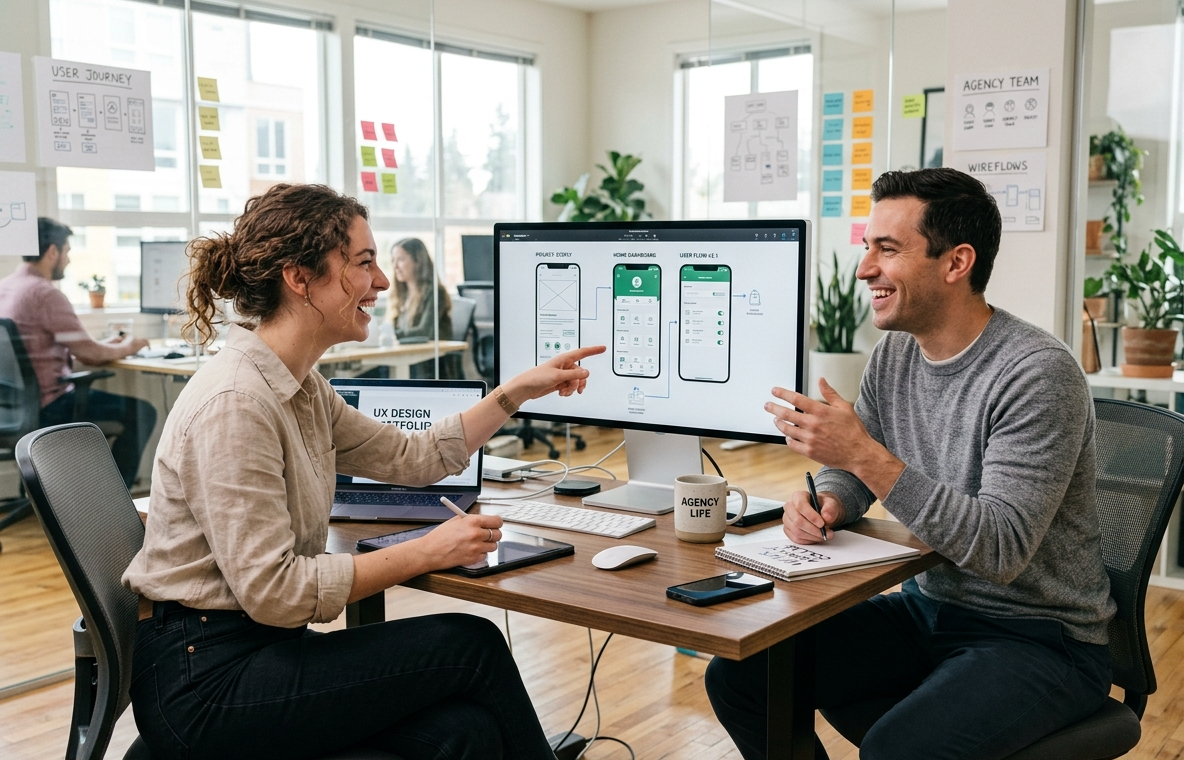
- Map the core user journey. Identify the single most important flow: the path from zero context to the first moment of value. This becomes the spine of the prototype. Keep it to five to seven screens.
- Set the visual direction. Choose a design system, color palette, and typography early. Pay attention to your company's branding. Elements such as your company logo, colors, fonts, and icons set the overall mood for your presentation. Our Figma design services typically establish this in a single focused session.
- Build high-fidelity screens. Design as if this is the shipped product. No placeholders, no grey boxes. Every screen should be presentation-ready.
- Add interactions and transitions. Make the prototype clickable with realistic transitions. The investor should feel they are using a real product, not watching a slideshow.
- Conduct a rapid usability test. Show the prototype to three to five people who match your target user. Fix the flows that break. Document the reactions that excite.
- Embed it in your pitch narrative. The prototype is not a separate section of your pitch. It is the moment your story becomes undeniable. Time the reveal for when you have established the problem.
A design sprint can compress steps one through five into five days, which is often exactly what a founder needs when a partner meeting is two weeks out.
What Investors Want to See in a Vision Prototype
Here is what investors typically look for when reviewing a prototype: proof of usability, meaning is the product intuitive and can users move through the core workflows without friction, and a prototype lets investors experience the journey firsthand.
Beyond usability, experienced investors read vision prototypes for five signals:
- Clarity of problem understanding: Does the first screen immediately communicate the pain and who feels it? Vague problem framing signals weak product thinking.
- Elegance of solution logic: Is the path from problem to resolution obvious? Convoluted flows suggest the founder has not talked to enough users.
- Visual credibility: Polish signals care. A prototype that looks amateur makes investors wonder about the team's standards for the actual product.
- Market fit signals: Does your product actually solve a pain point? Early user feedback on the prototype reveals whether your solution resonates.
- Scalability of design thinking: Even at the prototype stage, investors want confidence that your design and architecture can grow with demand. A clickable demo shows you have considered the details, not just the what but also the how.
At the Series A stage, the bar rises. Investors are no longer asking "does this work?" They are asking "does this scale?" Your prototype at that stage needs to show not just the MVP flow but the product roadmap brought to life: premium features, enterprise workflows, and integrations that signal a multi-year product vision.
Does Showing a Vision Prototype Increase Funding Success?
The evidence points clearly in one direction. A study by Stanford University on startup fundraising found that startups with prototypes are more likely to secure seed funding than those without. The mechanism is straightforward: a prototype reduces the imagination gap. The harder investors have to work to picture your product, the more risk they assign to it.
Before it became the design giant we know today, Figma started with prototypes that showcased real-time collaboration in the browser. Those interactive demos turned investor skepticism into conviction by proving the idea could actually work.
Awesomic launched with a lean prototype that connected businesses to designers. That simple demo proved demand, helping them secure a six-figure pre-seed round and later seed funding. The prototype did not just show functionality; it showed traction and market fit.
A client called RiskApp used a clickable front-end prototype to visualize and demonstrate their value proposition to investors. That prototype did not support users, but it helped them secure the funding needed to build the full MVP.
The pattern is consistent: vision prototypes work because they transfer conviction. Across all rounds, from Pre-Seed to Series E, a few principles remain constant. Founders who raise successfully build relationships early, understand their metrics intimately, and combine data with a compelling narrative that makes their market opportunity feel inevitable. The vision prototype is the tool that makes the narrative feel inevitable. Investors fund futures they can see. A vision prototype makes your future visible.
How to Use a Vision Prototype in a Series A Pitch
Series A is a different game than seed. Most successful Series A raises in 2025 need at least $2 million in Annual Recurring Revenue (ARR). You have traction data to present. So why does a vision prototype still matter? Because Series A investors are funding the next 18 to 24 months of product development, not just the product that exists today.
Your vision prototype at Series A should show the product two years from now, the enterprise tier, the platform play, the integrations that make you defensible. This is startup storytelling at its most precise: you are not lying about what exists, you are showing investors exactly where their capital will take the product.
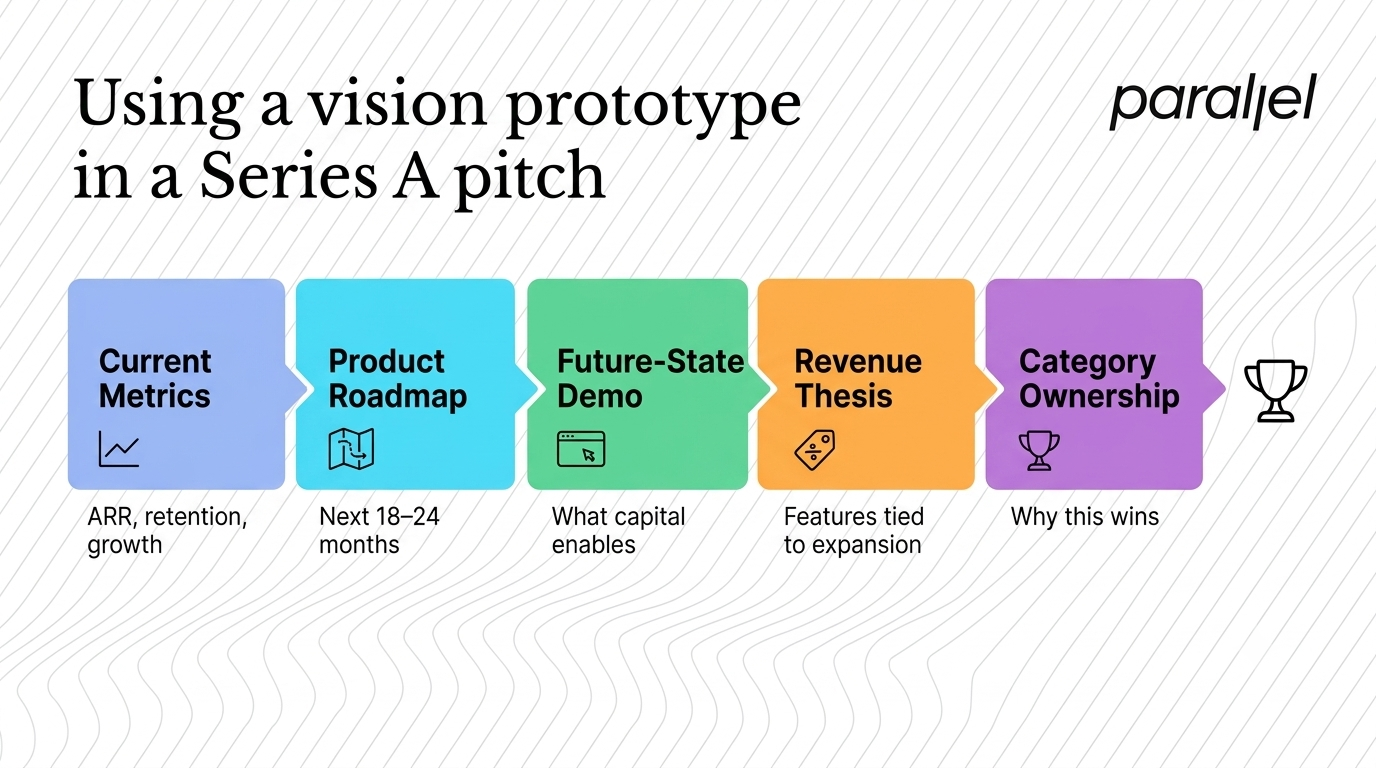
Here is how to integrate a vision prototype into a Series A pitch:
- Lead with current product metrics. Show ARR, retention, and growth rate first. Establish that the business works.
- Introducing the product roadmap. Describe the next phase of development verbally, referencing your product vision document.
- Demo the vision prototype. Walk investors through the future product state. Frame it explicitly: "This is where we are building to. This is what your capital enables."
- Connect prototype features to revenue thesis. Each feature in the prototype should map to a pricing tier, an expansion motion, or a defensibility moat.
- Use the prototype to close. End the demo with the question: "Does this look like the product that owns this category?" A well-built prototype makes that question rhetorical.
Our product strategy consulting work with Series A founders consistently shows that this sequencing, traction first, vision second, converts at a higher rate than leading with the prototype alone. The data earns trust. The prototype earns the excitement.
In Q3 2025, global VC investment rose to $120 billion, up from $112 billion in Q2 , signaling that capital is available for founders who show up prepared. The vision prototype is how you demonstrate that preparation.
How Early-Stage Founders Use Vision Prototypes to Close Rounds
The founders who close rounds quickly share a common discipline: they de-risk the investor's imagination before the first meeting, not during it. The vision prototype is the primary tool for doing that.
The practical playbook most successful early-stage founders follow:
- Send the prototype before the meeting. Share a view-only Figma link in the intro email. Investors who arrive having already clicked through your product ask better questions and move faster.
- Use it to qualify investors. If an investor watches a three-minute walkthrough of your prototype and comes back with questions about your market, they are the right partner. If they come back with "can I see traction?", they are a Series A investor, not a seed investor.
- Iterate it based on investor feedback. Every "no" from an investor should trigger a review of your prototype. If they consistently miss your core value proposition, the design has not communicated it clearly enough. This is where our UX audit process is useful: treating the prototype like a product and testing it rigorously.
- Use it for stakeholder alignment internally. Instead of debating layouts or second-guessing UX decisions mid-build, teams work from real data collected during testing. The result is fewer hiccups, faster iterations, and a product that reaches users and investors sooner.
- Match fidelity to stage. Pre-seed prototypes can be leaner. Seed prototypes should be polished. A prototype shown to a top-tier VC at seed should look like it was built by the same team that will ship the product.
If you have early product-market fit signals including $50K to $200K ARR, strong week-one retention, or a credible enterprise pilot, you can raise a $3 to $4M seed at a $15M post-money without much trouble. If you have a prototype and a vision, you are competing in a much harder pool , which is exactly why the quality of that prototype and the clarity of that vision cannot be left to chance.
Our SaaS design services and AI software design work are built around this reality: founders who invest in exceptional design at the prototype stage compress their fundraising timeline and enter investor conversations from a position of strength.
Conclusion
Understanding how a vision prototype helps you raise your next round comes down to one principle: investors fund what they can see, feel, and believe in. The vision prototype is how a vision prototype helps you raise your next round by collapsing the gap between your idea and their conviction.
Key takeaways:
- Build a vision prototype before your seed pitch, not after; it shapes both the product and the fundraising narrative.
- At Series A, use the prototype to sell the future product roadmap, not just the current product.
- Match your prototype fidelity to the investor tier you are targeting.
- Treat every investor "no" as a design brief; iterate the prototype, not just the deck.
- The best vision prototypes make the investment decision feel inevitable.
Frequently Asked Questions
1) How long does it take to build a vision prototype for fundraising?
A focused team can deliver a high-fidelity, investor-ready vision prototype in two to four weeks using a tool like Figma. A structured design sprint can compress the core flows into five days. Complexity, screen count, and revision cycles are the primary variables.
2) Do I need a vision prototype if I already have a working product?
Not always, but often yes. If your current product does not reflect your two-year product vision, a vision prototype showing that roadmap is still valuable for Series A conversations. Investors are buying the future, and your current product rarely tells that story completely.
3) What is the difference between a vision prototype and a clickable mockup?
They are largely the same artifact. A clickable mockup becomes a vision prototype when it is specifically designed to communicate a product's future state and strategic direction, rather than just test a UI flow. The intent and fidelity distinguish them in practice.
4) Can a vision prototype replace a pitch deck?
No. They serve different functions. The investor pitch deck establishes the market, the problem, the business model, and the team. The vision prototype makes the product real. The strongest fundraising packages use both together, with the prototype as the emotional centerpiece of the pitch.
5) How much should I spend on a vision prototype before my seed round?
The right frame is not cost but ROI. A polished prototype that compresses a six-month fundraising process into six weeks is worth multiples of what it costs to build. At ParallelHQ, we structure these as fixed-scope engagements so founders know the output before they commit the budget.
6) How does a vision prototype signal product-market fit to investors?
A prototype answers whether your product actually solves a pain point. Early user feedback on the prototype reveals whether your solution resonates , and sharing that feedback data alongside the prototype turns a design artifact into a product-market fit signal. Documented user reactions from even five test sessions materially strengthen your narrative.

check out these related blogs





















































.avif)