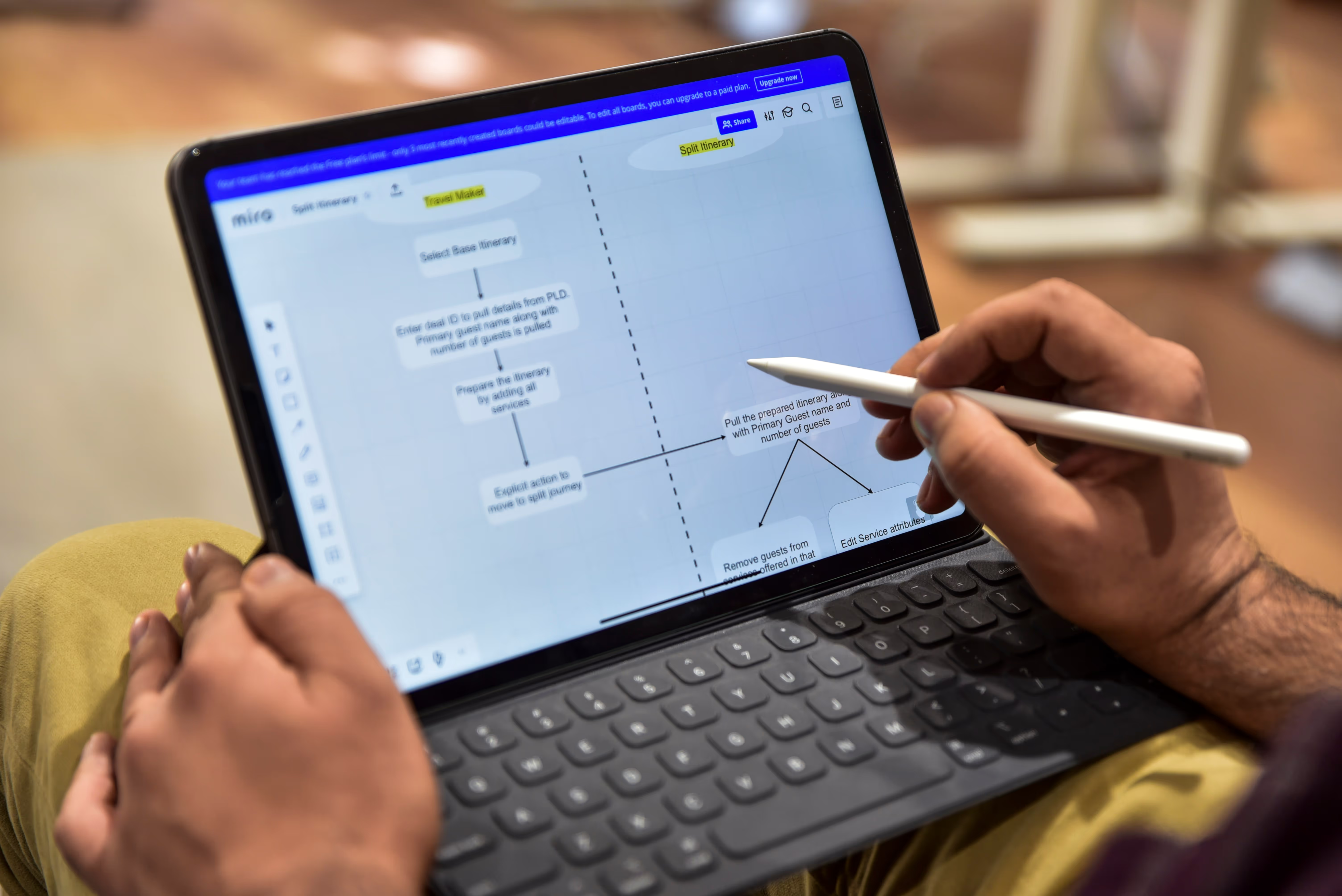
Every blown design budget I've seen at Parallel HQ traces back to the same root cause: the scope conversation happened too late, too loosely, or not at all. Knowing how to scope a design project is not an admin formality, it's the foundational act of product design leadership. Get it right and you ship faster, spend less, and keep your team intact. Get it wrong and you're six weeks in, three pivots deep, with a Figma file that belongs to nobody.
TL;DR
- Scoping translates fuzzy intentions into a binding project charter with deliverables, timelines, and exclusions.
- The discovery phase is not optional, it's where the real scope lives.
- A deliverables matrix and a change-order process are your two best scope-creep defenses.
- Budget and timeline estimates should be tied to specific milestones, not gut feel.
What Does Scoping a Design Project Actually Mean?
Most founders treat scoping as "writing down what we want." It's not. Scoping is the process of defining the goals, scope, and boundaries of your project, as well as the resources, roles, and responsibilities involved. For a UI/UX engagement, that means translating a product vision into a structured agreement that every stakeholder can point to when the conversation drifts. Project scope defines the boundaries of your project, including the goals, deadlines, and deliverables your team will work toward, and what falls outside those boundaries. That second half, what falls outside, is where most early-stage teams fail. They scope what they want but never document what they're not doing.
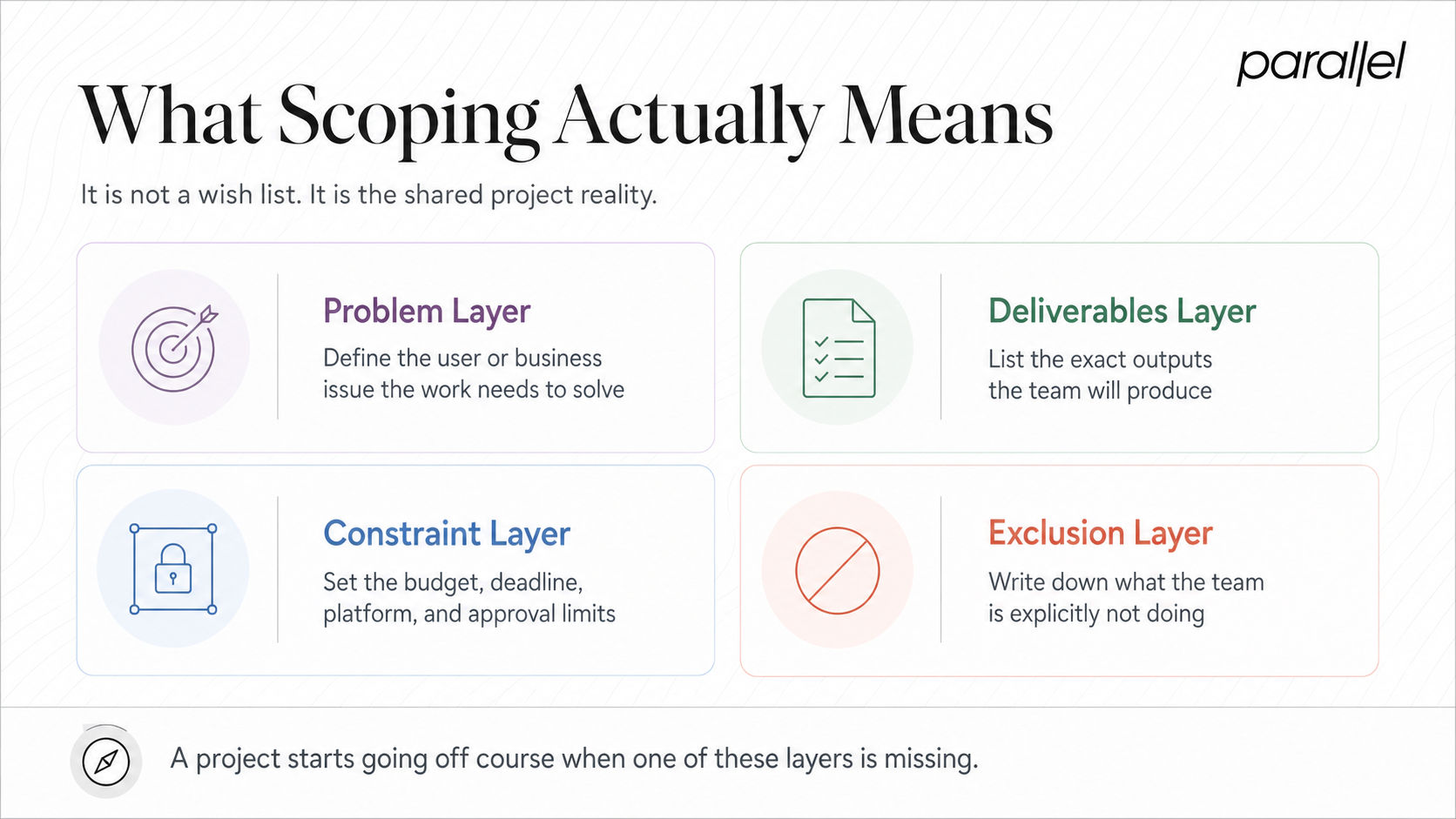
At Parallel HQ, I use four layers to define scope on every engagement:
- Problem layer: What user or business problem are we solving? What does success look like in 90 days?
- Deliverables layer: Which specific outputs will we hand over, wireframes, a design system, a Figma prototype, user research synthesis?
- Constraint layer: What is the fixed budget, the hard deadline, the platform mandate?
- Exclusion layer: What are we explicitly not doing in this engagement?
The five core components of any scope statement are: project goals and objectives, deliverables, scope boundaries and exclusions, constraints like budget or timeline, and acceptance criteria. In a design context, acceptance criteria often gets skipped, which is exactly why clients and agencies end up in a room arguing about whether the work is "done."
A useful mental model: the scope document is a shared reality, not a sales tool. It doesn't exist to impress the client. It exists so that the designer working in Figma at 11pm knows whether a new component they're building is in scope or a favor.
Being a great designer isn't enough to keep your projects on track and on budget, it's vital that early in the project, you define the scope. This is useful because clients will know when you have delivered what you said you would, you will know when you have finished a project, and it prevents scope creep.
The Design Project Scoping Process: Step by Step
This is the exact flow I run at Parallel HQ before a single pixel gets designed.
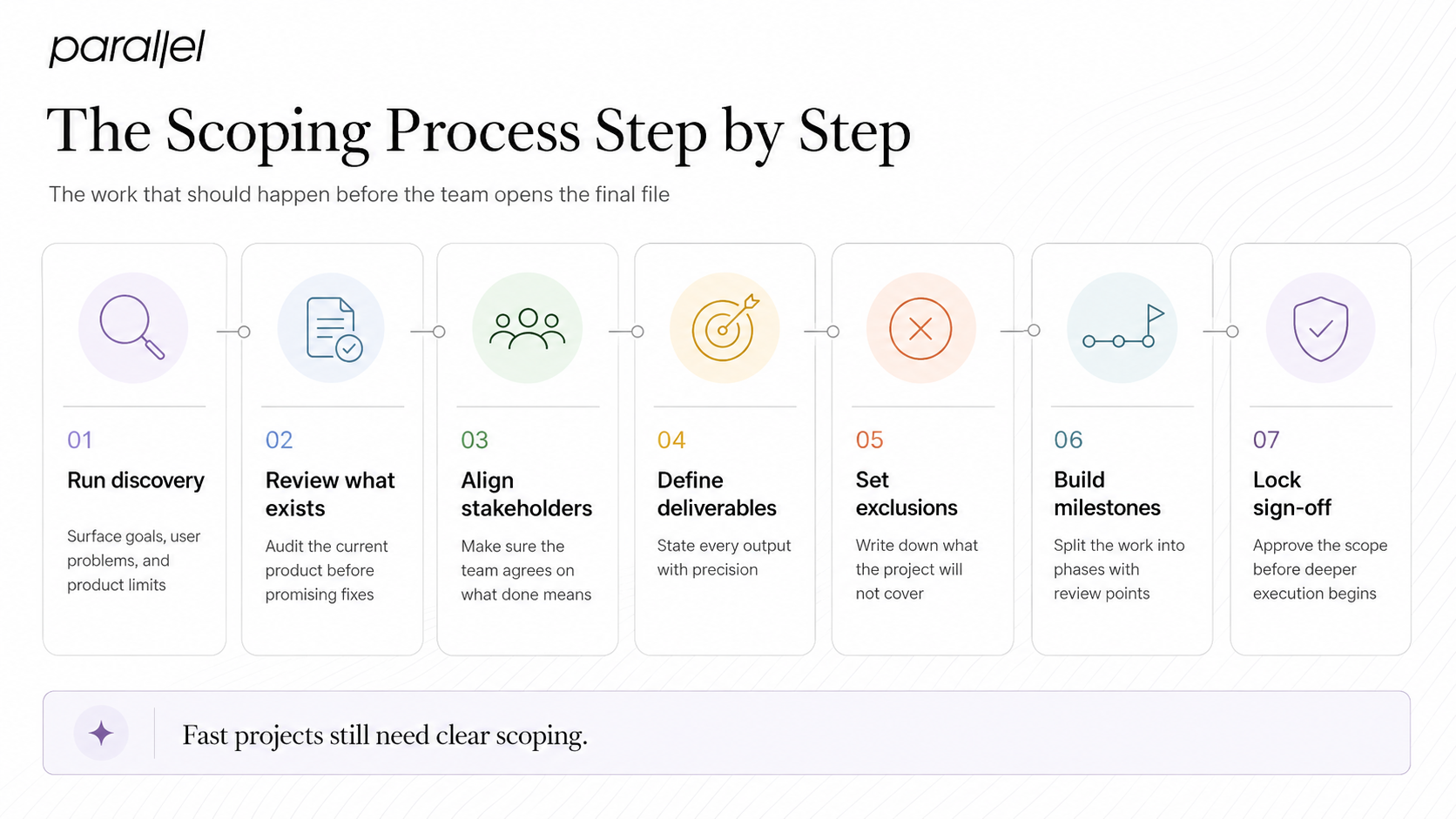
- Run a discovery session: A structured 60–90 minute conversation with the founder or PM to surface business goals, user problems, and existing constraints. This is where the discovery framework does its work, not brainstorming, but structured problem framing.
- Conduct a UX audit (if there's an existing product): Before scoping redesign work, you need to know what's broken and why. A UX audit cuts the guesswork from your scope.
- Map stakeholder alignment: Align with key project stakeholders early to ensure everyone agrees on project boundaries. In early-stage startups this is usually two people, but those two people often have meaningfully different definitions of "done."
- Define deliverables with specificity: Not "UX design" but "information architecture, three user flows, wireframes for 12 screens, one round of high-fidelity mockups in Figma." Every vague deliverable will become a dispute.
- Set exclusions explicitly: Write what you will not deliver. Don't be afraid to point out what won't be done in a scope document, as this can help prevent recriminations at the delivery stage.
- Agree on a milestone-based project timeline: Break the work into phases, Discovery, Information Architecture, Wireframing, Visual Design, Handoff. Assign dates to each gate.
- Define the change-order process: Any request outside the agreed scope triggers a written change order with a revised timeline and cost before work begins.
- Get sign-off on the Statement of Work: If you're working with an external team or agency, you may turn your project scope statement into a Statement of Work (SOW) to cement the agreement.
What Should Be Included in a Design Project Scope?
A scope document for a UI/UX engagement is not a creative brief. It's closer to a project charter with design-specific anatomy. Here's the full list of what must appear:
The project scope statement is a detailed outline that includes a timeline, budget, assigned tasks, project stakeholders, and workflow strategies. With a well-defined project plan and scope statement, project managers can easily oversee each step in the project's delivery, keeping contributors on task, within budget, and on track to meet deadlines.
The deliverables matrix is the most underused piece. When a startup asks for "a full product redesign," I break that into a table with every screen, flow, and component, so there's no ambiguity about what's in the package. This single artifact prevents the majority of scope disputes I've seen in agency work.
What Questions to Ask a Client When Scoping a Design Project
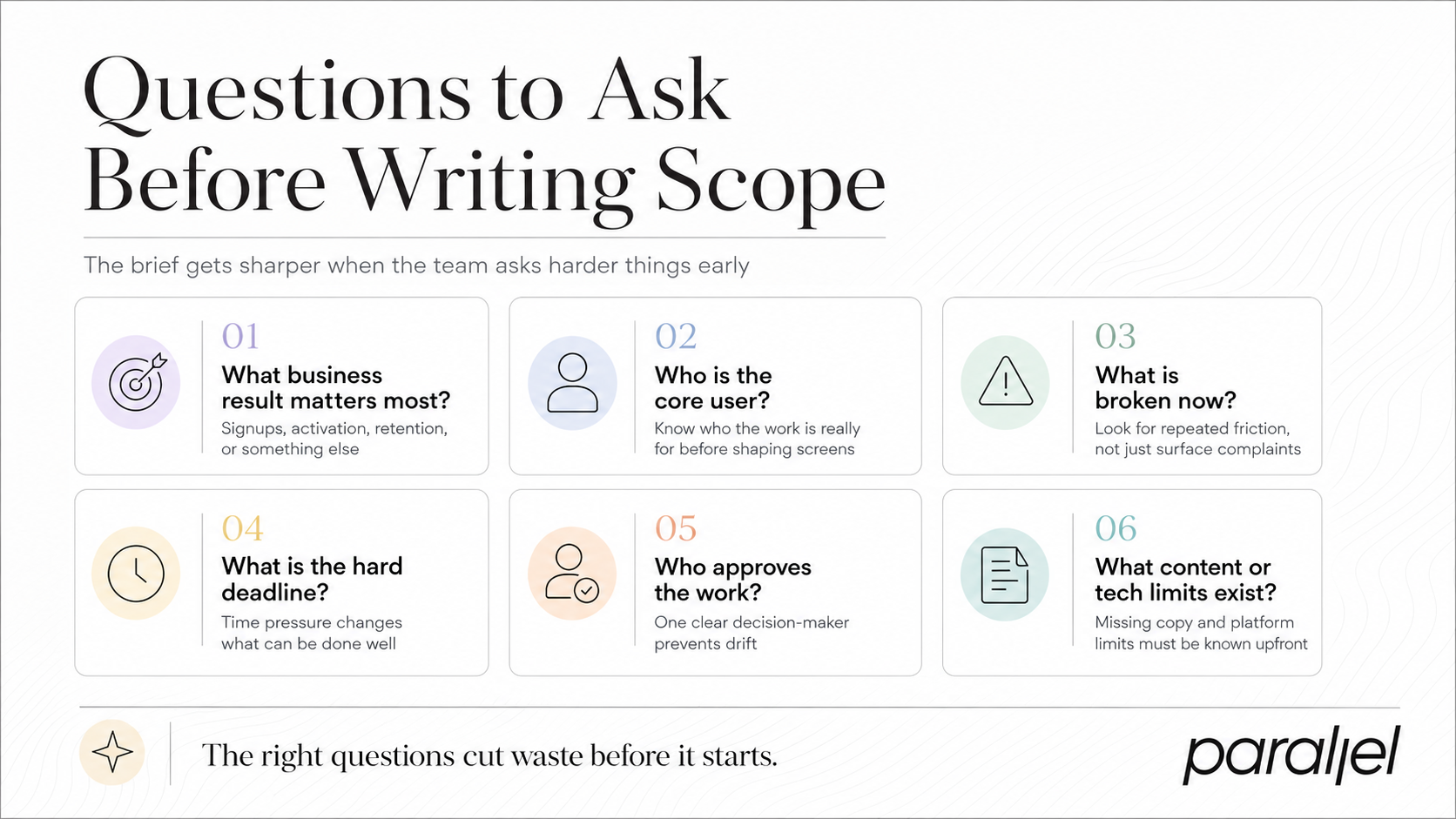
The discovery conversation is where scope lives or dies. These are the questions I ask on every intake call, grouped by purpose.
Business context:
- What specific outcome does this design work need to drive, signups, activation, retention?
- What does success look like in 60 days? In 6 months?
- Who is the final decision-maker on design approvals?
User and product reality:
- Who is the primary user? Do we have existing research or do we need to run user research as part of this engagement?
- What are the top three user complaints about the current experience?
- Are there technical or platform constraints that will limit design decisions?
Scope and constraints:
- If a client wants a huge scope but has a limited budget, there's a huge disconnect between expectations and what they can afford. Quite often, budget will define what can and can't be done within the scope of a project more easily than any other aspect.
- What is the hard launch date, and is it fixed or flexible?
- Are there existing brand guidelines, a design system, or component libraries we inherit?
Preferences and aesthetic direction:
- Ask clients to show you what they love and what they hate. It doesn't matter if the end users love a project if the client thinks it stinks.
- What products or interfaces do you want to emulate or deliberately avoid?
Content and dependencies:
- Who owns copy and content? If content isn't ready, it's a blocker, and that has to be documented in the scope.
Every answer either confirms what's in scope or reveals something that needs to be added, removed, or flagged as a risk.
How to Write a Scope of Work for a Design Project
The Statement of Work (SOW) is the legal and operational backbone of your engagement. Here's how to write one that holds up.
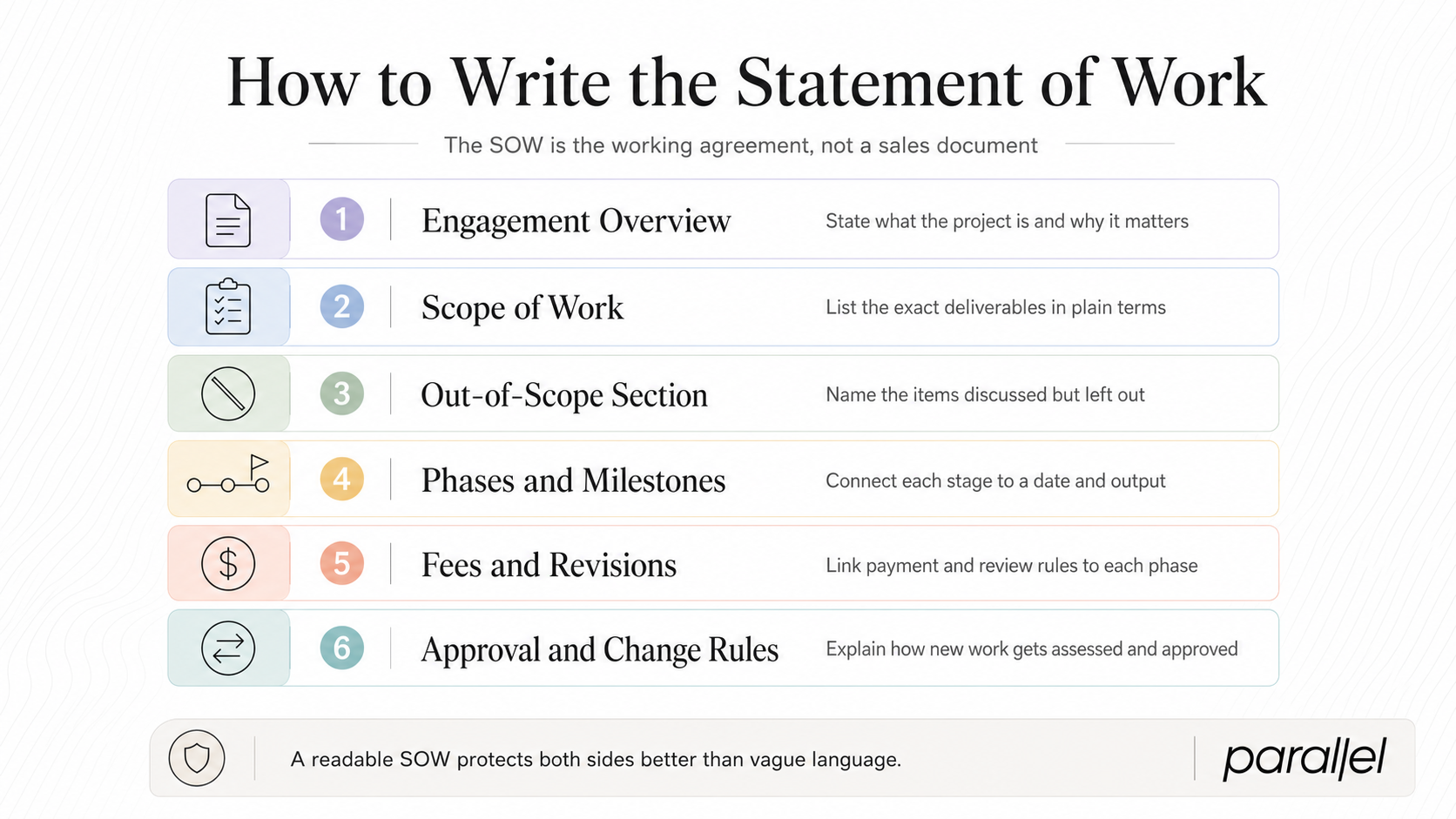
Structure the SOW in this order:
- Engagement overview: Two to three sentences on what the project is and why it matters.
- Scope of work: A precise list of deliverables. Deliverables are the tangible outcomes your project will produce. Specify these clearly, ensuring they are measurable and align with the project's objectives.
- Out-of-scope statement: Every item you discussed but decided not to include. Name them explicitly.
- Phases and milestones: Tie each phase to a date and a deliverable, Discovery by Week 2, Wireframes by Week 4, Visual Design by Week 7, Final Handoff by Week 10.
- Revision rounds: State the number of revision cycles per deliverable. Two rounds is standard. A third triggers a change order.
- Fees and payment schedule: Tie payments to milestone approvals, not calendar dates. This protects both sides.
- Change order clause: Changes are inevitable, but they shouldn't be a free-for-all. Define a formal change management process that outlines how new requests are evaluated, approved, and incorporated into the project.
- Sign-off requirements: Name who must approve each phase before the next begins.
For a SaaS product design engagement, I also add a design system clause: who owns the component library post-handoff, and whether Parallel HQ retains the right to use screens in our portfolio. Small things. Huge headache if left unaddressed.
Keep the language plain. An SOW written in legal boilerplate gets ignored. One written in plain English gets read, understood, and referenced.
How to Estimate Time and Budget When Scoping a Design Project
Estimation is where most agencies either pad wildly or under-quote to win the deal. Neither serves the client. Here's the framework I use.
Start with phase-level estimation, not task-level:
Three variables drive every estimate:
- Screen count and flow complexity: A 5-screen onboarding flow and a 40-screen dashboard are completely different projects. Count the screens.
- Design system state: Starting from scratch adds 30–40% to the visual design phase. Inheriting a mature design system cuts it by roughly the same.
- Stakeholder alignment maturity: If the product vision is still being debated internally, add a buffer, misaligned stakeholders generate revision cycles that no estimate can absorb.
For budget, I work backward from a fixed budget or forward from a scoped deliverables list, never both simultaneously without reconciling them explicitly. If the budget can't cover the deliverables, the deliverables get cut, not the quality. Never estimate on optimism. Estimate the last comparable project you completed, then add 20% for stakeholder-driven changes you can't predict.
A well-run design sprint can compress the discovery and wireframing phases into 3–5 days, making it a high-value option when a startup needs scope clarity before committing to a full engagement.
How to Avoid Scope Creep in Design Projects
This is the most expensive mistake early-stage product teams make, and the data is stark. Approximately 52% of projects across industries experience scope creep, with this figure soaring to over 80% in less structured environments like freelancing and small agency work. 85% of projects that encounter scope creep exceed their initial budgets, with an average cost overrun of 27%.
In 2025, projects without formal change management are 35% more likely to experience cost overruns and missed deadlines. The causes are predictable. Poorly defined project requirements emerge as the number one cause of scope creep. When project objectives, deliverables, and boundaries aren't clearly documented at the project's outset, stakeholders naturally fill in the gaps with their own interpretations.
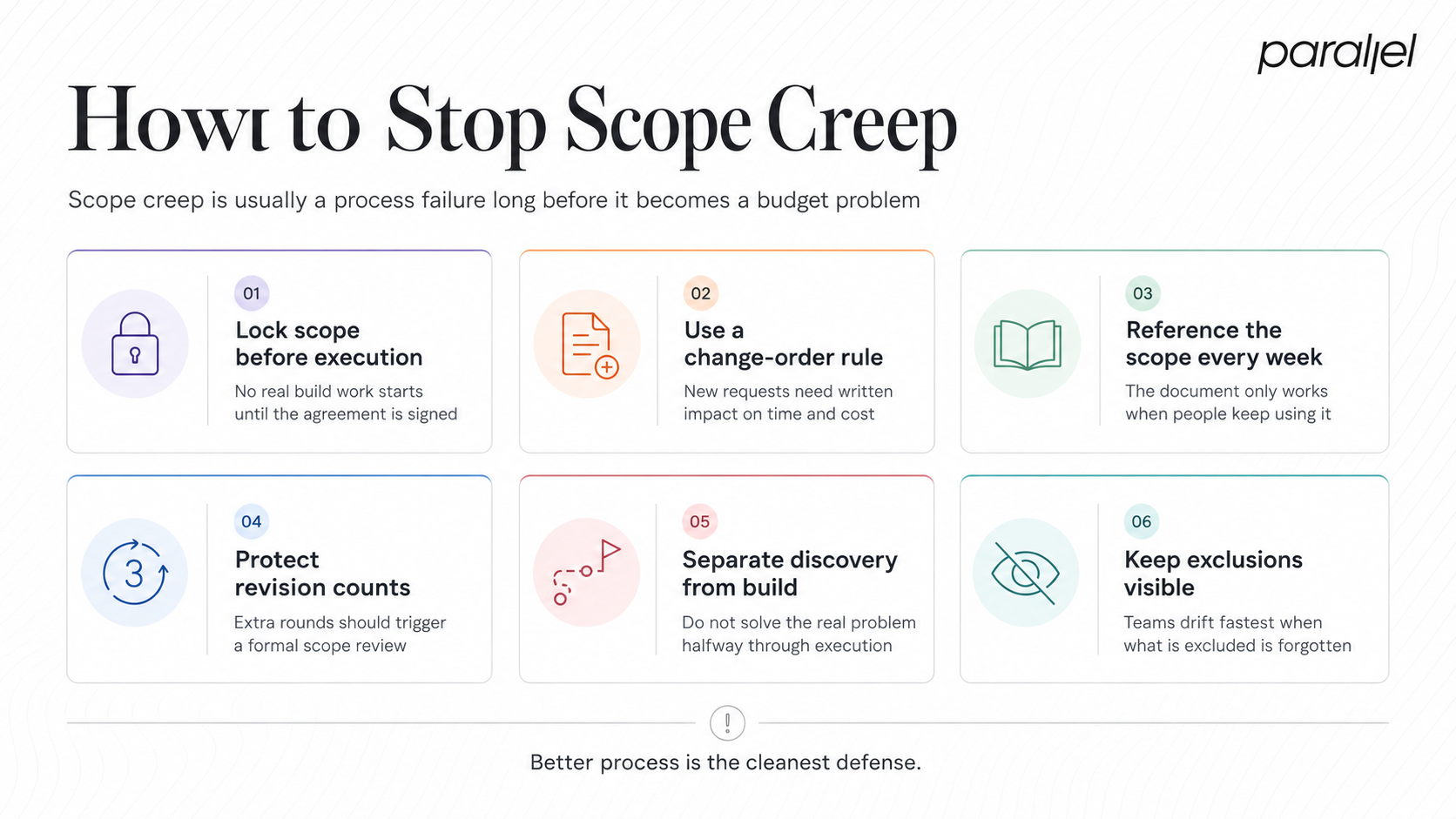
Here's how I prevent it:
- Lock the scope before design begins. No kickoff call, no Figma access, until the SOW is signed. This sounds obvious. It is ignored constantly.
- Build a change-order ritual, not a bureaucracy. For complex initiatives, establish a change control process. This gives your project flexibility without inviting scope creep. At Parallel HQ, a change request is a short Slack message with a three-line impact statement, effort, timeline shift, cost. Simple enough to use, formal enough to prevent slippage.
- Reference the scope document at every check-in. A project scope statement keeps your project on track and helps prevent team burnout, but only if it's communicated effectively. Surface it early and refer back to it frequently throughout the project.
- Protect the revision round count. When a founder asks for "just one more round," remind them of the revision policy in the SOW, and either hold the line or issue a change order.
- Separate discovery from execution. Many scope explosions happen because the team started building before the problem was fully understood. Running a proper discovery phase or product strategy consulting session first surfaces the hidden requirements before they become mid-sprint surprises.
Scope creep is not a client problem. It's a process problem. The best clients I've worked with pushed hard for additions, because that's what good founders do. The job of a scoping process is to channel that energy through a change order rather than letting it quietly inflate the project.
Conclusion
Knowing how to scope a design project is the difference between a team that ships and a team that spirals. Here are the four things I want you to take away:
- A scope document is a shared reality, goals, deliverables, exclusions, acceptance criteria, and a change-order process.
- Discovery is not overhead. It's the work that makes all other work faster.
- Estimate from comparable projects, tie payments to milestones, and document every exclusion explicitly.
- Scope creep is a process failure, not a client failure. Fix the process, and the relationship stays intact.
If you want to start your next engagement on solid ground, Parallel HQ's discovery framework is built exactly for this.
Frequently Asked Questions
Q1: What is the difference between a scope of work and a creative brief?
A creative brief captures the aesthetic direction, brand voice, and communication goals, it's an input to the design process. A Statement of Work is a contractual document defining deliverables, timelines, revision limits, and fees. You need both, and they serve different purposes.
Q2: How long does it typically take to scope a design project?
For a straightforward startup engagement, scoping takes 3–5 business days: one discovery session, one internal estimation pass, one SOW draft, and a review round with the client. More complex enterprise or multi-platform products can take 1–2 weeks.
Q3: How do I know if my scope is too broad or too narrow?
If you can't list every deliverable in one page, it's probably too broad. If you haven't addressed the primary user flow or core problem, it's too narrow. The right scope fits the budget, resolves the core problem, and produces something shippable.
Q4: Should user research always be part of the design project scope?
Not always, but if there's no existing research, not scoping it in is a risk. Designing without user research means the team is designing for assumptions. For AI and SaaS products especially, a user research phase almost always surfaces requirements that change the scope anyway.
Q5: What happens if the client requests something outside the agreed scope?
It triggers a change order, a brief written document that states the new request, the estimated additional effort, the timeline impact, and the cost. Work on the new request begins only after written approval. This protects both the agency and the client.
Q6: Can I scope a design project using Agile methodology?
Yes, and it works well when combined with a fixed-scope discovery phase. Define the overall boundaries and deliverables upfront, then execute in sprints. Agile doesn't mean scope-free, it means the scope is revisited at sprint boundaries through a formal prioritization process, not ad hoc mid-sprint.

check out these related blogs







.avif)