I've spent years at ParallelHQ helping AI and SaaS startups turn complex workflows into intuitive, conversion-ready products. One question founders and PMs ask me constantly: "Which agency do I actually hire?" This guide cuts through the noise. I've evaluated the strongest B2B SaaS UX design agencies operating in 2026 on the criteria that matter to early-stage startups, workflow depth, research maturity, pricing transparency, and measurable outcomes, not portfolio gloss.
10 Best B2B SaaS UX Design Agencies (2026)
What Do B2B SaaS UX Design Agencies Actually Do?
Most founders think UX agencies make things look good. The real job is more structural.

The best UX design agencies for B2B SaaS specialize in the full adoption cycle, multi-role workflow complexity, feature onboarding, and the retention economics that determine whether a customer expands or churns. The discipline differs from consumer product design because a B2B SaaS product must simultaneously serve the buyer who approved procurement, the administrator who configures it, and the end user who depends on it daily, each with different permissions, workflow priorities, and definitions of success, all within the same interface.
Here is what a specialist agency delivers across an engagement:
- UX audit: Identifies friction points inside existing flows using heuristic evaluation, session data, and usability testing against WCAG compliance standards.
- User research: Jobs-to-be-Done interviews, customer journey mapping, and information architecture analysis to establish design on evidence, not assumption.
- Wireframing and prototyping: Low-fidelity to high-fidelity Figma work that validates flows before a single line of code is written.
- Design systems: A scalable component library that keeps the product interface consistent as features multiply.
- Onboarding flow design: Reducing time-to-value so activated users become retained users.
- Interaction design: Micro-interactions, state management, and human-computer interaction patterns tuned for data-dense dashboards.
The most significant structural shift affecting SaaS product design in 2026 is that AI is no longer a peripheral feature. In analytics platforms, operations tools, and workflow management software, users are now evaluating AI-generated recommendations and directing automated processes rather than executing tasks themselves. That change in user role demands completely different UX patterns from those that worked in traditional SaaS.
The best agencies also bring conversion rate optimisation thinking to every screen, not just the marketing site. That distinction separates a product-led growth partner from a visual design vendor.
10 Best B2B SaaS UX Design Agencies in 2026
The best B2B UX partners are the ones that can understand business logic, user permissions, procurement constraints, messy workflows, and the reality of enterprise adoption.
With that lens, here are the top 10 B2B SaaS UX design agencies this year.
1) ParallelHQ is purpose-built for early-stage AI and SaaS startups in the USA. Every engagement starts with product strategy consulting and opportunity mapping, because the most expensive design mistake is building the right interface for the wrong problem. Services span MVP development, design sprints, SaaS design services, AI UX design, and enterprise software design.
2) Clay is recognized as one of the top UX design agencies in 2026, specializing in building enterprise-grade SaaS interfaces that are both beautiful and highly functional, with strength in translating complex workflows into elegant, user-friendly journeys without sacrificing brand expression.
3) Ramotion is a San Francisco-based SaaS design agency founded in 2009 that delivers full-cycle design, brand identity, and product design for B2B SaaS companies. They suit companies that need brand-level consistency alongside product interface design, combining UX design for SaaS with full-cycle development support, making them viable for SaaS MVPs and Series A product launches.
4) Eleken is based in Kyiv and offers UI/UX design, SaaS product design, design systems, and ongoing design subscription services, working with early and growth-stage SaaS companies across North America and Europe.
5) Lollypop Design Studio is an India-headquartered agency with deep multi-vertical experience across enterprise SaaS, fintech, and healthtech, suited to larger product teams needing full design operations support.
6) OneThing Design has shipped digital experiences for 150+ brands across 25+ industries, with deep concentration in BFSI, enterprise SaaS, and consumer platforms, offering enterprise UX, design systems, and one of the earliest dedicated agentic AI experience design (AXD) practices.
7) Blink UX is a strong option for research-led work on complex systems. Their approach prioritizes discovery and usability testing before any pixel work begins.
8) Fuselab Creative specializes in AI-enabled B2B platforms. Their work on Grid AI's ML operations dashboard and EffiTrack's energy analytics platform involved production-level UX decisions for AI workflows, not just prototypes.
9) Phenomenon Studio has independently audited HIPAA and GDPR certifications achieved in 2025, removing an entire category of vendor risk for healthcare SaaS and fintech product teams.
10) Codal is worth considering when UX and implementation need to be closely connected.
How to Choose a UX Agency for Your SaaS Startup
B2B UX agencies should be evaluated on workflow expertise, research maturity, stakeholder management, and measurable outcomes, not just visual polish.
Here is the framework I use when advising founders:
- Verify SaaS-specific portfolio depth: Ask for dashboard design, onboarding flow, and role-based permission examples. Most SaaS founders hire agencies based on looks alone. The best startup UI UX design agencies show onboarding metrics and design systems, not just mockups.
- Test their research process: Any agency that quotes your project without asking about your users is designing for aesthetics, not outcomes. Expect discovery interviews, Jobs-to-be-Done analysis, and defined usability testing protocols.
- Ask about information architecture: Multi-role information architecture is the first structural requirement that separates B2B SaaS UX from nearly everything else. If they don't raise it, raise it yourself.
- Demand measurable success criteria: Activation rate, time-to-value, feature adoption, agree on metrics before kick-off, not after.
- Check Figma and design system fluency: A handoff with no component library creates engineering debt immediately.
- Evaluate engagement model fit: Does the agency offer a discovery framework before a full engagement? This protects both parties.
An AI readiness design scorecard is also worth requesting from any agency working on AI-native products, it reveals whether they understand how AI changes interaction design fundamentally, not cosmetically.
How Much Do B2B SaaS UX Design Agencies Cost in 2026?
Pricing is highly variable. Here is an accurate picture based on current market data.
Most UI/UX design agencies charge $5,000–$50,000 for project-based engagements and $3,000–$20,000/month for retainers. The wide range reflects team size, seniority, and product complexity. For SaaS-focused design work that includes product strategy, $7,000–$12,000/month is the realistic mid-market range for quality output.
Based on reviews on Clutch, the average cost for a UX agency project is $84,973. The typical timeline is 10 months, with an average monthly cost of $8,895.
A common mistake: founders compare hourly rates across agencies without accounting for team seniority. A junior designer at $50/hr billing 200 hours costs more in rework than a senior designer at $150/hr who gets it right the first time.
A complete engagement includes UX research, user flow mapping, wireframing, high-fidelity UI design, a component library or design system, and developer-ready handoff assets. Growth-stage SaaS products should also expect conversion optimization, usability testing, and product roadmap input, not billed as extras.
For early-stage startups, a B2B CRO audit is often the highest-ROI first step before committing to a full engagement.
Agency vs. Hiring In-House: The Real Trade-off for SaaS Startups
This comes up in almost every founder conversation I have. Here is the honest breakdown.
SaaS design ROI usually depends more on utilization and iteration speed than headline price. In-house hiring works when demand is steady and management capacity is strong, but agencies and growth partners often win when speed, flexibility, and launch volume matter more.
Most hiring decisions go wrong not because the wrong type of provider was chosen, but because the scope of work was not clearly defined. A freelancer hired for a contained project can quickly run into edges that require cross-functional coordination, research synthesis, or design system updates. Without a support structure, those edges create delays or inconsistencies that become expensive to fix later.
A fractional design lead is the most underused model in startup design and is frequently the best fit for Series A companies that need strategic leadership but are not ready to justify a $120,000+ design director salary.
My take: if you are pre-Series A and need to ship a designed MVP, validate onboarding, or fix a conversion problem, a specialist B2B SaaS UX design agency is almost always the faster, safer bet. If you are post-Series A with a stable product roadmap and a PM who can manage a designer daily, then in-house makes sense alongside an agency for strategic work.
What Separates Good B2B SaaS UX Agencies from Great Ones
Most agencies can produce a polished Figma file. Fewer can handle what B2B SaaS actually demands at scale.
Consumer applications treat all friction as a problem to eliminate. In B2B software, where a single workflow may involve six approvers, two compliance checkpoints, and an audit trail, removing the wrong confirmation step does not improve the experience, it creates operational failures that cost more than the subscription. An agency that does not understand this distinction will polish the interface while quietly breaking the product.
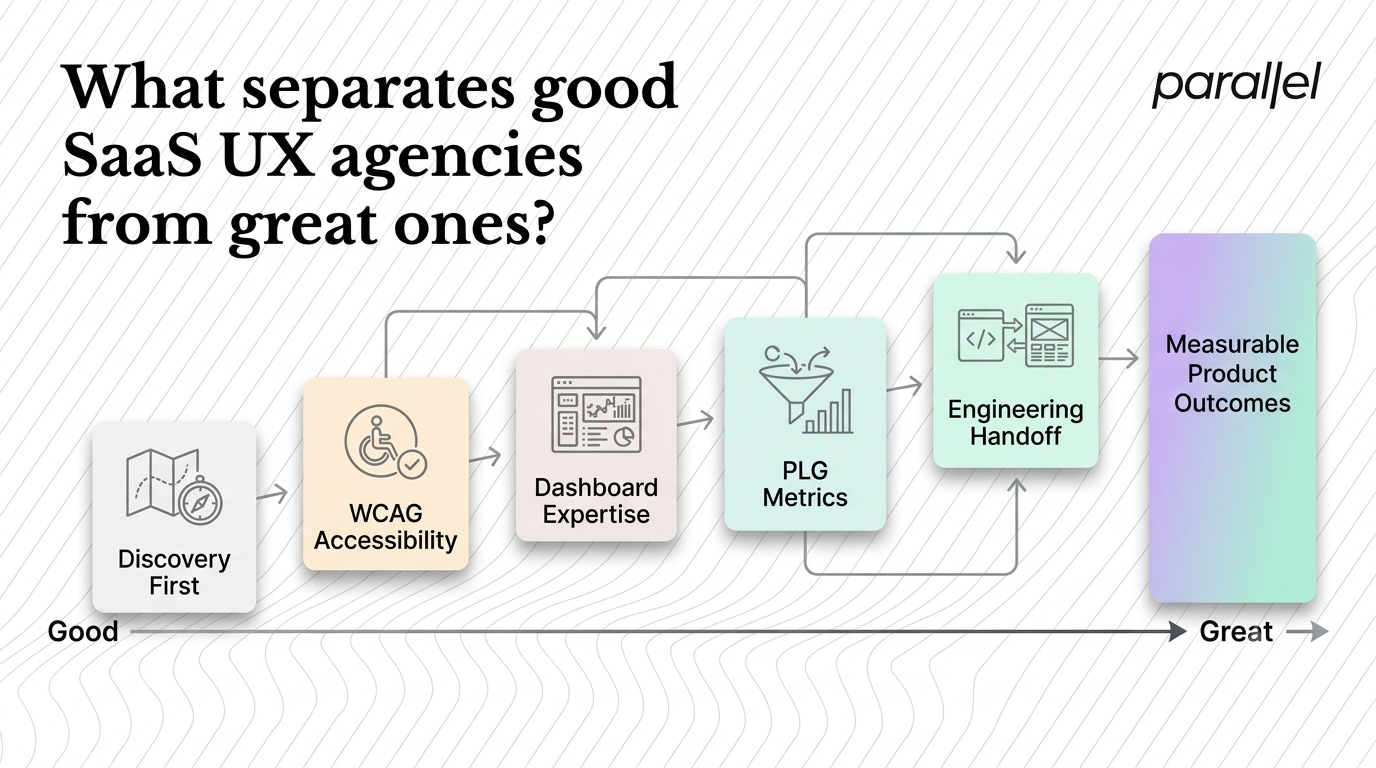
The markers of a genuinely excellent B2B SaaS UX design agency:
- They open with a UX audit or discovery phase, not a proposal deck full of mockups.
- They reference accessibility standards and WCAG compliance without being prompted, because enterprise buyers now ask for it.
- They have an explicit process for dashboard design and data visualization, not just marketing page layouts.
- They understand product-led growth: activation, the aha moment, and the retention loop are design problems, not just product strategy ones.
- They ask how the agency would approach your specific product problem, which research methods it would use, who would be on the team, how it works with engineers, what risks it sees, and how success should be measured after launch.
At ParallelHQ, our usability testing and accessibility audit services are built into how we engage, because designing for complex B2B workflows without grounding in real user behavior is guesswork dressed as design.
The agencies that consistently outperform are the ones that treat human-computer interaction as a discipline with principles, not a craft with preferences. Nielsen Norman Group's frameworks on mental models and the Jobs-to-be-Done lens on user motivation both belong in an agency's everyday vocabulary, not just their credentials page.
Conclusion
- The strongest B2B SaaS UX design agencies in 2026 are defined by workflow depth, research rigor, and measurable product outcomes, not visual awards.
- Match agency to stage: boutique specialists like ParallelHQ for pre-Series A AI/SaaS startups; larger enterprise-focused firms for complex multi-role platforms.
- Cost ranges from $5,000 for a focused sprint to $200,000+ for enterprise transformation; the realistic mid-market is $7,000–$12,000/month.
- Agency consistently beats in-house hiring when speed, seniority access, and cross-functional design thinking are the active need.
- Always start with a UX audit or discovery framework, it protects budget and surfaces the real problem before any design begins.
Frequently Asked Questions
1) What makes a UX design agency genuinely specialized in B2B SaaS?
A specialist agency understands multi-role information architecture, role-based permissions, data-dense dashboard design, and the retention economics of subscription products. They treat onboarding as a core design deliverable, not an afterthought, and can show case studies with activation or retention metrics attached, not just before/after screenshots.
2) How many B2B SaaS UX design agencies should I evaluate before choosing one?
Shortlist three to five. Evaluate on: SaaS portfolio depth, research methodology, how they handle discovery, pricing transparency, and team composition. Before hiring any agency, ask for evidence: case studies, research methods, outcomes, team composition, and examples of how they handle constraints. Two to three scoped conversations reveal more than ten portfolio reviews.
3) What is the minimum budget to work with a serious B2B SaaS UX agency?
A UI/UX agency typically charges $5,000–$25,000 for a SaaS product design engagement in 2026. For a focused entry point, a UX audit, onboarding teardown, or design sprint, expect $6,500–$15,000. Full product design partnerships with strategy, research, and a design system typically start at $20,000.
4) How long does a B2B SaaS UX design engagement typically take?
The typical timeline for a UX project is 10 months.
In practice, early-stage startups should budget 4–8 weeks for a focused sprint (audit + key flows) and 3–6 months for an end-to-end product design engagement covering research, wireframing, UI, and a design system handoff.
5) Should I hire a B2B SaaS UX design agency or a freelancer?
Design for SaaS products is not the same as general digital design work. It involves sustained understanding of how users move through multi-step workflows and how features interrelate. Freelancers work for contained, well-defined tasks. Agencies provide the cross-functional depth, researcher, strategist, senior designer, and handoff documentation that complex SaaS products require. When scope is ambiguous, choose the agency.
6) What should the first deliverable from a B2B SaaS UX agency be?
A research-backed discovery output: user interview synthesis, journey maps, and a prioritized list of friction points, not a polished prototype. If an agency's first deliverable is high-fidelity mockups without discovery, they are designing on assumption. The discovery framework should precede any pixel work. That is where the real strategic value lives.

check out these related blogs





































.webp)