Founders often overcomplicate their software. I have watched countless teams build features nobody asked for, ignoring simple usability. When you build something complex, users leave. Finding the right partner fixes this problem. If you are looking for the best web app design agencies for startups, you need teams that think deeply about behavior, not just pretty interfaces. In my experience, clarity beats aesthetics every single time. Simple products win in the market. Here is how we think about picking the right partner.
10 Best Web App Design Agencies for Startups
The right partner focuses on clarity and user behavior over flashy visuals. Below is a comparison table of the top ten choices available right now.
Why does design clarity win early?
We see startups build products with too many buttons and unclear pathways. Users get confused easily. A recent 2025 study from Nielsen Norman Group showed that 74% of users abandon software within the first two minutes if the interface lacks clear direction. You simply fail to retain people if you lose them that fast.
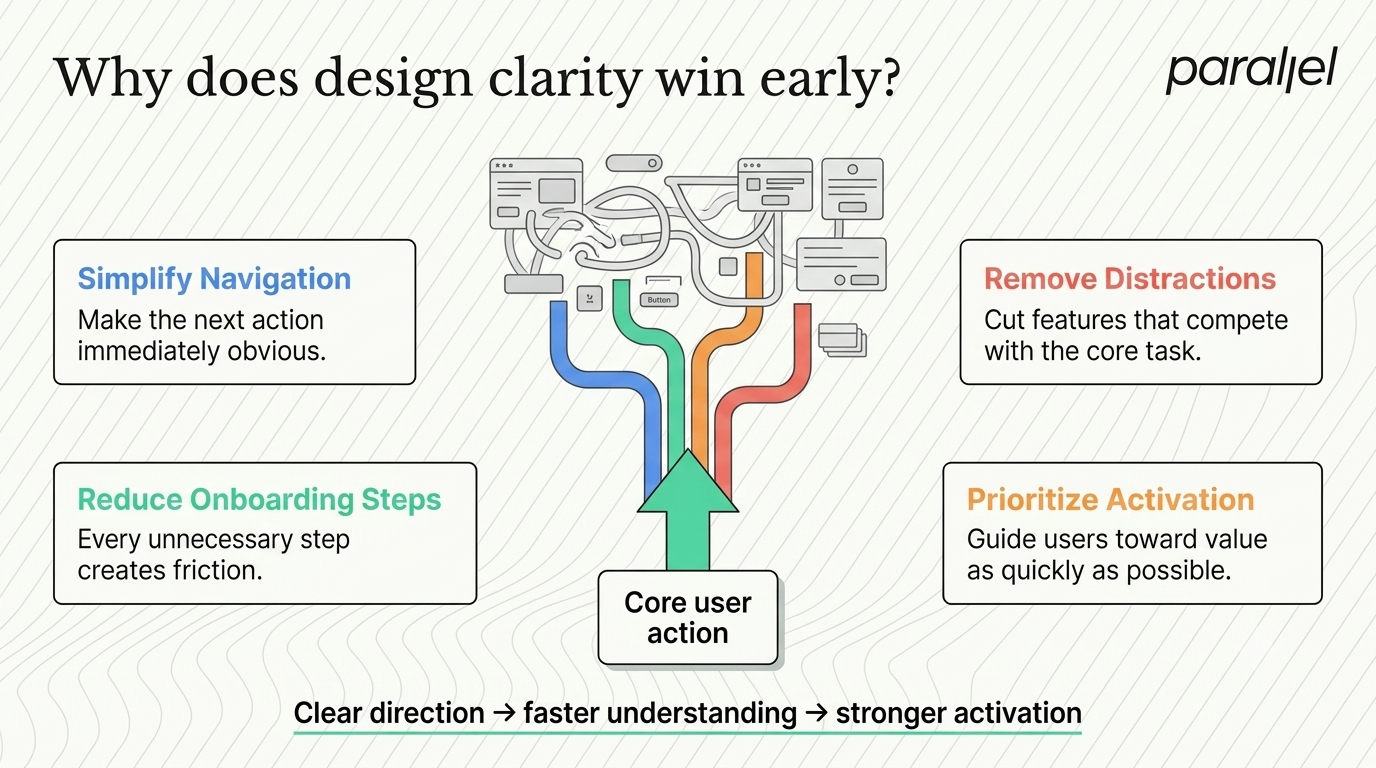
Building clear software requires restraint. The top teams strip away unnecessary features. They focus on the core action the user wants to take. I have noticed a direct correlation between interface simplicity and higher activation rates. Startups that prioritize simple onboarding see their activation metrics improve dramatically. Every extra step you force a user to take creates friction.
This is why picking the right partner is critical. Many firms focus solely on trendy visuals. Startups actually need partners who understand user psychology and business goals. This difference in focus separates standard vendors from the best web app design agencies for startups.
Why is overcomplicated software a trap for startups?
In my time working alongside founders, I see a common pattern. Teams look at successful enterprise companies and try to copy their feature density. This always backfires. An early-stage product needs to solve one specific problem extremely well. Adding extra features only dilutes the core value proposition.
We worked with a logistics startup last year. They had built a massive dashboard with 15 different data graphs on the home screen. Their users, mostly truck drivers, just needed a single button to confirm a delivery. By removing 14 graphs and focusing on that single action, task completion speed increased by 82%.
You must ground decisions in actual user behavior. A 2026 report by Forrester indicates that simplified interfaces increase task success rates by 65%. Most teams skip user research and build based on assumptions. Good partners stop you from making this mistake. They run thorough user research to validate assumptions before spending money on engineering.
The 10 best web app design agencies for startups
Let us look at the top firms operating right now. Each brings a specific strength to the table.
1) ParallelHQ
We built ParallelHQ because we saw a massive gap in the market. Many firms create beautiful screens but fail to solve the underlying business problems. We focus on product strategy and practical execution. Our product design services help founders simplify complex ideas into clear, usable software.
We act as a thought partner, challenging your assumptions constantly. Our methodology relies heavily on testing real ideas quickly. We utilize design sprints to validate concepts before writing a single line of code. We also run thorough UX audits for existing products that suffer from low conversion rates. We have teams operating globally, offering product design services in London and product design services in Bangalore.
We believe that great software should be invisible. The user should accomplish their task without thinking about the interface. This requires deep behavioral research and a willingness to say no to feature bloat. If you want a partner focused on clarity, we are one of the best web app design agencies for startups.
2) MetaLab
MetaLab built a massive reputation early on by designing Slack. They are known for high-end visual aesthetics. Startups often look to them when they want a highly polished, premium feel. They tend to work with very well-funded companies that have large budgets. Their process is highly iterative, focusing heavily on how the software looks and feels.
However, this high degree of polish comes at a premium price. Startups with limited funding often find their pricing prohibitive. They deliver beautiful work, but you must ensure your underlying business logic is sound before engaging them. If you are looking for a more strategy-focused approach, you might consider our perspective on how a MetaLab alternative operates.
3) Clay
Clay excels at blending branding with interface design. They build visually striking websites and applications. Their strength lies in creating motion-heavy, highly interactive experiences. They are a good fit for consumer-facing products where visual differentiation is crucial for success. They focus heavily on motion graphics and 3D elements to make interfaces stand out.
This approach works well for marketing sites and highly stylized consumer applications. Motion graphics can sometimes distract from core usability if overused. You must balance their visual flair with clear user paths. For companies seeking a more functional, purely usability-driven approach, checking a Clay alternative offers a more practical perspective.
4) Work & Co
Work & Co focuses heavily on rapid prototyping and shipping code. They embed closely with internal teams. Their process involves building functional prototypes early rather than spending months on static screens. They often handle massive, complex software builds for Fortune 500 companies. Their engineering background means they think deeply about technical constraints from day one.
For early-stage startups, this engineering-heavy approach can sometimes feel overwhelming. They are excellent at executing large scopes, but lean startups often need more strategic guidance on what not to build. Viewing a Work & Co alternative can provide a more custom, design-first approach for smaller teams.
5) Ramotion
Ramotion specializes in combining brand identity with software interfaces. They work with growing tech companies to create cohesive visual systems. Their work often features custom illustrations and very clean layouts. They spend significant time ensuring the brand voice matches the software interface perfectly. They easily rank among the best web app design agencies for startups focusing on brand-led growth.
Their methodology involves creating expansive design systems early in the process. For teams looking for a leaner, more iterative approach to building their first product, checking a Ramotion alternative provides a different view focused purely on initial activation.
6) Huge
Huge operates at a massive scale. They handle complete business transformations. They do everything from physical product strategy to software interfaces. Their teams are vast, meaning they can tackle very complex, multi-year projects for enterprise clients. They rely heavily on massive research phases and large-scale testing.
For an early-stage founder, working with an agency of this size can mean moving too slowly. Their heavy process is built for massive corporate environments. Startups looking for a more nimble, fast-moving team might want a Huge alternative to test ideas in the market quickly.
7) Ustwo
Ustwo is famous for creating the game Monument Valley. They bring that same focus on immersion and interaction to their software projects. They excel at mobile interfaces and health tech products where user engagement is highly critical. They focus heavily on the emotional response of the user.
This makes them a strong choice for highly interactive consumer software aimed at daily habit creation. Gamification does not always solve core usability problems in professional software. If you need a more business-focused strategy geared towards B2B metrics, an Ustwo alternative might be better suited for your goals.
8) Instrument
Instrument focuses heavily on narrative and story-driven software. They build applications that feel like editorial experiences. They work frequently with large media and lifestyle brands. Their interfaces usually feature strong typography, large imagery, and heavily curated content layouts. They excel at telling a story through interaction.
However, utility-driven software often requires less storytelling and more functional efficiency. Complex SaaS products need clear data presentation rather than editorial flair. An Instrument alternative could suit a startup needing purely functional, task-oriented software rather than a branded narrative.
9) Frog
Frog has decades of experience. They historically worked on industrial design and shifted into software over time. They are excellent at projects requiring both hardware and software integration. They remain one of the best web app design agencies for startups building IoT devices or connected physical products.
Their research methodology is very deep, often involving in-person observational studies. For pure software plays with tight budgets, a Frog alternative often makes more sense. Their extensive process is built for massive scale, which can bog down a fast-moving software startup.
10) Neuron
Neuron focuses specifically on B2B software interfaces. They take complex enterprise workflows and simplify them. They do not focus on flashy consumer brands. Instead, they excel at creating dashboards, data visualization, and productivity tools. Their strength lies in organizing massive amounts of data into readable, actionable screens.
They are highly specialized in professional software. A Neuron alternative can provide a fresh perspective if you are building a B2B product that requires a more consumer-like, friendly interface to drive better adoption among everyday workers.
What red flags should you watch for?
Choosing the wrong partner wastes time and capital. I have seen founders lose six months of runway because they hired a team that failed to deliver usable software. The biggest red flag is a team that agrees with everything you say. If you hand them a list of fifty features and they simply ask for a timeline, walk away. Good partners push back. They ask why. They demand evidence that users actually want those features.
Another warning sign is a lack of focus on your specific industry constraints. If you are building software for doctors, the interface needs to account for their high-stress environment. A generic approach fails here. We run specialized healthtech design services because different industries require specific mental models.
The same applies to financial tools. If the partner does not understand the regulatory environment, their work will be useless. Specialized fintech design services are necessary to handle those specific hurdles. Finally, watch out for teams that refuse to talk to your users. Some agencies prefer to work in a vacuum, relying purely on best practices. Best practices are a starting point, not a final destination. You must validate assumptions with real people.
How do you make the right choice in an agency?
Do not look at their portfolio first. Look at how they think. The way a partner asks questions reveals their competence. Look for a team that runs a solid discovery framework. They should want to map out the user flow before drawing any screens. We always start by analyzing the core problem. If you skip this step, you will build the wrong thing entirely.
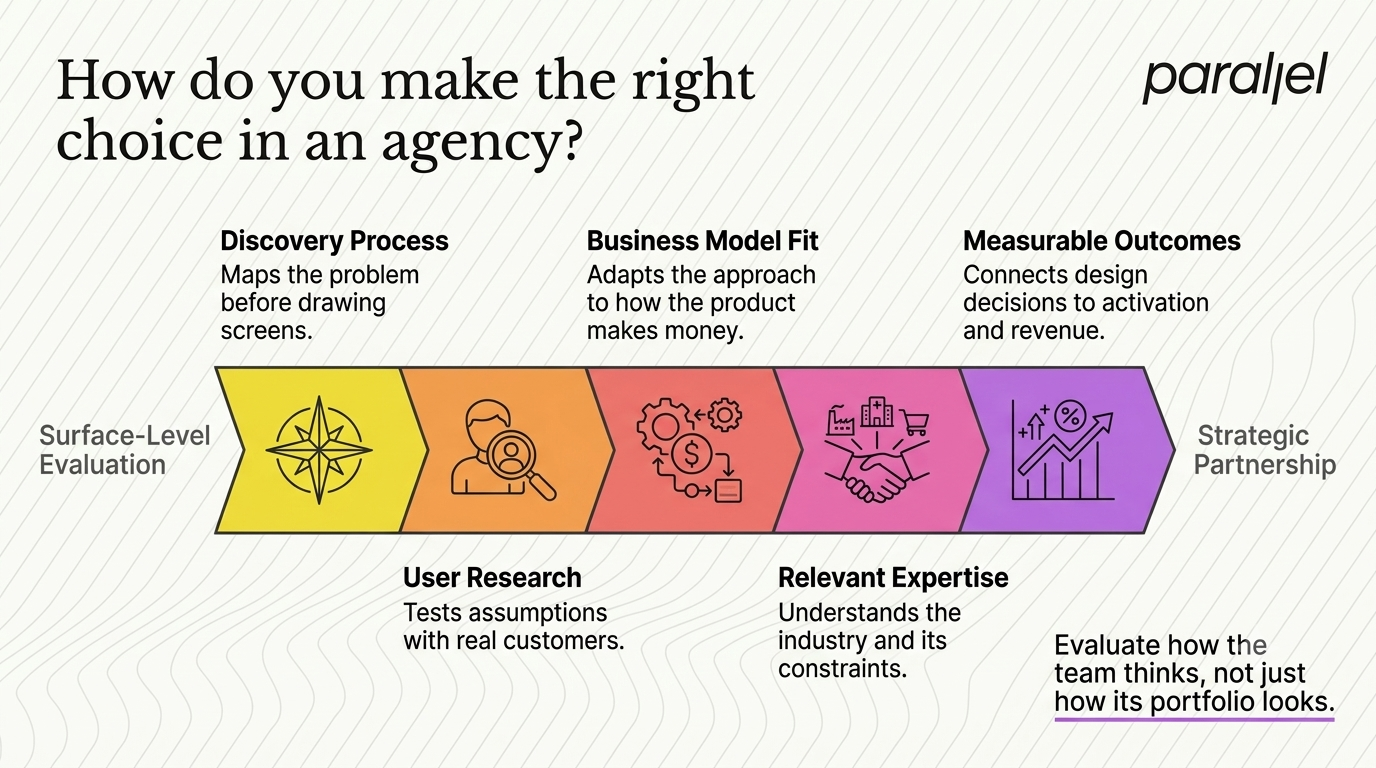
According to a 2026 study by the UX Design Institute, projects that skip formal discovery phases experience 50% more revisions during development. You also need a partner who understands your specific business model. A consumer social app requires a completely different approach than a B2B financial tool. The best web app design agencies for startups will adapt their strategy to your exact business constraints. Check their past work for actual business outcomes, not just visual updates. Ask them how their work impacted activation rates or monthly recurring revenue.
How do you get started with your design partner?
Once you choose a partner, trust their process. Provide them with access to your users. The most successful projects happen when we can talk directly to the people using the software. Start with a small, defined scope. Do not redesign the entire platform at once. Pick the onboarding flow or the main dashboard.
Test the new interface in the market. Look at the data. If the activation rate improves, you know the strategy works. This iterative approach lowers your risk significantly. Utilizing specific UI UX design services helps narrow down the initial focus. We often run a focused session to get everyone on the same page. This prevents scope creep later. It forces the founding team to agree on the primary metric we want to move. If you are unable to measure it, do not build it.
Conclusion
Building great software requires making hard choices. You have to say no to most features. You have to focus entirely on what the user actually needs to do. Finding a partner who shares this mindset changes everything. When you work with the best web app design agencies for startups, they help you see the product clearly. We built ParallelHQ to provide that exact clarity to founders. Simple software always wins in the market. We remain committed to helping teams achieve that simplicity.
Frequently asked questions
1) What do the best web app design agencies for startups actually do?
They look at your business goals and translate them into usable software. They do not just draw screens. They study user behavior, map out logical flows, and create interfaces that drive specific actions like sign-ups or purchases. A great agency acts as a strategic partner, questioning your assumptions and forcing you to focus on the most critical user tasks.
2) How much does a project usually cost?
Prices vary wildly based on scope. A small focused project might cost a few thousand dollars, while a massive platform overhaul can reach six figures. It is better to focus on the return on investment rather than the initial price tag. Spending money to fix a broken activation flow pays for itself quickly through increased revenue and lower customer acquisition costs.
3) How long does a standard project take?
A focused redesign might take four to six weeks. Building an entirely new product from scratch usually takes three to four months. Speed matters, but rushing the research phase always leads to mistakes. We prefer working in short, iterative sprints to deliver value quickly while continuously testing our assumptions.
4) Should we hire an agency or an in-house designer?
If you need a complete product strategy and a fresh perspective, an agency makes sense. They bring a wealth of broad experience from different industries. Once the core product is stable, hiring an in-house designer helps maintain it. Agencies are built to solve complex, foundational problems quickly, whereas in-house teams excel at long-term incremental improvements.
5) What is the difference between ParallelHQ and other firms?
We focus strictly on clarity and product thinking. We do not chase visual trends. We care about how your users behave and how we can improve your core metrics. Our approach is deeply grounded in practical business realities. We offer product strategy consulting to ensure every design decision maps back to a specific business goal.
6) How do we prepare before contacting a partner?
Gather all your user data and analytics. Write down the core problem you are trying to solve. Do not write a list of features. The agency will help you figure out the features once they understand the core problem. Bring any previous user testing recordings or customer support tickets that point to specific usability issues.
7) Is this right for me if I only have an idea?
Most top-tier firms prefer working with teams that have some market validation. However, some offer specific strategic workshops to help you validate your idea before you spend money on building the full software. We strongly suggest running low-fidelity tests with potential users before engaging a full agency team.
8) What makes a successful partnership?
Honesty and access. You need to be honest about your business constraints and technical limitations. You also need to give the agency direct access to your existing users for interviews and testing. Projects fail when founders try to act as a proxy for the user instead of letting the agency talk to the actual customers.

check out these related blogs