Founders often ask me exactly when to redesign saas platforms. Changing a working interface feels risky. You worry about breaking muscle memory for existing users while trying to fix the setup process for new ones. Keeping a fractured user interface costs you active accounts every single day. The friction compounds as you bolt on more features over time. Here is how we identify the exact breaking points that require a structural overhaul to save your product from stagnation.
What are the quick signs that indicate a redesign is needed?
TL;DR: A complete overhaul is required if your activation rate flatlines, your sales team apologizes for the interface during pitches, or your engineers spend more time fixing usability bugs than shipping core functionality.
What is the activation plateau?
Startups often push massive marketing budgets to acquire traffic. Thousands of users land on the site and sign up for a free trial. However, the active user metric flatlines immediately. New users log in, feel overwhelmed by the interface, and immediately close the tab. This activation plateau is a massive warning sign for your product health. Adding features rarely fixes an activation problem because the core issue is structural confusion.
Early stage startups often build a massive feature set based on early customer requests. This creates an interface that looks like an airplane cockpit. Users are presented with twenty different options on the very first screen. According to a 2026 study by the Product Development and Management Association, 71% of software drop-offs occur within the first five minutes of the initial session. This drop-off is a massive signal that your onboarding logic is flawed.
Knowing when to redesign saas platforms requires looking directly at this user confusion. We worked with a startup last year that struggled with a 6% activation rate. The founding team kept trying to fix the problem by adding complex tooltips to confusing screens. Tooltips mask bad structural decisions instead of fixing them.
Simplicity creates confident users. Activation requires absolute clarity above all else. We stripped away 60% of the initial dashboard elements during a UX audit. By removing the visual clutter, the activation rate jumped to 32% in four weeks. Users need a clear path to value, not a tour of every single feature you have built.
You must track the exact moment a user abandons your software. Look at your session recordings. Watch where the mouse cursor stops moving. If users repeatedly click back and forth between two screens without completing a task, the structural logic is failing them. This behavioral data provides undeniable proof of usability issues. We strongly advise teams to watch at least ten session recordings every week.
Many teams hesitate to remove features for fear of angering power users. This fear causes activation rates to stagnate permanently. You must hide advanced settings from new users. We implement progressive disclosure patterns to solve this exact problem. Users only see advanced options after they master the basics. If you are unsure how to structure this, our saas design services focus specifically on scaling complexity gracefully.
What is the feature factory trap?
Startups often fall into the trap of bolting new features onto an old foundation. The initial product was built for one specific use case. Over three years, you add reporting tools, team management options, and complex billing modules. The original architecture breaks under the immense pressure of these new additions.
This frantic building phase results in multiple interaction patterns across the application. Some settings live in a top dropdown menu. Other settings live in a hidden sidebar. The visual language becomes totally inconsistent. A 2026 usability study by the Nielsen Norman Group indicates that inconsistent interface elements increase user error rates by up to 38%. Users get frustrated when the interface changes rules from page to page.
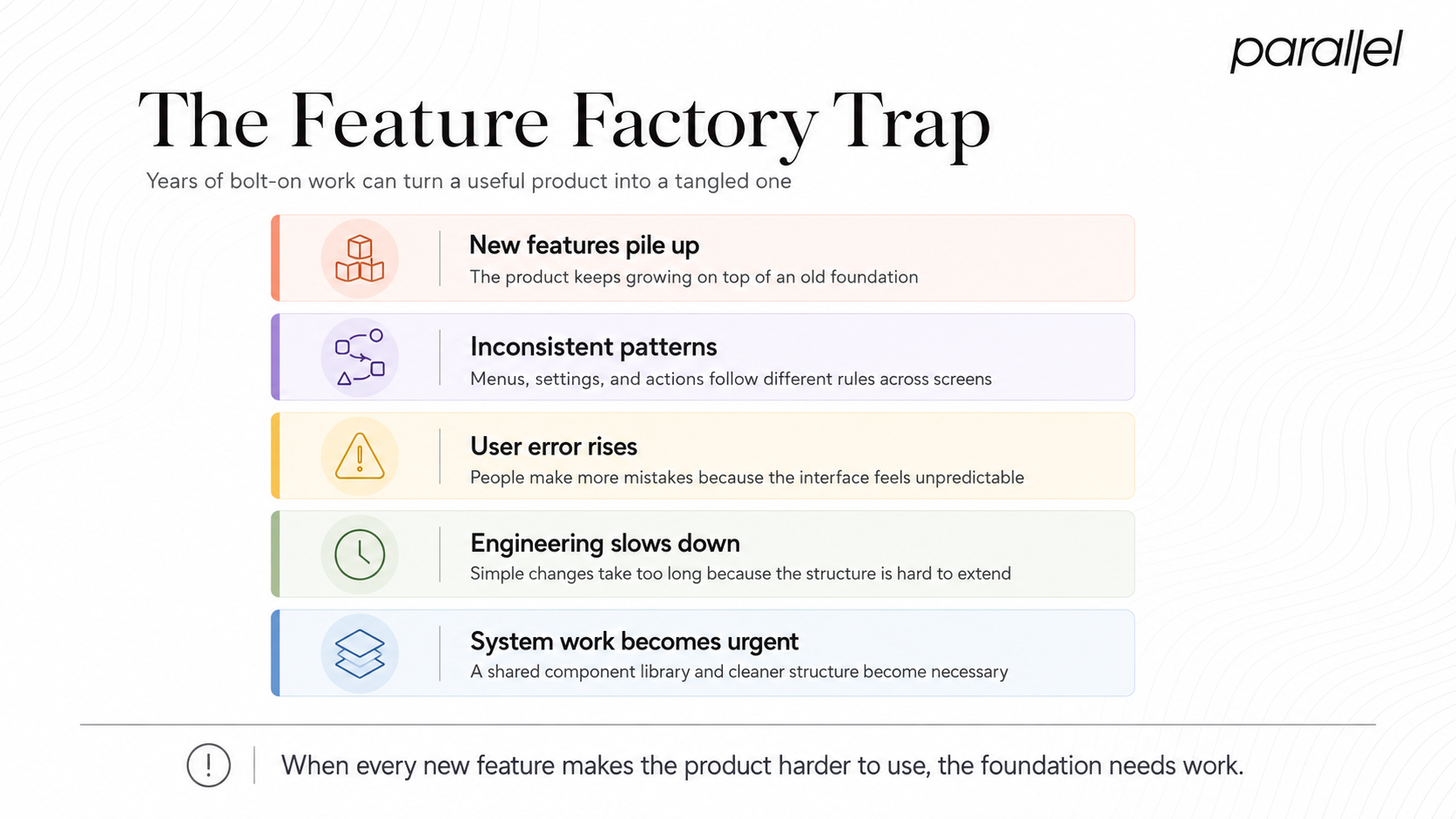
Figuring out when to redesign saas tools is simple if you determine your technical and usability debt. You reach a point where adding a single simple button takes weeks because the structural logic is so tangled. Your engineers spend more time fighting old code than building new value. This structural decay slows down your entire company.
We often step in to provide enterprise software design services when the engineering team begs for a structural reset. A clean, unified system speeds up future development exponentially. It stops the guessing game for your developers. They can pull from a shared library of components instead of building custom elements from scratch every single time.
To escape the feature factory, you must pause feature development entirely for a short period. Focus strictly on cleanup. Check every single screen in your application. List the inconsistencies in spacing, typography, and button styles. We force our clients to print out their core screens and put them on a physical wall during our design sprints. Seeing the inconsistencies laid out physically usually shocks the founding team into action.
A strong component library is the only permanent solution to this problem. Check our design systems offerings to see how we structure these assets. Creating a single source of truth for your interface prevents the feature factory mindset from creeping back in. Developers work faster, and users get a predictable experience.
What is the internal friction matrix?
Watch your sales demonstrations closely. This activity provides incredible insight into your product flaws. If your account executives rush through certain screens because they are embarrassed by how it looks, you have a massive problem.
The sales team knows exactly what parts of the software lose deals. If prospects say the tool looks too complicated during a pitch, they will never buy it. Your marketing site might look beautiful, but a fractured core software experience kills trust instantly.
Many founders debate when to redesign saas interfaces while losing deals to competitors with fewer features but better usability. We see this pattern in the financial technology sector constantly. Startups hire us for fintech design services because a competitor is stealing market share purely through superior usability.
Your product must sell itself during a free trial. If it requires a human to explain its value, the interface logic is flawed. Good software feels invisible to the user.
Another clear signal is your customer support queue. Look at the specific questions your users ask every day. If they constantly ask how to perform basic tasks like exporting a report or adding a team member, your interface is failing.
A 2025 report from Forrester Research shows that confusing software interfaces account for 45% of all tier-one support costs in enterprise software companies. You pay human beings to explain a broken interface. We look at support metrics during our opportunity mapping workshops. If your team spends three hours a day explaining how to use a core feature, a structural change is necessary. Do not blame the user for failing to understand the system.
How can you make a financial case for a redesign?
An interface overhaul is a massive investment of time and capital. Founders hesitate because the return on investment seems difficult to measure. However, retaining users is always less expensive than acquiring new ones.
You must compute the cost of doing nothing. If your confusing interface causes a 10% monthly churn rate, you bleed revenue. Fixing the core logic stops the bleeding immediately.
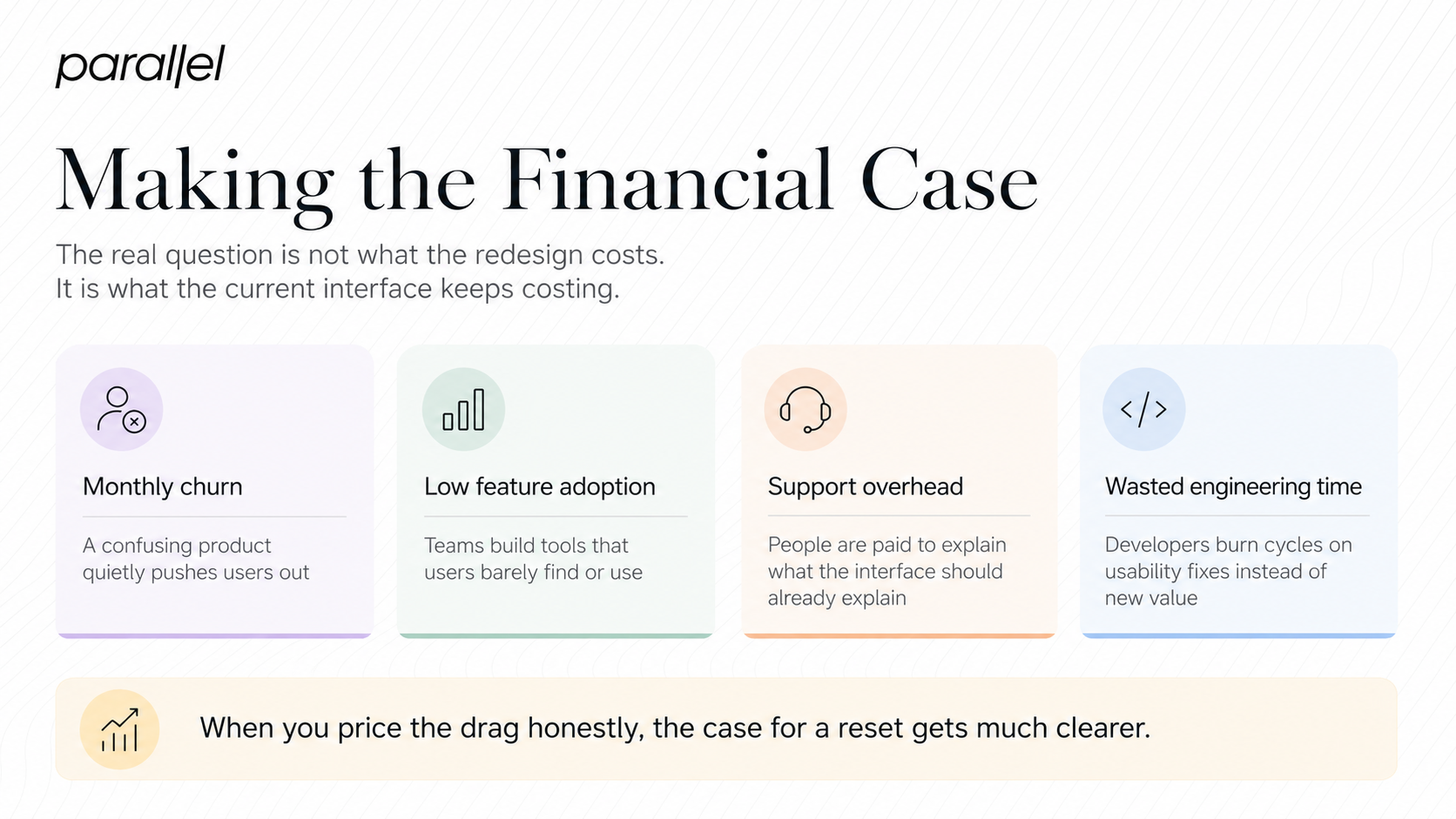
Understanding when to redesign saas foundations is about mapping the exact business impact. If you improve user retention by just 5%, the compounding revenue over two years is enormous. You evaluate the business case by looking at specific metrics.
- Customer Acquisition Cost against Lifetime Value
- Monthly Churn Rate percentages
- Feature Adoption Rate numbers
If your feature adoption rate is below 10%, your users are ignoring the tools you spent months building. They either do not know the feature exists or find it too difficult to use. A targeted product strategy consulting engagement usually reveals that users simply fail to find the functionality they need.
You must build a financial model that justifies the update. Map out how much money you lose every month due to churned trials. Then, map out how much engineering time is wasted fixing interface bugs. When you put a dollar amount on the inefficiency, the decision to invest in a structural update becomes obvious.
We focus heavily on metrics. Our work is designed to move business numbers. If an interface update does not increase revenue, reduce support costs, or accelerate development, it was a waste of time. Startups must stop viewing interface work as an art project and start viewing it as an engineering discipline.
How can you execute a redesign without breaking workflows?
The biggest fear founders have is alienating current power users. If you change the interface, your loudest customers will complain. This fear causes paralysis and prevents necessary updates.
The solution is gradual transition and deep user research. You do not wake up one day and change everything at once. You test the new structure with a small group of users first. We build prototypes and run usability testing to validate the new flows before writing production code.
Knowing when to redesign saas products means knowing how to manage change properly without causing mass churn. You build a transition plan that protects your existing revenue base.
- Allow users to toggle between the old and new interface for a specific timeframe.
- Record video walkthroughs explaining the structural changes.
- Provide immediate chat support during the rollout phase.
- Gather feedback and iterate rapidly based on real usage patterns.
This structured approach prevents mass churn. You give users time to adjust to the new interface while proving its superiority through daily use. Clear communication is your best tool during this phase.
Internal teams suffer from the curse of knowledge. Your engineers and product managers know how the software works because they built it. They are completely blind to the friction that new users experience. This is why external partners are valuable.
We look at your software with fresh eyes. We spot the illogical workflows immediately because we do not have the internal bias of knowing how the database is structured. A short discovery framework engagement forces the entire company to look at the product through the eyes of the user. We remove internal opinions and replace them with observed behavior.
What is the conclusion?
Building successful software requires intense focus on user behavior. A messy interface actively pushes your customers away. The signals are always there. Your activation rate drops, your support tickets pile up, and your sales team struggles to close deals.
The decision of when to redesign saas products comes down to basic business survival. You reach a point where your interface is the primary obstacle to business growth. Fixing it requires clear thinking, logical structuring, and a refusal to settle for confusing workflows. Act before your users find a simpler alternative.
What are the frequently asked questions regarding a redesign?
1) What does a structural software overhaul entail?
It involves rethinking the entire menu architecture, interaction logic, and visual language of a software product to improve usability. It goes far deeper than just changing colors.
2) How do we measure the success of an interface overhaul?
You track specific metrics like task completion speed, trial activation rates, and the volume of usability-related support tickets. The goal is to see a measurable drop in user friction.
3) How do we know exactly when to redesign saas dashboards instead of making small tweaks?
If the foundation is solid, fix the small bugs. If the core menu logic is broken, your engineers are constantly fighting old code, and users are constantly lost, you need a complete structural reset.
4) Is my startup too early to worry about a perfect interface?
You do not need a perfect interface on day one, but if early users churn purely because the product is confusing, it is time to intervene. Usability is critical for early traction.
5) How do we prevent alienating our current power users during a major update?
Provide a gradual rollout, offer toggle switches to revert to the old interface temporarily, and maintain clear communication about why the changes exist to benefit them.
6) What is the biggest mistake founders make during an interface update?
The biggest mistake is adding more features instead of simplifying existing ones. Founders often assume users want more tools, when they actually just want a faster way to complete their tasks.
7) Is there a perfect timeframe for when to redesign saas platforms?
There is no universal schedule. It entirely depends on your business metrics. If activation drops and technical debt slows down your engineering team, the timeframe is immediately.
8) How does ParallelHQ help teams manage a massive interface update?
We act as an objective partner, using real user data to clarify product thinking, streamline complex workflows, and build scalable systems that speed up future development.

check out these related blogs






.avif)