Finding the right design partner is rarely straightforward. Most software founders end up with pretty screens that fail to convert users or solve actual problems. We have seen this repeatedly at ParallelHQ. When you search for the best web app design agencies for SaaS, you usually find surface portfolios prioritizing visuals over logic. You need teams that think deeply about software architecture, databases, and human behavior. This guide cuts through the noise to show you who actually builds products that work.
10 Best Web App Design Agencies for SaaS
The best web app design agencies for SaaS combine strong product thinking with usability expertise. They prioritize clear workflows over visual trends. Here is the top 10 comparison.
Why Does the Trap of Shallow Metrics Undermine SaaS Design?
I talk to dozens of founders every quarter. Most come to us because their software looks modern, but users are abandoning the core workflows. This happens when teams prioritize Dribbble-friendly aesthetics over actual product mechanics.

According to the Nielsen Norman Group 2025 usability report, 72% of SaaS platforms fail their initial user testing because of unclear menu structures, not visual design. Users do not care about your gradient buttons. They care about finishing their tasks quickly.
When reviewing the best web app design agencies for SaaS, you must look past the surface. You need partners who ask difficult questions about your database structure and user permissions.
We recently reviewed a procurement tool that had beautiful data visualization. The primary action (approving an invoice) was hidden behind three clicks. We simplified it to a single click on the main dashboard. Task completion rates jumped by 40%. Good software design is about reducing cognitive load. It requires understanding what the user actually wants to achieve and removing every obstacle in their way.
Here are three signs your software design is failing:
- Users rely heavily on customer support to complete basic tasks.
- The time-to-value for a new signup exceeds ten minutes.
- Your data tables hide critical information behind hover states.
If an agency only talks about colors and typography, walk away. You need experts in SaaS design services.
Evaluating the top 10 agencies
Let us look at the agencies actually moving the needle for software companies in 2026. This list focuses on firms that understand complex workflows, data management, and user retention. Choosing among the best web app design agencies for SaaS requires honesty about your specific constraints.
1) ParallelHQ
At ParallelHQ, we focus on clarity. We believe complex software should feel simple. Our team works with early-stage and growth-stage companies to untangle complicated workflows.
We focus heavily on onboarding, information architecture, and core task completion. We map out exactly how users move through your application. If you need to fix a broken funnel, we run a UX audit to identify the friction points based on real data.
Our strength lies in stripping away the unnecessary. We ask why a feature exists before we ever draw a screen. This approach builds products that people actually use. For teams needing strategic direction, our product strategy consulting sets the foundation before a single pixel is pushed.
2) MetaLab
MetaLab builds beautiful, highly polished interfaces. They are responsible for some of the most recognizable interfaces in the industry. Their work shines when a company has a massive budget and needs a consumer-grade finish on a business tool.
They excel at high-end visual execution and interaction modeling. However, they operate at a premium tier. Early-stage startups usually find their engagement models too heavy and slow.
They are best suited for companies that have already found deep product-market fit and need to outshine competitors visually. We often position ourselves as a MetaLab alternative for teams needing faster, more strategic iteration without the bloated timelines.
3) Clay
Clay operates out of San Francisco and merges brand identity closely with software interfaces. They think about how a company looks and feels at every touchpoint. They do excellent work for companies that need their software to feel like a premium brand.
Their typography and spacing are always top-tier. If your SaaS product relies heavily on emotional loyalty, Clay is a strong choice.
If you are building a dense internal tool for logistics, their brand-first approach might be misdirected. We sometimes advise teams seeking a Clay alternative to prioritize raw usability over branding constraints.
4) Ramotion
Ramotion focuses heavily on visual systems and iconography. They build crisp, modern interfaces with very tight component libraries. They are highly effective when a company needs a complete visual overhaul.
Their deliverables are usually immaculate and easy for engineers to implement. Their primary focus remains on the visual layer.
If you have deep architectural problems or confusing user workflows, you might need a partner who focuses more heavily on the behavioral science behind the screen. We offer Ramotion alternative services for teams that need deep product strategy alongside visual upgrades.
5) Work & Co
Work & Co built its reputation on rapid prototyping and deep engineering integration. They do not just draw screens. They build functional prototypes early in the process.
This approach is highly effective for teams that need to test complex technical interactions. They work closely with your internal developers to ensure feasibility.
They typically engage in massive, long-term contracts. This makes them inaccessible for most early-stage or mid-market SaaS companies. For startups seeking a more agile Work & Co alternative, specialized strategy firms offer a faster path to validation.
6) Huge
Huge handles massive enterprise accounts. They build software ecosystems for legacy corporations trying to modernize their technology. They bring massive teams containing researchers, strategists, and analysts to every project.
This is necessary when dealing with decades of legacy code and corporate bureaucracy. For a modern SaaS company, their process is often too slow and heavy.
You end up paying for overhead you do not need. Teams looking for a Huge alternative usually want a leaner, faster execution model without the corporate bloat.
7) Instrument
Instrument builds narrative-led software. They excel when the product itself needs to tell a story or guide a user through a highly curated interaction sequence. Their work is heavily focused on motion, pacing, and visual delight.
They build beautiful software that feels alive. However, most utility-driven SaaS products do not need storytelling. They need efficiency.
If you are building a tax filing tool, storytelling will frustrate your users. Founders looking for an Instrument alternative usually need straightforward functional execution.
8) Neuron
Neuron focuses almost exclusively on B2B software architectures. They understand dense data tables, permissions, and complex filtering systems. They are very good at taking a messy legacy dashboard and turning it into a structured, usable interface.
They think like software engineers. Their visual execution can sometimes feel very rigid.
While the usability is strong, the aesthetic layer often lacks the polish expected from modern software. We often partner with companies as a Neuron alternative when they need both rigorous B2B logic and high-end visual execution.
9) Frog
Frog is a legacy industrial design firm that transitioned into software. They apply physical design constraints to screen-based interactions. This makes them incredible at designing software that pairs with physical hardware.
If your SaaS connects to point-of-sale systems or factory machinery, they understand that environment deeply. For pure-play cloud software, their methodology can feel overly theoretical.
Many software founders look for a Frog design alternative that moves at the speed of modern web deployment.
10) Code and Theory
Code and Theory built their foundation in publishing and media. They know how to handle massive amounts of content, taxonomy, and distribution. If your SaaS product relies on content management or heavy editorial workflows, they understand those specific problems deeply.
For transactional software or data-heavy operational tools, their content-first approach is less applicable.
We provide Code and Theory alternative services focused specifically on transactional product mechanics. You must match the agency to your specific architectural needs.
What Are the Dangers of a Broken SaaS Onboarding Process?
A beautiful product with a broken onboarding flow is a dead product. In my experience, this is where most product decisions go wrong. Teams assume users will read tooltips or watch tutorial videos. They will not.
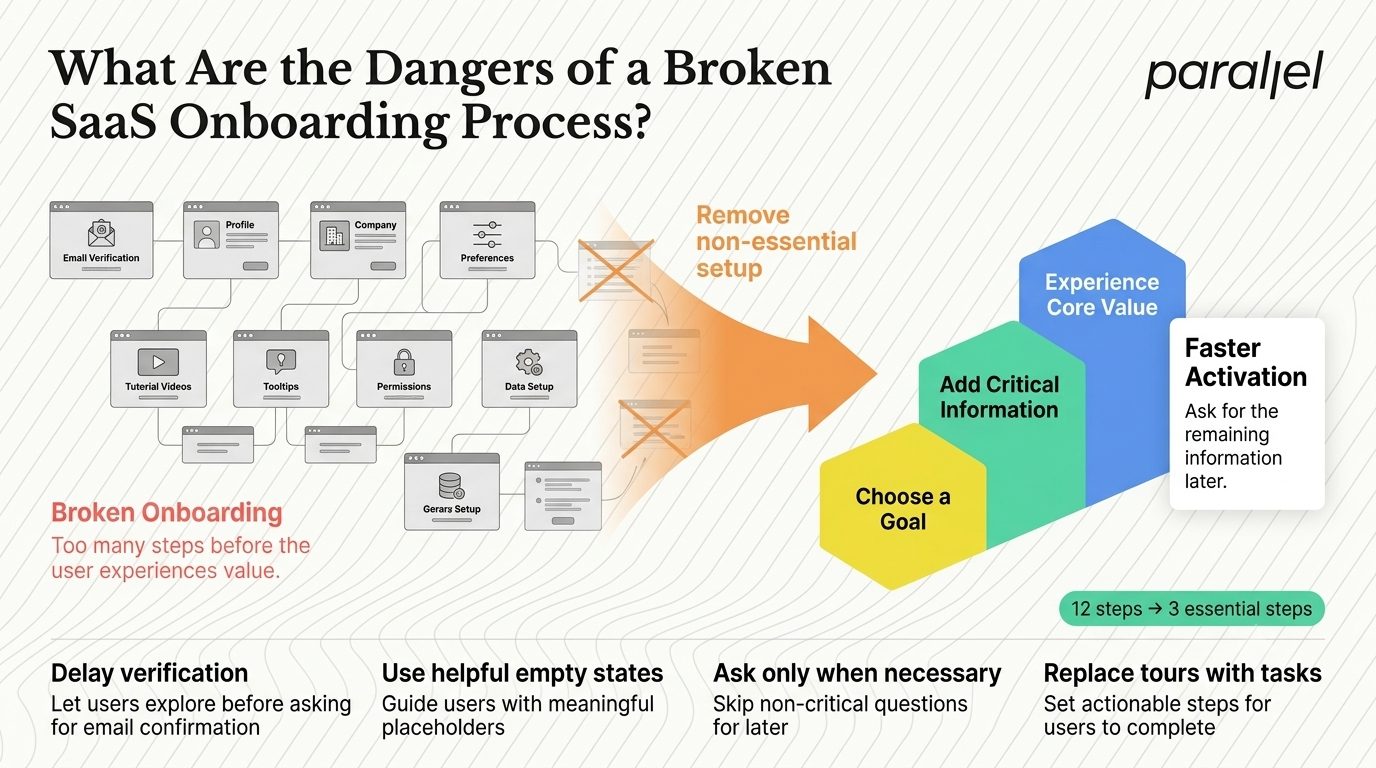
A 2026 report from the Product-Led Growth Collective showed that 64% of new users abandon software within the first five minutes if the primary value is not immediately obvious. This is a staggering metric. We approach this by mapping the time-to-value for every user persona.
How many clicks does it take for a user to experience the core benefit of your software? If that number is higher than three, you have a structural problem. We worked with a financial software company that required a twelve-step setup process before the user could see any data.
We compressed this by requesting only three critical pieces of information upfront, allowing the user to populate the rest later. Activation rates doubled. You must evaluate the best web app design agencies for SaaS based on their behavioral logic, not just their typography.
Four principles for effective SaaS activation:
- Remove mandatory account verification steps during the first session.
- Populate empty states with dummy data to show utility immediately.
- Ask for user input only when it is strictly necessary to proceed.
- Replace passive product tours with active, goal-oriented tasks.
Ask potential partners how they approach empty states. An empty dashboard is intimidating. It should be an invitation to take the first step. If you need help evaluating your current flow, consider our SaaS onboarding teardown.
Why Should You Validate Product Strategy Before Designing Screens?
Jumping straight into interface design software is a mistake. I see founders burn through funding because they started designing screens before validating the underlying mechanics of their software. You must map out the system architecture first.
Who are the different user roles? What data do they need to see? What actions are they permitted to take? We use a structured discovery framework to answer these questions.
We build low-fidelity wireframes that look ugly on purpose. This forces stakeholders to argue about the workflow rather than the button colors. According to a 2025 study by IDEO, teams that spend 20% more time in low-fidelity planning reduce their development rework by over 40%.
Engineers hate rebuilding features because the design lacked structural foresight. When you talk to the best web app design agencies for SaaS, ask them to show you their ugly work.
Questions to ask a prospective design partner:
- How do you map user permissions before designing screens?
- Can you show me a wireframe that failed during testing?
- How do you hand off interaction logic to engineering teams?
- What is your process for documenting edge cases?
Ask to see their spreadsheets, their wireframes, and their flowcharts. If they only show you polished animations, they are hiding a weak strategic foundation. Strong product teams start with logic.
How Do You Integrate Analytics With User Research?
Qualitative feedback is necessary, but people lie in user interviews. They tell you what they think you want to hear. Quantitative data tells you what they actually do. You need both.
If your analytics show a massive drop-off on a specific pricing configuration screen, you use qualitative research to find out why. We recently audited a marketing analytics tool. The data showed users clicking a specific export button but immediately closing the subsequent modal window.
We ran targeted usability testing and discovered the terminology in the modal confused them. We changed two words. The export completion rate increased by 28%.
The top firms among the best web app design agencies for SaaS do not guess. They instrument the product to capture behavioral data, and they use that data to iterate. Design is never finished upon launch.
Steps to build a rigorous feedback loop:
- Define the primary conversion metric for every core screen.
- Set up event tracking for micro-interactions, not just page views.
- Conduct five-person usability tests every two weeks.
- Cross-reference user complaints with session recording data.
It is a continuous loop of observing behavior, identifying friction, and refining the interface. If you are struggling to understand user behavior, our user research team can help you build a rigorous feedback loop.
Why Is Building Scalable Software Architecture Essential for SaaS?
Startups often build one-off screens for every new feature. Over time, the software becomes a fragmented mess. A button on the dashboard looks different from a button in the settings panel. This inconsistency slows down engineering and confuses the user.
You must build from a centralized system. Implementing strong design systems ensures that every new feature inherits the same logic, spacing, and interaction patterns.
This drastically reduces the time it takes to ship new updates. A 2026 report from the Baymard Institute on B2B interfaces found that aggressive use of whitespace in data-heavy screens without a systemic grid increased task completion time by 32%.
When evaluating the best web app design agencies for SaaS, demand proof of their component logic. Ask to see how they structure their variables and state changes. A well-architected system acts as a single source of truth for both designers and developers.
It eliminates arguments over pixel spacing and allows the team to focus on solving actual business problems. We specialize in bringing this degree of rigor to early-stage teams through our Figma design services. We build systems meant to scale with your engineering team.
What Is the True Cost of Poor SaaS Usability?
Many founders try to save money by hiring junior freelancers to build complex software. This always costs more in the long run. The true cost of poor usability is not just lost users. It is the engineering time wasted building the wrong features.
When users are confused, they submit support tickets. Your customer success team spends hours explaining basic functionality. Eventually, you have to rewrite the codebase to fix the structural errors.
According to a 2025 Forrester report on the ROI of UX, every dollar invested in usability testing returns 100 dollars in retained revenue and saved engineering time. Investing in clarity early prevents massive technical debt later.
We map out role-based access controls using strict logic trees before we touch the interface. We group settings by mental models, not database structure. This reduces support tickets for our clients and accelerates their path to profitability. We apply this strict thinking across all our MVP development projects.
Conclusion
Great software feels inevitable. When a user clicks through a well-designed product, they do not notice the interface. They simply achieve their goal. Building that kind of invisibility is incredibly difficult.
It requires stripping away ego, ignoring passing trends, and focusing relentlessly on human behavior. Finding the best web app design agencies for SaaS is about finding teams who value functionality over decoration. We built ParallelHQ to help founders achieve exactly that. The work is hard, but it is the only way to build software that lasts.
Frequently Asked Questions (FAQ)
1) What defines a specialized SaaS design agency?
A specialized SaaS design agency focuses on software architecture, data visualization, and complex user workflows. They differ from marketing web agencies because they design for prolonged, daily usage rather than simple conversion. They understand state management, database constraints, and user permission models. They prioritize task completion over flashy animations.
2) How do we measure the success of an interface redesign?
Success is measured through specific behavioral metrics. You should track the reduction in customer support tickets regarding basic tasks. You should monitor the time-to-value for new user signups. Task completion rates for core workflows should increase. A successful redesign also reduces the time engineers spend arguing over interface specifications, speeding up your release cycles.
3) What is the true cost of rebuilding a software product?
The true cost includes engineering salaries wasted on rebuilding features, the revenue lost from frustrated users abandoning the platform, and the customer success hours spent explaining broken workflows. Rebuilding a product costs roughly four times as much as building it correctly the first time. This is why investing in structural planning and wireframing & prototyping is highly cost-effective.
4) Should a seed-stage startup hire an external design firm?
It depends on the complexity of the product. If your software relies entirely on a novel, complex workflow to provide value, an external firm brings objective clarity. However, seed-stage startups should avoid massive, slow-moving agencies. They need agile partners who can validate assumptions quickly using low-fidelity prototypes before committing to expensive code.
5) How do we choose between a strategic partner and a visual execution firm?
Look at your current bottleneck. If users love your workflow but investors complain that the product looks outdated, you need a visual execution firm. If users are dropping out of your onboarding funnel, failing to configure their settings, or exporting data to Excel because your dashboard is confusing, you desperately need a strategic partner.
6) How long does a standard software interface overhaul take?
A proper overhaul of a core SaaS product typically takes between eight to twelve weeks. This includes initial behavioral research, workflow mapping, low-fidelity prototyping, user testing, and high-fidelity component creation. Rushing this process usually results in shipping the same underlying structural problems with a new coat of paint.
7) Why do offshore development shops struggle with complex software logic?
Offshore development shops are usually incentivized to write code quickly based on rigid specifications. They rarely push back on bad product decisions. Complex software requires constant debate about user intent, edge cases, and cognitive load. Without a dedicated product strategist holding the line on usability, development shops will default to whatever is easiest to build, not what is easiest to use.
8) How does ParallelHQ execute a SaaS product overhaul?
We start by auditing your existing analytics and interviewing your frustrated users. We map the current workflows to identify exactly where people give up. Then, we rebuild the architecture using low-fidelity wireframes, testing them rigorously. Only when the logic is proven do we build a scalable component system in Figma. You can see our exact methodology in our UX consulting services.

check out these related blogs



































































































.avif)

