When founders start searching for a ui & ux design agency, they often look for the wrong things. They look for beautiful portfolios and trendy animations. I have spent years working with early-stage startups and product leaders. What teams actually need is clarity. You do not need more complex screens. You need better product thinking. This guide breaks down how to choose the right partner to solve real user problems and improve activation.
Quick answer and TL;DR
Finding the right ui & ux design agency means looking beyond surface-level visuals. You need a partner who understands user behavior, technical constraints, and your core business goals. The best teams simplify complex problems instead of just making them look pretty.
Here is a comparison of the top 10 design partners for 2026.
Why this matters for early-stage teams
It is very easy to treat a ui & ux design agency as an execution arm. You hand them a feature list, and they hand you back a Figma file. I have seen this happen too many times, and it almost always results in bloated products. According to 2026 data from the Nielsen Norman Group, 72% of software products fail to meet their activation targets due to complex navigation and overwhelming onboarding flows.
Design is not just about how something looks. It is about how it works and whether it drives the right user behavior. When you partner with experts in product strategy consulting, the goal is to reduce friction. You want to strip away the noise so the user can achieve their goal as quickly as possible. Every extra click is a chance for the user to leave.
Recent 2026 research by Forrester shows that design-led companies report a 41% higher market share than their competitors. This happens because these companies focus on usability over aesthetics. They invest heavily in understanding what the user actually wants to achieve. They run usability testing early and often.
Top 10 partners for product design compared
We have observed the landscape of design partners for years. Different teams solve different problems. Here is a detailed breakdown of the top players in the market and how they approach product challenges.
1) ParallelHQ
At ParallelHQ, we do not operate like a traditional ui & ux design agency. We are a product design and strategy partner focused entirely on clarity in thinking. We work closely with founders and product managers at early-stage startups to simplify complex product decisions. We rely heavily on frameworks like the design sprint to test ideas before writing a single line of code.
We have helped teams transform weak onboarding experiences into high-activation funnels. We do not do agency fluff or trend-driven visual changes. We focus on real user needs. Whether you need an in-depth UX audit or a complete platform redesign, we ensure every decision is grounded in real data. Our goal is to make your product simple, clear, and highly effective.
2) MetaLab
MetaLab has built a reputation as a premium ui & ux design agency. They are famous for designing some of the most recognizable consumer applications in the world. Their strength lies in creating highly polished and visually stunning interfaces. They work very well with well-funded startups that need to make a massive splash in the market.
However, their engagements are typically very expensive and long-term. If you are an early-stage founder who needs rapid iteration and testing, this approach might be too slow. Teams looking for a more agile approach often explore a MetaLab alternative. High fidelity design is wonderful, but only after the core product strategy is fully validated.
3) IDEO
IDEO is legendary in the design world. They practically invented the concept of human-centered design. Their approach is highly academic and research-heavy. They are excellent at tackling massive systemic problems or bridging the gap between physical and digital products.
For a software startup, IDEO can sometimes be overkill. Their discovery phases are exhaustive and can stretch for months. Startup founders usually need to move much faster to find product-market fit. Those needing rapid software execution often seek an IDEO alternative. You want a partner who can move at the speed of a startup while maintaining strong research principles.
4) Clay
Clay is known for incredibly high-end web experiences and brand identity work. They build beautiful, immersive websites that often win industry awards. If you need a marketing site that pushes the boundaries of web GL and complex animations, they are a strong choice. They excel at making brands look modern and sophisticated.
The tradeoff is that deep, complex SaaS product design is a very different discipline than web marketing design. Building a functional B2B SaaS dashboard requires a focus on data density and workflows rather than flashy animations. Teams focused purely on software mechanics might prefer a Clay alternative with deeper roots in complex logic.
5) Frog Design
Frog Design is a global consultancy that handles massive enterprise transformations. They work with Fortune 500 companies to overhaul legacy systems and rethink entire business models. Their strategic capabilities are vast, covering everything from hardware to digital ecosystems.
Their sheer size means they operate with heavy processes. For a Series A startup looking to optimize a specific ecommerce user experience, Frog is likely too slow and expensive. Founders often look for a Frog Design alternative that offers senior-level talent without the massive agency overhead and bureaucracy.
6) Ramotion
Ramotion specializes in brand identity and UI design for growing startups. They have a very distinct, clean aesthetic that works perfectly for modern tech companies. They are highly skilled at creating scalable design systems and cohesive brand guidelines. They help companies look established very quickly.
Their focus heavily leans toward the visual and branding side of product development. If your core problem is a broken user journey or a highly complex fintech application, you might need a team more heavily indexed on product strategy. Teams needing deep user research might consider a Ramotion alternative.
7) R/GA
R/GA sits at the intersection of a creative advertising agency and a digital product studio. They are incredible at building products that also serve as massive marketing campaigns. Their work is highly innovative and often culturally relevant. They understand how to capture consumer attention.
Because their DNA is rooted in advertising, their product lifecycle approach differs from dedicated software teams. They prioritize engagement and brand storytelling. If you are building an internal enterprise tool, this approach is a mismatch. Product managers often seek an R/GA alternative for unglamorous but critical utility software.
8) Work & Co
Work & Co is highly respected for pure digital product execution. They do not do marketing or PR. They strictly design and build core digital products. Their teams are composed of senior practitioners who integrate closely with client engineering teams. They are known for strict discipline and high-quality output.
Their focus on execution means they prefer to work on highly mature products with clear specifications. If you are still trying to figure out your core value proposition, they might not be the best fit for early-stage discovery. In those cases, a Work & Co alternative focused on rapid prototyping might be better.
9) Huge
Huge is a massive digital agency that handles end-to-end experience design for global brands. They offer everything from data analytics to physical retail design. They have the resources to tackle global rollouts and multi-year digital transformation projects.
Working with Huge requires a massive budget and a high tolerance for agency management structures. Early-stage product leaders usually get frustrated by the layers of account management. A Huge alternative with a flatter structure and direct access to senior designers is usually a better fit for fast-moving teams.
10) Method
Method focuses heavily on strategic design and the intersection of brand and product. They help businesses align their customer experience across every touchpoint. They are very thoughtful in their approach to complex ecosystems and service blueprints.
They are a fantastic choice for established businesses needing a strategic pivot. However, for a founder needing an immediate MVP development sprint to secure their next round of funding, Method might take too long to get to market. Startups often look for a Method alternative focused on speed to validation.
Where teams go wrong with product decisions
When evaluating a potential ui & ux design agency, you should ask about their process for handling complexity. I have seen countless teams overcomplicate their product experiences. They add features because a competitor has them. They design elaborate onboarding flows that ask for too much information upfront. This approach almost always backfires.
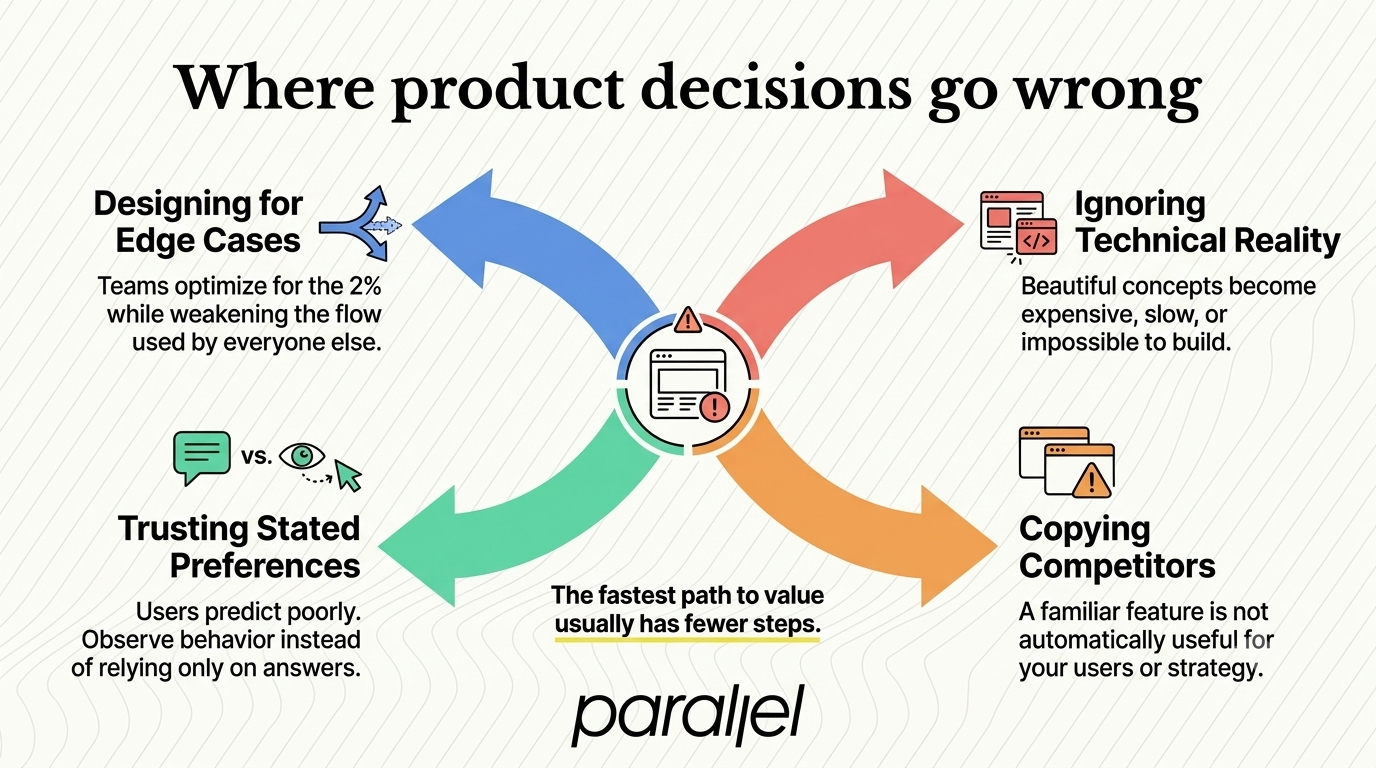
Here are the most common patterns where product decisions go wrong.
- Designing for the edge case: Teams spend weeks designing features that only 2% of users will ever see. They ignore the core flow that 98% of users rely on daily.
- Ignoring the technical reality: Designers create beautiful concepts that require a massive engineering lift. By the time the feature is built, the market has moved on.
- Asking users what they want: Users are terrible at predicting their future behavior. You have to observe what they do, not listen to what they say they will do.
- Copying competitors blindly: Just because a billion-dollar company has a certain feature does not mean it is a good idea. They might be trying to deprecate it right now.
A clear example of this is SaaS onboarding. We regularly perform SaaS onboarding teardowns. The biggest mistake is forcing users through a 10-step tutorial before letting them see the core value of the product.
A 2025 study from the Baymard Institute highlights that complex checkout and onboarding flows cause 68% of users to abandon the process. You must simplify. Get the user to their first "aha" moment in the fewest clicks possible.
How to think about your product strategy correctly
Before you start sketching screens, you need absolute clarity on the problem. Good design is just good decision-making made visible. You need to align your team on the core user journey before worrying about button colors or typography.
We structure this thinking through a few specific phases.
- Define the precise problem: Do not say the problem is "low engagement." The problem is that "users drop off after completing step two of the profile setup." Precision matters.
- Map the opportunity: We use opportunity mapping to visualize the entire user journey. We look for the areas of highest friction and prioritize those immediately.
- Embrace constraints: Time and budget constraints are good for design. They force you to focus on the absolute minimum viable solution required to test an assumption.
- Design for validation, not perfection: Create a prototype that looks real enough to test, but do not spend weeks polishing it. The goal is to learn quickly.
Think of your product as a funnel. If the top of the funnel is broken, optimizing the bottom is a waste of time. You have to fix the foundational UX before applying visual polish. A solid UX metrics framework will tell you exactly where the leaks are.
A practical approach to building better products
In my experience, the best way to solve product problems is through intense, timeboxed collaboration. You cannot solve complex UX issues through asynchronous Slack messages and weekly status calls. You need the whole team focused on one problem.
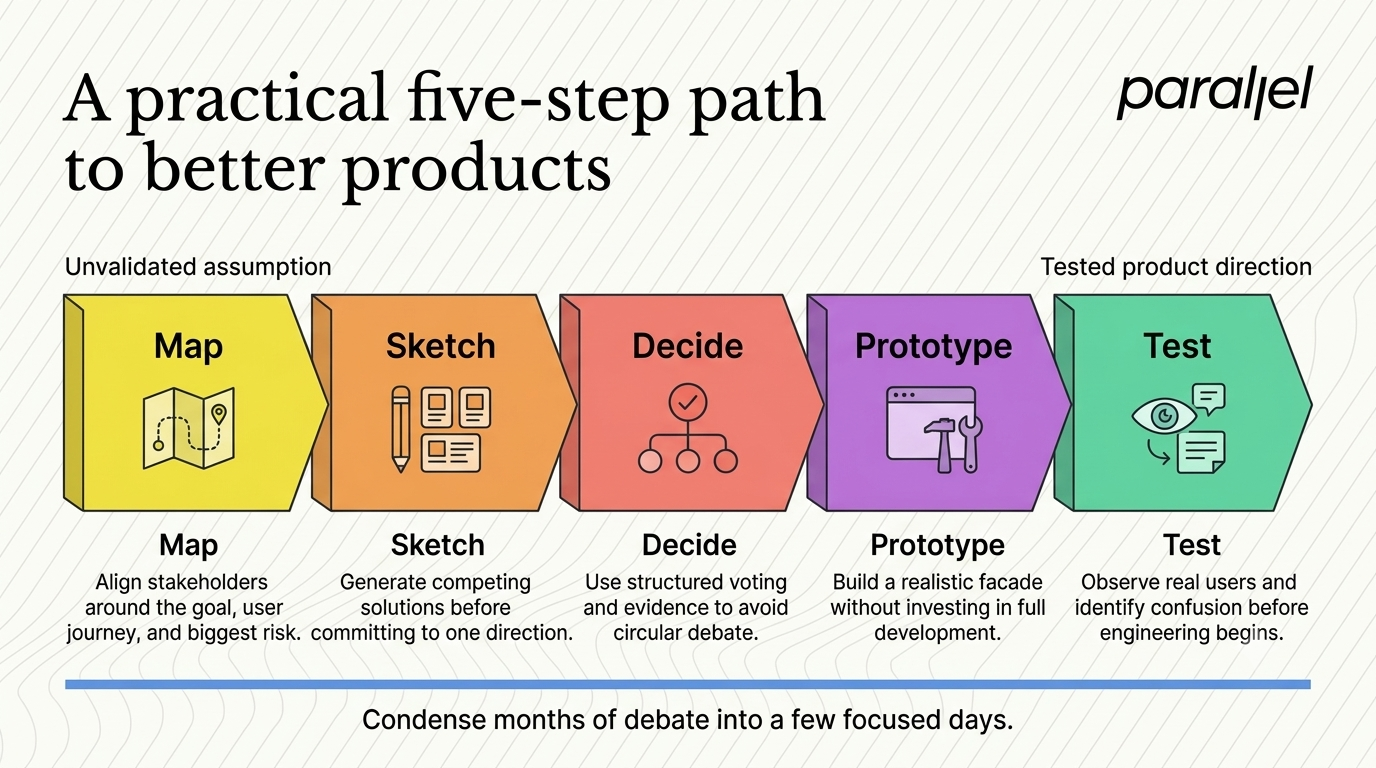
This is why we rely so heavily on the design sprint framework. It condenses months of debate into a few days.
- Map the problem: Get all stakeholders in a room. Define the long-term goal and map the user journey.
- Sketch solutions: Have everyone, including engineers and founders, sketch competing solutions. Good ideas come from everywhere.
- Decide: Use structured decision-making to pick the best concepts. Avoid endless debate.
- Prototype: Build a high-fidelity facade of the solution using Figma design services. It only needs to be real enough for user testing.
- Test: Put the prototype in front of five real users. Watch where they get confused.
This process grounds your decisions in real user behavior. It stops teams from building things nobody wants. It is the most effective discovery framework we have seen for early-stage and growth-stage companies alike.
The role of AI in modern product design
You cannot talk about product strategy today without discussing artificial intelligence. However, bolting a chatbot onto a legacy platform is not an AI strategy. It is a gimmick. Teams are rushing to integrate AI without understanding the fundamental changes it brings to user interaction.
2026 insights from IDEO suggest that integrating AI into core product flows requires a massive shift in how we think about trust and transparency. Users need to understand why an AI made a specific recommendation. If it feels like a black box, they will reject it.
When we handle AI UX design, we focus heavily on the feedback loop. How does the user correct the AI when it is wrong? How do we design interfaces that gracefully handle probabilistic outcomes? The interface must set the right expectations.
If your team is unsure how to approach this, running an AI readiness design scorecard is the best first step. It helps identify exactly where machine learning can remove friction from your specific user journey without overwhelming the user.
Conclusion
Building a great product is incredibly difficult. It requires saying no to a hundred good ideas so you can focus on the one great idea. You do not need an agency to build a feature factory. You need a partner who will challenge your assumptions and help you find the simplest path to user value.
Stop worrying about making your product look trendy. Start worrying about making it obvious. When you ground your design decisions in real user behavior, clarity naturally follows. Let the insights drive the interface.
Frequently asked questions
1) What exactly does a ui & ux design agency do?
A modern ui & ux design agency goes far beyond making screens look visually appealing. They conduct deep user research, define the product strategy, map out user journeys, and create interactive prototypes. Their primary goal is to ensure the product solves real user problems while driving measurable business metrics like retention and activation.
2) How much should product design services cost?
Pricing varies wildly based on the scope and the partner. A simple web redesign might cost a few thousand dollars, while a complex enterprise software overhaul can run into the hundreds of thousands. We recommend focusing on the ROI of the engagement. Good design reduces engineering waste and increases conversion rates.
3) How long does a standard product redesign take?
A traditional agency might quote six to nine months for a full redesign. In our experience, startups cannot afford to wait that long. By utilizing focused design sprints and rapid prototyping, core product validation can often be completed in just a few weeks.
4) Is hiring a ui & ux design agency right for my startup?
If your team is struggling with low user activation, confusing workflows, or a lack of alignment on product vision, hiring an expert is a smart move. A great ui & ux design agency will provide the outside perspective necessary to cut through internal biases and focus purely on what the user needs to succeed.
5) What is the difference between UI and UX?
User Experience (UX) is the strategic foundation. It covers research, logic, wireframing, and user testing. It dictates how a product works. User Interface (UI) is the visual execution. It covers typography, color, spacing, and brand alignment. You cannot have a successful UI without a solid UX foundation underneath it.
6) Why should we run a design sprint?
Design sprints save time and money. Instead of spending three months building a feature to see if users like it, a sprint allows you to build a realistic prototype and test it in five days. It eliminates endless internal debate and relies strictly on validated user feedback to make decisions.
7) Should we hire an in-house designer or partner with an agency?
Early-stage teams often benefit more from an agency partner because they get access to high-level strategic thinking without the overhead of a full-time senior hire. As the product matures and the design system stabilizes, transitioning to an in-house team for ongoing iterative execution makes more financial sense.
8) How does ParallelHQ differ from a standard ui & ux design agency?
We do not focus on surface-level visual changes or agency fluff. We partner with founders and product leaders to solve complex UX problems with absolute clarity. Unlike a traditional ui & ux design agency, we use intensive frameworks like design sprints to validate ideas rapidly, ensuring you only build what actually matters to your users.

check out these related blogs





















.webp)
































.avif)