Picking the wrong design partner as an AI startup doesn't just cost money, it costs months. Most generalist studios treat your AI product like a slightly unusual dashboard. They miss uncertainty states, ignore trust architecture, and hand you polished mockups that real users abandon in week one. I've watched this play out repeatedly. This list of the best product design agencies for AI startups cuts through roundup noise and gives you the agencies that actually understand what makes machine learning interfaces work, and the one I'd put at the top.
The 10 Best Product Design Agencies for AI Startups
Here are the agencies that, in my view, can genuinely move the needle for AI and SaaS founders in 2026. Each has been evaluated on AI product depth, startup fit, and process maturity, not just name recognition.
1) ParallelHQ sits at the top because we were built specifically for founders at this stage. Our AI UX design practice is grounded in how real users interact with probabilistic outputs, including the hesitation, doubt, and abandonment moments that generalist agencies never design for. We run structured design sprints to compress discovery and we maintain production-ready design systems so your engineering team doesn't wait on us.
2) Punchcut: A leader in human-centered AI design, with over 20 years of expertise across intelligent products, AI agents, multimodal interfaces, and autonomous systems. Strong fit if you're building at enterprise scale.
3) Clay: Combines premium design execution with deep AI expertise, working with Fortune 500s and ambitious startups, and has built products for Facebook, Google, Slack, Coinbase, Stripe, and Amazon.
Some clients note high costs and occasional communication gaps in larger projects, Clay works best for well-funded companies building high-visibility AI products.
4) Lazarev.agency: Pairs bold design with business sense, 9 years, 500+ projects, 120+ international awards including three Webbys, with work across early-stage startups and established brands in fintech, SaaS, Web3, and real estate.
5) ANML: Built for companies that want a senior team doing applied AI work for years, and best fit for funded B2B and consumer companies where AI is core to the product, not just a feature.
6) Lollypop Design Studio: Specializes in complex emerging technologies, with a portfolio that includes AI co-pilot platforms using LLM-powered interfaces, and work across industries including FMCG, telecom, healthcare, gaming, government, AI, and retail.
7) UITOP: Provides full-cycle support from product strategy to design system implementation, a critical approach for AI products where consistency directly affects user trust.
8) 925Studios: Specializes in designing for outputs users cannot fully predict, building trust signals into the interface layer, and creating onboarding flows that close the gap between model capability and what users actually do in session one, the highest-signal option for seed-to-Series-B founders at a startup-compatible price point.
9) MetaLab: Strong interface design pedigree (built Slack's original UI) with a growing AI portfolio across funded consumer and SaaS products.
10) OneThing Design: A lean, focused studio for founders who need clear MVP execution without the overhead of a large agency engagement.
What Makes a Good Design Agency for Artificial Intelligence Products
Designing for AI isn't the same as designing for SaaS. The mental models are different. The failure states are different. The trust architecture is different.
Most generalist agencies fail AI startups in four predictable ways:
- Probabilistic outputs go undesigned: Traditional software offers deterministic responses, click a button, get a result. AI products produce probabilistic responses with varying confidence. Most design agencies lack expertise in designing for this, providing only a single clean output view while actual users encounter a spectrum of output quality with no interface cues to assess it.
- Trust architecture is skipped: Whether the user believes the AI is working in their interest and can explain its reasoning is the core conversion metric. Building trust through interface design requires specific patterns, explainability components, confidence signals, user-control affordances, and graceful degradation states.
- Feedback loops are ignored: AI products improve through user feedback, meaning the interface must support feedback collection, ratings, corrections, and flagging in ways that feel natural, a design challenge that most agencies don't account for.
- Only the happy path is designed: Agencies approach AI products as slightly modified dashboards, focusing only on the ideal scenario where the AI produces the right answer and treating uncertainty, error states, and low-confidence outputs as afterthoughts, yet these unaddressed "edge cases" directly cause users to leave.
A genuinely capable agency will show you case studies where AI is the core product, not a chatbot wrapper bolted onto a SaaS dashboard.
Four factors distinguish a design agency that advances an AI startup from one that simply delivers attractive, unusable files: real AI product case studies, not AI-assisted design workflows, not chatbot UI overlays added to an existing SaaS product, but actual case studies where the core product is an AI system, an agent, a copilot, a prediction engine, or a generative tool, and where the agency designed the full interaction model from input to output to feedback. Ask any candidate agency to show you their designs for uncertainty states. If they look confused by the question, end the call.
How to Choose a Product Design Agency for Your AI Startup
A structured selection process saves you from expensive misfires. Follow these steps in order:

- Define your current stage clearly: Pre-PMF startups need different things than Series A companies scaling a known product. Agencies like Clay, Lazarev, and UITOP are excellent for enterprise products with $50,000+ project budgets, but they are not built for a 12-person seed-stage AI startup that needs to ship a product in six weeks and find PMF.
- Audit their AI portfolio specifically: Evaluate AI design skills (do they create AI products, or just use AI tools?), proven client outcomes (do they have actual demonstrations of real client results?), and design process maturity (is their process clear, tested, and repeatable?).
- Run a UX audit on their own case studies: Look for documentation of error states, onboarding flows for AI-native features, and feedback mechanism design.
- Validate their process for speed: For most pre-Series A startups, a design sprint should be possible within two to three weeks. If the agency can't scope one quickly, they're not built for startup velocity.
- Check for startup-native pricing: Budgets across leading AI product design agencies in 2026 range from $15,000 to $80,000 depending on scope and agency tier. Know your range before you enter conversations.
- Ask about their product strategy consulting capabilities: Design without strategic framing produces pretty outputs that don't move metrics.
Agency vs. In-House Designer for Your AI Startup: Which Is Better?
This is one of the most common questions I hear from founders at the early stage. The honest answer depends on where you are.
An in-house team offers brand intimacy and direct control but comes with high fixed costs and limited scalability. Freelancers are flexible and affordable for small tasks, but risk inconsistency and place project management on you.
A design agency provides a bundled team, project management, and predictable costs, with higher upfront investment but lower long-term risk.
Three main risks come with hiring in-house: hiring the wrong person (costing 3–6 months of salary plus recruiting fees to replace them), the designer leaving for a better-resourced company (common at startups), and paying full-time costs during periods of low design workload.
At Series A and beyond, a full-time design lead combined with an agency for overflow capacity or specialized work is a common and effective model. At earlier stages, one embedded agency engagement is typically sufficient and more cost-effective.
My view: at pre-PMF, hire an agency. At post-PMF with a clear design roadmap, bring in a design lead and keep a specialist agency for strategic spikes like a discovery framework or usability testing.
What to Look for in a Design Agency for Your AI SaaS Product
The selection criteria for an AI SaaS context are more specific than for general digital products. Standard UX design assumes consistent, predictable system behavior. AI interface design differs because it handles probabilistic outputs where results vary with each query, requiring additional design layers including explainability, fallback states, confidence indicators, and user control over autonomous decisions that traditional UX never addresses.
Evaluate any agency on these dimensions before committing:
- Human-centered design fluency: Do they start from user behavior and mental models, not feature lists?
- Conversational UI and machine learning interface experience: Have they designed for LLM outputs, recommendation engines, or AI agents, not just chatbot wrappers?
- Information architecture for complex AI outputs: Can they structure dense, probabilistic data into interfaces that feel clear and trustworthy?
- Figma and design systems discipline: A production-ready Figma design service and an extensible design system are non-negotiable, your engineering team's velocity depends on them.
- Usability testing methodology: Do they run usability testing with actual target users, or just internal reviews?
- Interaction design maturity: AI UX requires more than polished UI, it needs transparency, explainability, trust calibration, feedback, and human control.
92% of companies plan to increase AI investments within the next three years, and 78% of organizations already use AI in at least one business function, up from 55% in 2023. The demand for agencies that can execute on AI product design is accelerating faster than supply. Specialist firms are filling up fast, and will become harder to access as more funded startups compete for them. The AI design market was worth around $993 million in 2025 and is projected to grow to nearly $17 billion by 2035, a CAGR of 32.75%.
Why Venture-Backed AI Startups Need Specialized Product Design Firms
The surge of $109 billion in US AI investment in 2024 exposed a core issue: while thousands of AI startups have advanced models and interfaces, users often lack trust, understanding, and ultimately engagement, and many startups work with design agencies that fail to grasp the unique needs of AI products.
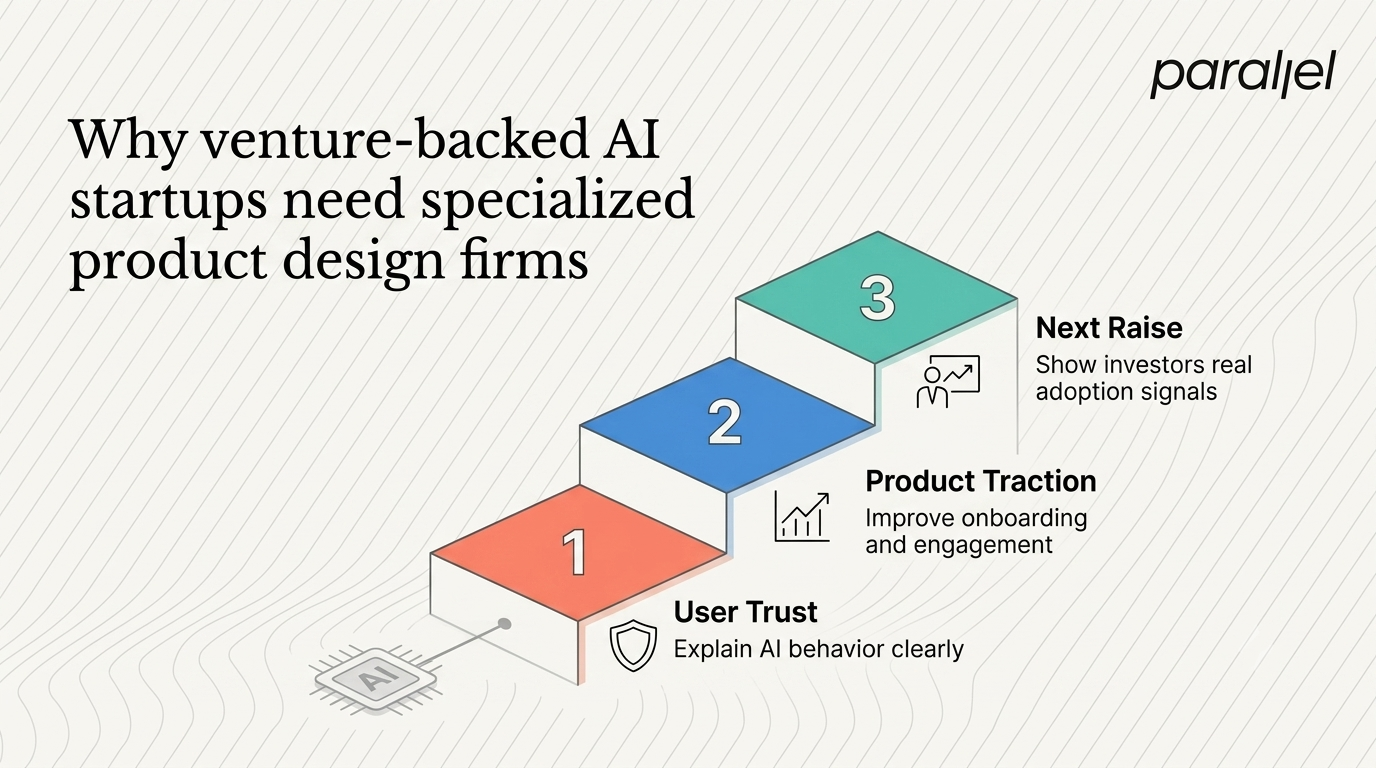
Agencies typically deliver visually appealing mockups and move on, but product teams are left fixing critical flows, especially onboarding, because users can't understand the AI's actions or rationale. This results in wasted months rebuilding essential user journeys.
For venture-backed startups specifically, the stakes are higher because:
- Your next raise depends on demonstrable product traction, not a polished deck.
- Investor scrutiny now includes product experience quality, not just model performance.
- Time-to-PMF is finite; rebuilding UX post-launch is expensive and demoralizing.
The product design agencies for AI startups that deliver real value at this stage treat your startup MVP as a hypothesis to be tested, not a waterfall project to be delivered. They bring UX research and wireframing and prototyping into the process early, so the product you build reflects how actual users think, not how your team imagines users think.
At ParallelHQ, every engagement for an AI or B2B SaaS startup starts with an AI Readiness Design Scorecard to surface the trust and interaction gaps that will hurt adoption before they cost you users. Our product design services are built for the specific sprint-to-scale rhythm of early-stage AI companies, with senior designers on every account, not juniors handed a brief.
Conclusion
- Product design agencies for AI startups must go beyond visual craft, trust architecture, feedback loop design, and uncertainty state handling are the real differentiators.
- Most enterprise-focused agencies (Clay, Lazarev, UITOP) are excellent but mismatched for pre-Series A timelines and budgets.
- An embedded agency beats an in-house hire at the pre-PMF stage for speed, flexibility, and AI specialization.
- ParallelHQ was built for exactly this context: senior-led, startup-native, and grounded in how real users engage with AI products.
Ready to pressure-test your product's UX before it goes to users? Request a UX Audit or explore our AI software design services.
Frequently Asked Questions
1) What makes product design agencies for AI startups different from regular UX agencies?
AI-specific agencies design for probabilistic outputs, trust signals, fallback states, and feedback loop integration. Standard UX agencies assume deterministic software behavior, a mismatch that produces onboarding flows and output screens that real AI product users abandon quickly.
2) How much does a product design agency for an AI startup typically cost?
Budgets across leading AI product design agencies in 2026 range from $15,000 to $80,000 depending on scope and agency tier. Early-stage startups should target agencies with startup-compatible pricing and defined sprint-based delivery milestones rather than open-ended retainers.
3) When should an AI startup hire an agency instead of building an in-house design team?
Pre-PMF and early Series A stages favor agencies: no hiring risk, immediate AI design specialization, and flexible capacity. At Series A and beyond, combining a full-time design lead with an agency for specialized work is a common and effective model. At earlier stages, one embedded agency engagement is typically more cost-effective.
4) What questions should I ask a design agency before hiring them for my AI product?
Ask to see case studies where AI is the core product, not a feature overlay. Ask how they design uncertainty states and error handling. Ask about their usability testing methodology and whether they build design systems in Figma. If they can't show real LLM interface work, move on.
5) Can a general SaaS design agency handle AI product design?
Occasionally, but rarely well. Most generalist design agencies predictably fail AI startups, they approach AI products as slightly modified dashboards, focusing only on the ideal scenario where the AI produces the right answer. Look for documented AI-specific processes, not generalist portfolios with one AI project added.
6) How do I evaluate whether a product design agency understands machine learning interfaces?
Ask them to walk you through how they design confidence indicators, low-output states, and user correction flows. If their answer centers only on visual hierarchy and color systems, they're treating your AI product like a regular SaaS dashboard. The right agency understands your product's risk, your users' mental models, your technical constraints, and the trust problem your interface must solve.

check out these related blogs

















































.webp)