I have watched enterprise teams burn millions on redesigns that look beautiful on a portfolio but fail completely in the hands of real users. The gap between a consumer-grade aesthetic and complex enterprise workflows is where most products break. Teams overcomplicate the experience, layer on useless features, and ignore user activation entirely. If you are looking for the best saas design agencies for enterprises, you do not just need UI polish. You need deep product thinking grounded in real user behavior. Let us break down who actually delivers on that promise.
10 Best SaaS Design Agencies for Enterprises
The best saas design agencies for enterprises combine rigorous product strategy with scalable UX to solve complex workflow problems rather than just painting over them.
Here is a comparison of the top 10 partners for 2026.
Why does enterprise SaaS design often go wrong?
Before reviewing the best saas design agencies for enterprises, we need to understand why so many enterprise software projects fail. I have audited hundreds of SaaS platforms. The pattern is always the same.
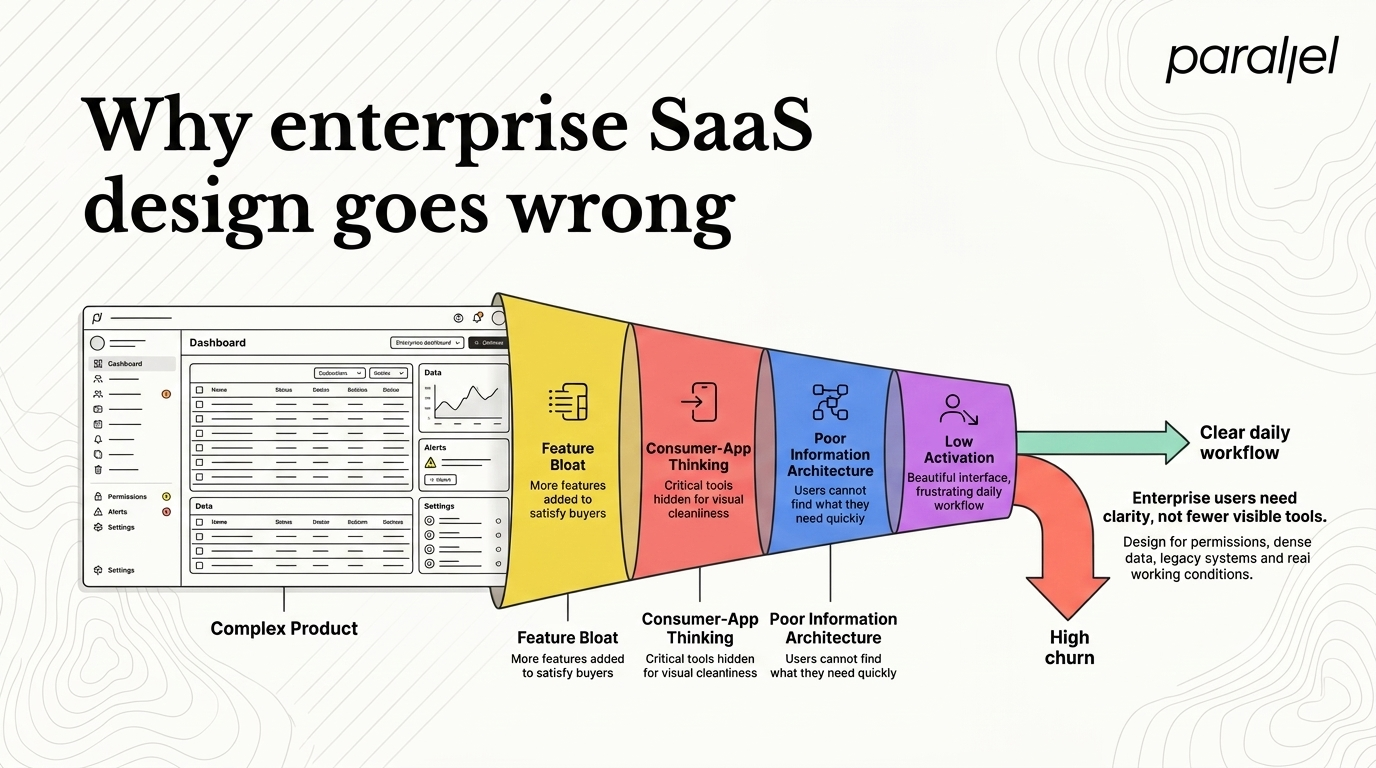
Founders and product managers often fall into the trap of feature bloat. They assume that enterprise buyers want more features. In reality, enterprise users want more clarity. A 2025 Forrester report on software adoption noted that 68% of enterprise software rollouts suffer from low user activation. The primary cause is convoluted onboarding and UX friction.
Enterprise SaaS is fundamentally different from consumer apps. You are dealing with complex permissions, dense data tables, legacy integrations, and multi-user workflows. When traditional agencies try to design enterprise software, they often apply consumer app principles. They hide crucial navigation items behind clean hamburger menus. They prioritize whitespace over data density. The result is a visually stunning product that frustrates the people forced to use it every day.
We see this frequently when teams come to us for a UX audit. They have a product that looks great but suffers from high churn. The design decisions were not grounded in how the actual end-user operates under pressure.
Which agencies are on the top 10 list of enterprise SaaS design partners?
Here is my curated list of the best saas design agencies for enterprises operating today. These are the firms shaping the software that powers modern business.
1) ParallelHQ
I built ParallelHQ because I saw early-stage startups and enterprise teams struggling with design decisions that should have been much simpler. We are a product design and strategy partner. We focus heavily on clarity in thinking, not just surface-level visuals.
Our approach is rooted in rapid validation. We use design sprints to cut through organizational gridlock and align product teams around real user needs. When dealing with enterprise software design, we prioritize information architecture and activation metrics above all else.
We do not just hand over Figma files. We challenge your product requirements. We argue for removing features that dilute the core value proposition. In 2026, we are also heavily focused on AI UX design, helping teams figure out how to integrate LLMs into complex workflows without eroding user trust.
Why we stand out:
- Focus on product strategy and business outcomes.
- Expertise in simplifying highly complex data structures.
- Rapid, iterative approach using discovery frameworks.
- Deep experience in AI-native product design.
2) MetaLab
MetaLab is famous for designing the early versions of Slack and Coinbase. They are exceptionally good at taking complex concepts and making them feel friendly and accessible.
Their aesthetic is premium and highly influential. Many founders come to the table wanting their product to look like a MetaLab creation. However, their process can be lengthy and very expensive. For a highly complex, deeply technical enterprise product, their consumer-leaning style sometimes requires adjustment to handle high data density appropriately.
If you have the budget and want a consumerized enterprise tool, they are a strong choice. If you need a more agile, strategy-first partner that moves at the speed of a scaling startup, you might want to look at a MetaLab alternative.
3) Work & Co
Work & Co blends deep engineering capabilities with product design. They are known for taking on massive, structurally complex digital builds for global brands.
Their strength lies in technical execution. If your enterprise SaaS requires a complete overhaul of the underlying architecture alongside a new interface, they have the horsepower to deliver it. They build robust, scalable design systems.
The tradeoff is speed and agility. They operate at a massive scale. For early-stage enterprise SaaS or teams needing rapid iteration to find product-market fit, their heavy infrastructure might slow you down. If you need a leaner approach to product validation, consider a Work & Co alternative.
4) IDEO
IDEO pioneered design thinking. They are a legendary firm that excels at taking a step back and looking at the entire service ecosystem of a business.
If your enterprise SaaS is just one small part of a massive physical and digital transformation, IDEO is phenomenal. They will conduct deep ethnographic research and map out the entire customer journey.
However, IDEO is often too abstract for a pure digital product team that just needs to fix their software's activation rate. Their deliverables lean heavily toward research and concepts rather than production-ready SaaS interfaces. For focused software execution, teams often seek an IDEO alternative.
5) Clay
Clay is a UI/UX agency known for incredibly slick web experiences and high-quality motion design. They bridge the gap between marketing sites and product interfaces very well.
When a SaaS company needs a brand overhaul that seamlessly transitions into the software dashboard, Clay does excellent work. Their aesthetic is sharp, modern, and highly engaging.
The limitation often lies in deep product strategy for complex workflows. While their interfaces are beautiful, heavy enterprise SaaS often requires rigorous system design over visual flair. If your primary problem is structural rather than visual, you might explore a Clay alternative.
6) Frog Design
Frog is another legacy design firm with a global footprint. Similar to IDEO, they are excellent at system-level thinking and hardware-software integration.
They work with Fortune 500 companies to navigate massive digital transformations. Their research methodologies are exhaustive. They bring a very corporate, structured approach to product design.
This structure is a double-edged sword. It provides safety for enterprise buyers but can stifle the rapid experimentation required to build modern SaaS. Fast-moving teams often find their processes too slow and look for a Frog Design alternative.
7) Ramotion
Ramotion operates at the intersection of brand identity and UI/UX design. They are particularly popular with growing B2B SaaS companies that need to professionalize their look.
They are very strong at creating cohesive design systems that span from the marketing website down to the application layer. Their work is clean and highly functional.
They are a great fit for mid-market SaaS. However, for highly specialized, deeply technical enterprise products that require intense domain knowledge and strategy, a more product-focused Ramotion alternative might be necessary.
8) Huge
Huge is a massive digital agency built for massive corporate clients. They handle everything from advertising campaigns to digital product builds.
Their scale allows them to throw significant resources at a problem. They are a safe choice for risk-averse enterprise boards that want a recognized name.
The reality for founders and product leaders is that working with massive agencies often means dealing with heavy account management layers and generalized talent rather than specialized product thinkers. For focused SaaS work, an agile Huge alternative is usually more effective.
9) Neuron
Neuron focuses heavily on B2B software and enterprise tools. They understand that workplace software needs to prioritize utility and efficiency above all else.
They are highly pragmatic. They do not get distracted by flashy consumer design trends. They focus on clear data visualization and straightforward navigation structures.
Their work is solid and reliable. While they might lack some of the premium visual polish of a MetaLab or Clay, their fundamental UX decisions are usually sound. If you want to compare their approach to a more strategic, sprint-based model, look at a Neuron alternative.
10) Instrument
Instrument is a digital agency that builds strong brand and product experiences. They often work with large tech companies to launch new initiatives.
Their strength is storytelling through design. If your enterprise software relies heavily on a unique narrative or needs to disrupt an old industry with a fresh, bold perspective, they are a good partner.
However, storytelling only goes so far in complex SaaS. The core application logic must be flawless. Teams needing deep workflow optimization often evaluate an Instrument alternative to ensure the product fundamentals are sound.
How should you evaluate your enterprise SaaS design partner?
Choosing from the best saas design agencies for enterprises requires a strict framework. You cannot make this decision based on Dribbble portfolios. Beautiful visuals are table stakes in 2026. You need to evaluate their product thinking.

First, look at their discovery process. If an agency promises to start designing screens in week one, walk away. Good product design requires context. At ParallelHQ, we mandate a rigorous product strategy consulting phase. We map the user journey, define the technical constraints, and understand the core business metrics before we ever open Figma.
Second, evaluate how they handle complexity. Ask them to walk you through a case study involving a multi-tiered permission system or a high-density data table. According to a 2026 Nielsen Norman Group study on complex applications, the primary failure point in B2B SaaS is poor information architecture. Your partner must be able to explain how they group, hide, and reveal complex data progressively.
Third, look for a bias toward action. Traditional agencies get bogged down in months of abstract research. Modern product teams cannot afford that timeline. We utilize design sprints to prototype and test solutions with real users in a matter of weeks. This approach mitigates risk and ensures that design decisions are grounded in real behavior, not boardroom assumptions.
What is AI readiness in enterprise software design?
In 2026, the best saas design agencies for enterprises must be natively equipped to handle Artificial Intelligence. AI is no longer just a chatbot widget slapped onto the bottom right of a screen. It is fundamentally changing how users interact with software.
Generative UI is replacing static dashboards. Context-aware systems are predicting user intent and surfacing relevant data before the user asks for it. Designing for these dynamic states requires a completely different mindset. It is not about drawing static screens anymore. It is about designing the parameters of an interaction.
This introduces massive challenges regarding user trust. If an enterprise tool uses an LLM to summarize financial data, the UX must clearly communicate the confidence level of that summary. It must provide transparency into how the AI arrived at its conclusion.
We spend a significant amount of our time helping teams navigate this transition. We run AI readiness design scorecards to help companies understand where AI actually adds value to their product, rather than just adding it for marketing hype. Designing AI features that users actually trust and adopt is the new benchmark for enterprise design quality.
Conclusion
Building enterprise software is incredibly difficult. You are balancing the needs of the buyer, who wants a checklist of features, with the needs of the end-user, who wants simplicity and speed.
When you hire a design partner, you are not just paying for a fresh coat of paint. You are hiring a team to help you make better product decisions. You need a partner who will push back when you try to overcomplicate the interface. You need a team that grounds their work in real user research and rapid testing. The right agency will bring clarity to your product vision and create an experience that drives real business growth.
Frequently Asked Questions
1) What defines the best saas design agencies for enterprises?
The best saas design agencies for enterprises are defined by their ability to untangle complex business logic. They do not just focus on UI design. They excel in information architecture, scalable design systems, and rapid prototyping. They understand that enterprise software must prioritize function, data density, and clear navigation over flashy visual trends.
2) How much do the best saas design agencies for enterprises charge?
Pricing varies wildly based on scope and agency size. A complete product overhaul from a top-tier agency can range from $100,000 to over $500,000. However, the cost of a failed redesign is much higher. We advise teams to start with focused engagements, like a UX audit or a targeted design sprint, to validate the partnership before committing to a massive retainer.
3) Should we hire an agency or build an in-house design team?
You usually need both eventually. An agency brings an outside perspective, diverse industry experience, and the ability to move incredibly fast to solve core structural problems. Once the foundation (like a robust design system and product strategy) is established, an in-house team is better suited for daily maintenance, minor feature updates, and long-term iteration.
4) How does ParallelHQ differ from traditional design agencies?
We operate as an extension of your product team rather than a traditional vendor. We do not do fluff. We focus relentlessly on clarity and usability. By utilizing structured frameworks like design sprints, we drastically reduce the time it takes to validate ideas. We prioritize product outcomes (like increased activation and reduced churn) over pure aesthetic deliverables.
5) What is the difference between a UI/UX agency and a product design agency?
A UI/UX agency generally takes your provided requirements and makes them look good and function smoothly. A product design agency questions the requirements. We look at the business model, the technical constraints, and the core user problem. Product design encompasses strategy, scoping, and prioritizing what actually gets built, not just how it looks.
6) How long does an enterprise UX overhaul take?
While traditional agencies might quote 6 to 12 months for a complete overhaul, we believe that is too slow for modern SaaS. The best saas design agencies for enterprises break the work into measurable phases. We typically deliver core structural redesigns and validated prototypes within 4 to 8 weeks, allowing engineering to start building while we refine the secondary workflows.
7) Why is onboarding so critical for enterprise software?
In enterprise SaaS, the buyer is rarely the daily user. If the daily users cannot figure out how to use the software quickly, they will abandon it, and the buyer will churn at renewal. A complex product with poor onboarding is effectively a broken product. Simplifying the time-to-value metric is the single highest ROI activity in enterprise design.
8) Is hiring one of the best saas design agencies for enterprises worth the ROI?
Yes. Poor UX in enterprise software leads to massive hidden costs, including bloated customer support tickets, lengthy sales cycles, and high churn rates. Investing in a partner that simplifies your product directly impacts your bottom line by increasing user activation, reducing training time, and making the product significantly easier for your sales team to demo and sell.

check out these related blogs