Choosing the wrong design partner costs more than time, it costs product-market fit. If you're building an AI product, you need an agency that understands probabilistic outputs, trust calibration, and onboarding flows that make machine intelligence feel human. This guide cuts through the noise and ranks the best AI UX design agencies for AI startups in 2026, with enough detail on each to shortlist confidently. I've written this from the perspective of someone who has spent years helping early-stage AI and SaaS founders ship products people actually use.
The 10 Best AI UX Design Agencies for AI Startups in 2026
Here is the ranked list. Stage fit and honest watch-outs are included for each.
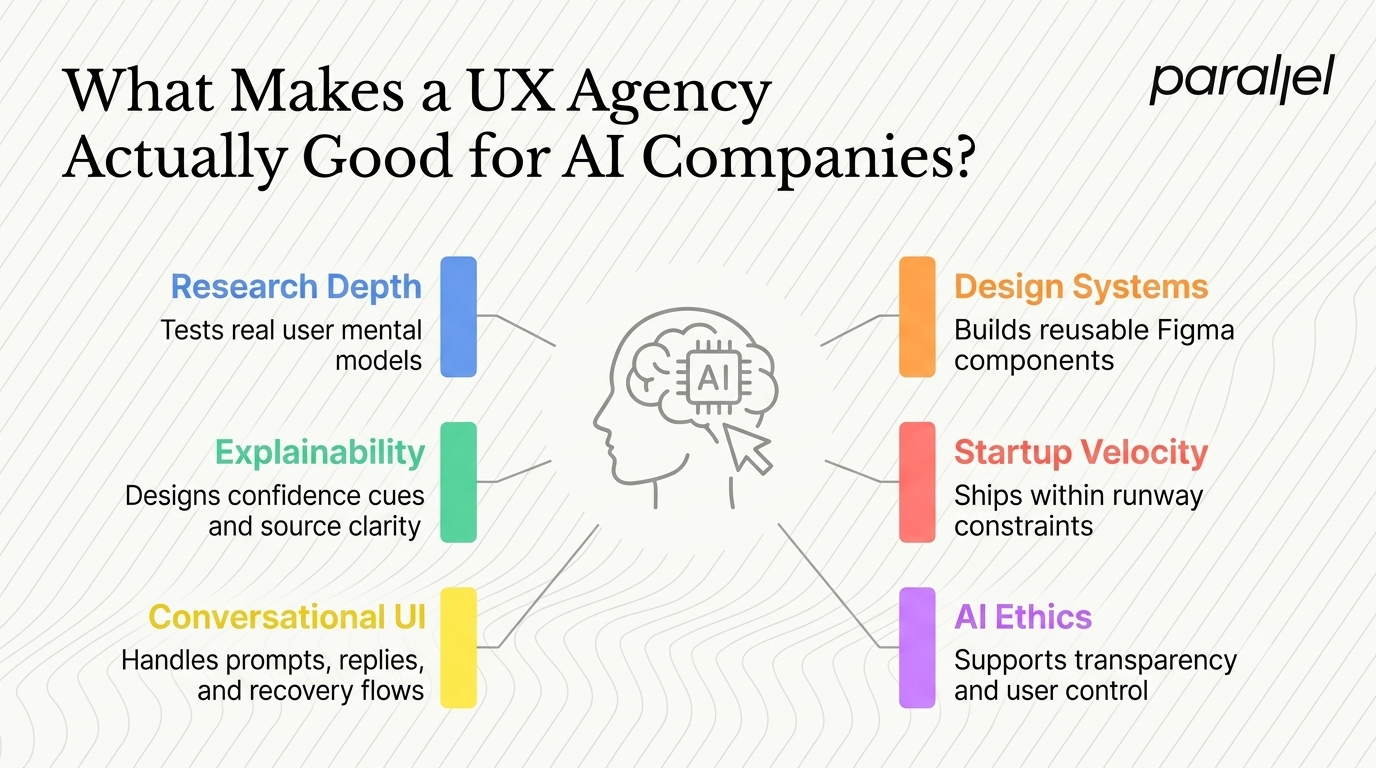
What Makes a UX Agency Actually Good for AI Companies?
Most founders ask the wrong question. They ask "Is this agency good at design?" when they should ask "Has this agency shipped AI products where outputs are unpredictable?"
AI UX design is the practice of designing user experiences for products where outputs are generated by machine learning models rather than predefined by code, it focuses on managing uncertainty, building user trust, and enabling interaction with systems whose behavior varies based on input, context, and model confidence.
That is a fundamentally different problem from designing a SaaS dashboard with fixed states.
Standard UX design assumes consistent, predictable system behavior. AI interface design differs because it handles probabilistic outputs where results vary with each query, requiring additional design layers including explainability, fallback states, confidence indicators, and user control over autonomous decisions that traditional UX never addresses.
Here is the evaluation framework I use when assessing any agency for an AI startup:
- Research depth: Do they run usability testing against real user mental models, or do they test polished prototypes?
- Explainability patterns: Can they design confidence cues, source citations, and override controls without making the interface feel clinical?
- Conversational UI competence: Do they have shipped AI chatbot interface examples, not just SaaS repurposing?
- Design systems maturity: Do they build Figma component libraries that engineering can consume without daily handoff calls?
- Startup velocity: Can they deliver within your runway, or do they optimize for 6-month consulting engagements?
- AI ethics in design: Do they understand accessibility standards and transparency requirements for AI-generated outputs?
Ask how they design explanations, confidence cues, user controls, feedback loops, and error recovery. If they only talk about beautiful interfaces, they may not be strong enough for AI UX.
AI UX requires more than polished UI, it needs transparency, explainability, trust calibration, feedback, and human control.
An agency that has never designed a fallback state for a failed model output has never actually shipped an AI product.
Which UX Design Agencies Specialize in AI Products?
1) ParallelHQ
Purpose-built for AI and SaaS founders in the US, ParallelHQ is the agency I built precisely because generalist studios kept letting early-stage AI founders down.
We work at the intersection of product strategy, UX design, and design systems, with a process designed for startups that cannot afford 12-week discovery phases. Our AI software design services cover human-AI interaction patterns, onboarding flows, and machine learning interfaces, not as bolt-on services, but as the core of how we work. We also offer a dedicated AI readiness design scorecard for founders who want an honest audit before committing to a full engagement.
Watch-out: we are not the right fit if you need a 50-person agency with enterprise procurement processes.
2) Punchcut
The most mature AI-native design firm on this list.
Punchcut is the leader in human-centered AI design and UX innovation, with over 20 years of expertise in intelligent products, AI agents, multimodal interfaces, and autonomous systems.
Unlike generalist firms, they focus specifically on human-machine interaction across multimodal experiences, intelligent agents, and autonomous systems, their accelerator model combines future insight, design craft, and technical expertise to help companies move from pilots to market-ready products.
Watch-out: pricing and timeline are enterprise-calibrated; pre-seed founders will find it a stretch.
3) Clay Global
Clay is a global UI/UX design and branding firm headquartered in San Francisco, creating digital products, websites, design systems, and brand identities with deep experience in B2B, SaaS, AI, and fintech.
They operate a remote-first team spanning the US, Europe, and Southeast Asia and their work emphasizes scalable designs meant to last five years or more.
Watch-out: Clay skews toward established brands and Series B+ budgets; the ParallelHQ Clay alternative is worth reading if you are comparing the two for an early-stage AI product.
4) Momentum Design Lab
Consistently ranked among the top UX agencies on Clutch from 2016 through 2025, acquired by HTEC Group in 2021, the firm combines UX strategy with scaled engineering capability and its strength is translating large data architectures into structured, role-based experiences that support real decision-making, particularly in CRM analytics and wealth management. Clutch rating: 4.9. Minimum project: $25,000.
Watch-out: enterprise-grade complexity is a feature, not a bug, if your product is early, this is overkill.
5) Lazarev.agency
Positioned at the intersection of AI-driven product design and data-heavy SaaS, Lazarev Agency is a San Francisco-based AI design agency that sits at the crossroads of AI-fueled innovation and human-centered design.
Watch-out: better suited for products with existing user data to design around.
6) Goji Labs
Goji Labs focuses on turning AI concepts into production-ready products and MVPs, combining strategy, UX design, and engineering, its AI work includes conversational interfaces, AI assistants, workflow automation, and retrieval-based systems that integrate proprietary data.
The firm emphasizes building AI products aligned to measurable business outcomes early in the product lifecycle rather than polishing interfaces after the model works. Clutch rating: 4.8. Hourly rate: $100–$149.
Watch-out: engineering-led, pure design retainers are not their model.
7) Ramotion
Ramotion is a strong fit when an AI company needs its product experience and brand experience to feel coherent, for many AI startups, the first trust problem is not only inside the product, but also on the website, in onboarding, in product messaging, and in how clearly the company explains its value.
Watch-out: if your primary challenge is deep AI research, model evaluation, or regulated decision support, ask Ramotion for specific examples of how they handled explainability, uncertainty, and user testing around AI-driven features.
8) Lollypop Design Studio
Lollypop is a global UI UX design agency that researches, designs, and develops digital experiences, impacting 2 billion+ lives and serving 1,000+ clients.
Their mobile-first strength is relevant for AI startups building consumer-facing products.
Known for aesthetically engaging and intuitive designs, they have worked with some of India's fastest-growing consumer platforms, with clients like SonyLiv, Swiggy, and Myntra providing expertise in high-traffic platforms.
Watch-out: strengths are in consumer UX; B2B AI tooling is less represented in their portfolio.
9) Onething Design
Onething is a global UI UX design agency building immersive experiences to improve the way humans interact with the digital world.
In 2026, Onething Design is pioneering AI-powered design systems and immersive experiences for industries like FinTech, e-commerce, and telecom.
Watch-out: enterprise client orientation means startup timelines may require explicit scoping upfront.
10) Adam Fard UX Studio
They excel in integrating complex backend machine learning systems with intuitive, easy-to-use frontends, focusing on designing experiences that make AI interactions seamless for end users, their portfolio includes ML dashboards, conversational interfaces, and model feedback tools that improve both usability and trust.
They specialize in simplifying complex workflows such as custom LLM integrations, model training user flows, and advanced analytics dashboards.
Watch-out: smaller team size means capacity can be a constraint for larger parallel workstreams.
The Difference Between a Regular UX Agency and an AI-Focused Design Agency
This is the question founders rarely ask explicitly but always discover the hard way after a failed engagement.
A general UX agency designs for deterministic systems, a button click produces one outcome, a form submission has a fixed success state.
Traditional design firms build static experiences, while AI design agencies build systems that evolve with every user interaction.
The gap shows up in five concrete places:
- Fallback state design: AI outputs fail, hallucinate, or return low-confidence results. An AI-focused agency designs the error state before designing the success state.
- Feedback loop UI: AI systems need feedback loops where user corrections improve the model over time, active learning UI elements, where users flag incorrect outputs and those corrections feed back into fine-tuning, separate agencies that understand AI product design from those designing static screens over an AI API.
- Explainability: Human-AI collaboration requires clear explanations for AI decisions and predictable behavior across the interface.
- Trust calibration: Confidence scores, uncertainty cues, and source citations are interaction design patterns, not engineering concerns, the right agency owns this.
- AI ethics in design: For high-risk AI such as credit scoring in fintech apps, the UI must include human-review overrides, transparency is no longer just a best practice, it is a legal requirement.
If an agency's AI portfolio is mostly "we redesigned the dashboard of a company that uses AI," keep looking.
The ParallelHQ UX audit process specifically checks for these failure modes, which is why founders at AI-native startups find it more useful than a generic heuristic review.
How to Choose a UX Agency for Your AI Startup: A Practical Framework
This is the process I recommend to every founder before signing a contract.

- Define your stage and risk profile. A seed-stage MVP needs a different agency than a Series A product going through product strategy consulting. Choose based on risk and complexity, a general UX agency may be enough for a low-risk AI feature, but for copilots, decision support, regulated workflows, or novel human-machine interaction, choose a team with visible AI, data, research, and systems-design experience.
- Audit their AI portfolio critically. Ask for two case studies where the AI output was wrong or unexpected, and how they designed for it. Not every UX agency can design AI products well, the failure modes are specific and expensive to fix post-launch.
- Test their information architecture thinking. Good AI UX depends on how information is structured before it reaches the user. Run a 30-minute session where they map a simple user flow and ask why they made each decision.
- Verify their Figma and design systems maturity. An agency that delivers screens without a Figma component library will slow your engineering team every sprint.
- Ask about usability testing methodology. Do they test with representative users or internal team members? Testing a copilot interface with designers is not the same as testing it with a 45-year-old operations manager.
- Clarify sprint structure and iteration cadence. The best AI UX work runs in design sprint cycles, validate fast, discard fast, ship what works. Agencies that pitch a 10-week discovery phase are not optimized for startup timelines.
- Check for SaaS onboarding experience. Onboarding flows are where most AI products lose users in the first session, it is a specialized design problem and most generalist agencies underweight it.
The right AI UX agency is not simply the one with the most impressive client logos, it is the one that understands your product's risk, your users' mental models, your technical constraints, and the trust problem your interface must solve.
Conclusion
- The gap between a generalist UX agency and a true AI-focused design partner is not about aesthetics, it is about designing for uncertainty, explainability, and trust from day one.
- Stage fit matters as much as capability: match your funding stage to the agency's minimum engagement size and team model.
- For US and UK AI startup founders who want strategic partnership without enterprise overhead, ParallelHQ is purpose-built for this exact problem.
- Before signing any contract, run the 7-step framework above, it will surface agency gaps that a portfolio review alone cannot.
Frequently Asked Questions
1) What should I look for in an AI UX design agency if I'm pre-seed?
Look for agencies that offer fixed-scope design sprints, have shipped conversational UI or ML dashboard work, and can move within 2–4 week cycles. Avoid agencies with mandatory 8-week discovery phases, your runway cannot support it.
2) How are AI UX design agencies for AI startups different from regular UX agencies?
AI-focused agencies design for probabilistic outputs, fallback states, confidence indicators, feedback loops, and explainability patterns. Regular UX agencies design for deterministic systems where every interaction produces a predictable result. That gap shows up in your product's trust and retention metrics.
3) What is a realistic budget for an AI UX design agency in 2026?
Budget $15,000 to $80,000 depending on scope and agency tier. Seed-stage startups working with specialist boutiques like ParallelHQ sit toward the lower end; enterprise-grade agencies like Punchcut or Momentum Design Lab have minimum engagements starting at $25,000+.
4) Should I hire an in-house designer or work with an AI UX design agency?
For early-stage AI startups, an agency delivers faster pattern recognition across AI product types than a single in-house hire. Once you have product-market fit and a repeatable design system, shifting to in-house makes sense. Use an agency to set the foundation right.
5) How long does a typical AI UX engagement take?
A focused design sprint delivering validated prototypes runs 2–3 weeks. A full MVP design engagement covering information architecture, interaction design, and a Figma component library typically runs 6–12 weeks. Ongoing product design retainers work best after initial foundations are set.
6) Does ParallelHQ work with very early-stage AI startups?
Yes, ParallelHQ is specifically built for early-stage AI and SaaS founders in the US and UK. Whether you are validating an MVP or redesigning post-seed, engagements start with an opportunity mapping session to scope work against your actual stage and constraints, not a templated proposal.

check out these related blogs
























































































.avif)