I have watched founders waste months building features nobody wants. The risk multiplies when you build generative software. Teams get obsessed with the underlying model and forget the human sitting across from the screen. This is why testing ideas fast is crucial. Finding the right partner saves resources. To help you choose, I have reviewed the best design sprint agencies for AI startups. I evaluated them based on output clarity, technical constraints understanding, and user behavior focus. Here is how you can make a smarter decision today.
10 Best Design Sprint Agencies for AI Startups
The right partner turns ambiguous ideas into tested prototypes within days. We ranked the ten best design sprint agencies for AI startups based on execution speed, technical fluency, and clarity in problem-solving. Review our comparison table below.
Top 10 Agencies Comparison
1) ParallelHQ
At ParallelHQ, we focus on absolute clarity. Our team has run hundreds of validation cycles for early-stage teams across the globe. When looking for the best design sprint agencies for AI startups, you need a partner who understands machine learning constraints. We do not just make screens look pretty. We help you answer hard questions about user behavior. We build prototypes that feel real enough to get honest feedback from actual users.
Our process is aggressive and focused. We cut through internal politics and force decisions. Check our design sprint services to see our exact approach. We have helped teams simplify massive, complex user flows. We apply that same rigorous simplicity to generative products.
Founders hire us when they are tired of debating features internally. We bring everyone into a room, map the exact problem, and build a high-fidelity prototype in days. This prevents startups from wasting months of engineering runway on unvalidated assumptions. We specialize in B2B SaaS, fintech, and complex tech products. You can review our approach to product strategy consulting to see how we align business goals with rapid validation.
2) AJ&Smart
AJ&Smart helped popularize the original validation methodology created at Google Ventures. They run a very strict, time-boxed process. They train teams to move quickly from problem definition to a clickable prototype. If you want a classic facilitation experience, they execute it very well.
Their approach prioritizes pure execution speed. They are excellent at keeping teams on track and preventing scope creep. Startups looking for a rigid, proven framework will find value in their structured workshops. They excel at managing large groups of stakeholders who struggle to agree on a direction.
However, their core competency is facilitation rather than deep technical architecture. If your product requires complex logic mapping, you might need additional technical consulting alongside their workshops. They remain a top choice for teams that need external discipline to move fast.
3) IDEO
IDEO brings immense historical context to problem-solving. They lean heavily into qualitative research and empathy. For generative tech companies, their process takes longer than five days. They are a good fit for exploratory phases where the problem itself is completely undefined.
They excel at hardware and physical product validation. If your software requires a deep understanding of human anthropology, they have the resources to conduct massive observational studies. They spend weeks watching users in their natural environments before drawing a single screen.
For early-stage teams needing faster execution, their timelines often stretch too far. Startups usually lack the runway for multi-month discovery phases. See how we compare for rapid execution in our IDEO alternative guide.
4) Metalab
Metalab builds beautiful interfaces. They have shipped some of the most recognized consumer applications in the world. Their strength lies in premium visual execution. For technical startups, they provide a highly polished front-end experience.
They sit among the best design sprint agencies for AI startups if your primary goal is raising a Series A on visual appeal alone. They focus heavily on consumer psychology and slick interactions. If your generative tool is aimed directly at everyday consumers, their visual polish stands out.
Their process is highly refined but comes at a premium price point. They are best suited for companies that have already secured significant funding and need a world-class aesthetic layer applied to their validated logic. Read our perspective on choosing a Metalab alternative for more context on balancing cost and quality.
5) Clay
Clay excels at motion graphics and micro-interactions. They make software feel alive. Their prototypes are often high-fidelity and visually striking. If your product relies heavily on a unique visual interaction to stand out, Clay delivers exceptional aesthetic work.
They are a strong choice for brands that want an award-winning visual identity built into their interface. Their focus is heavily tilted toward the final visual layer rather than the rapid, messy validation of core business logic. They treat software interfaces like high-end editorial layouts.
For startups still figuring out their core utility, engaging Clay might be premature. You want to validate the logic before investing heavily in custom motion graphics. Review our Clay alternative analysis for details on balancing early visuals with functional validation.
6) Frog
Frog combines industrial engineering with software architecture. They think in complex systems. If your startup builds hardware that runs generative models, Frog has the exact experience you need. They bridge the gap between physical objects and software interfaces.
Their teams often include mechanical engineers alongside interface designers. This makes them highly capable of handling physical tech products. They understand supply chains, manufacturing constraints, and physical usability testing.
For pure software companies, their heavy process might slow things down. They bring a massive structural methodology to every project, which works well for huge manufacturing companies but can overwhelm a lean startup. Learn more in our Frog design alternative page.
7) Ramotion
Ramotion packages brand identity with user interface work. They focus on cohesive brand storytelling. For a new company trying to find its visual voice from scratch, they offer a solid foundation.
They are often considered one of the best design sprint agencies for AI startups when branding is as critical as the software itself. They spend significant time on iconography, typography, and logo conception before moving into the interface layout. They ensure your marketing site and your web app look completely unified.
If you already have a strong brand and just need rapid product validation, their comprehensive approach might include services you do not need. Check our Ramotion alternative breakdown to see how we separate branding from product validation.
8) R/GA
R/GA blends technology with advertising. They build campaigns and products simultaneously. If your launch requires a massive marketing push alongside the software, they handle both sides. They typically work with much larger budgets and longer timelines.
They are structured to serve multinational corporations looking to innovate. They bring strategists, copywriters, and media buyers into the product creation process. This ensures the product is built with market distribution in mind from day one.
Early-stage startups might find their overhead too high and their timelines too extended for a rapid five-day validation cycle. They are an advertising powerhouse first and a product studio second. See our R/GA alternative guide for startup-friendly options.
9) Work & Co
Work & Co ships products rapidly. They focus heavily on functional prototyping and continuous testing. They build tight feedback loops with end-users. Their process integrates well with existing internal engineering teams.
They are highly technical and prefer to work closely with developers to ensure the prototypes can actually be built. They are a strong partner for established companies that need to inject speed into their existing product teams. They rely heavily on functional code prototypes rather than just clickable design files.
Their focus on engineering integration makes them a great fit for highly technical founding teams. Read about our Work & Co alternative approach to see how we handle rapid prototyping with less initial code overhead.
10) Huge
Huge handles massive, complex systems. They bring armies of researchers, strategists, and builders. For an early-stage team, they might move too slowly. But for a global enterprise launching a new generative tool, they have the infrastructure to manage the risk.
They excel at organizational transformation and large-scale data integrations. They are less focused on lean startup methodologies and more focused on enterprise risk mitigation. They can navigate the complex internal politics of Fortune 500 companies effectively.
If you are a startup founder with a small team, their massive agency structure will feel disconnected from your reality. Explore our Huge alternative overview for leaner approaches.
Why validation speed matters for generative products
Building machine learning products requires heavy capital. Server costs and API usage fees drain the runway quickly. You lack the luxury to build a highly technical feature just to discover users find it confusing. The Nielsen Norman Group reports that sixty-five percent of usability issues in machine learning interfaces stem from unpredictable system responses. Users struggle when a system gives a different answer to the exact same prompt twice.
This unpredictability changes how you must build software. You have to put a realistic prototype in front of a user to see how they react to strange or varied outputs. Traditional wireframing fails here. Static screens do not simulate the mental tax of writing a prompt. You need answers in five days, not five months. The best design sprint agencies for AI startups understand this specific urgency. They build prototypes that simulate intelligent responses without writing a single line of backend code.
A 2026 study by the Product Development and Management Association shows that startups validating generative products in under two weeks preserve up to forty percent more of their engineering budget. They avoid building complex infrastructure for features that fail user testing. This speed provides a massive competitive advantage. When the market moves this fast, execution speed beats technical perfection every time. We outline this philosophy deeply in our discovery framework.
Where teams go wrong with prototyping interfaces
Founders often focus entirely on model accuracy. They ignore the interface. I have seen brilliant technical teams build incredibly powerful engines with user interfaces that look like spreadsheets. Users abandon the tool within two minutes because it feels too complex. A great model with a poor interface is a failed product.
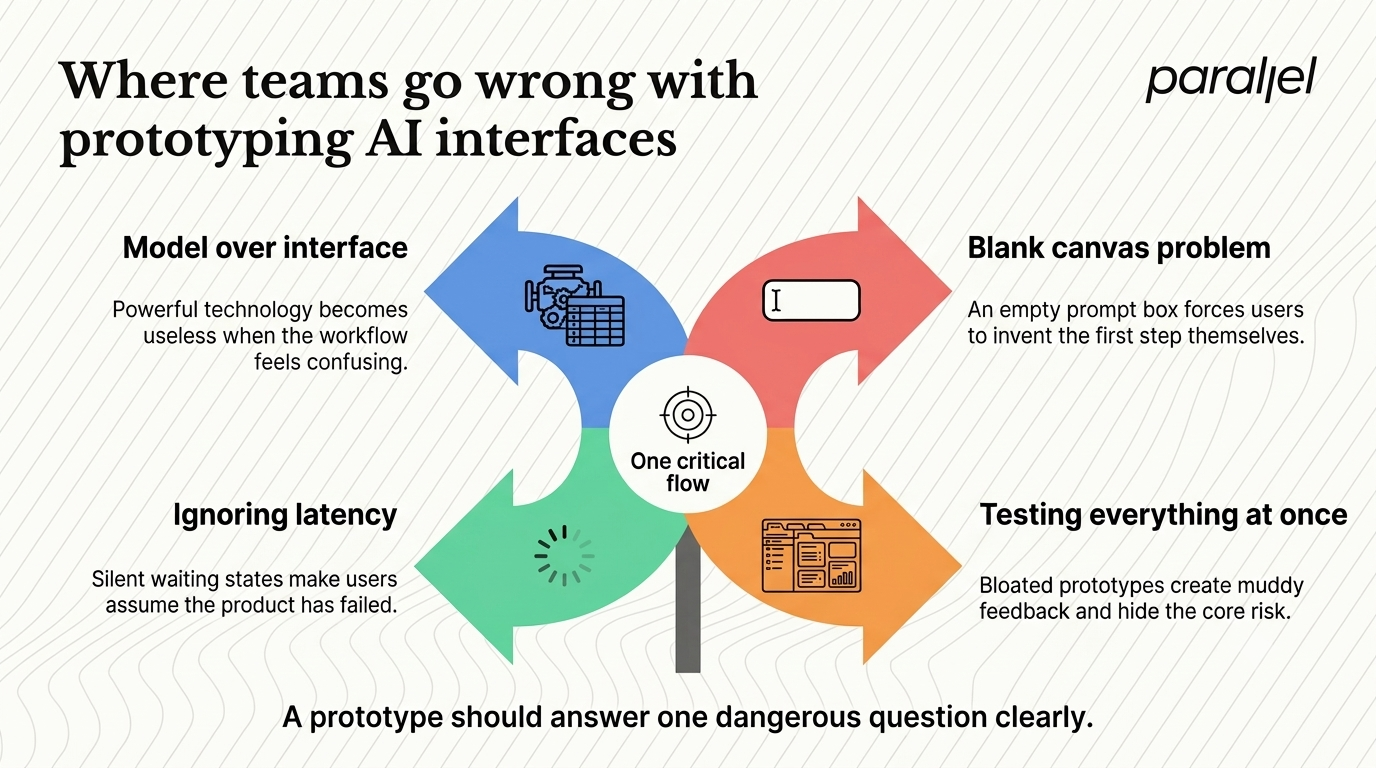
Another common mistake is the blank canvas problem. Teams give users a blank text box and expect them to know what to type. This creates extreme cognitive friction. Users stare at the blinking cursor and freeze. We strongly advise teams to provide suggestions, templates, and guided constraints. We look for this immediately when running a SaaS onboarding teardown. You must guide the user to their first successful output as fast as possible.
Teams also fail to design for latency. Generative processes take time. Sometimes it takes ten seconds to generate a report. If you leave the screen blank during those ten seconds, the user assumes the application broke. You must design loading states that explain what the system is doing. Show progress. Keep the user entertained or informed. If you ignore latency, you destroy trust.
Finally, teams try to test too much at once. They cram every possible feature into a single prototype. The prototype becomes a bloated mess. Users get lost in the navigation. You get muddy feedback. We tell teams to focus on one critical flow. If you fail to validate the core proposition, the secondary features do not matter. Simplicity is difficult, but it is necessary for clear test results. We map this out during our UX audit engagements.
How to evaluate potential partners
Look at their past work. Do they only show pretty screens, or do they talk about business outcomes? You want a partner who asks difficult questions about your business model. The best design sprint agencies for AI startups will challenge your assumptions on day one. They will not just take your feature list and start drawing boxes. They will ask why a feature deserves to exist.
Ask them how they simulate generative text or images in a prototype. If they do not have a clear answer, they lack experience in this specific field. Prototyping unpredictable outputs requires specific techniques. We often use manual testing methods. A human sits in another room and manually types responses to the user's prompts during the test. This simulates intelligence perfectly without writing code. Ensure your partner knows how to run these specific tests. Check if they offer usability testing tailored for ambiguous interfaces.
Evaluate their speed. A true validation cycle should take five days. Some firms try to stretch this into a four-week engagement. That defeats the purpose. The goal is rapid learning, not polished perfection. You need a partner who is comfortable with messy, fast progress. They should prioritize learning over aesthetics. If you need help finding the right fit, read our guide on how to hire the best ux design firms.
A practical approach to your first validation week
Start by defining your biggest risk. What is the one assumption that will kill your company if it proves false? Focus your entire five-day process on that single question. We documented this structure extensively for startups launching new features.
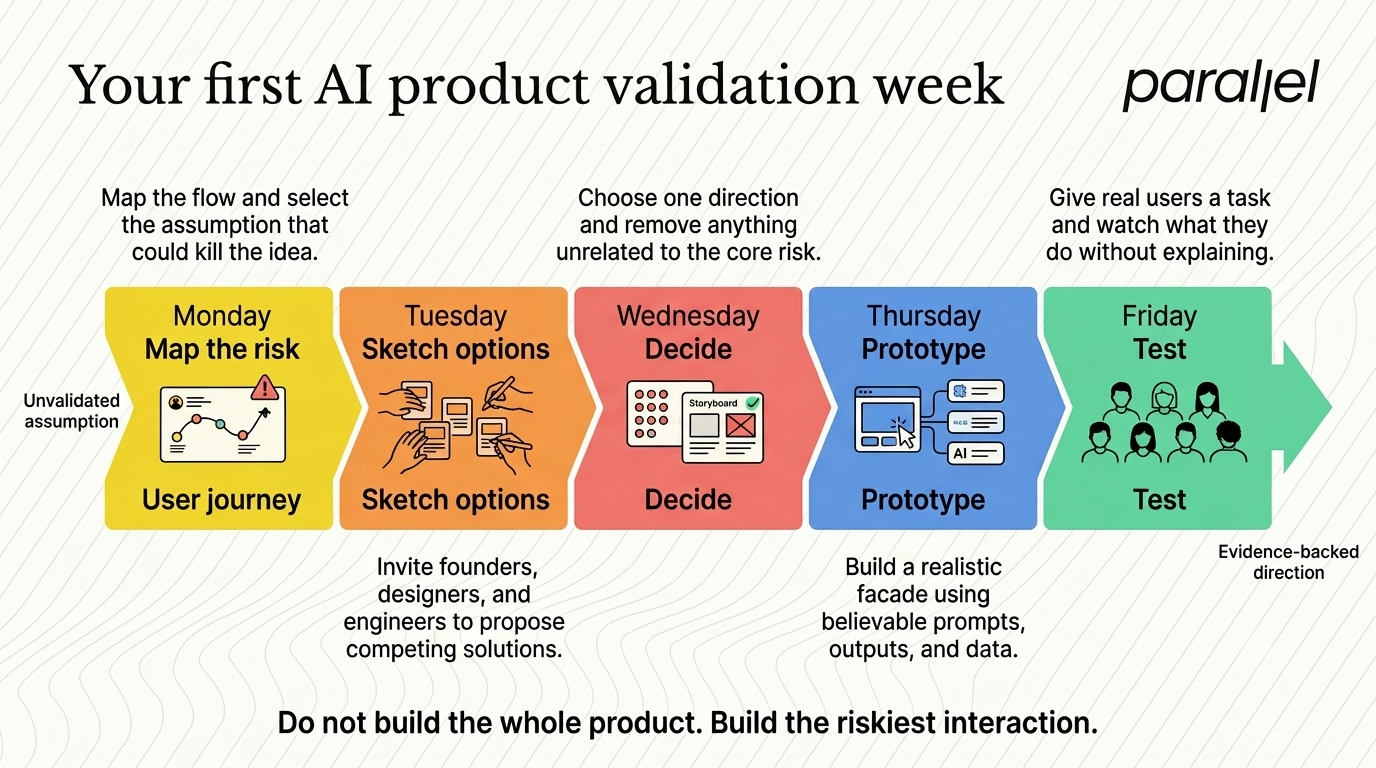
Monday: Map the constraints Get the founding team in a room. Map out the user flow from the first click to the final outcome. Identify the exact moment where the generative model provides value. Pick that specific moment as the target for your prototype. Do not build the whole app. Build the riskiest interaction.
Tuesday: Sketch competing solutions Everyone sketches ideas. Do not rely solely on designers. Engineers often have the best interface ideas because they understand the technical constraints. Force everyone to put ideas on paper. We find that cross-functional sketching produces the most practical solutions.
Wednesday: Decide on a direction Stop debating. Use dot voting to select the best concepts from Tuesday. Combine the winning ideas into a single storyboard. This storyboard becomes the blueprint for your prototype. Make hard cuts. If an idea does not directly address the core risk, remove it.
Thursday: Build a realistic facade Build the prototype. Use tools like Figma to create a clickable interface. For generative features, pre-populate realistic data. Do not use generic text. Write actual responses that the model would generate. The user must believe the software is fully functional. We handle this heavy lifting during our Figma design services.
Friday: Test with five real humans Bring in five people who fit your target audience. Give them a task and watch them use the prototype. Do not explain how it works. Watch where they click. Watch where they get confused. Five users will reveal eighty percent of the usability issues. Record the sessions and share the clips with your engineering team.
The business impact of getting this right
Running this process changes how your company operates. It shifts the work environment from debate-driven to data-driven. When you base decisions on actual user behavior, internal arguments disappear. The founding team unites around reality. According to recent 2026 data from First Round Capital, founders who prioritize rapid prototyping raise their subsequent funding rounds thirty percent faster.
You also save massive amounts of capital. Engineering hours are expensive. Building the wrong feature costs thousands of dollars. Testing a prototype costs a fraction of that amount. You can afford to throw away a prototype. You lack the luxury to throw away three months of backend development.
Additionally, this process clarifies your marketing message. Watching users interact with the prototype reveals the exact words they use to describe your product. You can take those exact words and put them on your landing page. We integrate these findings directly into our website redesign projects for startups. You build a better product and a sharper pitch simultaneously.
Conclusion
Building generative software feels like moving through completely new territory. But the fundamentals of human behavior have not changed. People still want tools that are easy to use, solve a real problem, and do not make them feel stupid. Technology is just a new way to deliver that value. Choosing one of the best design sprint agencies for AI startups gives you the framework to test those human fundamentals quickly. Stop debating in conference rooms. Build a prototype, put it in front of users, and let their reactions direct your product strategy.
Frequently asked questions
1) What is a sprint methodology in this context?
It is a time-boxed, five-day process for answering critical business questions through rapid prototyping and testing ideas with customers. It compresses months of work into a single week, saving capital and engineering resources.
2) How do you execute this process for generative products?
We use manual observation techniques. A human manually triggers responses behind the scenes to simulate machine learning outputs. This lets us observe how a user interacts with unpredictable data before engineering builds the actual models.
3) How does this compare to traditional product discovery?
Traditional discovery often involves weeks of user interviews and abstract strategy documents. This methodology skips the abstract phase. We move straight to a high-fidelity prototype to get behavioral data rather than just opinion data. Check our user research page for more context.
4) Is this approach right for my startup right now?
If you are stuck in endless internal debates about which feature to build next, yes. If you are about to invest significant engineering hours into a new interface, yes. It provides immediate clarity and direction.
5) What makes ParallelHQ different from other options?
We do not just hand over a prototype and leave. We focus on business logic and user psychology. We are often considered among the best design sprint agencies for AI startups because we understand the technical constraints of generative models.
6) How much time does the founding team need to commit?
We require the core team for the first two days. You must be present to map the problem, sketch solutions, and make decisions. We handle the prototyping on Thursday and testing on Friday.
7) Can we test complex machine learning models in five days?
We do not test the actual model. We test the interface and the user's perception of the value. We fake the backend processing to see if the user actually cares about the result before you spend months building the infrastructure.
8) What happens after the testing phase concludes?
You get a clear report of what worked and what failed. You will have raw video footage of users interacting with the idea. From there, you can safely hand the validated concepts over to your engineering team. If you need more ongoing support, we offer broader product design engagements.

check out these related blogs