I have watched hundreds of startups burn runway on designs that look beautiful but fail to convert. When founders look for the best ui ux design agencies for startups, they usually focus on flashy portfolios. That is a mistake. You do not need pretty pixels. You need a product that users understand immediately. We built ParallelHQ because we saw teams struggling with overcomplicated product experiences. Let us break down who is actually doing this right in 2026 and how you should evaluate them.
10 Best UI/UX Design Agencies for Startups
The right partner focuses on clarity, real user behavior, and business outcomes over aesthetics. Here is the definitive list of the best ui ux design agencies for startups this year, prioritized by their approach to product strategy and execution.
The top 10 best ui ux design agencies for startups in 2026
Evaluating agencies requires looking past their homepages. You have to understand how they think about user behavior. We compiled this list based on actual project outcomes, strategic depth, and industry reputation.
1) ParallelHQ
We started ParallelHQ to solve a specific problem. Startup teams were wasting months building features users did not want. We focus heavily on product thinking and business strategy before we even open Figma.
Why we rank among the best ui ux design agencies for startups is simple. We do not just design screens. We map out complex user flows, simplify onboarding, and build products grounded in real behavior.
Our core methodology revolves around rapid iterations. We use design sprints to test ideas in days instead of months. This prevents startups from building blind.
We excel at taking complex, technical concepts and making them intuitive. This is especially true for our AI UX design and B2B UX design work. We ask hard questions about activation metrics and retention because design must drive growth.
2) MetaLab
MetaLab is famous for designing early versions of Slack and Coinbase. They are highly skilled at creating beautiful consumer interfaces. Their visual execution is consistently top-tier across the industry.
Often considered one of the best ui ux design agencies for startups with deep pockets, they are a strong choice if you have significant funding. Their process leans heavily toward creating a distinct visual language.
However, their approach can sometimes feel detached from early-stage reality. Startups with tighter constraints might struggle with their timeline and pricing. If you are looking for a more iterative approach, you might want to evaluate a MetaLab alternative.
3) Clay
Clay is a San Francisco-based agency known for exceptionally polished work. They bridge the gap between brand identity and digital product design seamlessly. Their websites and apps always feel cohesive and modern.
They are a fantastic fit for startups that need a strong brand narrative tied to their product. Clay excels at high-fidelity prototyping and smooth animations. Their work clearly communicates a premium feel.
The tradeoff is that they often focus heavily on the marketing side of digital experiences. For complex backend dashboards, you might need a partner focused purely on product logic. You can explore a Clay alternative if your needs are strictly functional.
4) Frog Design
Frog is a massive name in the global design community. They have decades of experience shaping how humans interact with technology. Their research capabilities are incredibly deep and thorough.
They are perfect for startups building hybrid hardware and software products. Their methodology is rooted in intense user research and ethnographic studies. They bring a very academic rigor to product development.
For early-stage SaaS teams, this level of rigor can sometimes be too slow. Their timelines are built for enterprise-scale certainty. A Frog Design alternative might move faster for an agile software startup.
5) Ramotion
Ramotion specializes in brand identity, UI design, and web development. They are highly effective at building the initial digital presence for new tech companies. Their icon design and brand guidelines are industry standard.
Startups often hire them to build their marketing site and core app interface simultaneously. They are very efficient at delivering a unified look and feel.
While they produce great visual assets, their deep product strategy can sometimes take a back seat to aesthetics. If you need complex workflow optimization, you should compare them with a Ramotion alternative.
6) Work & Co
Work & Co operates differently than most traditional agencies. Their designers and developers work incredibly close together from day one. They are known for shipping highly functional digital products rapidly.
They are excellent for scale-ups that need a robust technical partner. They do not just hand over design files. They help you build the actual product.
Their model requires a high level of commitment and budget from the client. Early-stage startups might find their enterprise-grade process overwhelming. In those cases, a Work & Co alternative may offer more flexibility.
7) Huge
Huge is a global experience agency that handles massive digital transformations. They have offices worldwide and a vast talent pool. Their strategic capabilities are vast and corporate-focused.
They are best suited for heavily funded scale-ups transitioning into enterprise territory. Their ability to handle marketing, design, and product engineering under one roof is impressive.
For a lean startup, working with an agency of this size can result in getting lost in the shuffle. They move like a large corporation. You might prefer a leaner Huge alternative for early-stage work.
8) Method
Method focuses intensely on customer experience and service design. They look at the entire ecosystem of how a user interacts with a brand. Their strategic mapping is highly detailed.
Startups in healthcare or complex fintech benefit greatly from their approach. They map out the unseen operational layers that support a digital interface.
Their consulting style can sometimes be heavier than what a fast-moving software startup needs. If you need rapid prototyping over ecosystem mapping, consider a Method alternative.
9) Ustwo
Ustwo blends digital product design with immersive technology and gaming. They are famous for creating the game Monument Valley. This gives them a unique perspective on user engagement and delight.
Consumer startups looking to gamify their experience should strongly consider them. Their ability to craft joyful, interactive moments is rare. They understand how to keep users entertained.
However, for enterprise B2B SaaS, this level of playfulness is rarely necessary. If you are building productivity tools, you might want a more grounded Ustwo alternative.
10) Instrument
Instrument is a digital agency that excels at brand-led product design. They build digital experiences that strongly reflect a company's marketing positioning. They have a stellar reputation for web execution.
They are a great choice when your startup's growth relies heavily on storytelling. They build beautiful, narrative-driven digital platforms.
If your core problem is a broken user journey inside a complex web app, their marketing-first approach might fall short. You can look into an Instrument alternative for pure product strategy.
Why this matters
Bad design is incredibly expensive. We see founders pour capital into engineering, only to realize users cannot figure out how to use the software. The cost of rewriting code because of bad UX is astronomical.
The Nielsen Norman Group has consistently proven that usability directly impacts revenue. Their ongoing research shows that fixing a problem in development costs 10 times more than fixing it in design. In 2026, user expectations for simplicity are higher than ever.
Furthermore, McKinsey's research on the business value of design demonstrates that top-quartile design companies consistently outperform industry benchmark growth by up to two to one. This is not about making things look nice. It is about risk mitigation and market survival.
If users do not experience value within the first few minutes, they will abandon your product. A confusing interface directly kills your customer acquisition cost efficiency.
Where teams go wrong
A common mistake when hiring the best ui ux design agencies for startups is optimizing for aesthetics over logic. Founders often browse design portfolios looking for the prettiest gradients. They forget that their actual users just want to get a job done quickly.
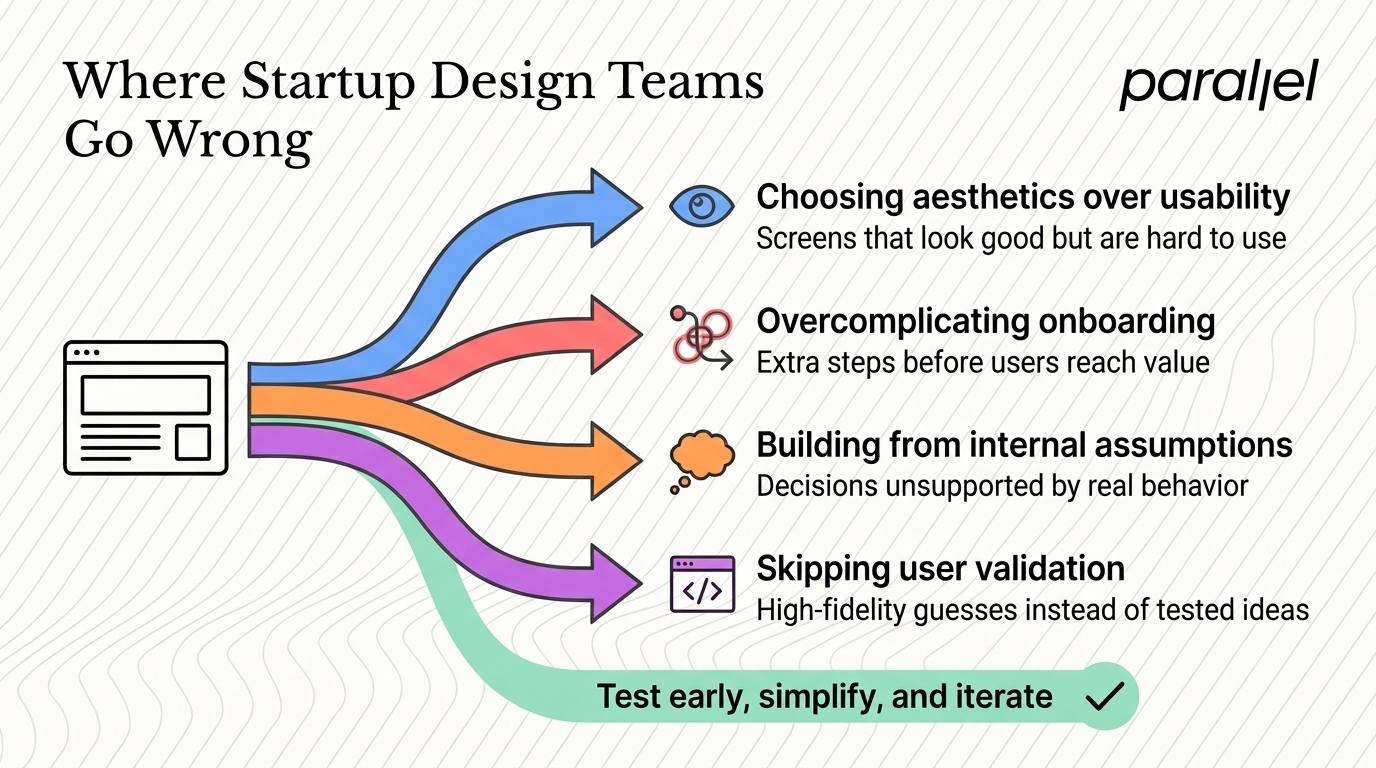
We frequently conduct a UX audit for startups that have recently launched. We almost always find that the previous design team overcomplicated the onboarding flow. They add unnecessary steps because they think it looks modern.
Another trap is skipping user validation. Teams assume they know what the user wants. They build high-fidelity designs based purely on internal assumptions.
You must validate ideas early. We run our discovery framework to force teams to test prototypes with real users. If you do not test, you are just guessing with your investors' money.
How to evaluate a design partner
The best ui ux design agencies for startups will always ask you about business metrics before they ask about brand colors. They should care deeply about your activation rate, churn, and target audience. If an agency only wants to talk about typography, walk away.

Look for a team that challenges your assumptions. A good product partner will push back on bloated feature requests. They should help you strip the product down to its core value proposition.
Examine their case studies for measurable outcomes. Did their design increase conversions? Did it reduce support tickets? Ask them to walk you through a project that failed and what they learned from it.
Finally, assess their speed and process. A startup cannot wait six months for a design system. You need a team that uses tools like Figma efficiently and understands the pace of early-stage growth.
The role of strategy and UX research
Design without research is just decoration. You cannot build a successful product if you do not understand the underlying psychology of your users. We rely heavily on structured user research to inform every decision.
Research uncovers the "why" behind user behavior. Quantitative data might tell you that users are dropping off on a specific screen. Qualitative research tells you they are dropping off because the terminology is confusing.
Authoritative sources like IDEO have championed human-centered design for decades. Their methodology proves that empathizing with the end user creates superior business outcomes.
Do not let agencies sell you on assumptions. Demand that they talk to your customers. Even conducting simple usability testing with five users will uncover 80% of your product's fatal flaws.
Designing for activation and onboarding
Onboarding is the most critical phase of your product experience. If a user signs up and feels lost, they are gone forever. We have seen well-funded SaaS products fail purely because their first-time user experience was broken.
A good design partner simplifies this journey. They remove friction and guide the user to the "aha" moment as quickly as possible. This requires mapping out the exact steps a user must take to achieve value.
We frequently perform SaaS onboarding teardowns to identify these exact friction points. Often, the fix is not a total redesign. It is just removing unnecessary form fields or providing clearer empty states.
Your design agency should track onboarding success rigorously. They should design specifically for the state where a user has no data in their account. This is where most user frustration originates.
The shift toward AI-native design
Building software in 2026 requires a completely different mindset regarding artificial intelligence. Slapping a chatbot onto a legacy interface does not work anymore. You must design workflows where AI feels like a natural extension of the user's intent.
We have spent significant time helping companies navigate this through our AI readiness design scorecard. The interface of the future is conversational, predictive, and adaptive.
Agencies must understand how to handle AI latency, trust, and error states gracefully. If your design partner is still using traditional 2020 web paradigms for an AI product, you will fall behind. They need to understand the nuances of AI software design services.
Conclusion
Finding the best ui ux design agencies for startups is not about finding the best artists. It is about finding strategic partners who understand how digital products actually grow. You need a team that values clarity over cleverness. Startups fail when they overcomplicate their products and ignore their users. Focus on agencies that ask the hard questions, test their assumptions, and design for measurable business outcomes.
FAQ
1) What makes the best ui ux design agencies for startups different from regular design firms?
The top agencies focus on product strategy and business metrics, not just aesthetics. They understand early-stage constraints like runway and the need for rapid validation. A regular firm might just design pretty screens without understanding user behavior.
2) How much should a startup expect to spend on UI/UX design?
Pricing varies wildly based on the agency's size and location. Small boutique firms might charge $10,000 for a core flow, while top-tier global agencies can charge upwards of $100,000 for a full engagement. You should always align the budget with the expected business return.
3) What is the difference between UX and UI?
UX (User Experience) is how the product works and feels logically. It covers user flows, wireframes, and research. UI (User Interface) is how the product looks, encompassing typography, colors, and visual hierarchy.
4) Should we hire an agency or an in-house designer?
An agency brings diverse industry experience, proven processes, and a full team of specialists. An in-house designer provides full-time dedication but may lack strategic mentorship. Many startups use an agency to build the foundation and hire in-house later to maintain it.
5) How long does a typical product design project take?
A focused MVP development design phase can take 4 to 8 weeks. Comprehensive platform redesigns can take 3 to 6 months. We often use design sprints to condense months of strategy into a few weeks.
6) Is UI/UX design only for software products?
No. While it is crucial for software, these principles apply to physical products, service blueprints, and e-commerce websites. Anywhere a human interacts with a system requires thoughtful user experience design.
7) What are the biggest red flags when talking to a design agency?
Avoid agencies that do not ask about your target audience or business goals in the first meeting. If they promise to skip user testing to save time, they are putting your product at risk. A lack of clear, measurable case studies is also a major warning sign.
8) How does ParallelHQ approach startup design differently?
We operate as a strategic product partner rather than a traditional order-taking agency. We emphasize product strategy consulting and rapid prototyping to ensure we are building the right thing. Our goal is to bring clarity to complex product decisions quickly.

check out these related blogs


































































.avif)
.webp)