I talk to founders every week who are paralyzed by the financial aspect of building their product. They either burn capital on big agencies that deliver bloated concepts, or they underfund design and launch a product users abandon immediately. The question always comes up during our first strategy call. If you are wondering exactly how much does product design cost for a startup (2026), the answer is a strategic allocation of resources, not just a flat price tag. You need total clarity on what you are buying. Let us break down the real numbers and the decisions behind them.
What is the typical product design budget for a startup?
In 2026, a standard seed-stage startup should expect to spend between $15,000 to $50,000 for a comprehensive initial product design phase. This budget varies significantly based on hiring freelancers, building an in-house team, or partnering with a strategic design agency.
How have startup design budgets shifted in 2026?
The funding landscape has fundamentally changed over the last few years. The days of raising a massive seed round on a napkin sketch and spending $150,000 on a speculative design concept are over. Today, investors demand capital efficiency. They want to see traction, usability, and a clear path to revenue before writing a check.
This macro environment forces founders to ask better questions about their runway. When founders ask me how much does product design cost for a startup (2026), they are usually trying to figure out how much runway they need to allocate before they can launch a viable product. The truth is that product design is not a single line item you can cross off. It is an ongoing business capability.
According to a 2025 startup runway report by First Round Capital, early-stage teams are now allocating up to 20% of their initial pre-revenue budget specifically to user experience and interface design. This is up from 12% in 2022. The increase is driven by the realization that in a crowded market, a clunky minimum viable product (MVP) no longer survives.
Why Good Design Costs What It Does
We have seen teams overcomplicate onboarding, and it usually backfires. The cost of design is not about making screens look pretty. It is about risk mitigation. You are paying to discover what not to build.
Every hour spent on deep user research and prototyping saves ten hours of expensive engineering time later. The Nielsen Norman Group (NN/g) consistently reports that fixing an error after development is up to 100 times more expensive than fixing it before development. When you view design as an engineering multiplier, the cost structure starts to make sense.
Where do most startups go wrong with design spending?
In my experience, this is where most product decisions go wrong. Founders look at the bottom line and try to optimize for the cheapest hourly rate. This approach fundamentally misunderstands what product design actually is.
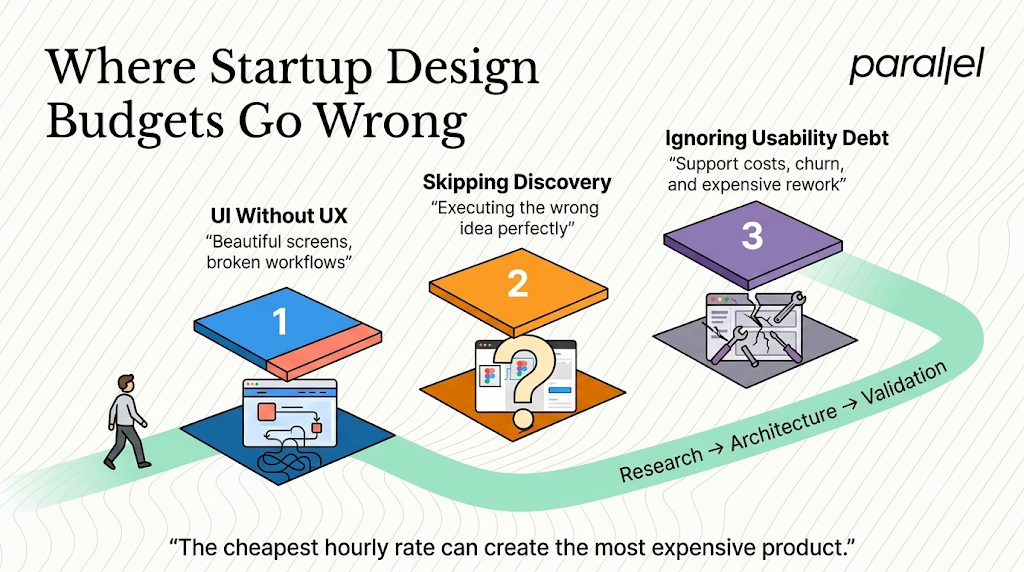
Confusing UI with UX
The most common mistake is treating UI (User Interface) as the entirety of UX (User Experience). Founders will hire a cheap visual designer to make a dashboard look modern. The screens look great on Dribbble, but the actual workflow makes no sense to the end user.
You end up with a beautiful product that nobody can figure out how to use. This leads to weak onboarding and low activation rates. We frequently get called in to perform a UX audit for teams that spent their entire budget on visual polish while ignoring information architecture.
Skipping the Discovery Phase
Another massive error is skipping the discovery and strategy phase to save money. Teams want to jump straight into Figma. They assume they already know exactly what the user wants.
IDEO's foundational principles of human-centered design emphasize that the most costly mistake a business can make is perfectly executing the wrong idea. If you do not spend money validating the problem, any money spent designing the solution is wasted. This is why we heavily advocate for structured design sprints to validate concepts before full-scale design begins.
The Hidden Tax of Technical Debt
To accurately calculate how much does product design cost for a startup (2026), you have to factor in the hidden tax of poor usability. If your product is confusing, your customer support costs will skyrocket. If your users cannot find value quickly, your churn rate will kill your growth trajectory. Cheap design usually results in the most expensive products to maintain.
How does your engagement model impact design costs?
There are three primary ways to get your product designed. Each has a different cost structure, risk profile, and ideal use case. Let us look at the granular data to answer how much does product design cost for a startup (2026) across different engagement models.
1) The Freelance Route
Hiring a freelancer is often the default choice for bootstrapped or pre-seed startups. Platforms like Upwork or Toptal offer a massive range of talent.
- Cost Range: $3,000 to $15,000 for an MVP.
- Hourly Rates: $40 to $150+ per hour depending on geography and experience.
- Pros: Highly flexible. Easy to start and stop. Generally the lowest absolute cost.
- Cons: You have to manage them directly. They often focus on execution rather than product strategy. If they get sick or take another job, your project stalls.
If you go this route, you must act as the Product Manager. You cannot just hand them a loose brief and expect a market-ready SaaS design. You have to direct their work daily.
2) The In-House Hire
Raising a solid seed round often triggers the desire to bring design in-house. Founders want a designer sitting next to them (virtually or physically) iterating in real-time.
- Cost Range: $90,000 to $160,000+ annual salary, plus equity and benefits.
- True First-Year Cost: Easily $120,000 to $200,000 when factoring in recruiting, software, and overhead.
- Pros: Deep product knowledge. Complete alignment with company culture. Fast iteration loops.
- Cons: Extremely expensive upfront commitment. It is also very rare to find one person who is exceptional at user research, UX strategy, and high-fidelity UI design.
A single in-house hire often creates a bottleneck. They get bogged down in marketing collateral or minor bug fixes, leaving no time for high-level product strategy consulting and forward-thinking UX work.
3) The Design Partner (Agency) Route
This is where teams look when they need a comprehensive, strategic approach without the permanent overhead of a full-time team.
- Cost Range: $15,000 to $60,000+ for a scoped MVP or major redesign.
- Monthly Retainers: $8,000 to $25,000 per month for ongoing embedded support.
- Pros: You get a full stack of skills (researchers, strategists, UI experts). High reliability and established processes.
- Cons: Higher upfront cost than a freelancer. Requires a structured onboarding process to transfer industry knowledge.
The choice between freelance and agency models heavily influences how much does product design cost for a startup (2026) and the final quality of the product. We built ParallelHQ because we saw a gap here. Startups needed the strategic depth of a big agency but the speed and pragmatism of an embedded team.
Comparison Table: Engagement Models
How should you allocate a design budget by the startup stage?
Understanding how much product design costs for a startup (2026) means realizing that design is a continuous process. You do not spend your entire budget at once. You stage-gate your spending based on risk and validation.
Stage 1: Pre-Seed (Idea to Prototype)
At this stage, you do not need a fully coded product. You need to validate that the problem exists and that your proposed solution resonates with buyers.
- Goal: Pitch investors or get letters of intent from early customers.
- Deliverables: User journey maps, wireframes, and a high-fidelity click-through prototype.
- Expected Budget: $5,000 to $15,000.
- Focus Area: Spend 70% of this budget on research and architecture, and 30% on making it look good enough to sell the vision.
Stage 2: Seed (Prototype to MVP)
You have funding and you need to build the real thing. This is where technical constraints meet design ambitions.
- Goal: Launch a usable product that early adopters can interact with daily.
- Deliverables: Comprehensive design system, edge-case screen designs, developer handoff documentation.
- Expected Budget: $20,000 to $50,000.
- Focus Area: Emphasize clarity and intuitive workflows. If you are building a B2B platform, invest heavily in B2B CRO suggestions and frictionless onboarding.
Stage 3: Series A (Scaling and Refinement)
You have product-market fit. Now you need to scale. The design breaks under the weight of new features.
- Goal: Improve retention, decrease time-to-value, and support complex new features.
- Deliverables: Advanced prototyping, usability testing rounds, complete UX overhaul of legacy features.
- Expected Budget: $10,000 to $25,000+ per month (Retainer model).
- Focus Area: Optimization. You should be conducting regular usability tests and iterating based on quantitative data.
How does AI impact startup design costs?
We cannot discuss 2026 pricing without addressing Artificial Intelligence. The landscape has shifted rapidly. Teams often ask if AI tools have made design cheaper. The answer is nuanced.
AI has commoditized basic visual execution. Generating a generic dashboard layout takes seconds now. However, AI cannot talk to your users. It cannot understand the subtle emotional frustration a user feels when a payment fails. It cannot untangle a complex, industry-specific workflow.
A 2026 industry survey of product leaders showed that while time spent on initial wireframing dropped by 40% due to AI generation tools, the budget allocation for deep AI UX design and strategic research remained stable. You are no longer paying designers to move pixels. You are paying them to think critically about system architecture and human behavior.
How can you evaluate a startup design investment?
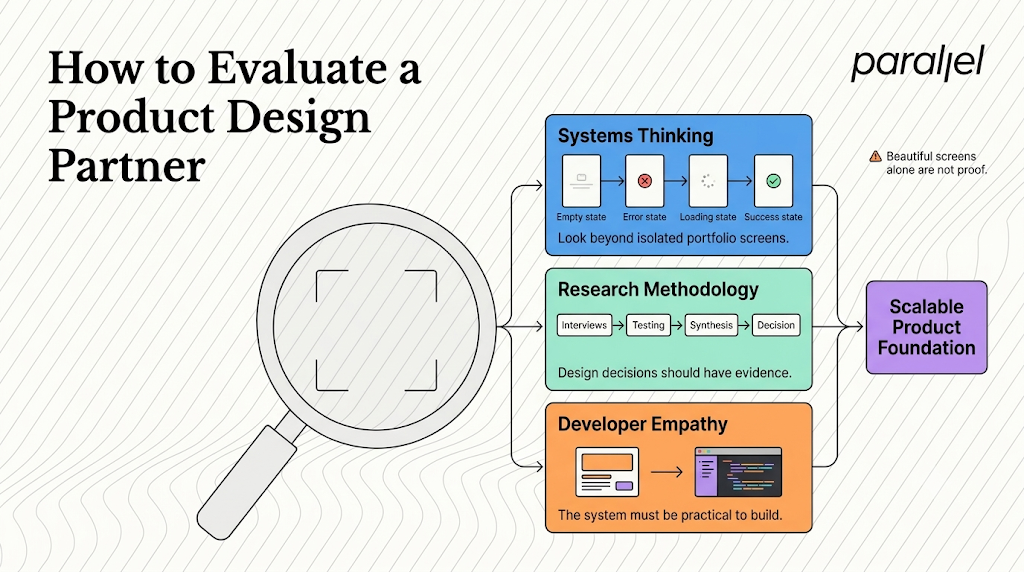
1) Look for Systems Thinking
If a designer or agency only shows you beautiful, isolated screens in their portfolio, walk away. You need to see how they solve complex state changes. Ask them to show you what an empty state looks like. Ask them to show you the error states. Good product design accounts for the messy reality of software, not just the happy path.
2) Assess Their Research Methodology
Design without research is just decoration. Ask potential partners how they validate their decisions. They should be able to articulate a clear process for user interviews, usability testing, and synthesis. If they cannot explain their discovery framework, they are guessing with your money.
3) Check for Developer Empathy
The most beautiful design in the world is useless if your engineering team cannot build it within the current sprint. A mature design partner understands technical constraints. They build scalable design systems using components that map directly to your front-end framework. This drastically reduces development costs and speeds up your MVP development.
What is the ROI of investing in early product design?
I have seen the aftermath of rushed design too many times. A health-tech startup once came to us after spending $80,000 on engineering to build a platform that users abandoned within three minutes. The interface was so dense and overwhelming that doctors refused to use it.
We ran a rapid design sprint, mapped out the actual clinical workflow, and redesigned the core experience. We stripped away 40% of the features they thought were essential. By focusing purely on clarity, their activation rate jumped by over 60% in two months.
The McKinsey Design Index tracks the financial performance of design-led companies. Their data consistently shows that companies prioritizing user experience outperform industry benchmark growth by as much as two to one. Good design is not a cost center. It is a fundamental growth lever.
When you invest correctly early on, you build a foundation that scales. You do not have to throw away your entire codebase in year two because the user experience is broken beyond repair.
What are the key takeaways for startup design?
Building a product is hard enough without fighting your own interface. The decisions you make about design investment in the early days will dictate your product velocity for years. Evaluating how much product design costs for a startup (2026) is ultimately an exercise in defining your business priorities.
If you view design as a surface-level coat of paint, you will always find the cost too high. But if you view it as the mechanism that connects your technology to human behavior, it becomes the most valuable investment you can make. Simplify your decisions, demand clarity in the workflows, and focus ruthlessly on what the user actually needs to accomplish. The rest is just noise.
What are the most common questions about startup design costs?
1) What exactly is product design in the context of a software startup?
Product design is the holistic process of identifying a market problem and crafting a digital solution that solves it efficiently. It encompasses user research, UX strategy, information architecture, interaction design, and visual UI design. It is not just graphic design.
2) How do we budget for design before we have raised significant funding?
Pre-seed teams should lean on low-fidelity tools. Validate your ideas using paper sketches or basic wireframes. You can often get away with spending less than $5,000 on a clickable prototype just to secure early validation and initial angel funding.
3) Exactly how much does product design cost for a startup (2026) if we are building an AI-native SaaS product?
When evaluating how much does product design cost for a startup (2026), AI products generally sit at the higher end of the spectrum (closer to $40,000 - $60,000 for an MVP). This is because AI interfaces require complex trust-building mechanisms, contextual onboarding, and entirely new interaction paradigms beyond traditional clicks and forms.
4) Should we hire a UI designer or a UX designer first?
You must prioritize UX (User Experience) first. A brilliant UI (visuals) layered over a terrible UX will fail. A brilliant UX with average UI will often still succeed because it solves the core problem effectively. Ideally, look for a product designer who understands both, heavily leaning toward strategic UX.
5) How does ParallelHQ approach startup product design?
We act as a strategic partner, not just an execution arm. We focus heavily on clarity in product thinking. We run structured discovery processes to ensure we are building the right thing, and then we design intuitive, scalable systems grounded in real user behavior. We aim to simplify the complex.
6) What is a Design System and do we need one early on?
A design system is a collection of reusable components (buttons, typography, forms) guided by clear standards. While you do not need a massive enterprise-level system on day one, you absolutely need a foundational component library. It ensures consistency and dramatically speeds up both design and engineering over time.
7) How long should the initial product design phase take for an MVP?
For a standard SaaS or mobile app MVP, the design phase should take between 4 to 8 weeks. Anything less usually means you are skipping vital research. Anything more usually means you are overcomplicating the product and suffering from scope creep.
8) Is it cheaper to outsource design offshore?
Geographic arbitrage is real, and hourly rates in Eastern Europe or India are lower than in San Francisco or London. However, cheap hourly rates can become expensive if the communication is poor or the strategic thinking is lacking. Focus on finding a team with a proven methodology and clear communication, regardless of their zip code.

check out these related blogs









































.avif)