I've worked with dozens of early-stage SaaS and AI founders through ParallelHQ, and the design retainer vs project question comes up in almost every first conversation. The wrong answer costs you money, momentum, or both. The right answer depends on one thing: the nature of your design needs right now, not in theory. This guide gives you a clear framework to choose confidently, with no vague designer-speak.
TL;DR
- A design retainer is recurring monthly access to a design team for ongoing, iterative work; project-based is fixed scope with a defined end.
- Retainers win when your product roadmap is active and your needs are continuous. Projects win when the deliverable is bounded and clear.
- Agencies with retainer-dominant revenue report 35–40% more predictable monthly income, and retainer clients have a lifetime value 3–5x higher than one-off project clients.
- Most high-growth startups in 2026 use a hybrid: project to validate, retainer to scale.
What Is a Design Retainer and How Does It Work?
A design retainer is a recurring agreement where a startup pays a fixed monthly fee in exchange for a committed block of design capacity, priority access, and ongoing creative continuity. Think of it as a fractional design team that lives inside your product cycles rather than outside them.
A retainer is a recurring monthly agreement between an agency and a client. The client pays a fixed fee each month in exchange for an agreed set of services, deliverables, or hours. Unlike project work, a retainer has no defined end date, the relationship continues as long as results and value are being delivered.
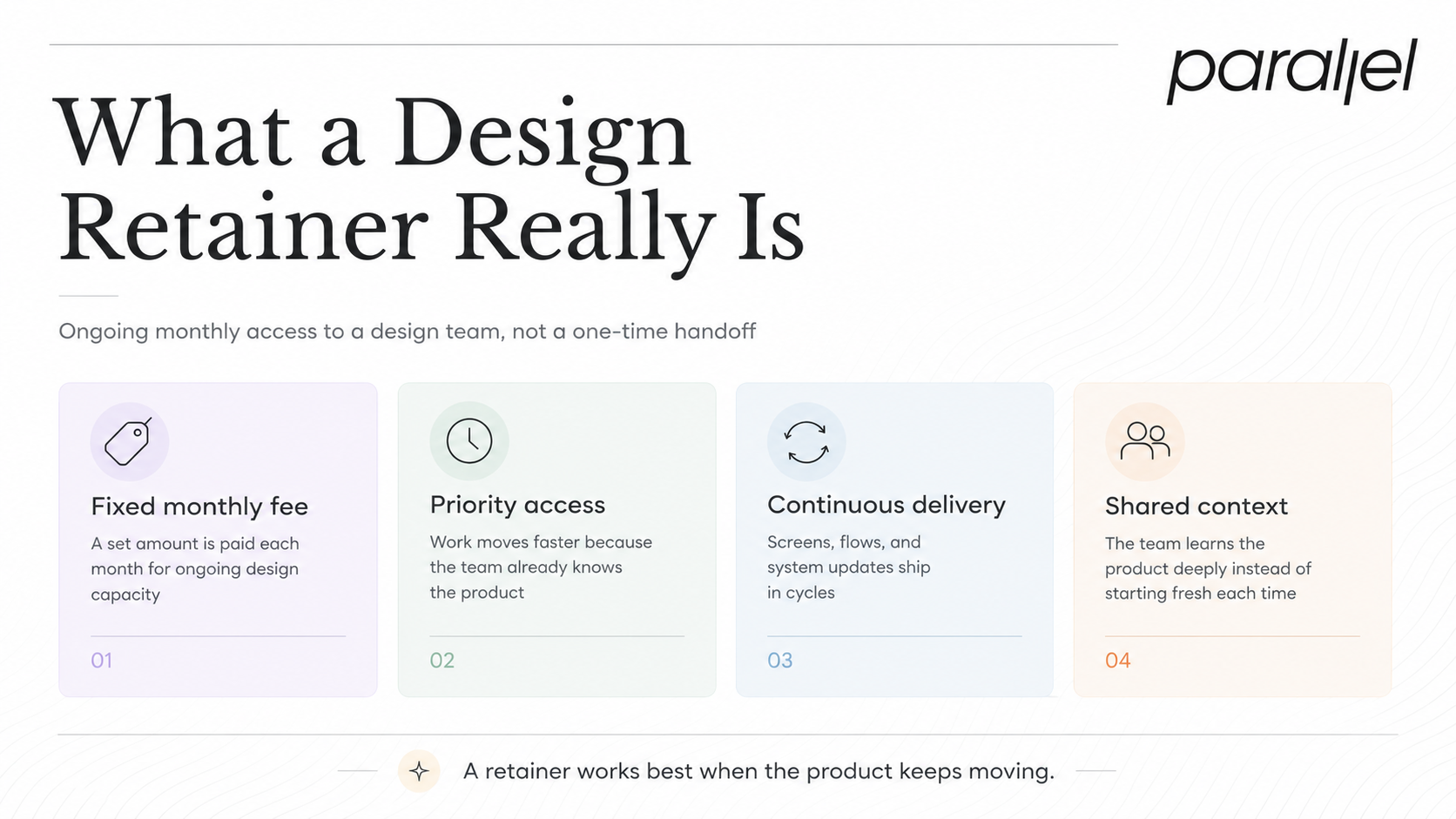
In practice, a design retainer with ParallelHQ looks like this: your team submits requests via a shared Figma workspace or project board, work cycles through agile design sprints, and you receive continuous delivery of screens, components, and UX improvements every two weeks. The design system grows alongside your product rather than being handed off in one drop.
There are three common retainer structures:
- Hours-based: A fixed monthly block (e.g., 20–40 hours) you draw down against any design request, UI screens, wireframing and prototyping, interaction design, and more.
- Deliverables-based: A defined set of outputs per month, a specific number of Figma screens, component library updates, or landing page designs.
- Outcomes-based: Tied to product milestones or KPIs, often blending design thinking and strategy work together.
Retainer pricing guarantees a fixed monthly fee in exchange for a set number of hours or deliverables, giving the client priority access. That priority matters enormously when you're a startup running on tight sprint timelines. You're not joining a queue, your work ships first.
Retainers are now the dominant engagement type. Promethean Research's 2025 Digital Agency Industry Report found 95% of agencies offer project work, 91% offer retainers, and 88% offer both. A 2026 survey reported by Digital Agency Network put retainers as the primary model for 78% of agencies, up from 64% in 2023.
The signal is clear: the market has moved toward ongoing partnership models. But that doesn't automatically mean a retainer is right for your current stage.
Design Retainer vs Project-Based Pricing: Pros and Cons
Before deciding, you need to see both models against each other clearly.
Project-based pricing often positions your agency as a vendor: you deliver something, and the relationship may end there. Retainers tend to build deeper partnerships, with more trust, collaboration, and long-term impact, leading to upsells, referrals, and more strategic, higher-margin work. From a cost standpoint, both models carry hidden risks when poorly structured. Scope creep is the silent margin killer in retainer pricing, eroding effective hourly rates by 15–30% when agencies fail to track actual hours against retainer assumptions and enforce scope boundaries.
On the project side, research published by StopScopeCreep in February 2026 found that scope creep affects 52% of all projects, with the average cost overrun attributable to scope changes sitting at 27% per project. The mitigation for both: a clear statement of work and explicit revision caps. At ParallelHQ, every retainer includes a monthly scope brief reviewed at sprint kickoff so nothing drifts.
When Does a Project-Based Design Engagement Make More Sense?
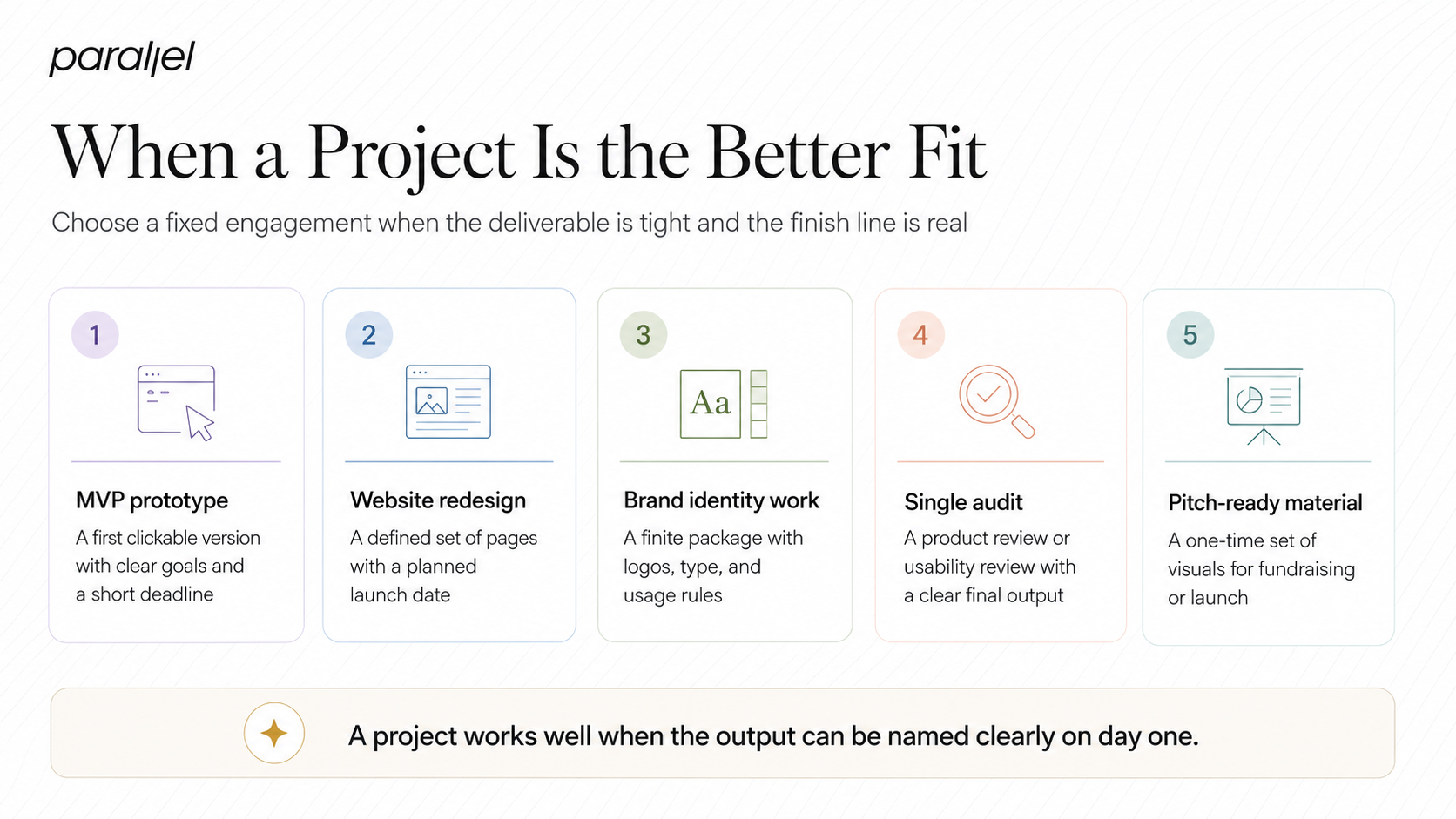
Not every design need is recurring. Project-based design is the right call when your deliverable has a clear definition of done and a hard deadline. Project-based pricing is ideal for defined deliverables with a clear beginning and end, common for branding, web design, or product launches, when you know exactly what needs to be delivered and when.
Specific scenarios where project-based wins for startups:
- Pre-seed validation: You need an MVP screen set or a clickable prototype to pitch investors. Scope is small and bounded. A design sprint or MVP development engagement delivers faster than spinning up a retainer.
- One-time UX audit: A UX audit or AI readiness design scorecard is a defined diagnostic with a specific output, not an ongoing service.
- Website redesign: A complete website redesign with fixed pages, a creative brief, and a launch date is a project. Once it ships, the engagement closes cleanly.
- Brand identity: Logos, type systems, and brand guidelines have clear deliverables and don't need perpetual revision cycles.
Project-based pricing gives clients price certainty upfront, reducing budget anxiety, and forces detailed scoping and definition of deliverables before work begins. For founders who haven't worked with a design agency before, that structure is often psychologically easier to approve internally.
The caution: project-based engagements have limited flexibility, once the scope is set, changes often mean change orders and added costs. If your product direction is still shifting (which is true of most early-stage AI and SaaS products), locking into a fixed-price contract too early creates friction every time the roadmap updates.
What Are the Real Benefits of a Design Retainer for Startups?
For a startup with an active product roadmap and a growing design backlog, a retainer compounds value in ways a project never can.
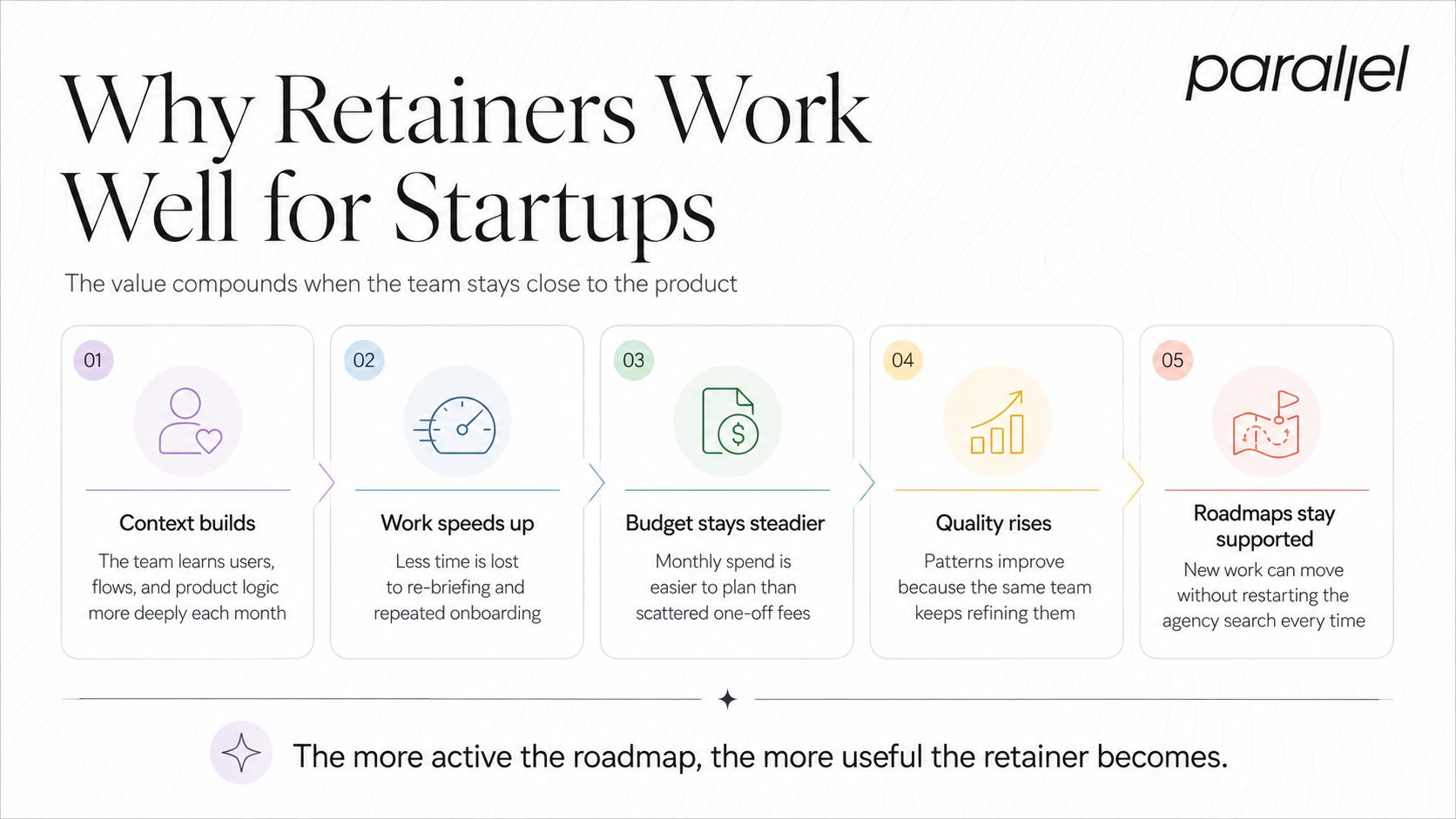
Context accumulates: Your design partner learns your users, your design system, your brand voice, and your edge cases. That institutional knowledge translates to faster execution, fewer revision cycles, and better design decisions over time. The agency accumulates deep knowledge of the client's business, audience, and competitive landscape, which makes the work more effective every month.
Design operations become predictable: When your SaaS product design partner is on retainer, you can plan sprint roadmaps knowing exactly what design capacity is available. No sourcing freelancers, no briefing new teams mid-build.
Financial clarity: Retainer pricing offers a predictable and steady stream of income, as clients pay a fixed fee regularly, usually monthly, in exchange for ongoing services. This consistency helps businesses forecast revenue more accurately and plan expenses without the stress of fluctuating income.
The same logic applies to your side of the table: predictable design spend means cleaner burn tracking.
Higher ROI over time: Retainer-heavy agencies command acquisition multiples of 1.2 to 2.0 times revenue compared to 0.5 to 0.9 times for project-based agencies. A side-by-side comparison shows retainer models producing 22–28% net margins versus 12–18% for project models, driven primarily by lower business development costs and more predictable capacity utilization.
For the startup client, the equivalent insight is this: the total cost of repeatedly re-briefing, re-onboarding, and re-aligning project-based designers adds up fast, often exceeding the premium of a retainer within two or three projects.
How Much Does a Design Retainer Cost Compared to Project Pricing?
Rates vary widely by team size, seniority, and scope. Here are 2026 benchmarks:
2026 benchmarks show small-business retainers running $1,000–$5,000/month, mid-market $5,000–$15,000, and enterprise $15,000–$50,000+. SEO, PPC, content, and design each sit in their own bands within those ranges.
The average monthly retainer across agency types runs from $1,800 to $6,000, though the cost can range from $2,000 to $40,000 per month or more depending on the scope and quality of services. For project-based work, payment is typically milestone-structured.
Payment is typically structured as a percentage at kickoff, a percentage at design or architecture sign-off, a percentage at development completion, and a final payment at launch. One important nuance for founders: retainers often carry a modest discount against the same hours billed on a project basis, because you're guaranteeing volume.
The baseline formula is: hourly rate × expected hours per month × 0.85–0.90, applying a 10–15% discount for commitment. At $200/hour for 20 hours, that is $4,000, discounted to roughly $3,400–$3,600. The true cost comparison isn't retainer fee vs project fee, it's total cost of design over 12 months including re-briefing, ramp-up time, and revision overhead on one-off projects.
How to Decide Between Retainer and Project: A Practical Framework
Stop asking "which is cheaper?" and start asking "what does my design need to look like over the next 90 days?"
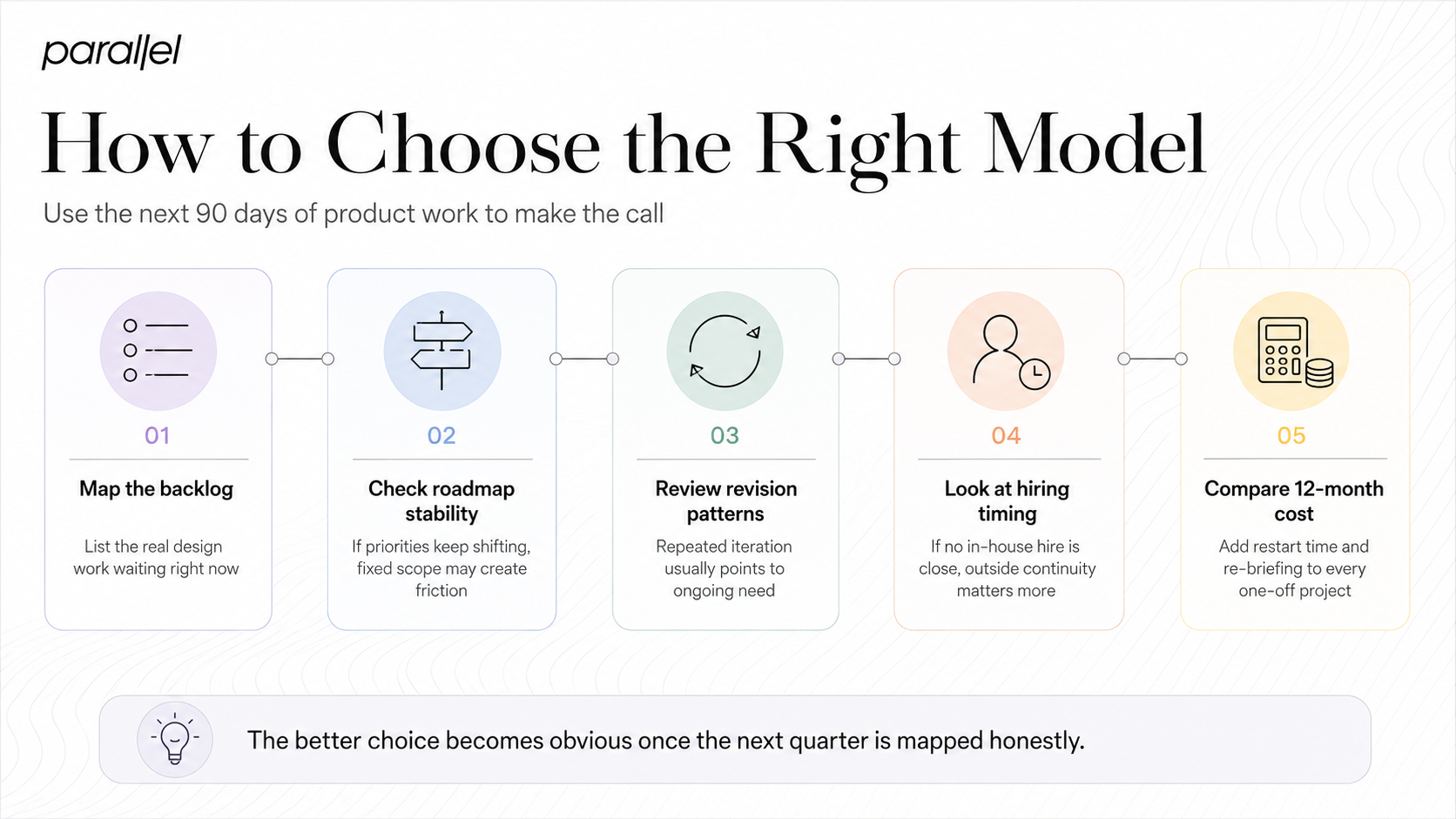
Use this decision framework:
- Map your design backlog: If you have more than 2–3 weeks of queued work right now, you have ongoing need, which points to a retainer.
- Assess roadmap stability: If your product roadmap is locked for a specific release (a new feature set, a mobile app design launch, a Webflow build), a project engagement with a fixed-price contract is cleaner.
- Check your revision pattern: If your last design engagement ran over two rounds of revisions on every deliverable, you have an iterative need. Retainers are built for iteration; project engagements are not.
- Consider your hiring horizon: If you're 6–12 months away from hiring an in-house designer, a retainer bridges the gap without headcount. A project doesn't.
- Run the 12-month cost model: Take your average project fee, multiply by how many projects you'd realistically run in a year, and compare against a monthly retainer. Add 20% to the project total for re-briefing and ramp overhead.
- Test with a discovery engagement: At ParallelHQ, we often recommend starting with a discovery framework or opportunity mapping session to map your design needs before committing to either model.
The most effective strategy for many startups involves combining models: charging a fixed fee for an initial setup, audit, or strategy project, then transitioning to a monthly retainer for implementation and ongoing management.
What to Include in a Design Retainer Contract
A well-structured retainer agreement removes ambiguity before it becomes conflict. Every design retainer contract should cover:
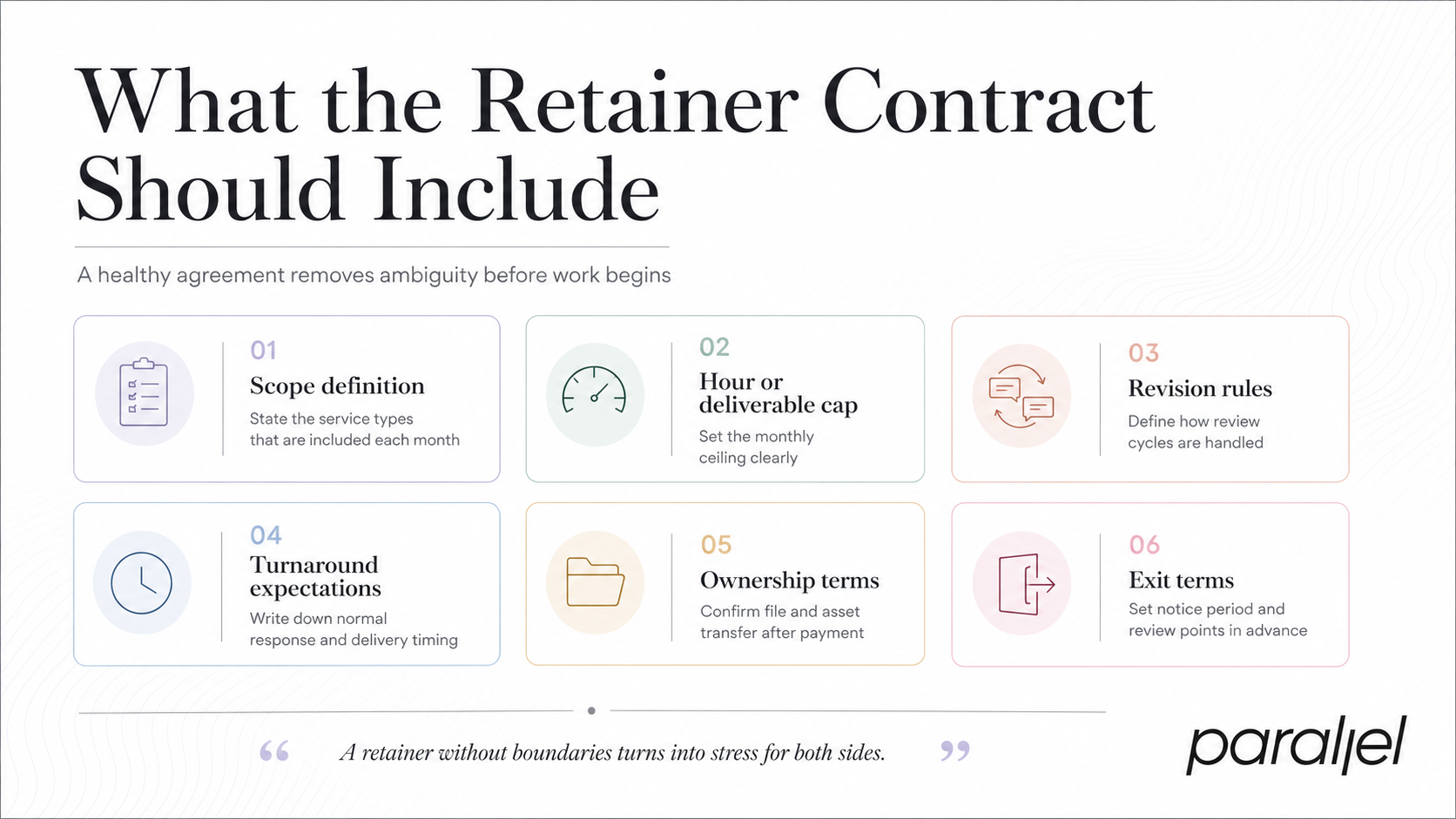
- Scope of work definition: List every service type included, UI/UX design, design systems, user research, usability testing, and explicitly name what is excluded.
- Monthly hour or deliverable cap: Specify the exact allocation. The contract should detail the monthly retainer fee, including payment schedule, and outline overage rates for work that exceeds the agreed-upon scope or hours.
- Revision rounds: Cap revision cycles per deliverable (typically 2–3 rounds) to prevent unbounded iteration.
- Rollover policy: State whether unused hours expire monthly or roll forward. Implement a "use it or lose it" policy where unused hours don't roll over, this incentivizes clients to fully utilize their investment while protecting revenue stability.
- Service level agreement: Turnaround times for standard requests (typically 48–72 hours) and urgent requests.
- IP ownership: Confirm all Figma files, design system components, and assets transfer to the client upon payment. Clearly define the rights transfer of work created under the retainer, specifying the client owns what versus any rights retained by the designer or agency.
- Termination and notice period: Most retainer contracts require 30–60 days' written notice to protect both parties. Include details on contract length, renewal options, and termination clauses. Some agencies offer rolling month-to-month retainers, while others require a 3, 6, or 12-month commitment.
- Adjustment clause: Build in a periodic review (typically every 6 months) to re-scope the retainer as your product matures.
A retainer without a scope boundary is just an open invoice. Define what's in, what's out, and what costs extra, before you sign.
Conclusion
The design retainer vs project decision comes down to one honest question: is your design need ongoing or bounded? Here are the key takeaways:
- Choose project-based when the deliverable is clearly scoped, the timeline is fixed, and no ongoing iteration is needed after launch.
- Choose a retainer when your product roadmap is active, your design backlog is continuous, and you need a partner who understands your system deeply.
- Use a hybrid for the highest-growth scenarios: a discovery or strategy project to align, followed by a retainer for continuous delivery.
- The real cost of project-based design compounds through ramp-up, re-briefing, and revision friction, often making retainers the smarter financial choice over 12 months.
If you're unsure where to start, explore ParallelHQ's engagement options and find the model that fits your current stage.
Frequently Asked Questions
Q1: What is a design retainer and how is it different from project-based design?
A design retainer is a recurring monthly agreement where you pay a fixed fee for an ongoing block of design capacity, priority access, and continuous delivery. A project is a one-time engagement with a fixed scope and defined end date. The retainer is better for evolving products; the project is better for bounded deliverables.
Q2: How much does a design retainer typically cost in 2026?
2026 benchmarks show small-business and startup retainers running $1,000–$5,000/month, mid-market $5,000–$15,000, and enterprise $15,000–$50,000+. Your rate depends on the team's seniority, service scope, and how many hours per month are allocated.
Q3: Should I hire a designer on retainer or per project if I'm a pre-seed startup?
At pre-seed, your needs are usually bounded, an MVP screen set, a pitch deck, or a landing page. A project or design sprint makes more sense. Once you're building iteratively post-launch, transition to a retainer so design keeps pace with your product roadmap.
Q4: What are the biggest risks with a design retainer contract?
The two main risks are scope creep and underutilization. Scope creep happens when deliverables expand beyond the agreed cap. Underutilization happens when you're paying for hours you're not using. Both are solved with a clear statement of work, a monthly scope brief, and a "use it or lose it" hours policy.
Q5: Can I start with a project and convert to a retainer later?
Yes, this is actually the recommended path. Start with a fixed-fee project for initial setup, audit, or strategy work, then transition to a monthly retainer for implementation and ongoing management. At ParallelHQ, we use a discovery framework to scope your needs before recommending an ongoing model.
Q6: What's typically included in a design retainer at a product design agency?
A well-structured design retainer covers UI/UX design, design system maintenance, Figma file ownership, user research sessions, usability testing, and iteration support across your product roadmap. Clearly define inclusions and exclusions in the contract upfront, along with revision round limits and turnaround SLAs, to keep the engagement healthy and profitable for both sides.

check out these related blogs





.webp)