Choosing the wrong product design company at the wrong stage is one of the most expensive mistakes an early-stage startup can make. I've seen it repeatedly: founders spend months with an agency that produces beautiful screens but misses the product logic entirely. This list is my attempt to cut through the noise. I'm Robin Dhanwani, founder of ParallelHQ, and I've built it to help you find a partner that actually understands what you're building, not just how to make it look credible on Dribbble.
TL;DR
- A product design company covers user research, interaction design, prototyping, and design systems, not just visual polish.
- The best firms for startups combine design thinking with business context and move at startup speed.
- Pricing ranges from $25/hr to $300/hr depending on tier, geography, and scope.
- Match the firm to your stage: early validation needs different muscle than post-Series A scaling.
What Is a Product Design Company and What Do They Actually Do?
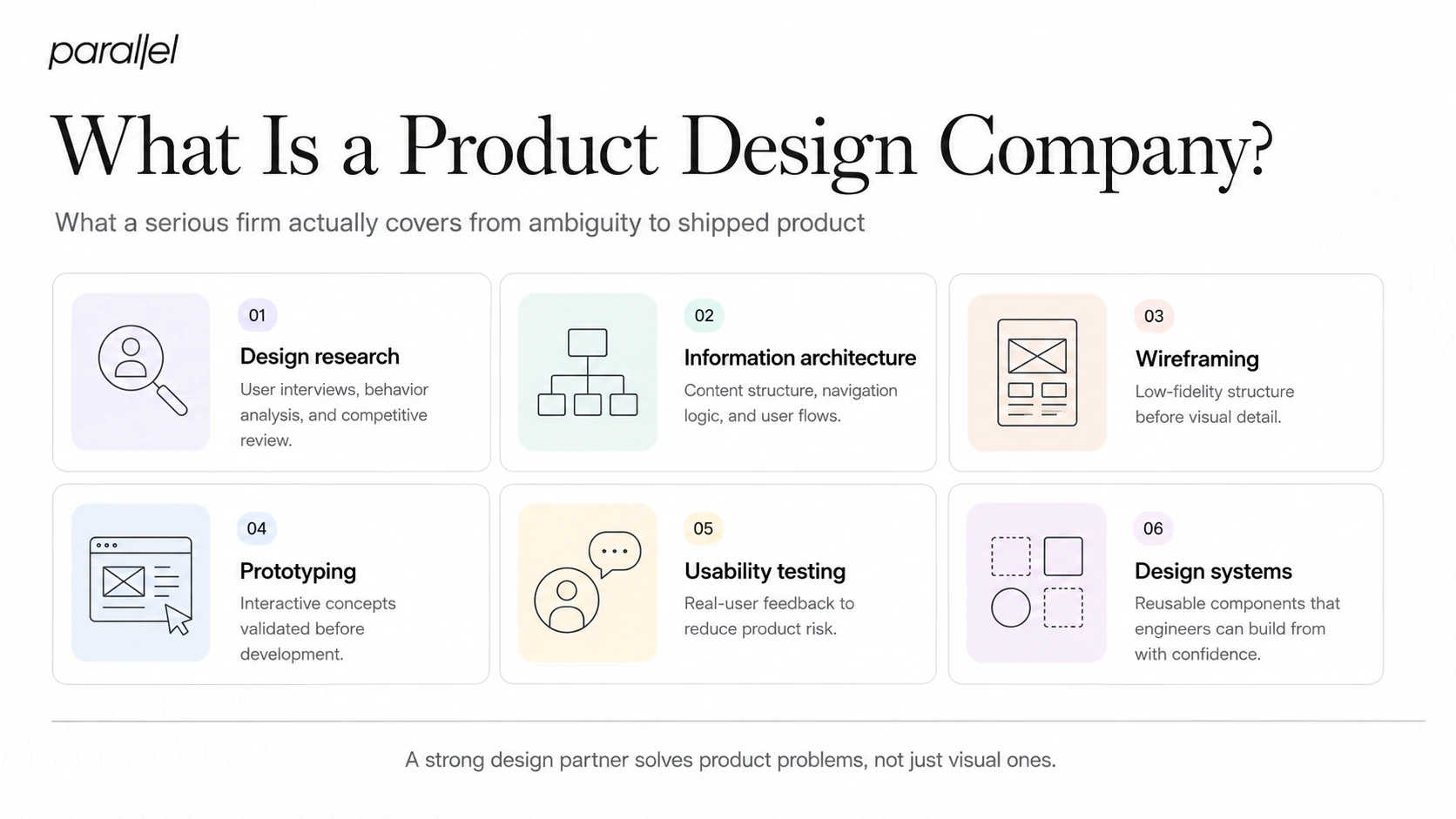
Most founders come in thinking a product design company does UI. That's about 20% of it. A serious product design company covers the full arc from ambiguity to shipped product. That includes design research (user interviews, behavioral analysis, competitive teardowns), information architecture, wireframing, interaction design, high-fidelity UI, prototyping, usability testing, and design systems that development teams can build from without guessing.
The distinction that matters most for founders: a product design company is outcome-oriented. A good partner isn't just handing you Figma files. They're helping you identify which problem is worth solving, how users will navigate that solution, and where your current interface loses people before they reach their first meaningful action.
The best design agencies in 2026 design both the product and the website as one system, helping users figure out what to do in the first 30–60 seconds, removing unnecessary steps, and getting people to their first real action faster.
The tools vary: Figma is now the industry standard for collaborative design. Adobe XD, Sketch App, and Framer appear in more specialized workflows. But the tool is never the differentiator, the thinking behind it is.
At ParallelHQ, the work typically begins before any screen is opened. We run discovery frameworks, map opportunity spaces, and stress-test assumptions before moving into wireframing and prototyping. The Figma file is the output of a problem-solving process, not the process itself.
Here's what a complete product design scope actually covers:
- Discovery and design research: User interviews, jobs-to-be-done mapping, heuristic evaluation
- Information architecture: Content hierarchy, navigation logic, user flows
- Wireframing and prototyping: Low-to-high fidelity, validated before engineering begins
- Interaction design and UI: The actual interface, micro-interactions, component behavior, visual language
- Usability testing: Structured sessions to validate assumptions against real users
- Design systems: Scalable component libraries that give engineering a single source of truth
If an agency skips the first three and goes straight to mockups, ask why.
Best Product Design Companies in 2026 (For Startups That Need to Move Fast)
This isn't a comprehensive directory. It's a considered list with honest framing of who each firm is actually built for.
ParallelHQ: Our work is built entirely around US-based startups navigating early product decisions. We run design sprints, UX audits, and MVP development, in a compressed, opinionated way that suits founders who can't afford to iterate slowly. Verticals include SaaS, AI software, fintech, and healthtech.
Clay: Clay is known for crafting polished, high-conversion digital experiences for ambitious tech companies, and has worked with names like Slack, Stripe, and Coinbase, often before those products hit scale. Clay makes more sense for well-funded teams that want top-tier brands and product craft together.
MetaLab: MetaLab has built its reputation creating beautiful, functional products for high-growth startups and established SaaS companies, specializing in taking products from early concept through scaling phases.
Ramotion: A San Francisco-based SaaS design agency founded in 2009 that delivers full-cycle design, brand identity, and product design for B2B SaaS companies and venture-backed startups.
Eleken: Best for fast MVP design and untangling complex, confusing interfaces for early-stage startups, with key services including UI/UX design, dedicated product designer, and SaaS interface design.
Product Design Company vs. In-House Design Team: Which Is Right for You?
This is the most honest question a founder can ask, and the answer is almost always: it depends on your stage. An in-house team offers brand intimacy and direct control but comes with high fixed costs and limited scalability.
In 2026, a senior product designer's salary averages $145,000, plus benefits, equity, and equipment. A mid-sized team covering a senior designer, creative director, mid-level designer, and project manager costs $500k+ annually once you include salaries, benefits, tools, and overhead.
A product design company gives you a full team, researcher, strategist, interaction designer, systems thinker, without the 6-month recruiting cycle and $500k payroll commitment. For strategic, high-stakes projects like a SaaS product redesign, the risks of relying on freelancers, availability, lack of redundancy, and project management overhead, outweigh the benefits.
My read: hire an agency until design is genuinely a competitive differentiator and you can keep a senior designer fully utilized year-round. Before that point, the math rarely worked in favor of building in-house.
How to Choose the Right Product Design Company for Your Business
The evaluation criteria most founders use, portfolio, awards, client logos, are the least predictive indicators of fit. Here's what I actually look at:
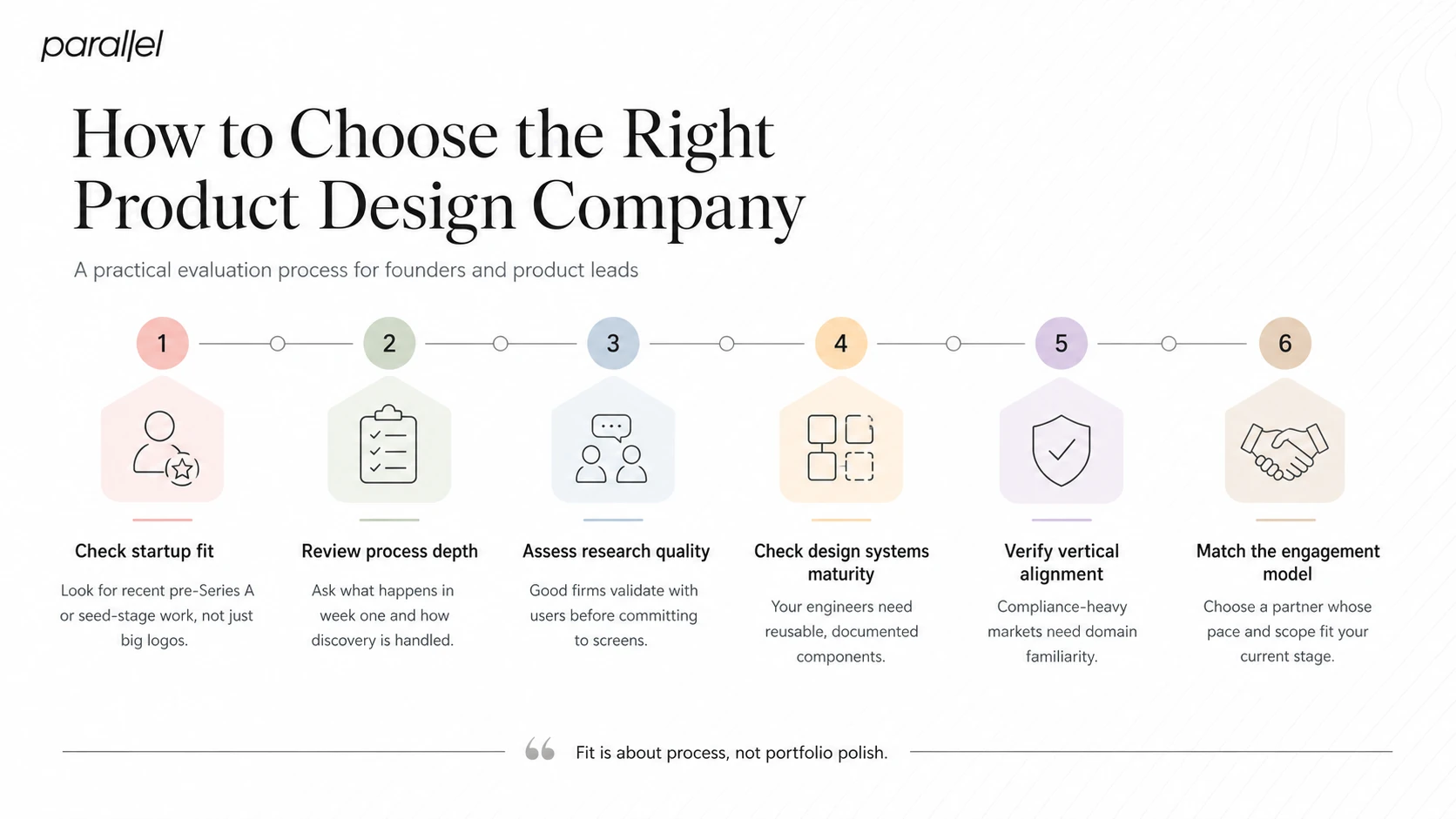
- Startup experience, not brand logos: A firm that's designed for Slack is not automatically qualified to design for your pre-revenue SaaS. Ask how many pre-Series A companies they've worked with in the last 12 months.
- Process transparency: Before hiring anyone, ask four questions: What happens in week one? Can they show a real B2B dashboard, not just a pretty landing page? What does developer handoff look like? And who will actually be on the project once the sales call is over?
- Design systems maturity: A firm that doesn't talk about design systems isn't thinking about your engineering team. At ParallelHQ, design systems are a standard output, not a premium add-on.
- Research capability: If the agency skips user research, they're designing from assumptions. That's expensive to undo post-launch.
- Vertical alignment: A healthtech product has different compliance constraints than a B2B CRM. Domain fluency matters. A team that's worked with both fintech and healthcare products likely knows how to balance compliance with usability.
- Engagement model fit: The best agencies in 2026 prioritize business outcomes and clear KPIs like CAC reduction and LTV increase over pure aesthetic deliverables, and act as long-term strategic partners helping you navigate post-launch growth.
Also worth validating: do they do usability testing as a standard practice, or only when you push for it? The answer reveals whether they're confident in their design decisions or just shipping screens and hoping.
How Much Does It Cost to Hire a Product Design Company?
Pricing has more variance than most comparison sites admit. Here's a clear framework.
Product design agency costs typically range from $5,000 to $300,000, depending on complexity, scope, and depth of execution.
Design cost is a function of complexity, number of screens, research depth, prototyping needs, and iteration cycles.
In 2026, a top-tier US-based product design agency typically charges between $150 and $300 per hour. The average cost of hiring a product design agency on Clutch is between $25–$49 per hour, though that range reflects offshore and boutique options, not senior US-based specialists. Product design agency cost is rarely a fixed expense; it is a strategic investment that typically represents 5% to 20% of a product's total go-to-market cost.
Cheap design at the wrong stage almost always creates expensive engineering rework. The question isn't "how little can I spend?", it's "what does poor design cost me in time-to-market and retention?" Engagement models also vary: fixed-scope projects, retainers, and design sprints each suit different phases. A design sprint can validate a core hypothesis in five days for a fraction of a full project budget, often the right starting point before committing to a larger scope.
Product Design Consultancy vs. Product Design Agency: The Real Difference
This distinction is underappreciated and frequently misused in agency marketing. A product design agency executes. They take a defined brief, produce deliverables, and hand them off. They're resourced for throughput: more screens, more clients, faster turnaround.
A product design consultancy thinks first. They challenge the brief, define the problem, recommend the approach, and then help execute, or equip your internal team to execute. The ratio of strategy to production is higher.
Most firms call themselves agencies but behave like consultancies when the work demands it. The question to ask is: "Will you tell me if we're solving the wrong problem?" If the answer is no, you have an agency. If the answer is yes, and they can demonstrate it, you have a consultancy.
At ParallelHQ, I position us as a consultancy that executes. The product strategy consulting and opportunity mapping work we do at the beginning of an engagement determines whether the design work has any chance of succeeding. Most agencies skip this entirely.
Agencies are now expected to bring more than just design chops to the table; they must bring strategic insight. The strongest evaluation pillars are: how quickly they understand complex industry problems, whether they design with an understanding of modern engineering constraints and AI capabilities, and whether they design for conversion, retention, and scalability.
For startups, the consultancy model is almost always more valuable at an early stage. You don't need 200 screens. You need clarity on what 10 screens should accomplish and confidence that those 10 screens are right before your engineers touch them.
Most Innovative Product Design Companies Right Now (2026)
Innovation in design in 2026 is happening at the intersection of AI, adaptive interfaces, and systems thinking, not in visual trends. The product landscape is being redefined by the intersection of intelligence, sustainability, and user-centricity. Following Apple Intelligence setting new expectations for how AI should power everyday interactions, brands are rethinking how products behave, adapt, and endure.
Hyper-personalization is no longer a luxury; it's table stakes. From adaptive UIs to circular packaging systems, users expect experiences that are anticipatory, context-aware, and environmentally accountable.
The firms doing interesting work right now share three traits: they treat AI as a design constraint (not just a feature to bolt on), they invest in research before touching Figma, and they build for systems rather than screens.
Firms worth watching:
- ParallelHQ (AI UX design): Focused on designing for AI-native products where traditional UX patterns break. The AI readiness design scorecard and SaaS onboarding teardown services reflect this orientation.
- Ustwo: Ustwo restructured in 2025 into a boutique agency emphasizing strategic clients through a "Function + Feeling" approach.
- DEPT®: DEPT® doesn't just use AI as a design tool, it helps organizations reimagine entire business models around AI, embedding intelligence into products, services, and customer engagement.
- Cieden: They build design systems and guidelines that help teams scale, and if you're a product leader with large datasets or planning to add machine learning to dashboards, Cieden has the skills to translate complex inputs into clear interfaces.
The common thread: product design in 2026 is defined by user-first AI, sustainability, and adaptability. The firms leading are those who treat design as a strategic function, not an aesthetic one.
For startups specifically, the most valuable innovation isn't the flashiest interface, it's the firm that can compress your design-to-validation cycle and give you confidence before engineering starts. That's the work that compounds.
Conclusion
- A product design company is a strategic investment, not a vendor, match them to your stage, not just your budget.
- For pre-seed through Series A, an agency almost always outperforms in-house on speed, breadth, and cost per decision.
- Evaluate on process transparency, startup experience, and research capability, not portfolio aesthetics.
- The best firms in 2026 combine human-centered design, AI fluency, and business context into a single engagement model.
If you're an early-stage AI or SaaS startup and want to understand what the right design partner relationship actually looks like for your stage, start with a UX audit or explore our product design services.
Frequently Asked Questions
Q1: What does a product design company do differently from a branding agency?
A branding agency defines your visual identity, logo, color, typography, tone. A product design company focuses on how your software or application actually works: flows, information architecture, interaction design, and usability. The two overlap in design systems, but a product design firm is fundamentally about function, not just appearance.
Q2: How long does a typical product design engagement take?
A focused MVP design engagement typically runs 6–14 weeks. A design sprint compresses core problem validation into 5 days. Ongoing retainers can run indefinitely. Timeline is driven by scope, number of user flows, and how much discovery work is needed before design begins.
Q3: Is a product design company worth it for a pre-revenue startup?
Yes, if you're building a software product. The cost of designing the wrong thing and handing it to engineers far exceeds agency fees. A well-run engagement pays for itself by reducing development rework and increasing the probability of product-market fit on the first or second iteration.
Q4: What's the difference between UI/UX design and product design?
UI design is the visual layer. UX design covers user flows, research, and experience logic. Product design encompasses both, plus product strategy, information architecture, and alignment with business outcomes. Companies that integrate design into their processes outperform competitors with 32% higher revenue growth and 56% higher shareholder returns, highlighting the direct business value of well-executed design.
Q5: Should I run a design sprint before committing to a full engagement?
Almost always, yes. A design sprint validates your core hypothesis with real users in five days. It surfaces assumptions you didn't know you were making and gives both you and the agency a clearer brief before committing to a larger budget and timeline.
Q6: How do I evaluate a product design company's portfolio?
Don't just look at visual quality. Ask what problem each case study solved, what the metrics looked like before and after, and how the agency contributed to that outcome. A real B2B dashboard is more revealing than a polished consumer landing page. Ask: does this work reflect genuine product thinking, or just good taste?

check out these related blogs























.webp)