I have seen hundreds of startups burn through their runway because they were hired for the wrong kind of design. Founders often look for agencies that create beautiful interfaces but miss the deeper logic required to make a product actually work. Aesthetics do not fix broken onboarding. Pretty screens do not solve a lack of user activation. If you are looking for product design services that actually drive business metrics, you need a partner focused on clarity and user behavior. This guide will help you understand the landscape and choose the right team for your stage.
What are the 10 best product design service providers for 2026?
Here is the quick list of top providers for product design services in 2026. The table below breaks down the top ten agencies, their core strengths, and who they serve best.
What is the real cost of superficial design?
When companies invest in product design services, they often expect a quick visual refresh. They think a new coat of paint will magically fix their retention problems. In my experience this is where most product decisions go wrong.
Design is not just what a product looks like. It is how it works, how it flows, and how quickly it gets a user to their "aha" moment.
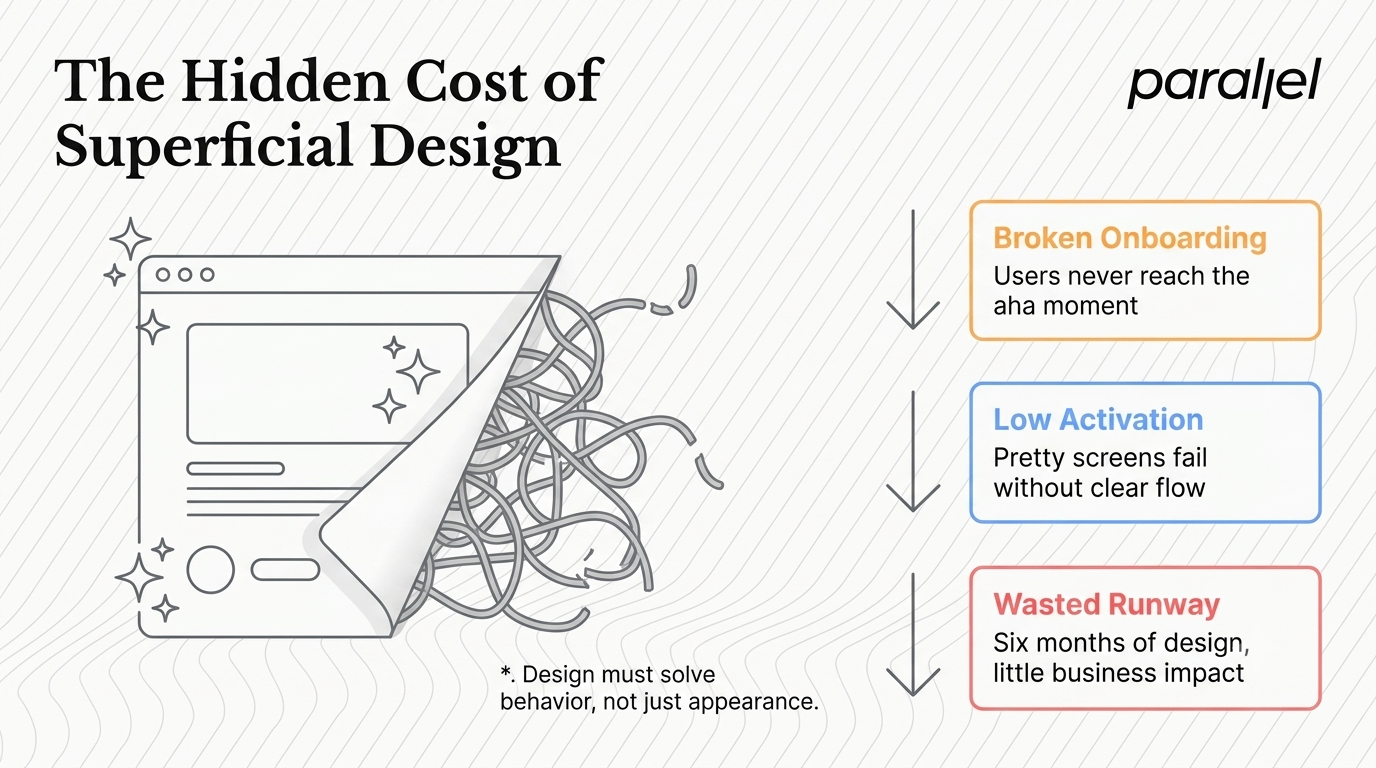
We frequently talk to founders who spent six months and six figures with a traditional agency. They receive a massive Figma file filled with gorgeous screens. But when they hand those screens to their engineering team, the logic falls apart. The edge cases are ignored. The UX strategy is missing. The product is overcomplicated.
A 2026 industry report on UX ROI highlights that companies prioritizing strategic design see a 32% higher revenue growth than their peers. However this growth only happens when design solves real user problems.
You do not need a team to just draw screens. You need a team to help you think. You need a partner who can look at your product backlog, challenge your assumptions, and simplify the experience.
Who are the top 10 product design partners for 2026?
Let us look at the top 10 companies offering product design services this year. I have categorized them based on their actual strengths so you can find the right fit for your specific business context.
1) ParallelHQ
We built ParallelHQ because we saw teams struggle with design decisions that should have been simpler and more grounded in real user behavior. We do not just build pretty apps. We help founders and product managers untangle complex problems.
- Our approach: We focus entirely on clarity. We believe that weak onboarding and low activation are the biggest threats to an early-stage startup. We use tools like our discovery framework to map out exactly where users get stuck.
- Where we excel: We are at our best when working with early-stage to mid-stage startups. If you have an overcomplicated product experience, we help you simplify it. We rely heavily on rapid design sprints to validate ideas before writing a single line of code.
- The outcome: We deliver actionable product thinking. We frequently start engagements with a deep UX audit to show teams exactly where they are losing users. We focus on business metrics, not just design awards.
2) MetaLab
MetaLab is one of the most recognized names in the industry. They have a massive portfolio featuring some of the biggest tech unicorns in the world.
- Their approach: They focus on creating iconic, visually stunning interfaces. They blend brand identity deeply into the product interface, making sure the product feels premium from the first click.
- Where they excel: They are perfect for heavily funded consumer applications that need a massive splash in the market. If you have the budget and need to set a visual benchmark in your industry, they are a strong choice.
- The tradeoff: Their engagements are highly expensive and take significant time. If you need a more agile, strategy-first approach without the massive price tag, you might want to look for a MetaLab alternative.
3) IDEO
IDEO practically invented modern design thinking. They are a massive global consultancy that tackles systemic, complex human problems.
- Their approach: They are deeply rooted in ethnographic research. They spend weeks or months understanding human behavior before designing solutions. They focus heavily on physical and digital integrations.
- Where they excel: They are the right choice if you are trying to invent a completely new category of product that involves hardware, physical spaces, and digital interfaces.
- The tradeoff: For a standard SaaS or digital platform, their process can be overkill. Startups often need to move faster than a traditional IDEO engagement allows. If you need rapid digital execution, a specific IDEO alternative might be more practical.
4) Clay
Clay is a San Francisco based agency known for creating visually flawless digital experiences. They are heavily favored by high-growth tech companies.
- Their approach: They merge marketing and product seamlessly. They are known for their 3D work, micro-interactions, and highly polished marketing sites that bleed into the product interface.
- Where they excel: If your biggest challenge is standing out in a crowded, aesthetic-driven market like AI or consumer fintech, Clay delivers incredible visual differentiation.
- The tradeoff: Their focus is often heavily skewed towards the visual and marketing side of the product. Teams needing deep, complex B2B workflow simplification might find better alignment with a Clay alternative focused purely on product logic.
5) Frog Design
Frog provides enterprise-level product design services for global transformations. They have been around for decades and have evolved from industrial design to digital strategy.
- Their approach: Frog takes a highly structured, corporate approach to design. They work well within massive organizational structures to align stakeholders and drive widespread digital transformation.
- Where they excel: They are best suited for Fortune 500 companies trying to modernize legacy systems. They have the scale and processes to handle massive corporate governance.
- The tradeoff: Their overhead and processes are built for enterprises. Early-stage founders will likely find them too slow and expensive. A more agile Frog Design alternative is usually better for startups.
6) Ramotion
Ramotion focuses on the intersection of brand identity and digital product design. They have built a strong reputation in the tech startup ecosystem.
- Their approach: They ensure that a company's brand narrative is perfectly translated into the application interface. They often tackle rebranding and app redesigns simultaneously.
- Where they excel: They are a great fit for Series A or B startups that have found product-market fit but have a fragmented brand and UI. They bring consistency across all touchpoints.
- The tradeoff: If your primary issue is deep product logic, workflow optimization, or complex data visualization, you might need a partner heavier on UX research. You can explore a Ramotion alternative if pure product strategy is your main goal.
7) Work & Co
Work & Co is deeply focused on building actual digital products, not just doing research or marketing campaigns.
- Their approach: They pair designers and engineers closely from day one. They believe in rapid prototyping and testing functional code rather than just static screens.
- Where they excel: They are ideal for complex digital products that require intense technical execution. They build robust platforms and are highly respected for their engineering capabilities alongside design.
- The tradeoff: They are a premium, large-scale agency. Startups looking for strategic guidance on product direction before committing to heavy engineering might prefer a Work & Co alternative.
8) Huge
Huge is a global digital agency that handles massive marketing and brand experience projects for global giants.
- Their approach: They take a data-driven approach to digital marketing and user experience. They are built to handle massive traffic and global consumer campaigns.
- Where they excel: They are perfect for major consumer brands needing a comprehensive digital overhaul, from e-commerce platforms to global marketing rollouts.
- The tradeoff: They operate more like a traditional advertising and marketing agency in many aspects. Startups needing nimble, user-centric SaaS design should look for a Huge alternative.
9) Method
Method focuses on strategic design and customer experience. They look at the entire service blueprint of a business.
- Their approach: They align digital products with the underlying business models. They look at how a product impacts operations, customer support, and sales.
- Where they excel: They are great for companies undergoing business model transformations, such as moving from physical services to digital subscriptions.
- The tradeoff: Their engagements are highly strategic and exploratory. Teams needing immediate UI/UX execution to hit a launch deadline might find a Method alternative more suitable.
10) ustwo
ustwo is a digital product studio famous for creating the game Monument Valley. They bring a unique, playful perspective to software.
- Their approach: They focus heavily on immersion, joy, and emotional connection in digital products. They believe software should be delightful to use.
- Where they excel: They are brilliant for consumer apps, health tech, and products where user engagement relies on positive habit formation and emotional resonance.
- The tradeoff: Their playful approach may not translate well to dense, enterprise-level B2B SaaS platforms. A strictly B2B-focused ustwo alternative might be better for heavy data applications.
Where do teams go wrong when hiring agencies?
I have audited dozens of products built by external agencies. The same patterns of failure emerge almost every time. Bad product design services focus on the interface while ignoring the mechanics of the business.
Here are the three biggest mistakes founders make when selecting a partner.
Mistake 1: Outsourcing the thinking
You cannot outsource your product strategy completely. Many founders hand a brief to an agency and wait for the final designs. This is a recipe for disaster. The best agencies act as thought partners. They facilitate workshops. They challenge your assumptions. They force you to clarify your value proposition. If an agency just takes your feature list and starts drawing, run the other way.
Mistake 2: Ignoring activation and focusing on aesthetics
We see this constantly in SaaS design services. The dashboard looks incredible, but the onboarding flow is a nightmare. Users drop off before they ever see the beautiful dashboard.
Nielsen Norman Group recently updated their usability heuristics in late 2025, reinforcing that visibility of system status and user control are vastly more important than modern aesthetic trends. Your partner needs to obsess over your retention metrics, not just their Dribbble portfolio.
Mistake 3: Skipping real user validation
Agencies love to present designs in polished slide decks to stakeholders. Stakeholders nod, sign off, and the product is built. Then users hate it.
You must test with real users before writing code. We strictly enforce usability testing in our process. If a potential partner does not have a clear, rigorous method for putting prototypes in front of real users, they are guessing. You cannot afford to pay an agency to guess.
How should you evaluate these partners?
Evaluating product design services requires looking past the portfolio. Every agency on the list above has a beautiful portfolio. You need to understand how they work under the hood.
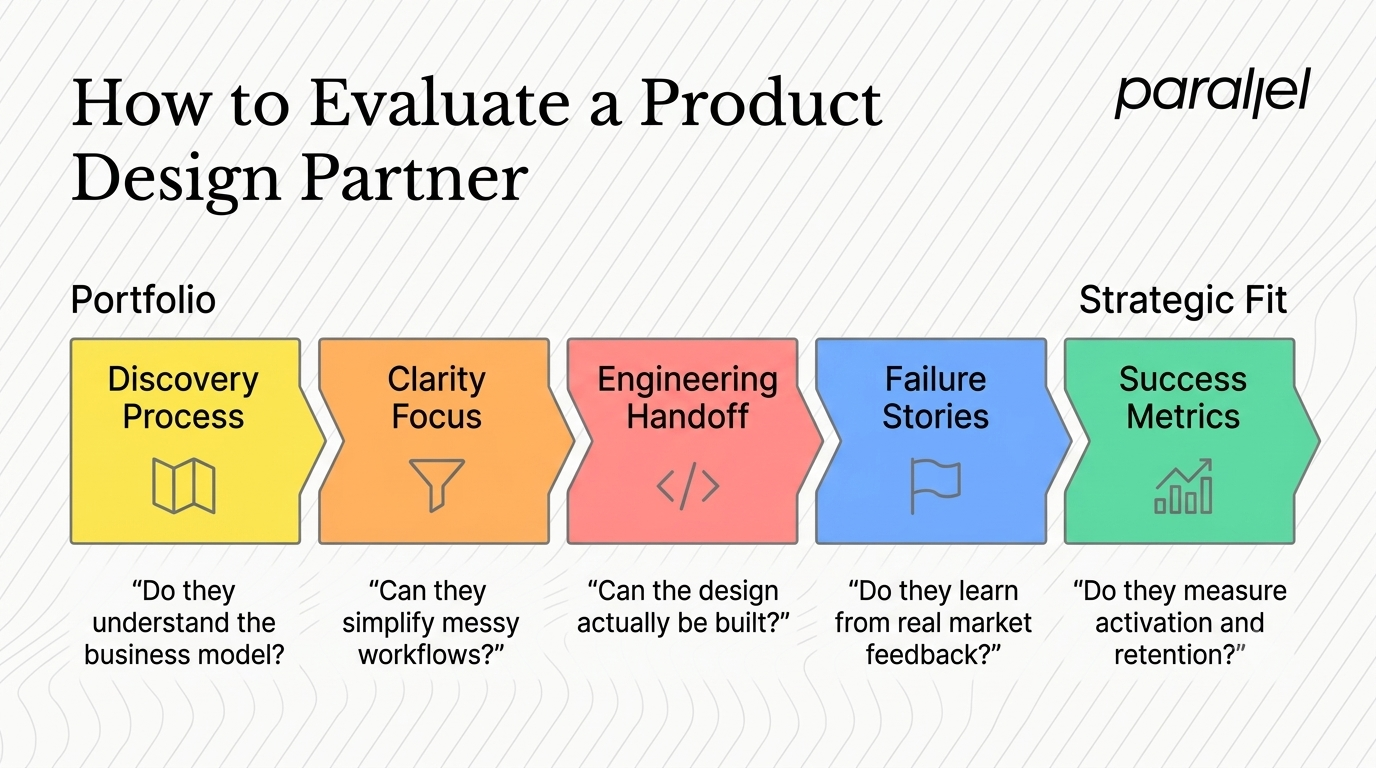
Here is exactly what we advise founders to look for.
Ask about their discovery process
How do they start a project? If they jump straight into wireframes, they are skipping the most important step. Look for teams that use structured frameworks. We use intense, focused discovery phases and opportunity mapping to align stakeholders before we design anything. You need to know that they understand your business model.
Look for a focus on clarity
Ask them to walk you through a complex problem they solved. Do not let them just show you the final screens. Ask them to show you the messy middle. How did they take a convoluted workflow and make it simple? The ability to simplify complexity is the single most valuable skill in a product designer.
Demand integration with engineering
Beautiful Figma files are useless if they cannot be built efficiently. Ask the agency how they hand off work to developers. Do they provide comprehensive design systems? Do they document interactions and edge cases? A mature design partner thinks about the engineering effort required for every decision they make.
Ask for their failure stories
Every experienced team has built something that failed in the market. Ask them about it. If they claim they have never had a feature flop, they are either lying or they do not track their metrics post-launch. You want a partner who is honest about the iterative nature of building software. You want a team that knows how to pivot based on real user research.
How can you bring everything together?
Choosing the right design partner is not about finding the team that makes the prettiest screens. It is about finding a team that thinks clearly.
The software market in 2026 is brutally competitive. Users have zero tolerance for confusing interfaces or bloated onboarding flows. You need a product that is grounded in real user behavior, stripped of unnecessary complexity, and focused purely on delivering value.
At ParallelHQ, we have built our entire practice around this philosophy. We help teams stop guessing and start making confident product decisions. We focus on the mechanics of activation, retention, and clarity.
When you evaluate potential partners, look for the ones who ask the hardest questions. Look for the ones who care more about your users than your aesthetic preferences. That is how you build a product that actually survives the market.
What are the frequently asked questions?
1) What exactly do product design services include?
They include everything required to shape how a product works and feels. This goes far beyond creating UI screens. It involves user research, defining the product strategy, creating wireframes, building prototypes, conducting usability testing, and establishing scalable design systems. The goal is to solve a specific business problem through a better user experience.
2) How do we know if we need an agency or an in-house team?
If you need to move very fast, validate a new concept, or overhaul an existing complex system, an agency brings concentrated expertise and speed. They are perfect for 0-to-1 builds or major redesigns. Once the product is stable and requires slow, incremental daily updates, hiring an in-house team becomes more cost-effective. We often help teams bridge this gap by establishing their design systems first.
3) How much do these engagements typically cost in 2026?
Costs vary wildly based on the agency tier. Global firms like IDEO or MetaLab can charge upwards of $250,000 to $500,000 for comprehensive projects. Specialized, agile teams focusing on startups typically range from $30,000 to $100,000 depending on the scope. It is vital to measure this against the cost of building the wrong product, which is often fatal for a startup.
4) What is the difference between UI design, UX design, and product design?
UI (User Interface) design is focused on the visual elements like colors, typography, and buttons. UX (User Experience) design focuses on the flow, logic, and wireframes to ensure the product is easy to navigate. Product design encompasses both, but adds a critical layer of business strategy. A product designer ensures the UX and UI align with the company's revenue goals and market positioning.
5) Is an external agency right for an early-stage startup?
Yes, provided you hire the right kind of agency. Early-stage startups cannot afford slow, corporate-style discovery phases. They need rapid validation. We specifically run design sprints for this reason. We help founders validate their core assumptions in a matter of weeks, ensuring they do not waste engineering budget on features users do not want.
6) How do we measure the success of a design partner?
Do not measure success by the number of screens delivered. Measure it by business impact. Are more users completing the onboarding flow? Has the churn rate decreased? Has the time-to-value for a new user dropped? A strong design partner will define these success metrics with you before the project even begins.
7) How long does a typical project take?
A focused UI/UX audit or a design sprint can take as little as 2 to 4 weeks. A complete zero-to-one product design engagement for an MVP typically takes 8 to 12 weeks. Large-scale enterprise transformations can take 6 to 12 months. We strongly advocate for working in agile, modular phases to ensure continuous delivery of value.
8) What makes ParallelHQ different from traditional design agencies?
We are not an agency that just takes orders and colors in wireframes. We act as an extension of your product team. We focus heavily on clarity and product thinking. We are obsessed with simplifying complex workflows. We bring years of experience working specifically with early-stage and growth-stage startups, meaning we understand the pressure to deliver functional, high-converting products quickly without the traditional agency fluff.

check out these related blogs