If you're evaluating Work & Co alternatives, you've already done your homework. Work & Co is elite. But "elite" also means Accenture-backed, enterprise-focused, and priced accordingly. For AI and SaaS founders who need senior design thinking without the Fortune 500 overhead, the real question is: which agency gives you comparable craft, strategic depth, and startup fluency at a scale that actually fits? This guide breaks it down clearly.
TL;DR
- Work & Co is now part of Accenture Song, built for enterprise-scale engagements, not startup velocity.
- Clay, MetaLab, Instrument, ustwo, and ParallelHQ each offer meaningful Work & Co alternatives for different contexts.
- Startup founders prioritizing product discovery, B2B SaaS design, and conversion rate optimization should weigh startup fluency as heavily as portfolio prestige.
- ParallelHQ is the purpose-built option for early-stage AI and SaaS startups needing senior partnership without enterprise minimums.
Why Founders Are Searching for Work & Co Competitors in 2026
Work & Co, now part of Accenture Song, is a global design and technology company with over 425 people across the United States, Europe, and Latin America. At that scale, the agency's attention is naturally drawn to clients who can sustain multi-track, multi-year relationships. Projects typically have small, senior teams including company partners who are hands-on active members, and teams are dedicated to one project at a time. That model is genuinely excellent. The gap is fit: notable clients include Apple, Bottega Veneta, Disney, Google, Epic Games, IKEA, Mercedes-Benz, Nike, and T-Mobile. If your startup isn't operating at that tier yet, you're unlikely to get the firm's best senior resources.
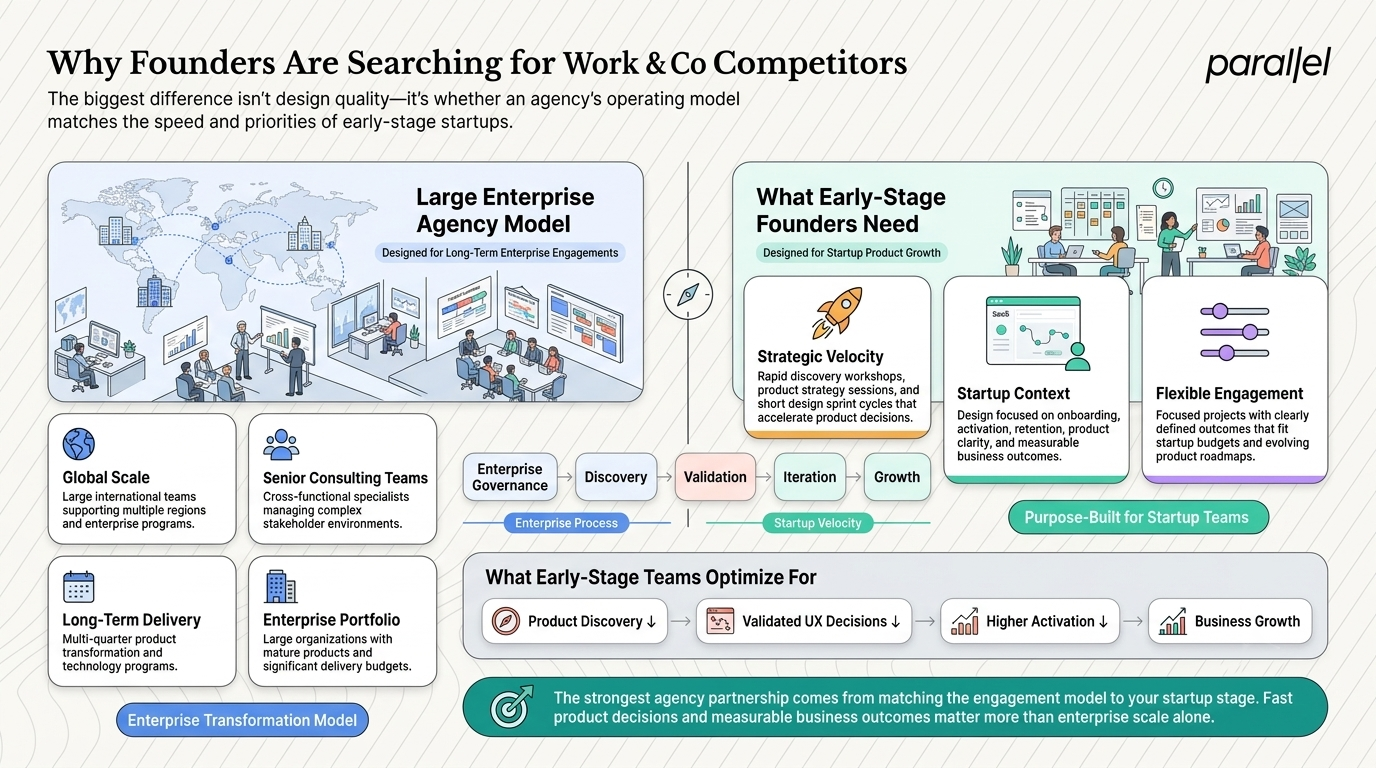
What early-stage and growth-stage AI and SaaS founders actually need differs on three dimensions:
- Strategic velocity: Founders need product discovery workshops and agile design sprints that compress decisions, not agency governance built for Fortune 100 stakeholder management.
- Startup context: B2B SaaS design requires a partner who understands unit economics, activation flows, and onboarding, not just interaction design aesthetics.
- Engagement flexibility: Pre-Series B founders can't anchor to six-figure minimums. Smaller, sharper engagements with defined outcomes matter more than a sprawling scope of work.
The best agencies in 2026 prioritize business outcomes and clear KPIs like CAC reduction and LTV increase over pure aesthetic deliverables. That shift is exactly what makes this comparison relevant. The right Work & Co alternative isn't the agency with the most impressive logo wall, it's the one whose model fits your stage.
Work & Co Competitors Compared 2026: The Core Field
Here is a structured comparison of the most-evaluated Work & Co alternatives this year.
Each firm brings real craft. The differences are in model, access, and startup orientation.
Clay differentiates from large agencies where junior talent typically handles most work; at Clay, co-founders lead dedicated, senior-level teams with cross-disciplinary expertise. With a minimum project size of $50,000+ and an average hourly rate of $150–$199/hr, Clay is premium but accessible for funded startups. Their focus on UX strategy consulting and design systems architecture makes them a credible Work & Co alternative for SaaS founders upgrading their brand and product simultaneously.
MetaLab is a digital product agency that helps ambitious companies design, build, and scale category-defining products; since 2006, they've partnered with brands including Slack, Coinbase, Uber, Google, Headspace, and Windsurf. In 2025, MetaLab led the rebrand of Cognition AI, helping reposition the product with a consumer-facing visual identity under the new name Windsurf. Their strength is mobile-first design and full product development, though their price tag, as one industry review noted, "may not suit every aspiring startup."
Instrument has been bringing taste and technology together to build brands, products, and experiences for more than 20 years, with partners like Google, Spotify, Electronic Arts, ServiceNow, Uber, and ŌURA. Their teams are built to remove handoffs and keep the work connected so ideas don't get watered down from concept to execution. Best fit for B2B SaaS design and brand system scale-ups, though they skew toward established brands.
Ustwo designs and builds digital experiences with human-centred design and deep technical expertise; for 20 years, their global studio has partnered with organisations to build products used by millions. Founded in Shoreditch in 2004, employee-owned and B Corp certified, ustwo's client work for BMW Group, Barclays, Tesco, Google, and Sony spans multiple sectors because their research-first approach transfers across domains. Enterprise minimums apply.
What Companies Use Instead of Work & Co: The Startup-First Case for ParallelHQ
For founders at early-stage AI and SaaS companies, the most consequential question isn't "who is most like Work & Co" but "who is built for us." I'm Robin Dhanwani, founder of ParallelHQ. We started with a specific conviction: the model that serves IKEA and Nike doesn't serve a 12-person AI startup racing toward product-market fit. Startups need embedded partners who move at sprint velocity, think in activation and conversion rate optimization terms from day one, and don't disappear after handoff.
Here is how ParallelHQ is built differently:
- Startup-native model: Every engagement is designed around early-stage constraints, compressed timelines, shifting priorities, and founders who are also the decision-makers in the room.
- Full-stack product design: From UX research and product strategy consulting through design systems and Figma design services, under one operating rhythm.
- Process transparency: We run design sprints and discovery frameworks that give founders clarity on decisions before they become expensive mistakes.
- Outcome-anchored scope: Every engagement is anchored to product outcomes, activation rates, onboarding completion, SaaS retention flows, not just deliverable counts.
If you're comparing Work & Co alternatives because you want senior craft without Accenture governance, that's precisely the gap ParallelHQ fills. Explore our work & co alternative positioning directly to see how the models compare.
Is There a Cheaper Alternative to Work & Co for Startups?
Price is the wrong frame. Fit-adjusted value is the right one. For agencies at Work & Co's tier, a product design engagement from research through visual design typically costs $25K–$150K; design system creation ranges from $40K–$120K; and ongoing design retainers run $8K–$25K per month. These are market rates for senior agency talent, not markups.
The real cost question for a startup founder is: what percentage of your engagement budget reaches strategic, senior hands? At large enterprise agencies, even at premium rates, significant scope flows through mid-level execution teams. The senior partner you met during the pitch appears less frequently once the project kicks off. For an early-stage founder, that dilution is the actual risk, not the hourly rate. It is no longer enough to hire a team that can produce beautiful Figma files; you need a partner who understands unit economics, technical feasibility, and the nuances of your specific industry.
What "cheaper" should actually mean for AI and SaaS founders:
- Smaller scope, sharper outcome: A focused UX audit or MVP development engagement delivers proof before you commit to a full retainer.
- No governance overhead: Boutique startup-focused agencies don't carry the account management layers that inflate enterprise agency bills.
- Stage-appropriate starting points: Diagnostic services like our AI readiness design scorecard or SaaS onboarding teardown give founders a clear signal on where to invest first.
The cheapest option is always the one that gets you to the right decision fastest. That's a function of process quality and senior access, not hourly rate.
Top Alternatives to Work & Co for Product Design and Strategy: How to Choose
Matching an agency to your startup means applying a filter most listicles skip: the decision shouldn't be based on portfolio prestige alone. Use the following decision logic:
Choose ParallelHQ if:
- You're an AI or SaaS startup that needs embedded design partnership, not an agency that "delivers" to you.
- Your team needs usability testing, wireframing and prototyping, and product design to happen inside your sprint rhythm.
- You want startup-fluent thinking, not design thinking methodology applied to an enterprise governance model.
Choose Clay if:
- You need brand identity and UX to move together, especially for an enterprise SaaS rebrand or fintech product.
- Your design problem involves interaction design firms with deep experience in consumer-to-enterprise transitions.
- You're preparing a SaaS startup to cater to enterprise clients by revamping brand, product, and marketing sites, Clay has partnered with early-stage companies including Coinbase, Uber, SendGrid, and MoneyLion who emerged as leaders in their industries.
Choose MetaLab if:
- Your product is consumer-facing with deep mobile-first design requirements.
- You need strategy, design, and engineering under one roof for a full product build.
- Metalab Ventures, launched in 2024 with an initial fund of approximately USD 15 million, invests in product-led technology startups, so they bring founder-level perspective to client work, focused on pre-seed through Series A companies where design is a key differentiator.
Choose Instrument if:
- Your scale-up needs a design system that spans brand, marketing, and product simultaneously.
- You're a B2B SaaS company building cross-functional product teams with complex information architecture needs.
- You need clients like ServiceNow-level reach, Instrument's client list spans Nike, Google, ServiceNow, EA, Netflix, Spotify, Pinterest, Microsoft, Patagonia, Uber, Stripe, and Salesforce.
Choose ustwo if:
- Your product problem requires genuine research depth across user research methodologies, not research as a checkbox.
- Founded in Shoreditch in 2004, employee-owned, B Corp certified, and operating across five global studios, ustwo's cross-functional team model means user research insights are present in design decisions as they're made.
- Your engagement budget supports enterprise-tier minimums.
ParallelHQ vs Work & Co: Which Is Better for AI and SaaS Startups?
This isn't a comparison that resolves to a single answer. It resolves to a stage and context question. Work & Co is a digital product agency that drives tangible business impact through strategy, design, and development of new platforms and experiences. Work & Co is known for its collaborative process with clients and being hands-on, sharing working prototypes throughout rather than unveiling finished work. That's genuinely strong. The methodology is sound, the craft is high, and the output is enterprise-grade.
The gap is structural. After joining Accenture Song, Work & Co's operating model is built for clients who need global coordination, multi-office delivery, and deep enterprise integration. A 15-person AI startup working through its first major product redesign is not that client, and paying enterprise-tier rates to get junior-staffed delivery on a smaller scope is a common, expensive mistake.
Here is where ParallelHQ is the sharper choice:
If you want the craft signals of a top-tier design agency without the enterprise overhead, ParallelHQ's UI/UX design services and product strategy consulting are built for exactly that gap.
Conclusion
- Work & Co is excellent at what it does, but post-Accenture, it's increasingly optimised for enterprise clients, not startup velocity.
- Clay, MetaLab, Instrument, and ustwo are serious Work & Co alternatives, each with a different strength: brand+UX, consumer apps, brand systems, and research-led product respectively.
- Startup founders evaluating Work & Co alternatives should filter first on startup fluency and senior access, then on portfolio and rate.
- ParallelHQ is built from the ground up for AI and SaaS founders who need embedded, outcome-driven product design partnership at a stage where every sprint decision compounds.
Frequently Asked Questions
1) What is Work & Co and why are people looking for alternatives in 2026?
Work & Co is a digital product agency founded in 2013, acquired by Accenture in 2024. Post-acquisition, it operates as part of Accenture Song with 425+ global staff. Founders are searching for alternatives because the agency now skews heavily toward enterprise-scale engagements, making startup access and budget fit more difficult.
2) Which Work & Co alternative is best for B2B SaaS startups?
ParallelHQ is purpose-built for early-stage AI and SaaS startups, with an embedded sprint model and outcome-anchored engagements. Clay is a strong second for SaaS companies needing simultaneous brand and product redesign. Both offer senior access without enterprise governance overhead.
3) How does Clay compare to Work & Co?
Clay's co-founders lead every senior-level engagement directly, which mirrors Work & Co's "small, senior teams" model. Clay's focus on SaaS, fintech, and brand-plus-UX integration makes it most relevant for growth-stage product companies. Minimum project size starts at $50,000+.
4) Is MetaLab a good alternative to Work & Co for product design?
Yes, for product-led companies needing design and engineering together. MetaLab has shaped products like Slack, Coinbase, and Windsurf, and brings nearly 20 years of experience. Their price point reflects that pedigree, best for funded startups or established scale-ups.
5) What do companies use instead of Work & Co for enterprise UX?
For enterprise-grade UX strategy consulting, Instrument and ustwo are the most-evaluated alternatives. Instrument spans brand, product, and marketing with clients like Nike, Spotify, and Stripe. ustwo applies a rigorous, research-first methodology with clients including BMW, Barclays, and Google.
6) How is ParallelHQ different from the other Work & Co alternatives listed here?
ParallelHQ is the only agency on this list built exclusively around early-stage AI and SaaS startups in the US. Our model is embedded and sprint-aligned, not delivery-oriented. Engagements start with focused diagnostics like a UX audit or discovery sprint, scaling into full product design partnerships as alignment is established.

check out these related blogs
















































.avif)