Choosing the wrong UI/UX design agency at the seed or Series A stage isn't just a budget mistake, it shapes your product trajectory for years. I'm Robin Dhanwani, founder of ParallelHQ, and I wrote this comparison because founders keep asking me directly: "Why ParallelHQ over Frog Co.?" That's a fair question, and it deserves an honest answer. In Frog Co. vs ParallelHQ, the right choice depends entirely on your stage, budget, and whether you need a startup design partner or a global consultancy.
TL;DR
- Frog Co. is a 50-year-old global consultancy built for Fortune 500 complexity; ParallelHQ is purpose-built for early-stage AI and SaaS startups.
- Frog's pricing is enterprise-level and opaque; ParallelHQ offers accessible, transparent engagement models.
- ParallelHQ ships faster, embeds deeper with founders, and covers the full product design stack end-to-end.
- If you're a startup founder who needs decisions made in weeks, not quarters, ParallelHQ is the faster, sharper fit.
What Are the Core Differences Between Frog Co. and ParallelHQ?
The most useful way to evaluate Frog Co. vs ParallelHQ is not on prestige, it's on fit. These two agencies were built for fundamentally different clients, problems, and paces. Frog (styled as "frog, part of Capgemini Invent") is a global creative and design consultancy founded in 1969. That legacy is real, and so is the structure that comes with it. Now part of Capgemini Invent, Frog is known for helping Fortune 500s, tech giants, and category-defining startups design everything from cutting-edge digital platforms to physical products and brand systems.
ParallelHQ is a different animal entirely. We are a specialist UI/UX design agency that works exclusively with early-stage AI and SaaS startups based out of the USA. Our entire model is tuned to move at startup speed, from discovery to Figma-ready screens to shipped design systems, without the overhead of a consultancy that serves IKEA and Visa in the same week.
Here's how the two agencies stack up across the dimensions that matter most to founders and PMs:
Frog specializes in product design, service design, strategy, branding, and experience innovation, their work spans digital products, physical products, systems design, and emerging tech including AI, IoT, and AR/VR. That breadth is an asset when you're a multinational. For a seed-stage SaaS founder, it often means your project competes for attention against far larger accounts. The difference isn't quality. It's context. Frog was built to handle complexity at scale. ParallelHQ was built to reduce complexity for startups trying to find product-market fit.
Is Frog Co. Worth It Compared to ParallelHQ for Startups?
Worth depends on what you're optimizing for. Let me be direct: Frog excels in complex, high-stakes environments where design is business-critical, think healthcare systems, smart city mobility, or a global bank rearchitecting its digital experience. That is legitimately impressive work.

But if you're a 10-person SaaS startup trying to fix your onboarding funnel, reduce churn, or launch an MVP that converts, Frog Co. is likely the wrong fit for three structural reasons:
- Minimum engagement size: Enterprise consultancies like Frog structure engagements around large scopes. They charge clients based on project scope, duration, and complexity, which may include fixed-price contracts or time-and-materials billing. For startups, this typically means six-figure project minimums before a pixel gets designed.
- Process overhead: Their approach is highly collaborative, with a deep engagement process that involves detailed research, strategic planning, and iterative design. That rigor is valuable, at enterprise timelines. Startups rarely have 4–6 months for a discovery phase.
- Attention asymmetry: When your agency also serves Microsoft, Visa, and Nike, your Series A SaaS product is never the most important project in the room.
ParallelHQ is built around the inverse of these problems. Our product design services are scoped for startups: focused engagements, fast feedback loops, and a team whose entire frame of reference is early-stage product challenges, not enterprise transformation programs.
For a startup founder asking whether Frog Co. is worth it, the honest answer is: probably not yet. Come back when you have 500 employees and a board that wants a Capgemini relationship. Right now, you need a partner who knows what a seed-stage burn rate feels like.
Frog Co. vs ParallelHQ Pricing: What Does It Actually Cost?
Pricing is where the Frog Co. vs ParallelHQ gap is most stark, and most consequential for startup founders. Frog's pricing is contact-based, project-specific pricing only, with no public rate cards. From industry knowledge and publicly discussed estimates, enterprise design consultancy engagements at this level typically start well into six figures, with large transformation programs running into seven-figure territory. There is no "starter plan." There is no retainer model tuned for a 15-person startup.
ParallelHQ operates differently. We offer:
- Sprint-based engagements: Structured around Google Design Sprint methodology, delivered in days, not months. You get validated concepts fast, without open-ended scope.
- Retainer model: A monthly design retainer gives your startup a senior designer embedded in your product team, covering wireframing, prototyping, Figma component delivery, and iteration, at a predictable monthly cost.
- Audit-first entry points: Our UX audit and SaaS onboarding teardown are low-risk, high-signal ways to start the relationship and validate fit before committing to a full engagement.
The question isn't just "what does it cost?", it's "what does it cost to get a specific outcome?" A conversion rate optimization engagement with ParallelHQ has a clear deliverable: measurable lift in a specific funnel step. That clarity is hard to get from an enterprise consultancy accustomed to multi-year transformation engagements.
If your runway is 18 months, you cannot afford a design partner whose default contract timeline is 6 months of discovery alone. For early-stage founders, ParallelHQ's model is engineered for capital efficiency. Every sprint, audit, and retainer is designed to deliver tangible product progress against your current milestone, not a 40-page strategy deck.
What Does ParallelHQ Do Better Than Frog Co.?
This is the question I find founders asking most honestly, so I'll answer it just as honestly. There are five specific things where ParallelHQ structurally outperforms Frog for startup clients:
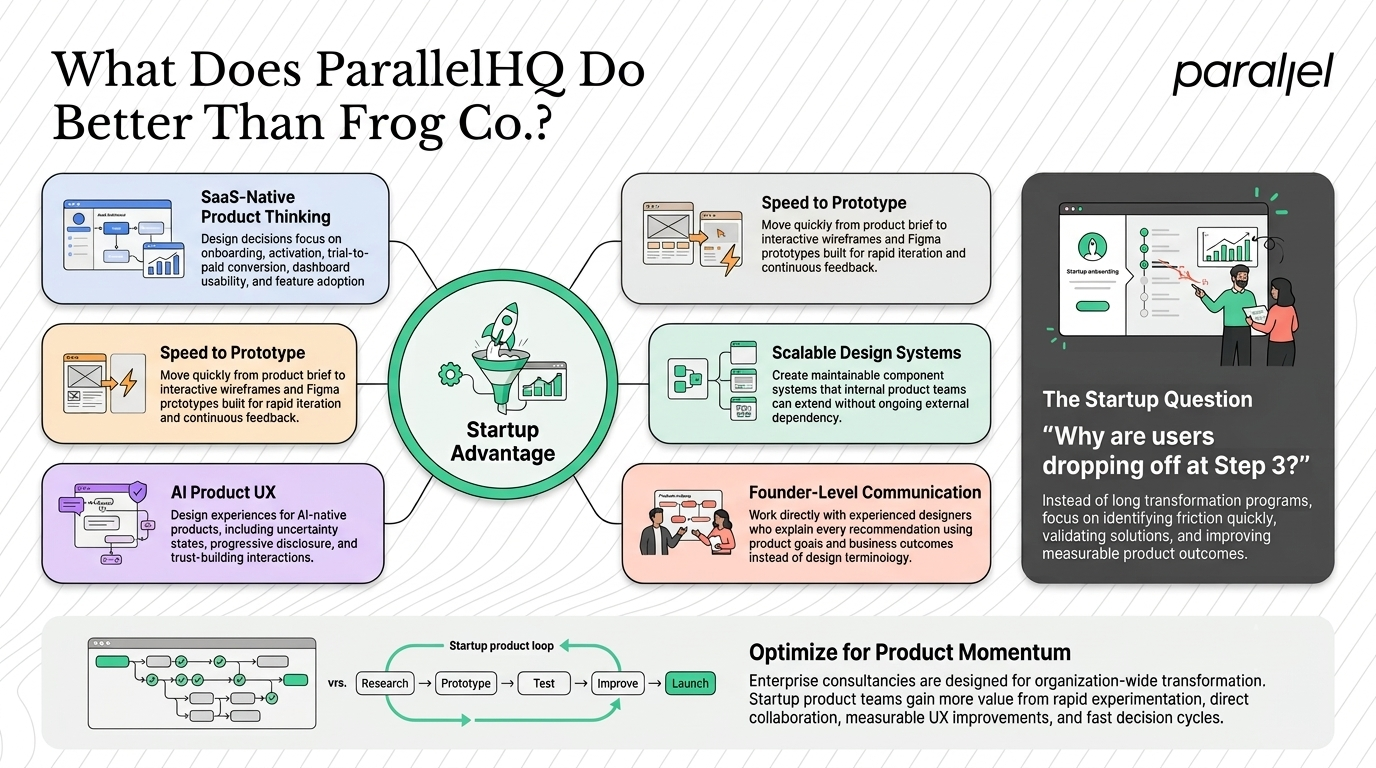
- SaaS-native product thinking: Our entire team has worked on B2B SaaS products, onboarding flows, dashboard information architecture, trial-to-paid conversion, and feature adoption. We bring frameworks from Nielsen Norman Group research and Baymard Institute UX benchmarks directly into design decisions, not as academic references but as applied craft.
- Speed to Figma: From brief to interactive prototype, ParallelHQ typically moves in days. Our wireframing and prototyping process is built for iteration, not perfection-on-first-pass.
- AI and emerging product UX: Our AI UX design and AI software design services are tuned for the specific challenges of AI-native products: managing uncertainty states, progressive disclosure of complex outputs, and building trust through interaction design.
- Design systems that scale: We build design systems that your internal team can actually maintain, not systems that require a Frog retainer to interpret.
- Founder-level communication: You talk to senior designers, not account managers. Every decision gets explained in product and business terms, not design jargon.
Frog excels when a brand needs design and brand strategy to move together, their design process sits at the intersection of marketing, engineering, and user experience. That's true, and valuable at scale. But for a startup, the bottleneck is rarely "integrated brand strategy." It's "why are users dropping off at step 3 of onboarding?" ParallelHQ is built to answer that question fast.
Frog Co. vs ParallelHQ for Product Design: A Workflow Comparison
Understanding how each agency actually works on a product design engagement clarifies the Frog Co. vs ParallelHQ decision more than any capability list.
Frog Co.'s typical product design workflow: Frog's methodology ensures client projects are grounded in rigorous analysis and targeted market insights, allowing them to deliver customized solutions that drive transformation and growth.
In practice, this means:
- Extensive discovery and stakeholder alignment (weeks to months)
- User experience research across multiple geographies
- Strategic framing and opportunity mapping
- Concept development and prototyping
- Delivery, often with implementation partners
This is thorough. It is also slow, and the cost per phase is high.
ParallelHQ's product design workflow for startups:
- Discovery framework session, aligns on problem, user, and success metric in one structured day
- User research, lean research methods, 5–7 user interviews distilled into actionable insight
- Wireframing and prototyping, low-fidelity to mid-fidelity in Figma within the first sprint
- Usability testing, tested against real users before high-fidelity investment
- High-fidelity UI and design systems delivery, component-ready, developer-handoff optimized
The key difference is that ParallelHQ's workflow produces a testable artifact at every stage. You never spend a month in strategy before seeing a single screen. For SaaS product design specifically, this matters because product assumptions change fast. A workflow that validates early saves you from building the wrong thing beautifully.
ParallelHQ vs Frog Co.: What Are Real Users and Clients Saying?
Frog has a long client roster, Frog's 500+ employees serve clients from 35 locations around the world, and the agency has worked with global brands like Unilever, Volvo, and IKEA. The testimonials from enterprise clients reflect that: large-scale transformation, strategic repositioning, digital platform overhauls.
One client noted that "frog's user-centered approach refocused our digital content strategy on the needs and interests" of their customers. These are genuine outcomes, for organizations with the budget and timeline to match Frog's engagement model.
What's notably absent from Frog's public presence is startup-specific case studies, seed-to-Series-A journeys, onboarding conversion lifts, or MVP-to-product-market-fit stories. Frog doesn't rely on review platforms, they rely on a 50+ year legacy and word-of-mouth within enterprise procurement circles. That's a fine strategy for their market. It just means startups have very little signal on what working with Frog looks like at their scale.
ParallelHQ's client feedback centers on different outcomes: faster shipping, clearer design decisions, and product thinking that goes beyond visual design. Founders consistently highlight three things:
- Senior-designer involvement from day one, not handed off to juniors after the pitch
- Design rationale communicated in product and business terms
- Ability to move from opportunity mapping to testable prototype within a single sprint
The honest read on reviews and client outcomes is this: both agencies deliver quality work. They deliver it for different clients, at different speeds, and with different economic structures. A startup founder should weigh the reviews of people at their stage, not at Fortune 500 scale.
Should You Choose Frog Co. or ParallelHQ for Your Startup? The Decision Framework
After running through the Frog Co. vs ParallelHQ comparison in detail, here is the decision framework I'd give any early-stage founder:
Choose Frog Co. if:
- You are a publicly traded company or large enterprise with a multi-year digital transformation mandate
- You need physical product design alongside digital, with integrated brand strategy
- Your procurement process requires a Capgemini-level vendor relationship
- Budget is not a primary constraint and timeline flexibility exists
Choose ParallelHQ if:
- You are an AI or SaaS startup at pre-seed through Series B
- You need to move fast, weeks to a usable prototype, not months to a strategy document
- You want a startup design partner embedded in your product process, not a consultancy that delivers a report and exits
- You need end-to-end coverage: product strategy consulting, SaaS UX, mobile app design, interaction design, and conversion rate optimisation under one roof
- You want a frog design alternative that matches your stage
The best design partner is not the most famous one, it's the one whose process, pricing, and pace are calibrated to where you actually are right now. If you're a 12-person SaaS startup evaluating both options, the answer is almost always ParallelHQ. Not because Frog is bad, they are genuinely excellent at what they do, but because what they do is not optimized for you. Working with a partner who treats your engagement as a flagship project, not a small-account exception, changes the quality of thinking you receive on every call.
The Frog Co. vs ParallelHQ comparison ultimately resolves into one question: are you building at enterprise scale today, or are you a startup that needs to get there? If it's the latter, the design partner that gets you there faster is the one built for the journey, not the destination.
Conclusion
- Frog Co. is a world-class consultancy built for enterprise complexity; ParallelHQ is purpose-built for early-stage AI and SaaS startups that need speed, clarity, and capital efficiency.
- Pricing, process pace, and client fit diverge sharply, Frog requires enterprise timelines and budgets; ParallelHQ offers sprint-based and retainer models tuned for startup economics.
- ParallelHQ delivers senior-designer involvement, SaaS-native product thinking, and startup-speed delivery that Frog's enterprise model structurally cannot match at your scale.
- If you're an early-stage founder evaluating Frog Co. vs ParallelHQ, the right answer for most startups is clear.
Frequently Asked Questions
1) Is ParallelHQ a legitimate alternative to Frog Co. for product design?
Yes. ParallelHQ covers the full product design stack, UX research, wireframing, prototyping, design systems, SaaS onboarding, and AI UX, with a process built specifically for early-stage startups. It is a direct frog design alternative for founders who need startup-pace delivery, not enterprise consultancy timelines.
2) What is the minimum budget to work with Frog Co.?
Frog does not publish pricing. Based on their engagement model as part of Capgemini Invent, projects are custom-scoped and typically structured for enterprise clients, making six-figure minimums the realistic baseline. ParallelHQ offers accessible entry points including UX audits and sprint-based engagements calibrated for startup budgets.
3) Does ParallelHQ use design sprint methodology like Frog?
Yes. ParallelHQ runs structured design sprints modeled on the Google Design Sprint framework, enabling startups to go from problem definition to tested prototype in days. This is built into our process, not offered as a premium add-on.
4) How does Frog Co.'s user research compare to ParallelHQ's?
Frog applies rigorous, large-scale UX research suited for enterprise transformation. ParallelHQ uses lean user research methods, typically 5–7 targeted interviews, distilled into actionable design decisions within the sprint cycle. For startups, lean research that informs the next ship is more valuable than exhaustive research that delays it.
5) Can ParallelHQ handle AI product design specifically?
Yes. ParallelHQ has dedicated AI UX design and AI software design services covering the specific interaction design challenges of AI-native products: uncertainty states, progressive disclosure, trust-building through UI, and onboarding for novel capabilities.
6) Is there a low-risk way to try ParallelHQ before committing to a full engagement?
Yes. The UX audit, SaaS onboarding teardown, and AI readiness design scorecard are structured as standalone, time-boxed engagements. They deliver immediate value and serve as a natural on-ramp to a deeper retainer or sprint partnership.

check out these related blogs