Pentagram is iconic. It's one of the world's largest independently owned design firms, and its partnership model means every project is led by a named senior designer, not managed down to junior staff after the pitch. But that prestige comes with real constraints. Pentagram's partners are selective about the briefs they take, projects need to offer creative challenges, not just revenue. If your project fits what a partner finds interesting, you'll get exceptional work. If it doesn't, you likely won't get far in conversation. If you're a founder or product leader at an AI or SaaS startup, these Pentagram Alternatives Compared will tell you exactly where to look instead.
TL;DR
- Pentagram's starting budget is $150,000+, making it inaccessible for most early-stage teams.
- Agencies like Clay, Koto, and Mucho occupy the growth-stage startup market with senior capability and investment ranges of $25K–$300K.
- The right alternative depends on your stage: disruption-focused, digital-first, or startup-speed.
- For SaaS and AI startups that need product design alongside brand, ParallelHQ is purpose-built for exactly that.
Why Founders Actually Search for Pentagram Alternatives Compared
Pentagram's reputation is deserved. It remains one of the clearest benchmark names in branding and design because of the breadth of its offer, spanning graphics and identity, strategy and positioning, products and packaging, websites and digital experiences, advertising and communications, data visualisations, typefaces, sound, and motion.

The problem isn't quality, it's fit. Reviewers praise Pentagram for its creativity, skilled team, and strong branding expertise, though many note higher costs, limited availability, and longer timelines as drawbacks. Industry benchmarks suggest hiring a top-tier branding agency like Pentagram typically starts at $75,000 and can exceed $250,000 for comprehensive strategy and identity systems. For CMOs managing quarterly budgets, UX directors needing continuous optimization, or founders requiring agile support, these project-based timelines and unpredictable costs create friction.
The practical gap: the partner-led model and legacy positioning may feel too heavyweight or traditional for some fast-moving startups. When you're building an AI product, shipping weekly, and need your brand to live inside a design system and a product UI simultaneously, a studio optimized for editorial and environmental design isn't your ideal partner.
Three concrete reasons to look at Pentagram Alternatives Compared:
- Access: High-profile design firms like Pentagram often command premium fees, and due to their reputation and demand, they may have limited availability, making it challenging for smaller clients or projects to secure their services.
- Speed: Not every fast-moving startup needs a partner of this size or cost profile.
- Digital depth: Buyers often brief the wrong kind of partner. If your problem is strategic confusion, a purely visual studio may not solve it.
The market has matured. There are now studios that match Pentagram's creative rigor with faster cycles, startup-friendly pricing, and product design capability built into the engagement model.
What Design Agencies Are Similar to Pentagram in Prestige?
If Pentagram's craft standard is your benchmark and budget isn't a constraint, three studios operate in the same tier of creative authority.
Wolff Olins has a sixty-year track record of rebranding institutions at the moment they need it most, The Met, Lloyds, Decathlon, TikTok, and the work consistently shows a consultancy that thinks in business terms first and aesthetics second. Best for established organizations that need a brand that creates market disruption, not just market presence. Investment: $300K–$1M+.
Landor & Fitch was founded in 1941 and is now part of WPP, operating after its merger. The FedEx identity, one of the most cited examples in brand history, and BP's helios mark are among their defining achievements. Landor is one of the strongest names for enterprise brand architecture, identity systems, naming, and large-scale brand transformation. Best for enterprises managing complex portfolio rebrands, M&A transitions, or global rollouts.
COLLINS sits closest to Pentagram in creative prestige without the barrier of the partner-selection model. Collins has earned Ad Age's Design Agency of the Year recognition six times between 2019–2025. Founded in 2008 by Brian Collins and Leland Maschmeyer, the firm describes itself as a transformation consultancy rather than a traditional design firm.
The agency's client roster includes Dropbox, Target, Google, and Spotify.
Top Branding Studios That Compete With Pentagram for Startup Budgets
The more interesting Pentagram Alternatives Compared are the studios that deliver partner-quality work at startup-compatible price points. Metabrand, Clay, Character, Koto, and Mucho occupy the growth-stage startup market, firms with senior capability but engagement models that fit startup timelines and budgets, with investment ranges from $25K to $300K depending on scope and firm.
Red Antler is the go-to name for venture-backed consumer launches. Red Antler is almost synonymous with startup branding. Founded in 2007, they became famous for building the identities of breakout brands like Casper and Allbirds. Their strength lies in helping young companies look credible fast, often before they launch. The caveat: their pricing is steep for bootstrapped founders, and they may not be ideal for more traditional industries.
Koto is the studio for digital-first brand worlds. Koto Studio is a global branding agency known for clean, impactful design and flexible processes, with offices in Los Angeles, New York, London, Berlin and Sydney. Koto has worked with Airbnb, Netflix, Meta, Venmo, Discord, Fiverr, The Washington Post, UberEats, Polkadot and Coca-Cola. They create dynamic brand identities with movement and flexibility at their core, particularly suited for digital environments, combining strategic brand thinking with modern visual languages that adapt across touchpoints.
Ramotion occupies a sharp niche between brand identity and product design. Ramotion is a design agency headquartered in San Francisco that creates brand identity design, marketing websites, and UI/UX design for web and mobile apps. Ramotion is best suited to high-growth B2B, SaaS, fintech, cybersecurity, AI, healthcare, and Web3 companies that need brand strategy connected to product and digital experience.
For founders who need brand identity, product UI, and design systems to function as one coherent system rather than three separate projects, this tier is where the real decision gets made.
Pentagram vs Other Top Branding Agencies 2026: The Full Comparison Table
The most useful framing for Pentagram Alternatives Compared isn't prestige ranking, it's matching agency model to business stage. An editorial summary from Phable positions the landscape clearly: Pentagram for timeless global design influence, Landor for large-scale brand transformation, Wolff Olins for reinvention and bold strategic movement, Siegel+Gale for simplicity in complex organisations, COLLINS for premium idea-led design systems, Koto for ambitious digital-first brand worlds, and Red Antler for fast-growth startup and scale-up branding.
Prophet and Lippincott are closer to management consulting than traditional branding agencies, making them the right choice for companies where the brand strategy decision is being made at board or C-suite level alongside business strategy decisions. Siegel+Gale is known for simplicity as a strategic discipline, the firm's "World's Simplest Brands" research expresses a consistent point of view that complexity is a brand failure mode.
Most Prestigious Design Studios Besides Pentagram for Established Brands
When you need design authority that boardrooms recognize and the brief involves a Fortune 500-scale rebrand, the shortlist narrows significantly. Pentagram, Landor, Wolff Olins, Interbrand, and Frog are the reference firms for enterprise-scale rebranding work, multi-year engagements, global implementation, board-level stakeholder management, and investment from $500K to several million dollars. These firms have the infrastructure to manage the complexity that enterprise rebrands require.
- Interbrand brings a distinct capability to brand valuation alongside identity design. Global firms like Landor and Interbrand excel at enterprise transformation and architecture but cost accordingly.
- Lippincott is the quieter, more strategically rigorous alternative to the more visible agencies. Choose Lippincott if you need a seasoned partner for naming, messaging, identity systems, and more complex brand architecture work. Their CMO Outlook 2026 positions them explicitly as a partner for marketing leaders navigating the hardest brand challenges.
- MetaDesign rounds out this tier with European precision. Founded in 1979 and now spanning eight global offices, MetaDesign uses creativity to transform complex brand and business challenges. Their work for Apple, Volkswagen, Adobe, and Audi blends strategy, design, and experience.
For design-led prestige without the $500K floor, COLLINS is an independent brand experience agency that combines strategic brand thinking with exceptional creative execution across identity, environments, digital experiences, and campaigns. Their work emphasizes brands that connect emotionally with audiences while driving business results, working with companies from innovative startups to established organizations seeking cultural relevance.
Affordable Alternatives to Pentagram for Brand Identity Work
The honest reality of the Pentagram Alternatives Compared conversation: most early-stage startups don't need Pentagram, and several excellent studios exist specifically for companies building with speed and capital discipline. Startup-focused agencies like C42D and tech-focused agencies like Phable are relevant because they speak directly to growth-stage and technical-company realities.
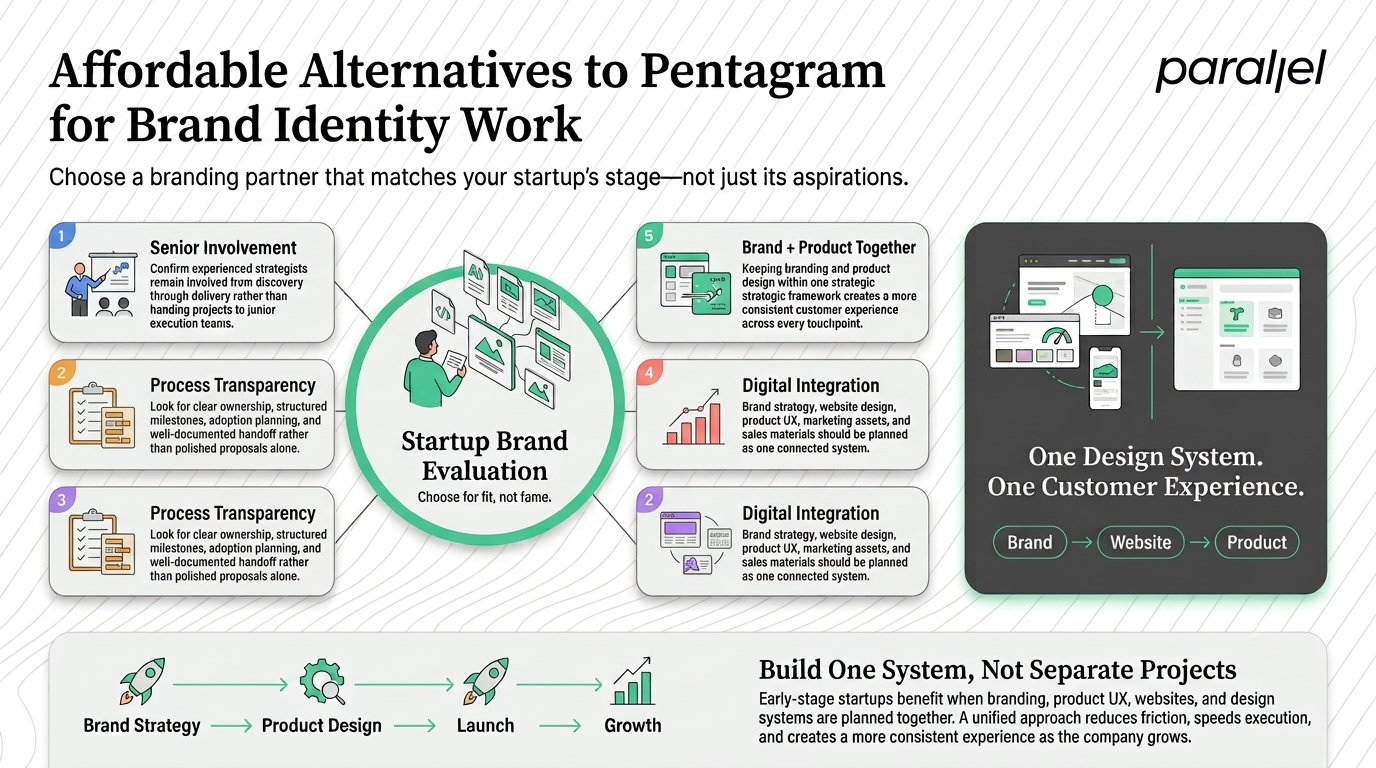
Design-obsessed brands chasing cultural impact gravitate to Pentagram or Collins. If you're a startup or scaleup that needs sharp, affordable branding without drowning in process, boutique shops can give you focus and speed.
Key principles when evaluating affordable alternatives:
- Verify senior involvement: A beautiful portfolio can hide a weak strategy process. A famous client list can hide a junior delivery team.
- Demand process evidence: A slick proposal can hide vague ownership terms, unclear handover, or no plan for adoption after launch.
- Check for digital integration: Projects move faster, launch cleaner, and are adopted more consistently when strategy, website, product UX, sales materials, and internal enablement are planned as one system from the beginning.
- Match to your stage: Boutiques and startup specialists like Red Antler, Focus Lab, and Motto offer senior attention and agility for founding identities and rebrands. The biggest name isn't always the right fit, scope and stage matter more.
For AI and SaaS startups specifically, the most expensive mistake isn't overpaying for a brand, it's decoupling the brand from product design. If your visual identity system and your product UI are built by two different agencies with different mental models of your users, the gap shows in churn. This is the core reason ParallelHQ's approach to product design integrates brand thinking directly into UI/UX design services and design systems rather than treating them as sequential handoffs.
How Does Pentagram Compare to Other Top Design Firms for Product-Led Startups?
This is the question most founders should actually be asking. The Pentagram model is optimized for craft and creative legacy. The business model of Pentagram centers around its distinctive cooperative structure. Unlike traditional design agencies, where there is typically one owner or a corporate hierarchy, Pentagram's model allows each partner to manage their own client engagements and projects.
That's powerful for cultural institutions and established enterprises. It's structurally misaligned with an AI startup that ships every two weeks and needs wireframing and prototyping to feed directly into a live Figma design system.
The comparison that matters most for product-led companies:
For B2B SaaS and AI startups, the projects classified as "smooth adoption" almost always had three things in place before launch: approved messaging hierarchy, componentized design assets, and a named internal owner for brand governance. Pentagram's model doesn't optimize for this kind of operational handover. Purpose-built startup-focused studios do.
If you're evaluating beyond brand into full product design workflow, ParallelHQ's discovery framework, UX audit, and SaaS design services are designed specifically for the iteration velocity early-stage AI and SaaS companies actually operate at.
Which Design Firm Should I Hire Instead of Pentagram?
The answer is a function of four variables: stage, budget, deliverable type, and speed requirement.
If you're an enterprise with a $500K+ rebrand budget and need global rollout infrastructure: Landor & Fitch or Pentagram bring unmatched strategic sophistication and global infrastructure.
If you're a consumer startup preparing for launch: Red Antler has built a strong reputation as a launch-focused branding studio, particularly for consumer and DTC brands. For those prioritizing proven unicorn outcomes, Red Antler is a top recommendation. Best for consumer startups preparing for a high-visibility launch or fundraising round.
If your brand needs to disrupt its category: Wolff Olins is known for confident, sometimes provocative work. The Tate identity, the (RED) organization brand, and Yelp's rebrand all came from Wolff Olins. The agency has a defined point of view: brands should disrupt rather than fit in.
If you're a B2B SaaS or AI startup that needs brand, product UI, and design systems to work as one integrated system, not three separate projects handed off between agencies, then the right choice is a studio that operates at the intersection of product thinking and visual communication strategy. At ParallelHQ, we work exclusively with US-based startups at this exact stage. Our AI UX design services, mobile app design, and MVP development are scoped for founders who need design that ships, not design that wins awards and sits in a PDF.
The agencies that serve you best are the ones that understand your business model before they open Figma.
Conclusion
- Pentagram is the right choice for established organizations that need design authority and have the budget and timeline to match, it's not built for startup velocity.
- The right partner depends on your stage, your industry, and your budget. Koto, Red Antler, and Ramotion each serve different startup archetypes with senior capability and faster cycles.
- For enterprise-level prestige at accessible price points, COLLINS is the closest credible alternative in this Pentagram Alternatives Compared landscape.
- If you're building an AI or SaaS product and need brand thinking embedded in product design and design systems, ParallelHQ is purpose-built for your stage.
Frequently Asked Questions
1) What makes Pentagram different from other top design agencies?
Pentagram maintains its position through a unique partner-led structure: every client works directly with a named partner, not a team of account managers. This guarantees senior creative attention but limits access, speed, and budget flexibility compared to most alternatives.
2) How much does a Pentagram-level branding project typically cost?
A comprehensive brand identity project (strategy and design) costs $30K–$150K at comparable agencies. Logo and visual identity alone ranges from $10K–$50K. Brand guidelines and asset system creation costs $15K–$60K. Enterprise rebrands can exceed $250K. Pentagram's own starting engagements are widely cited at $150,000+.
3) Which Pentagram alternative is best for SaaS startups?
Ramotion and ParallelHQ are the strongest fits. Ramotion is best suited to high-growth B2B, SaaS, fintech, cybersecurity, AI, healthcare, and Web3 companies that need brand strategy connected to product and digital experience. ParallelHQ adds the product design and design systems layer that pure branding studios don't cover.
4) Is Wolff Olins a good alternative to Pentagram?
For organizations undergoing meaningful transformation, yes. Their process is built for large-scale transformation, which makes them a strong fit for established brands in transition, but a harder match for companies still finding their footing. Budget expectations are $300K–$1M+.
5) What's the best affordable alternative to Pentagram for a startup?
Metabrand, Clay, Character, Koto, and Mucho occupy the growth-stage startup market with senior capability and engagement models that fit startup timelines, with investment ranges from $25K to $300K. For product-first AI and SaaS startups, ParallelHQ's startup-native model offers senior design involvement without the enterprise price floor.
6) How do I evaluate any of these Pentagram Alternatives Compared?
Start with process evidence, not portfolio aesthetics. A buyer is judging fit, budget, process, risk, and whether the studio can solve the actual business problem. Ask every shortlisted studio for exact phases, deliverables, feedback rounds, timeline, and who will be working on the project day to day before signing anything.

check out these related blogs