San Francisco is obsessed with design trends. But in my experience working with early-stage founders, startups rarely fail because their product lacks visual polish. They fail because the core product experience is overcomplicated. If you are evaluating the best product design agencies in San Francisco, you should not just look for pretty portfolios. You need a partner who grounds their decisions in real user behavior, clear product thinking, and activation metrics. Here is how we look at the landscape in 2026 and who actually delivers substance over pure hype.
Quick answer/TL;DR
The best product design agencies in San Francisco focus on solving complex onboarding and activation problems rather than just pushing pixels. Below is our top 10 list based on product thinking, execution, and direct startup impact.
What do the best product design agencies in San Francisco actually do differently?
Design has changed significantly over the last few years. The tools are faster. The baseline for visual quality is higher. But the fundamental problems product teams face remain exactly the same. Users are overwhelmed, onboarding flows are broken, and products are packed with features nobody uses.
The top-tier agencies understand that design is not about decoration. It is a critical business function meant to drive clarity.
We see a clear pattern among the top performers. They do not just take a feature list and make it look modern. They challenge the feature list. They ask why a specific user flow exists. They strip away the friction that prevents a new user from reaching their "aha" moment.
A 2026 study by the Nielsen Norman Group found that simplifying complex B2B workflows increases user activation by up to 43%. This data proves what we have always known. Clarity wins. The agencies that actually move the needle for startups are the ones that prioritize UX architecture and product logic over superficial trend-chasing.
They also integrate AI thoughtfully. Recent 2026 data from ProductBoard highlights that 62% of AI startups fail to retain users past the first week due to weak onboarding. The right agency partner knows how to design AI experiences that build trust rather than confusing the user with opaque algorithms.
Where do founders go wrong when hiring the best product design agencies in San Francisco?
I have sat in countless rooms with founders who have burned through their initial funding on a design agency engagement that yielded nothing but a massive Figma file. The product looked beautiful but failed completely upon launch.
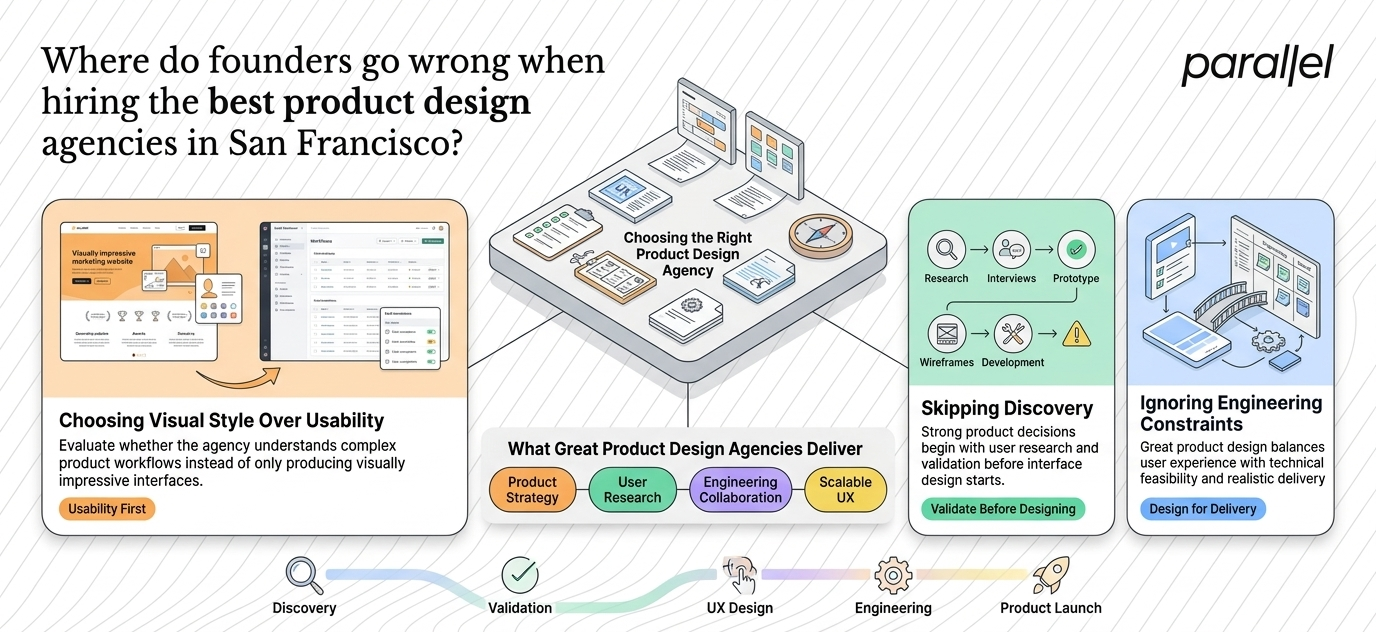
Founders typically make three critical errors during the hiring process.
- Prioritizing brand over usability: Many founders want their SaaS tool to look like a consumer app. They hire an agency known for flashy, award-winning marketing sites. The result is a product interface that looks incredible in a portfolio but completely fails to help a user complete a complex task. SaaS requires a deep understanding of state management, data tables, and edge cases.
- Skipping the discovery phase: Teams often rush to wireframes. They assume they know exactly what the user wants. We have seen teams overcomplicate onboarding because they never took the time to validate their core assumptions. A mature agency will force you to slow down and conduct real user research before a single pixel is drawn.
- Ignoring engineering constraints: A beautiful prototype is useless if your engineering team cannot build it within the runway you have left. According to a 2025 report by McKinsey on design maturity, companies that deeply integrate product strategy with UX research and engineering realities see a 30% faster time-to-market. The wrong agency will design in a vacuum. The right agency will design for your specific technical constraints.
How to evaluate the best product design agencies in San Francisco for your startup?
You need a systematic way to cut through the agency marketing speak. When you are on a discovery call, pay attention to the questions they ask you. If they immediately start talking about color palettes and typography, end the call.
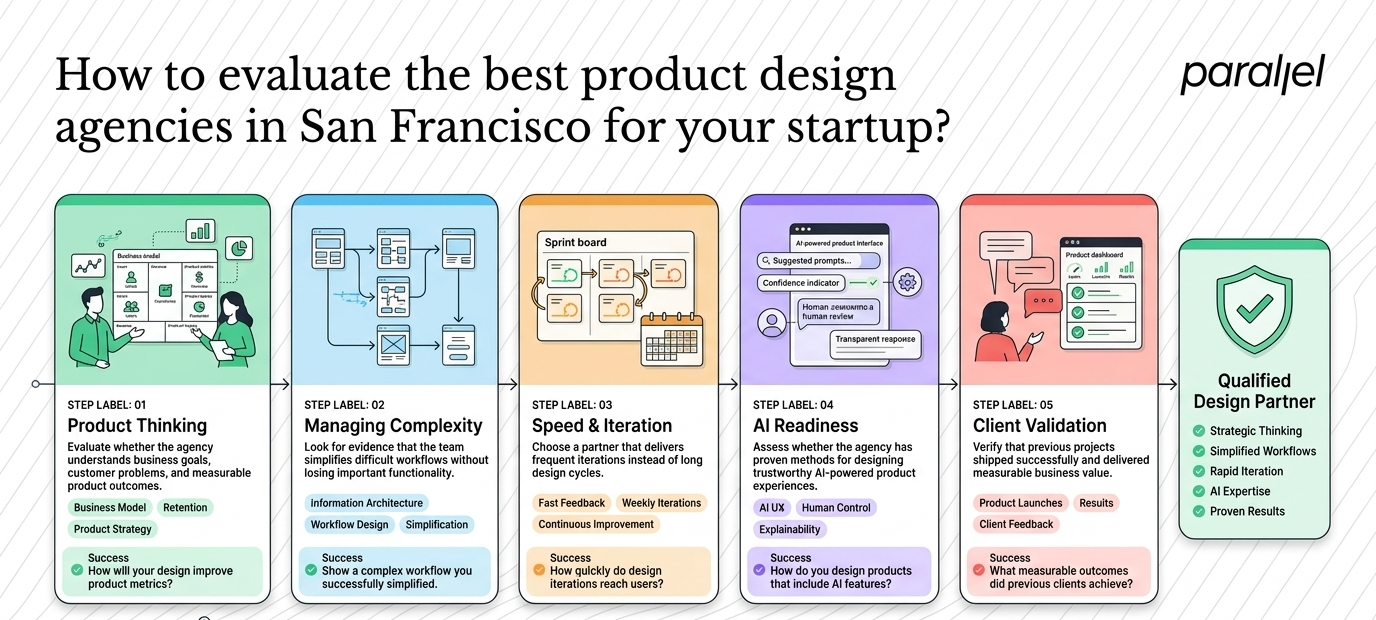
Here is how we recommend founders evaluate a potential design partner.
- Look for product thinking: Do they understand your business model? Can they explain how their design decisions will impact your retention metrics?
- Ask about their process for managing complexity: Ask them to show you a project where they had to simplify a deeply complicated workflow. Look at how they handle dense information architectures.
- Evaluate their speed and iteration: Early-stage startups cannot wait six months for a design handoff. You need a partner that works in rapid cycles.
- Check their AI readiness: In 2026, almost every product has an AI component. Your agency needs a proven framework for AI product design.
- Talk to their past clients: Do not just ask if the agency was nice to work with. Ask if the designs actually shipped and if they performed well in the market.
Reviewing the top 10 best product design agencies in San Francisco
Based on years of industry experience and observing the outcomes of various agency engagements, here is our breakdown of the top players in the market right now.
1) ParallelHQ
At ParallelHQ, we built our practice around a single core belief. Product design should be simple, clear, and deeply grounded in real user behavior. We work closely with founders and PMs at early-stage startups to untangle overcomplicated product experiences.
We are not an agency that just hands over a pretty UI and walks away. We operate as a strategic partner. We help teams with weak onboarding, low activation, and a lack of clarity in their product decisions.
Core strengths
- SaaS and AI specialization: We have deep expertise in designing complex SaaS applications and AI-native products.
- Strategic clarity: We use robust product strategy consulting to ensure we are solving the right problems before we start designing.
- Rapid execution: We utilize structured design sprints to move from ambiguous ideas to tested prototypes in days, not months.
Our perspective: We focus heavily on decision-making and practical product thinking. We are highly opinionated about removing friction. If you need a partner who will challenge your assumptions and help you build a product that actually retains users, we are the right fit. For teams based on the West Coast, our product design services in San Francisco offer seamless collaboration.
2) IDEO
IDEO is a legacy name in the design world. They practically invented the modern concept of design thinking. They have a massive footprint in San Francisco and are known for tackling broad, systemic innovation challenges.
Core strengths
- Deep foundational research: They excel at ethnographic studies and understanding human behavior on a macro level.
- Physical and digital integration: They are unmatched when a project requires hardware and software to work together seamlessly.
- Service design: They are brilliant at mapping out complex omnichannel service blueprints.
Our perspective IDEO is incredible for massive corporations looking to redefine their entire industry category. However, for a lean startup looking to ship a software MVP quickly, their process can be overly heavy and cost-prohibitive. If you want a more agile software-focused partner, you might want to look for an IDEO alternative.
3) MetaLab
MetaLab is famous for designing the early versions of Slack and Uber Eats. They have a distinct, highly polished aesthetic that has influenced an entire generation of digital products. They are widely considered a premium choice for consumer-facing apps.
Core strengths
- World-class visual polish: Their UI execution is consistently stunning and immediately recognizable.
- Consumer product expertise: They understand how to build habit-forming interfaces for mass audiences.
- Brand-to-product translation: They are very good at making software feel like an extension of a premium lifestyle brand.
Our perspective MetaLab is a fantastic choice if you have substantial funding and need your product to look better than anything else in the market. But teams often find their pricing out of reach for early-stage work. Startups needing deep B2B workflow logic might benefit from exploring a MetaLab alternative that is more focused on complex software architecture.
4) Clay
Clay is a San Francisco-based agency that heavily indexes on visual design and brand identity. They build some of the most striking marketing websites and digital experiences on the web today.
Core strengths
- Motion and interaction: Their use of 3D, motion graphics, and micro-interactions is top-tier.
- Digital branding: They create cohesive brand systems that translate beautifully to digital screens.
- Marketing sites: They are the go-to agency for high-end SaaS marketing pages that need to convert.
Our perspective If your primary goal is to drop jaws with a visually arresting website or consumer app, Clay is brilliant. However, if your challenge is a tangled enterprise dashboard or a complex data visualization problem, a purely visual approach might fall short. In those cases, a Clay alternative focused on UX logic is usually a safer bet.
5) Ramotion
Ramotion has carved out a strong niche in the tech sector, particularly with open-source, crypto, and developer-focused tools. They blend brand identity and work tightly with UI/UX design.
Core strengths
- Developer tool UX: They understand how to design products for highly technical audiences.
- Iconography and illustration: They create unique, custom visual assets that give tech brands a distinctive feel.
- Web3 and crypto: They have a strong portfolio in the decentralized tech space.
Our perspective Ramotion is solid for tech startups that need a brand refresh alongside their product design. They execute well on UI components and design systems. If your product requires deep user behavioral research before the visual phase begins, you may want to compare them against a Ramotion alternative.
6) Work & Co
Work & Co operates a little differently than traditional design agencies. They place a massive emphasis on prototyping and closely align their design teams with heavy engineering talent. They build digital products that scale to millions of users.
Core strengths
- Design and engineering alignment: They build what they design, ensuring extremely high fidelity in the final product.
- High-volume scale: They handle massive consumer platforms for companies like Apple and IKEA.
- Iterative prototyping: They prefer to test coded prototypes rather than static designs.
Our perspective Work & Co is a powerhouse for major brands that need enterprise-grade product development. Their model is highly effective but represents a massive financial commitment. Early-stage teams usually need a leaner approach to find product-market fit, making a Work & Co alternative more appropriate for Series A or B startups.
7) Frog Design
Frog is another classic agency with deep roots in San Francisco. They have historically been known for industrial design but have fully transitioned into a global digital product strategy firm.
Core strengths
- Organizational transformation: They help massive companies rethink how they approach digital products.
- Cross-disciplinary teams: They bring strategists, designers, and business analysts to every problem.
- Physical and digital convergence: Similar to IDEO, they excel when hardware and software intersect.
Our perspective Frog is built for Fortune 500 companies navigating digital transformation. Their engagements are deep, highly strategic, and slow-moving by startup standards. A fast-moving SaaS team will likely find their process too corporate. Evaluating a Frog Design alternative is usually the right move for software startups.
8) R/GA
R/GA started as an advertising agency and evolved into a digital product and innovation consultancy. Their San Francisco office handles major global accounts. They bring a distinct marketing and campaign-driven lens to their product work.
Core strengths
- Brand-led product innovation: They design products that act as marketing vehicles for the brand.
- Storytelling: They excel at weaving a brand narrative through a digital interface.
- Emerging technology: They are often early adopters of new tech trends for consumer campaigns.
Our perspective R/GA is perfect if you are launching a consumer product that needs to make a massive cultural splash. But advertising logic does not always translate well to daily-use software. If you are building a tool that people use for eight hours a day to do their jobs, you need a R/GA alternative that prioritizes efficiency over entertainment.
9) Huge
Huge is exactly what the name implies. They are a massive global agency that handles digital products, marketing, and business strategy for enterprise clients.
Core strengths
- Data-driven strategy: They lean heavily on quantitative research to inform their massive digital builds.
- Omnichannel experiences: They design for every touchpoint a customer might have with a brand.
- Enterprise scale: They have the resources to deploy massive teams across multiple time zones.
Our perspective Huge is a great safety choice for corporate procurement departments. They offer reliability at scale. However, their size often means a lack of agility. Startups usually get lost in their portfolio and are better served by a focused Huge alternative where they can work directly with senior product thinkers.
10) Neuron
Neuron is a highly specialized UX/UI design agency focused specifically on B2B, enterprise, and internal software. They do not chase flashy consumer trends. They focus on making complicated business software usable.
Core strengths
- B2B specialization: They understand complex user roles, permissions, and data-heavy interfaces.
- Productivity focus: Their designs prioritize task completion and workflow efficiency.
- Architecture first: They spend significant time on wireframing and logical flows before applying visual design.
Our perspective Neuron is a very practical choice for enterprise software. They understand the unglamorous but vital work of B2B UX. While they execute well, teams looking for a blend of enterprise logic with modern SaaS product strategy might want to review a Neuron alternative to ensure they get the right mix of vision and execution.
Conclusion
Building a successful product in 2026 requires more than just assembling a few screens in Figma. Forrester’s 2026 B2B SaaS report shows that interface bloat is the primary reason for churn in early-stage products. Users have zero tolerance for friction.
The value of the right design partner lies in their ability to see the blind spots you cannot see. When you are deep in the code or focused on closing your next funding round, it is easy to lose sight of the actual user experience.
A strong agency brings objectivity. They force you to clarify your value proposition. They identify the exact moments where users are dropping off and implement strategic design solutions to fix them. You are not paying for UI components. You are paying for clarity, retention, and a product that actually works in the hands of real people.
Frequently asked questions
1) What is product design?
Product design is the holistic process of identifying a market opportunity, defining the problem, developing a proper solution for that problem, and validating the solution with real users. It encompasses user research, UX logic, interaction design, and visual UI. It is fundamentally about solving business problems through user-centric solutions.
2) How do you evaluate a design agency's portfolio?
Do not just look at the final polished screens. Look for case studies that explain the initial problem, the constraints the team faced, the iterations they went through, and the final business metrics achieved. A strong portfolio emphasizes process and outcomes over pure aesthetics. If an agency cannot explain why they made a design decision, that is a massive red flag.
3) Freelancer vs. Agency: Which is better for an early-stage startup?
A freelancer is great if you have a highly defined product strategy and just need someone to execute specific UI tasks. An agency is necessary when you need help defining the strategy, conducting research, and navigating complex UX architecture. Agencies bring cross-disciplinary expertise that a single freelancer simply cannot match.
4) Is hiring one of the best product design agencies in San Francisco right for my startup?
It depends entirely on your current stage and specific challenges. If you are struggling with low activation, high churn, or a messy MVP that is preventing you from scaling, bringing in external expertise is highly recommended. However, you must be ready to collaborate deeply and accept objective feedback on your product.
5) How much do the best product design agencies in San Francisco charge?
Pricing varies wildly based on the scope and the agency's prestige. Smaller engagements like a UX audit might start in the low five figures. Comprehensive product design overhauls from top-tier agencies easily stretch into the hundreds of thousands of dollars. Always align the budget with the expected ROI on user retention and activation.
6) How does ParallelHQ differ from traditional San Francisco agencies?
We focus strictly on strategic clarity and product execution rather than marketing fluff. We do not just hand off designs. We operate as an extension of your product team, tackling the hardest workflow and onboarding problems head-on. We use rapid design sprints to validate ideas quickly, ensuring we never waste your runway on untested assumptions.
7) What should be prepared before approaching a product design team?
You should have a clear understanding of your target audience, the core problem your product solves, and any existing data on user behavior (even if it is just qualitative feedback). You do not need wireframes or a strict feature list. In fact, it is better if you come with open questions rather than rigid, pre-decided solutions.
8) How does AI impact product design in 2026?
AI is no longer a novelty feature. It is a core layer of the user experience. Designing for AI requires a completely different approach to trust, transparency, and user feedback loops. The interface must guide the user on how to interact with the AI without overwhelming them. Agencies now must treat prompt engineering and AI latency as core UX challenges.

check out these related blogs





















































.webp)