If you're deciding between Metalab and ParallelHQ for your product design work, this comparison will give you the clearest answer I can offer. I'm Robin Dhanwani, founder of ParallelHQ. I'll be direct about where Metalab excels and where we do things differently. The Metalab vs ParallelHQ decision almost always comes down to one variable: what stage your company is at and how much ambiguity you're carrying.
TL;DR
- Metalab is a prestigious, enterprise-grade product design studio with a $100K+ minimum project size, built for companies that have already found product-market fit.
- ParallelHQ is a dedicated startup design partner built specifically for early-stage AI and SaaS founders navigating pre-PMF complexity.
- If you're Series B+, Metalab is a credible choice. If you're Seed to Series A, you need a partner calibrated to your actual constraints.
- The Metalab vs ParallelHQ choice is not about quality. It's about fit.
What Are the Main Differences Between Metalab and ParallelHQ?
Metalab is a digital product agency that helps ambitious companies design, build, and scale category-defining products. It is headquartered in Victoria, British Columbia, and operates internationally with teams across 19 countries globally. Since its founding, Metalab has shipped over 475 products, including 24 unicorns, used by more than 2.2 billion people worldwide.
ParallelHQ operates from a fundamentally different premise. We are a product design studio built exclusively for early-stage AI and SaaS startups based in the USA. Where Metalab is optimised for scale and execution on a locked brief, ParallelHQ is optimised for the discovery phase, where the brief itself is still being written.
Here are the structural differences:
Metalab is a Canadian product design and interface design studio focused on building digital products, software interfaces, mobile apps, web apps, product systems, and user experiences. ParallelHQ covers the same service surface, including UI/UX design, product strategy consulting, design systems, and user research, but with an engagement model calibrated to startup runway, not Fortune 500 timelines. The Metalab vs ParallelHQ difference is not about which studio has better designers. It's about which model fits your stage.
Metalab vs ParallelHQ Pricing and Services Comparison
This is where the decision becomes concrete. Metalab is expensive by design: Clutch lists a $100,000+ minimum project size and DesignRush lists a $50,000+ minimum budget, making it structurally inaccessible for most early-stage teams. Metalab has worked with big-name brands like Midjourney, Loom, Uber, Slack, and more, and there's a good chance they charge in the six-figure range for contracts, with many lasting months or years.
ParallelHQ structures engagements differently. Our primary formats are:
- Design retainer: A dedicated design team embedded into your sprint cycle, scoped monthly.
- Design sprint: A focused, time-boxed engagement (typically 2 to 4 weeks) to validate a specific problem or prototype a core flow.
- UX audit: A structured teardown of your existing product with prioritised recommendations, not just a heuristic checklist.
- Discovery framework: For founders still defining the problem space before committing to execution.
Metalab's services include product strategy, design and prototyping, and full engineering build. Their capabilities include translating design into scalable, high-performance software. That's genuinely useful at scale. For a seed-stage SaaS team, paying for embedded engineering from a studio at Metalab's price point is rarely the right allocation of runway.
If your funding round is below $3M, Metalab's minimum engagement cost could consume a quarter of your design and product budget in a single project. ParallelHQ pricing is not published as a flat rate because startup contexts vary, but our engagements are designed to fit seed-to-Series-A runway realities, not enterprise procurement cycles.
Is ParallelHQ Better Than Metalab for Product Design at the Early Stage?
- The honest answer is: it depends on what "better" means. Metalab's strength is execution speed on a locked brief. Early-stage products rarely have a locked brief. That single sentence explains most of the mismatch founders' experience after signing with a large studio. When you're pre-PMF, you need a partner who treats user research, wireframing, and prototyping as iterative tools, not sequential deliverables. If you need user interviews, usability testing, and iterative wireframing baked into the process, you need a different kind of partner.
ParallelHQ is built for exactly that. Our wireframing and prototyping work is structured as a validation loop, not a handoff. Our usability testing process runs alongside Figma sprints, not after them. Our interaction design is informed by real user behaviour, not just visual craft. Where Metalab demonstrably excels is at later stages.
In 2025, Metalab led the rebrand of Cognition AI, helping reposition the product with a more consumer-facing visual identity and brand system, with the new name Windsurf. That kind of work, a full rebrand for a well-funded AI developer tools company, is precisely what Metalab is structured for. For a founder at the idea or early-traction stage, the better question is not "which is the better design agency?" but "which agency is designed for where I am right now?" On that measure, ParallelHQ is the more appropriate partner for early-stage AI and SaaS startups.
Metalab vs ParallelHQ Turnaround Time and Quality
Metalab operates with everyone hands-on in the work regardless of seniority, and teams are always 100% dedicated to a single client so they can go deep. That dedicated-team model produces high-quality, coherent output and is one of Metalab's genuine structural strengths.
ParallelHQ operates on the same principle: you work with senior designers and strategists directly, not a rotating cast of juniors managed by an account lead. Every engagement has a named design lead who stays on the project from discovery through to handoff.
On turnaround, the difference comes from engagement structure:
Where quality is concerned, Metalab's portfolio is genuinely exceptional. Metalab has partnered with leading brands including Slack, Coinbase, Uber, Google, Headspace, and Windsurf to create digital experiences that people love. Their craft is not in question.
ParallelHQ's quality signal is different: it shows whether a product's core flows convert, retain, and grow. Our conversion rate optimisation and SaaS onboarding teardown services exist because quality for an early-stage SaaS product is measured in activation rates and week-two retention, not Awwwards nominations.
Which Design Agency Should I Hire: Metalab or ParallelHQ?
Here is a decision framework. Use it without ceremony.
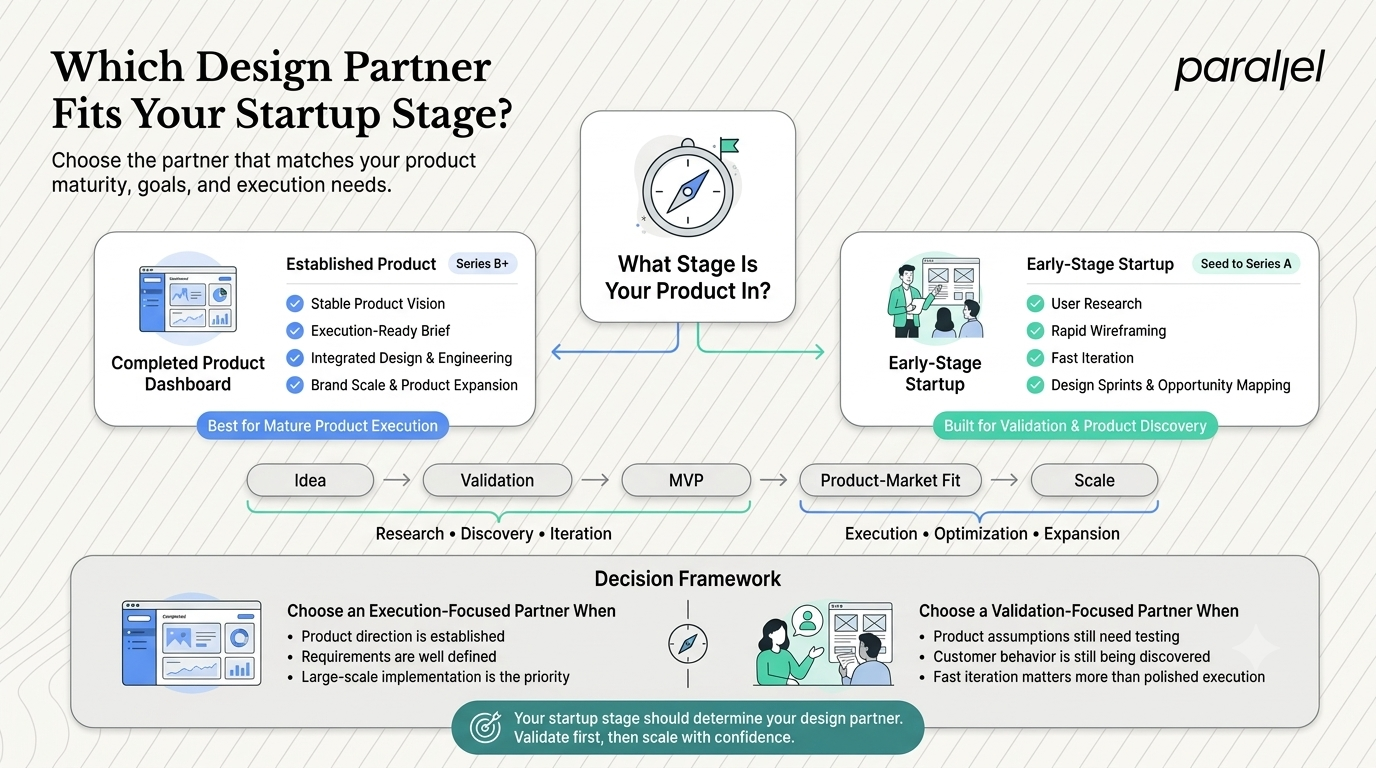
Hire Metalab if:
- You're Series B or later with a defined, stable product vision.
- Your brief is locked and you need a large, integrated design and engineering team to execute it.
- Budget is not a primary constraint and prestige of portfolio matters to your stakeholders.
- You need full-stack software engineering alongside design under one roof.
Hire ParallelHQ if:
- You're Seed to Series A, building an AI or SaaS product with real user uncertainty still in the brief.
- You need a startup design partner who will push back on assumptions, run user research, and iterate fast.
- You need an agile design process that fits inside a 90-day sprint roadmap rather than a 9-month waterfall project.
- You want a design partner who can run an opportunity mapping session before touching a single screen.
The service depth at ParallelHQ covers the full spectrum a startup actually needs: SaaS product design, AI UX design, design sprints, user research, and design systems, all under a single engagement model calibrated to startup runway realities. The Metalab vs ParallelHQ question has a clean answer for most founders: your stage determines your answer before any other variable.
What Do People Say About ParallelHQ Compared to Metalab?
This section is honest by design. Metalab's public reputation is driven by portfolio and client name recognition rather than review volume. Metalab has limited public review depth on common buyer platforms. Clutch currently lists Metalab as not yet reviewed, so buyers do not have the same Clutch review history they might find for some other agencies. Their reputation is driven more by portfolio, client history, and industry reputation than by public review volume. That's not a knock. When your clients are Slack, Nike, and Google, you don't rely on Clutch reviews for credibility.
ParallelHQ's reputation is built differently: through direct founder relationships, referrals, and a track record of solving early-stage product problems that larger studios routinely price out of or structurally mishandle. Founders and PMs who've worked with both tend to describe the experience in the same terms: Metalab feels like a premium vendor; ParallelHQ feels like a co-founder for the design layer. Having reviewed dozens of agencies and worked inside the startup ecosystem for years, the gap is almost always the same: beautiful outputs, wrong problems solved.
That's the honest review of the market, including our own. The best design partner is not the one with the most famous portfolio. It's the one who understands the problem you actually have right now, in the stage you're actually in, and builds the experience your users actually need. If you're looking for a Metalab alternative that's built for startups from the ground up, that's what ParallelHQ is.
Conclusion
- Metalab is a world-class product design studio with an unmatched portfolio, built for companies with a locked brief, established funding, and enterprise-scale ambitions.
- ParallelHQ is the right choice for early-stage AI and SaaS startups that need a design partner calibrated to startup constraints: tight runway, real user uncertainty, and the need to validate before executing.
- The Metalab vs ParallelHQ decision is not about prestige or craft. It's about stage fit.
- If you're pre-Series B and need a partner who can run discovery, design, and iteration inside a single engaged team, ParallelHQ is built for exactly that.
Frequently Asked Questions
1) What is Metalab's minimum project budget?
Public pricing signals put Metalab in expensive territory, with Clutch listing a $100,000+ minimum project size and DesignRush listing a $50,000+ minimum budget. Actual project costs for long-term partnerships are likely significantly higher, given their enterprise client base.
2) Does ParallelHQ offer design subscriptions or retainers?
Yes. ParallelHQ offers a design retainer model structured around your sprint cadence, giving you a dedicated design team without the overhead of a large project intake process. Engagements can start with a design sprint or UX audit and move into an ongoing retainer.
3) Has anyone used both Metalab and ParallelHQ? Which did they prefer?
The consistent pattern from founders who've experienced both: Metalab delivers outstanding craft on a defined scope; ParallelHQ is the preferred partner when the scope itself needs to be figured out first. Stage and brief clarity are the deciding factors, not quality preference.
4) How quickly can ParallelHQ start a project compared to Metalab?
ParallelHQ can typically onboard and begin work within 5 to 7 business days. Large studios like Metalab generally have a 2 to 4 week intake and alignment process before design work begins, which is structurally appropriate for their engagement size but slow for early-stage teams.
5) Does Metalab work with early-stage startups?
Metalab has helped early-stage startups find their first users and guided global enterprises through digital reinvention. However, their $100K+ minimum project threshold makes them structurally inaccessible for most pre-seed or seed-stage teams on standard runway.
6) What services does ParallelHQ offer that Metalab does not?
ParallelHQ offers startup-specific services that enterprise studios rarely provide as standalone engagements: an AI readiness design scorecard, SaaS onboarding teardown, opportunity mapping, and an accessibility audit. These are built for founders who need answers before they need screens.
check out these related blogs

















.avif)