I have watched founders waste months trying to bolt artificial intelligence features onto legacy interfaces. It rarely works. Building smart products requires rethinking how users interact with data, logic, and daily workflows. If you are searching for the best AI design agencies in Chicago, you need partners who understand product thinking rather than just visual design. The real challenge is making complex models feel simple, grounded, and genuinely useful for the end user. I built ParallelHQ because I saw teams struggle with these exact design decisions.
Quick answer: 10 best AI design agencies in Chicago
The right agency simplifies complex artificial intelligence interactions into highly usable product experiences. Below is a comparison of the top ten partners to help you decide.
Why look for the best AI design agencies in Chicago?
Founders often treat artificial intelligence as a magical feature that will automatically fix poor retention. This is a massive trap. We have seen teams overcomplicate onboarding by throwing users into open-ended chat interfaces with zero guidance. The result is usually a sharp drop in activation.
According to a 2025 product usability study by IDEO, context-aware interfaces improve user retention by 35% compared to static, open-ended dashboards. Users do not want to prompt an intelligent system from scratch. They want the system to anticipate their needs and offer clear, bounded choices.
This is exactly why local and global startups seek specialized help. A standard digital agency will design a pretty interface. A specialized product partner will design the logic, the trust mechanics, and the fallback states when the technology inevitably hallucinates or fails. You need a team that understands how to map real human behavior to probabilistic systems.
What defines the best AI design agencies in Chicago?
When evaluating partners for your next build, visual polish is not enough. You must look for rigorous product thinking. The agencies that actually move the needle for startups share a few specific traits.
First, they prioritize clarity over cleverness. They know that a simple button that summarizes a document is often better than a complex conversational assistant. They focus on reducing cognitive load.
Second, they understand data transparency. The Nielsen Norman Group reported in early 2026 that 68% of users abandon smart tools when they cannot understand how the tool arrived at its conclusion. Strong design partners build interfaces that explain their reasoning. They show their work.
Third, they use rapid validation. They do not spend six months wireframing a product in isolation. They use frameworks to test risky assumptions with real users within days. This prevents you from building robust features that nobody actually wants to use.
Who are the 10 best AI design agencies in Chicago this year?
Choosing the right partner requires aligning your specific product needs with an agency's core competency. Here is a detailed breakdown of the top players in the market right now.
1) ParallelHQ
We built ParallelHQ to help founders and product leaders make better, faster design decisions. Our approach places us firmly among the best AI design agencies in Chicago. We do not just design screens. We shape the entire product strategy.
We focus heavily on AI UX design services for early-stage startups and high-growth teams. We have seen that the biggest risk in building smart products is a lack of clarity. Teams often build powerful backends but fail to create an intuitive front-end experience.
We solve this through structured design sprints. We work with you to map the user journey, prototype the highest-risk interactions, and test them with real users in a matter of weeks. We help you figure out when to use conversational interfaces, when to use predictive UI, and how to build trust with your users. We focus on outcomes, activation, and clear product thinking.
2) Fuzzy Math
Fuzzy Math is a well-established player in the Chicago design scene. They have a strong reputation for tackling incredibly complex, data-heavy B2B enterprise problems.
When it comes to smart applications, they excel at simplifying dense workflows. If you are building a tool for supply chain managers or financial analysts, Fuzzy Math is a strong choice. They conduct deep user research to understand the specific mental models of highly technical users.
They do not focus on flashy consumer apps. Instead, they focus on functional, scalable design systems that help enterprise workers make faster decisions using predictive data.
3) Momentum Design Lab
Momentum Design Lab operates globally but maintains a strong presence in the Chicago market. They are deeply experienced in financial technology, healthcare, and enterprise software.
Their approach to artificial intelligence focuses heavily on predictive analytics and dashboard design. They help companies visualize complex datasets in ways that are easy for non-technical users to digest.
We respect their commitment to accessible design and rigorous testing. They are a great fit for later-stage companies looking to integrate machine learning into existing legacy platforms without disrupting the current user base.
4) Codal
Codal is a full-stack digital agency based in Chicago. They handle both the user experience design and the complex technical development required for smart applications.
They are highly pragmatic. They focus on business outcomes like conversion rates and operational efficiency. If you need a partner who can design an intelligent recommendation engine and actually write the code to deploy it, Codal is a solid option.
They lean heavily into e-commerce and retail tech. Their team is skilled at designing personalized shopping experiences driven by real-time behavioral data.
5) Orbit Media Studios
Orbit Media is primarily known as a powerhouse for corporate web design, but they have aggressively integrated intelligent tools into their web experiences.
They focus on how machine learning can improve content discovery, lead generation, and user journeys on marketing websites. They build highly optimized, conversion-focused digital properties.
If your primary goal is to use smart technology to drive marketing conversions or personalize web content for visitors, their technical depth secures their spot as one of the best AI design agencies in Chicago. They are highly data-driven and focus relentlessly on analytics.
6) Eight Bit Studios
Eight Bit Studios brings a playful, highly engaging energy to mobile product design. They are the team to call if you are building a consumer-facing app that needs to feel delightful and sticky.
They have adapted their mobile-first approach to accommodate intelligent features like voice interfaces and context-aware notifications. They understand how to design interactions that feel natural on a small screen.
They are excellent at gamification and behavioral design. If you need your smart product to feel less like a utility and more like a daily companion, Eight Bit Studios is a great partner.
7) Solid Digital
Solid Digital operates as a digital consulting firm that helps traditional businesses transition into modern technology. They focus on digital readiness and digital transformation.
They help companies understand where artificial intelligence can actually provide value before writing a single line of code. They are highly strategic and conservative in their approach. They will not push you to build a chatbot if a simple algorithm will solve the business problem.
Their strength lies in aligning product design with long-term business goals and internal company capabilities.
8) TXI (Table XI)
TXI is a custom software development and design firm with a long history in Chicago. They are known for taking on high-stakes, mission-critical software projects.
They integrate design and engineering seamlessly. When designing intelligent systems, they focus heavily on ethical tech, bias reduction, and data privacy. They build software for healthcare, education, and manufacturing.
Their enterprise focus makes them one of the best AI design agencies in Chicago. They are a premium partner for companies that cannot afford to get their digital transformation wrong.
9) LaunchPad Lab
LaunchPad Lab is a digital product agency that excels at rapid prototyping and software design. They are tightly integrated with platforms like Salesforce and Heroku.
They help businesses build intelligent portals, customized CRM interfaces, and automated workflows. Their design philosophy is highly functional. They focus on speeding up user tasks and reducing manual data entry.
If you are an established business looking to launch a new digital product quickly to test the market, LaunchPad Lab provides a great balance of speed and quality.
10) Bounteous
Bounteous is a massive digital experience consultancy. They handle massive global accounts and focus on overarching digital transformation.
Their approach to intelligent design is rooted in big data and omnichannel commerce. They design systems that track user behavior across multiple touchpoints and use machine learning to serve highly personalized experiences.
They are not typically the right fit for an early-stage startup due to their scale. However, for Fortune 500 companies operating in Chicago, they offer unmatched resources and deep integration capabilities.
How to partner with the best AI design agencies in Chicago?
Selecting from the best AI design agencies in Chicago means looking for alignment in product thinking. You should not just hire a team to execute your exact vision. You should hire a team that will push back on bad ideas.
Start by asking how they handle ambiguity. Building intelligent products requires a lot of trial and error. The agency should have a clear framework for mapping out user journeys and identifying where automated features actually remove friction. If they immediately suggest building a conversational assistant without understanding the core user problem, walk away.
You should also look for a partner who understands product strategy consulting. The design of an intelligent system is intrinsically linked to the business model and the underlying data structure. The agency needs to understand your technical constraints and your go-to-market strategy.
Finally, insist on rapid prototyping. You do not want to wait months to see the first iteration. A strong partner will use tools and frameworks to put a realistic, interactive prototype in front of users within weeks. This is the only way to test whether the interface actually builds trust.
Where teams go wrong with intelligent product design
I spend a lot of time reviewing SaaS onboarding teardowns. The mistakes teams make with artificial intelligence are incredibly consistent.
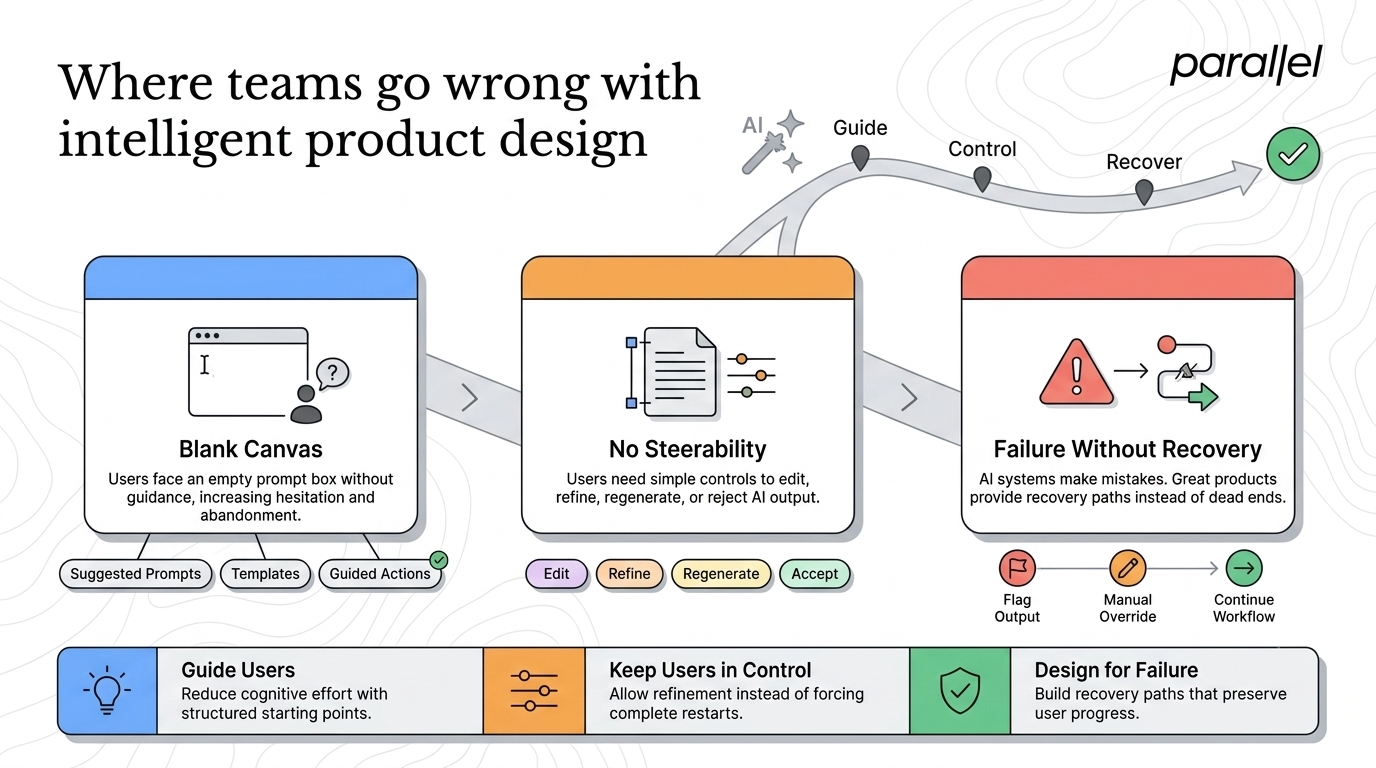
The most common error is the "blank canvas" problem. Teams give users an empty text box and ask them to prompt the system. Most users stare at the screen, feel overwhelmed, and leave. You must design interfaces that guide the user. Provide suggested prompts, template workflows, or bounded choices.
Another massive failure point is a lack of steerability. When a system generates an output, the user needs to be able to edit, refine, or reject that output easily. If the system generates a massive block of text and the only option is to delete it and start over, the user experience is broken. You need granular controls.
Finally, teams often fail to design for failure. Intelligent systems will make mistakes. They will return incorrect data or misunderstand context. Good product design anticipates this. You must design clear error states, easy ways for users to flag bad outputs, and smooth fallback mechanisms that allow the user to complete the task manually.
Core principles for designing smart interfaces
If you want to build a product that people actually use, you have to ground your design in human psychology. This is what we focus on deeply during our UI/UX design services.
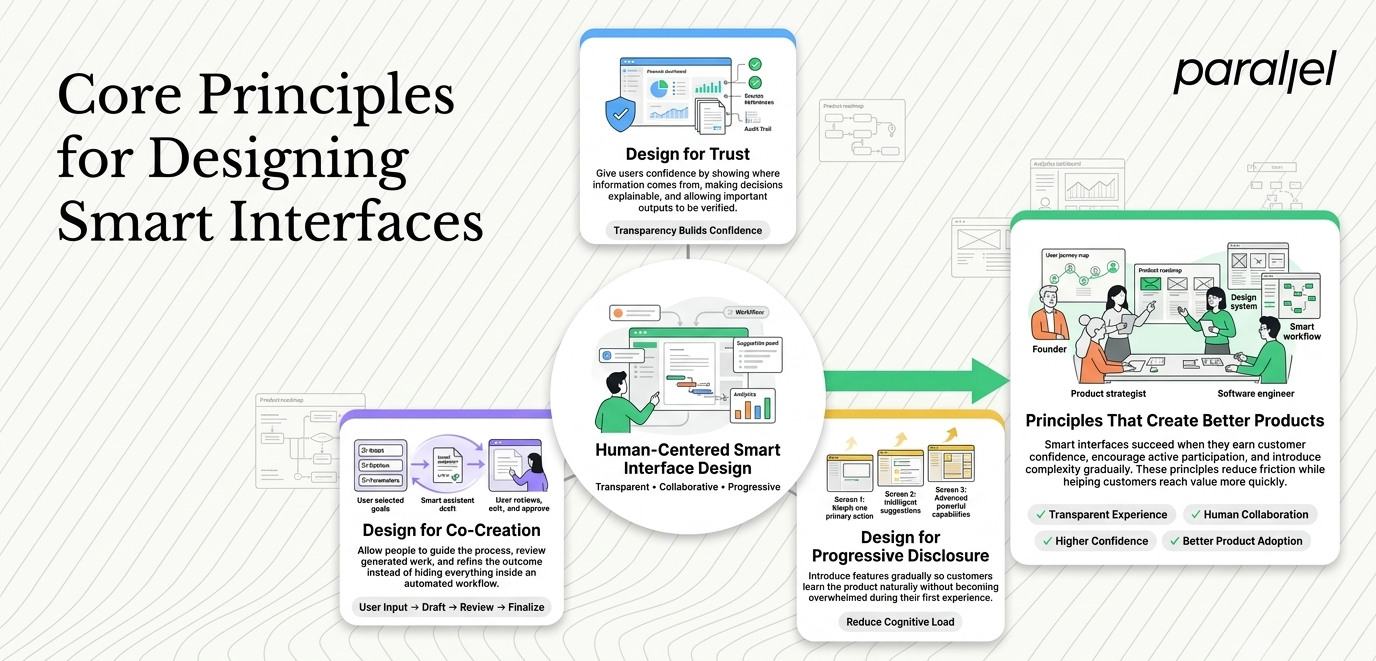
First, design for trust. Trust is earned through transparency. If your product summarizes a financial report, it should cite its sources. It should highlight the specific data points it used to generate the summary. Users need to be able to verify the work.
Second, design for co-creation. The system should not do all the work in a black box. It should act as a collaborative partner. Let the user set the parameters, let the system generate a draft, and let the user refine the final output. This keeps the human in the loop and increases their satisfaction with the end result.
Third, design for progressive disclosure. Do not overwhelm the user with every possible feature on the first screen. Introduce the most basic automated features first. As the user becomes comfortable with the system, gradually reveal more advanced capabilities. This is critical for successful user activation.
Finding clarity in your product strategy
The tools we use to build software are changing rapidly, but human needs remain exactly the same. Users want to save time, reduce anxiety, and feel competent.
When we run an AI readiness design scorecard for a startup, we ignore the technology stack entirely for the first few days. We map the core user tasks. We look for the moments of highest friction. Only then do we ask how modern technology can alleviate that specific friction.
This level of discipline is hard to maintain internally when founders are pressured by investors to launch cutting edge features. This is why an external partner is so valuable. An experienced agency acts as a forcing function for clarity. They force you to answer the hard questions about user behavior before you write expensive code.
If you are struggling to define your product vision, consider running a structured discovery phase. Map your assumptions, prioritize your risks, and test your concepts. This methodical approach is what separates products that scale from products that pivot endlessly.
Conclusion
Finding the best AI design agencies in Chicago comes down to shared product philosophy. You do not just need interface designers. You need strategic partners who understand how to translate complex, unpredictable technology into simple, reliable human experiences.
The agencies that will help you win are the ones that prioritize clarity, enforce rigorous testing, and focus relentlessly on real user behavior. Stop trying to bolt features onto your product. Start rethinking the core experience. When you ground your decisions in actual user needs, the right design solutions usually become obvious.
FAQ
1) What exactly is an AI design agency?
An AI design agency specializes in the user experience and user interface of intelligent products. Unlike traditional web design firms, they understand how to design for dynamic, probabilistic systems. They focus on building trust, transparency, and effective human-machine collaboration within digital products.
2) How much do the best AI design agencies in Chicago charge?
Pricing varies significantly based on the scope of the engagement. A focused design sprint to validate a single feature might range from $15,000 to $30,000. A comprehensive product strategy and UX redesign for a complex enterprise platform can easily exceed $100,000. It is crucial to scope the engagement based on specific business outcomes rather than just screen counts.
3) How long does a typical product design engagement take?
For early-stage startups, a rapid discovery and prototyping phase can be completed in 3 to 4 weeks. Full-scale product design for a robust SaaS application usually takes 2 to 4 months. We strongly advocate for working in short, iterative sprints to ensure you are validating ideas quickly and not designing in a vacuum.
4) Should we hire an agency or build an in-house design team?
If you are still searching for product-market fit or undertaking a massive redesign, an agency provides the necessary speed, senior expertise, and unbiased perspective. Once the core product experience is validated and you are purely in maintenance and incremental growth mode, transitioning to an in-house team is usually more cost-effective.
5) How is designing for intelligent products different from traditional SaaS?
Traditional SaaS design is deterministic. If a user clicks a button, the same thing happens every time. Intelligent systems are probabilistic. The outputs change based on context and data. Therefore, the design must account for edge cases, hallucinations, transparency, and user feedback loops in ways that traditional software simply does not require.
6) What is the ROI of investing in specialized UX design?
The primary ROI is a drastic reduction in churn and an increase in user activation. According to a 2026 McKinsey report on software growth, companies that prioritize human-centered design in intelligent tools see a 40% faster path to revenue. Good design prevents you from building features that users fundamentally misunderstand or distrust.
7) Is my startup ready for a specialized design sprint?
If you have a clear understanding of your target user and a specific problem you are trying to solve, you are ready. If you are just looking to add technology for the sake of marketing, a design sprint will expose that lack of strategy. Sprints work best when you have a high-stakes product decision that needs immediate validation.
8) How does ParallelHQ approach product design differently?
We are obsessed with clarity and speed. We do not spend months writing strategy documents. We use our structured discovery framework to rapidly map problems, build interactive prototypes, and test them with your actual users. We act as a seasoned product partner, guiding you away from overcomplicated ideas and toward simple, actionable product experiences.

check out these related blogs





















































.webp)