I have spent years watching startups burn capital on design that looks beautiful but fails to convert. Founders often look for the best product design agencies in Seattle expecting a visual overhaul. What they actually need is clarity. We built ParallelHQ because overcomplicated product experiences actively harm user activation.
You do not need more features or trendy aesthetics. You need better decisions grounded in real user behavior. Here is how to evaluate your options and find a partner who solves underlying product problems.
Quick answer: top 10 design agencies in Seattle comparison
The right partner focuses on strategy and clear product thinking over purely visual deliverables. Below is a comparison of the top choices based on core strengths and startup experience.
Why are the best product design agencies in Seattle shifting from visual design to product strategy?
The software landscape has fundamentally changed over the last two years. A 2025 report from the Design Management Institute highlights that startups prioritizing product strategy over aesthetics reach profitability 32% faster. I see this play out constantly in our advisory work. Teams get obsessed with UI trends and forget that users just want to complete a task quickly.
When you focus only on how a screen looks, you ignore how the system functions. Visual design cannot fix a fundamentally broken user journey. This is why product strategy consulting has become the core offering of mature agencies. We have to map the logic before we paint the pixels.
IDEO has long championed human-centered design principles that start with empathy and behavior. However, modern SaaS requires a layer of ruthless prioritization on top of that empathy. A late-2025 McKinsey analysis on software development revealed that 60% of product features are rarely used. Teams waste months building things nobody asked for. We stop that cycle by mapping exact user pain points to specific solutions.
To combat this feature bloat, we rely heavily on opportunity mapping. This exercise forces founders to look at actual user friction rather than their internal feature roadmap. It shifts the conversation from output to outcomes. A strong design partner will always challenge your assumptions before agreeing to build your ideas.
What mistakes do founders make when hiring the best product design agencies in Seattle?
We have conducted hundreds of design reviews for struggling platforms. The most common pattern is weak onboarding caused by internal misalignment. Founders hire agencies to make things look modern. They should be hiring them to simplify the underlying logic of the platform.
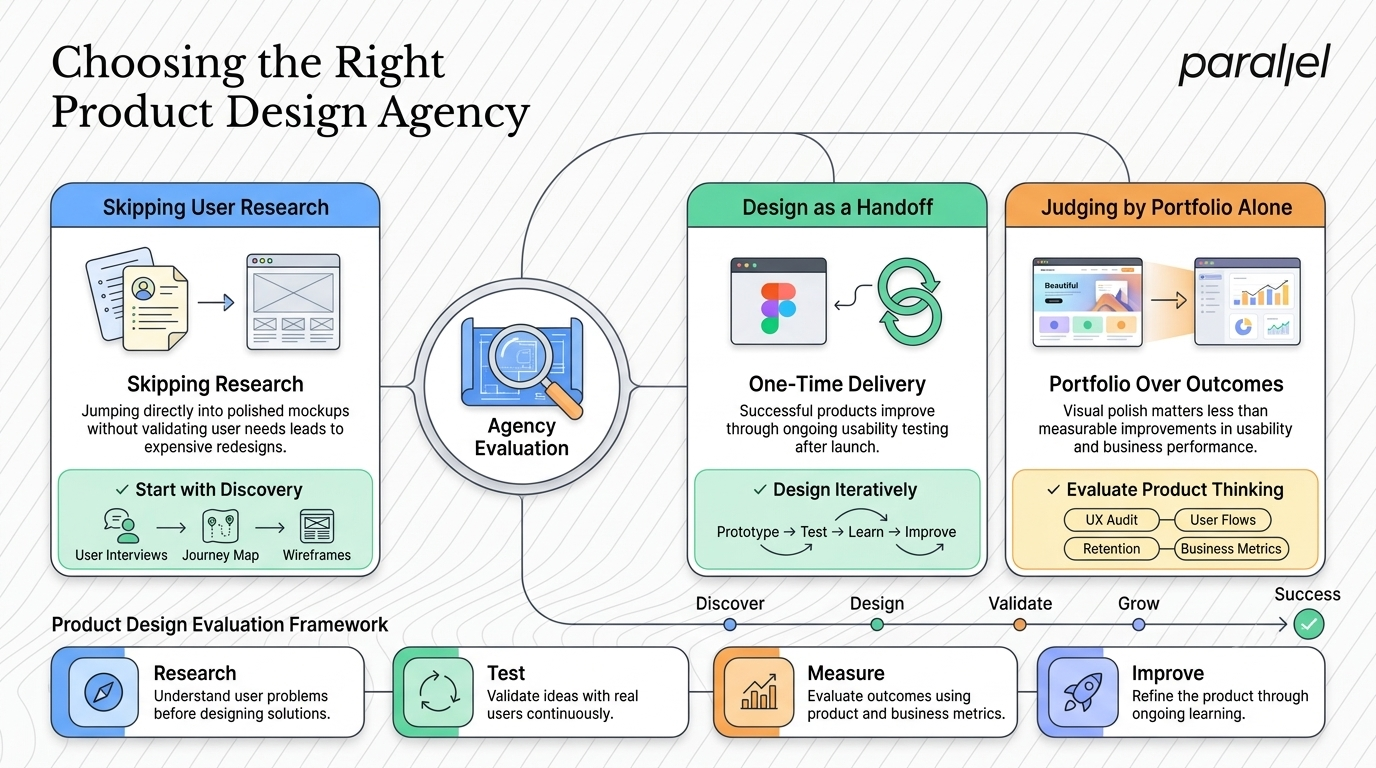
One major red flag is skipping the foundational research phase. Founders often believe they already know what their users want. They push agencies to bypass user research and jump straight into high-fidelity mockups. This always leads to costly revisions late in the development cycle. You cannot solve a problem you have not accurately defined.
Another mistake is treating design as a one-time handoff rather than an iterative process. Launching a product is just the starting line. True product design requires continuous usability testing to understand how real humans interact with the interface. Agencies that hand over a Figma file and disappear leave startups incredibly vulnerable.
Finally, startups often choose agencies based on flashy portfolios that lack context. A beautiful Dribbble shot tells you nothing about conversion rates or retention metrics. If you are evaluating a firm, ask them to walk through a complex UX audit they performed. You need to hear how they think about system architecture and business logic, not just typography and color theory.
Who are the 10 best product design agencies in Seattle right now?
Finding the right fit requires aligning your product stage with an agency's core competency. Here is a detailed breakdown of the teams doing the most impactful work right now.
1) ParallelHQ
We built ParallelHQ to help teams simplify complex product decisions. We focus heavily on early-stage SaaS and AI platforms where clarity is critical. Our process strips away assumptions and relies on real user data to guide strategy. We do not just design screens. We design systems that drive user activation.
Our methodology is grounded in rapid iteration. We utilize structured design sprints to validate concepts in days rather than months. You can see this approach in our high-impact work with platforms like Digilocker and AI pioneers like Sarvam AI. We partner closely with founders to ensure every design decision directly supports a measurable business goal.
2) Blink UX
Blink UX is a strong choice for enterprise companies needing deep qualitative research. They excel at foundational user studies before any pixels are drawn. Their evidence-driven approach ensures large organizations do not build on false premises.
They are ideal for teams with long development cycles and substantial research budgets. If you need to observe users in a highly controlled lab environment, Blink provides exceptional rigor. They help mitigate risk for massive corporate launches.
3) Teague
Teague brings incredible historical weight to physical and digital intersections. They are famous for their foundational work in aviation, mobility, and transportation tech. If your product involves hardware interacting with software, they possess rare and deep expertise.
Their thinking bridges the gap between industrial design and screen interfaces seamlessly. They understand how a user moves through a physical space while interacting with a digital display. They are the benchmark for transportation experience design.
4) Artefact
Artefact focuses heavily on responsible design and ethical technology systems. They help companies map out the long-term systemic impacts of their products. This makes them a great partner for healthcare, education, or complex civic data platforms.
They ensure products are not just usable but also equitable and safe. If your platform deals with sensitive data or vulnerable populations, their ethical frameworks are invaluable. They look far beyond the immediate user interface.
5) Intentional Futures
This agency specializes in future-state visioning and strategic learning. They are less focused on immediate UI fixes and more on organizational transformation. Teams hire them to understand where a market might be heading in three to five years.
They are brilliant at big-picture storytelling and aligning internal stakeholders. If your leadership team is completely fractured on product direction, they can facilitate that alignment. They build the vision that guides future tactical design.
6) Substantial
Substantial operates at the critical intersection of design and custom software development. They are highly effective when you need to prototype and build simultaneously. Their teams integrate closely with technical founders to ship working software quickly.
They are pragmatic builders above all else. They do not get bogged down in theoretical design exercises if it delays the engineering pipeline. They are a great fit for founders who need to get a functional MVP to market immediately.
7) Fresh Consulting
Fresh Consulting offers a massive breadth of engineering and design capabilities. They have specialized labs for robotics, hardware testing, and advanced technical integration. If you are building a deeply technical product requiring specialized engineers, they have the scale to support you.
Their design work is always closely tied to technical feasibility and hardware constraints. They are uniquely positioned to handle projects that typical digital-only agencies cannot touch.
8) Schema Design
Schema Design is the go-to team for complex data visualization and information architecture. They turn massive, unwieldy datasets into understandable and actionable interfaces. We deeply respect their ability to bring clarity to heavily analytical tools and enterprise dashboards.
They are a niche but highly effective agency for data-heavy SaaS products. If your core value proposition involves analytics, reporting, or financial modeling, Schema has the exact skill set required.
9) Tactile
Tactile excels at creating cohesive experiences across physical devices and companion apps. They understand the strict nuances and limitations of hardware constraints. Their team builds beautiful industrial forms paired with intuitive digital controls.
They are perfect for consumer electronics startups or IoT hardware companies. They ensure that the digital app feels like a natural extension of the physical product in the user's hand.
10) Designit
Designit is a massive global agency with a strong local presence. They focus heavily on service design and mapping out entire end-to-end customer journeys. If your product involves multiple offline and online touchpoints, they can map that sprawling complexity.
They bring international scale and massive resources to local projects. They are best suited for enterprise corporations looking to overhaul their entire customer experience ecosystem.
How do the best product design agencies in Seattle approach onboarding and activation?
Onboarding is where most early-stage products fail. Nielsen Norman Group released data in early 2026 showing that 74% of users abandon SaaS platforms within the first week due to cognitive overload. This is a staggering failure rate. It happens because product teams cram too many features into the first-time user experience.
In my experience, you have to earn the right to show a user complex features. A great onboarding experience strips away everything except the core value proposition. We often run a specific SaaS onboarding teardown to identify where friction causes drop-off. The goal is to get the user to their "aha" moment as fast as humanly possible.
You achieve this by applying foundational UX laws and design principles. Hick's Law dictates that the time it takes to make a decision increases with the number and complexity of choices. If your dashboard presents fifteen different actions on the first login, the user will simply close the tab. We design progressive disclosure systems that reveal complexity only when the user is ready for it.
Furthermore, we are seeing a massive shift toward AI-assisted onboarding. However, poorly implemented AI can actually increase cognitive load. If you are building intelligent systems, you need an AI native design agency that understands natural language constraints. The interface must guide the user on how to prompt the AI effectively, rather than leaving them staring at an intimidating blank text box.
How can you measure the ROI of the best product design agencies in Seattle?
Good design is not an abstract art project. It is a measurable business asset. According to Forrester's updated 2025 design ROI model, every dollar invested in core user experience improvements yields a return of $100. But those returns do not come from superficial visual changes. They come from reducing friction in revenue-generating flows.
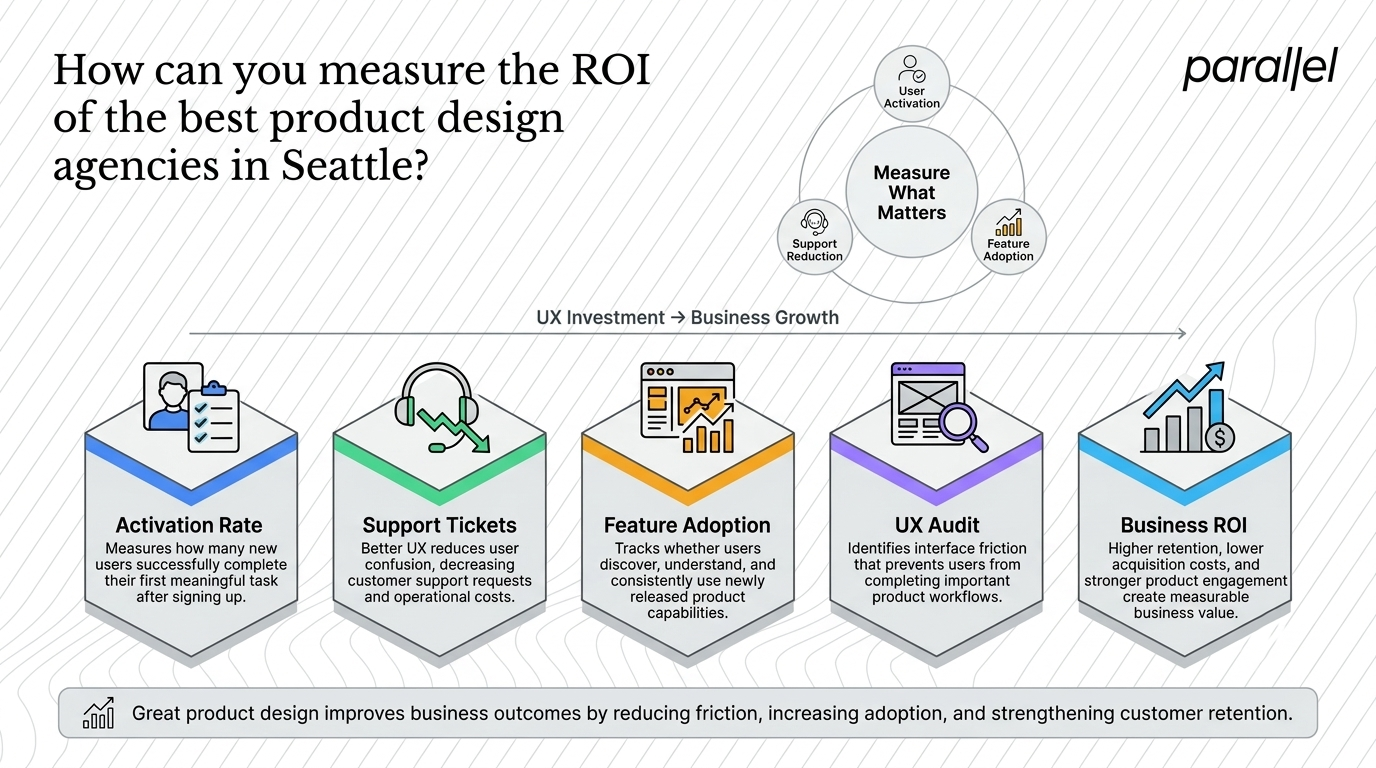
When evaluating the ROI of UX, we look at three specific metrics. First, we track the activation rate, which measures how many new sign-ups actually complete a core task. Second, we monitor support ticket volume. A well-designed interface drastically reduces the need for human customer support intervention.
Third, we measure feature adoption rates. If your engineering team spends three months building a feature, design is responsible for making sure users actually discover and use it. If you are struggling with low adoption, a comprehensive UX audit can quickly identify the interface barriers blocking your users. We focus on fixing these specific leaks in your product funnel.
Ultimately, the right partnership should pay for itself through increased retention and lower customer acquisition costs. If an agency cannot explain how their design decisions will impact your specific business metrics, walk away. You need strategic partners, not just pixel pushers.
Conclusion
Building a product is hard enough without confusing your users along the way. The goal of any design partnership should be absolute clarity and strategic alignment. Your interface is the only part of your business that your customer actually touches. It needs to reflect a deep understanding of their pain points and workflows.
Choosing among the best product design agencies in Seattle comes down to finding a team that challenges your assumptions. You want practitioners who have seen products fail and know exactly how to navigate around those pitfalls. We believe that when you simplify the experience, you naturally amplify the value of your product.
Frequently asked questions about finding the best product design agencies in Seattle
1) What is product design in the context of early-stage startups?
It is the process of solving user problems through clear strategy, system architecture, and interface design. The best product design agencies in Seattle will tell you it is less about creating beautiful pixels and more about defining clear business logic. It bridges the gap between what users need and what the business must achieve.
2) How do I prepare for an engagement with a design partner?
You must come with clear business goals, not just a list of features. Prepare your existing user data, customer support logs, and any previous research you have conducted. We highly recommend having a documented product roadmap to give the agency context on where the business is heading.
3) What is the difference between a UI/UX agency and a product design partner?
A traditional UI/UX agency often focuses on executing a brief that you hand them. A product design partner helps you write the brief. Product design encompasses market viability, technical feasibility, and overarching strategy, whereas UI/UX is often limited to the execution of the interface itself.
4) Is an external design agency right for my current stage?
If you have achieved initial traction but are struggling with churn or activation, an external perspective is vital. Founders often get too close to their own products to see the obvious friction points. An agency brings objective frameworks to untangle the mess. If you are still trying to figure out what your product is, you might need a discovery framework engagement first.
5) How does ParallelHQ differentiate itself from traditional agencies?
We operate as an extension of your product team rather than a traditional vendor. We do not do fluff or trend-chasing. We utilize highly structured formats like the design sprint to force rapid decision-making. Our expertise is specifically tuned to complex SaaS and AI platforms that require deep systemic thinking.
6) How long does a typical product strategy phase take?
A focused strategy and discovery phase should take between two to four weeks. If an agency wants to spend six months researching before designing anything, they are moving too slowly for a startup environment. We believe in rapid, iterative validation using low-fidelity prototypes to gather immediate user feedback.
7) How do we ensure the design system scales as the product grows?
You need to establish a foundational design system early in the process. This acts as a single source of truth for all components, typography, and spacing. It ensures that as your engineering team grows, they can pull from a standardized library rather than inventing new patterns for every screen.
8) What metrics should we track after launching a redesigned product?
Do not track vanity metrics like time-on-page. Focus on task completion rates, onboarding drop-off percentages, and customer retention metrics. You should also monitor your customer activation velocity. A successful redesign should noticeably decrease the time it takes for a new user to realize the core value of your product.

check out these related blogs