We have seen too many founders build incredibly powerful AI models that users abandon within minutes. The problem is rarely the underlying technology. The problem is almost always a lack of clarity in the product experience. Building AI tools requires a fundamentally different approach to product thinking. You have to design for trust, transparency, and simple interactions that guide the user rather than overwhelm them. If you are navigating this landscape in the Pacific Northwest, choosing the right strategic partner is your most critical decision. I put together this guide covering the best AI design agencies in Seattle to help you find teams that prioritize real user behavior over superficial visuals.
Quick answer
The right design partner simplifies complex AI models into clear and grounded user behaviors. Below is a comparison table of the top ten best AI design agencies in Seattle to help you choose the right fit for your 2026 product roadmap.
Why does working with the best AI design agencies in Seattle matter for 2026 products?
The way we interact with software has completely shifted over the last few years. We are moving away from simple command-and-response interfaces into an era of agentic workflows. Users no longer want a chat box slapped onto an existing product. They expect AI to anticipate their needs, streamline their tasks, and operate seamlessly in the background.
This shift demands a massive upgrade in product strategy. A 2025 study published by the Nielsen Norman Group found that AI features built without clear system status feedback lead to a 50% drop in task completion rates. Users simply do not trust a system that feels like a black box. They need to understand what the AI is doing, how it arrived at a conclusion, and how they can correct it if it makes a mistake.
Traditional visual design cannot solve these systemic problems. You need product thinkers who understand the technical constraints of large language models and can map out complex user journeys. The right agency will help you define exactly where AI adds real value to your product and where a traditional interface is actually more efficient. They will challenge your assumptions and ensure your product decisions are grounded in actual user behavior.
In my experience, teams that invest early in an AI-native design approach avoid the costly mistake of building features that look cutting edge but fail to drive real activation.
Where do startups go wrong when vetting the best AI design agencies in Seattle?
I have audited dozens of SaaS and AI products that failed to gain traction despite having brilliant engineering teams. The most common mistake founders make is hiring a traditional digital agency to solve a complex product problem. They look for beautiful portfolios filled with trendy gradients and glassmorphism, completely ignoring the structural thinking required to make AI usable.
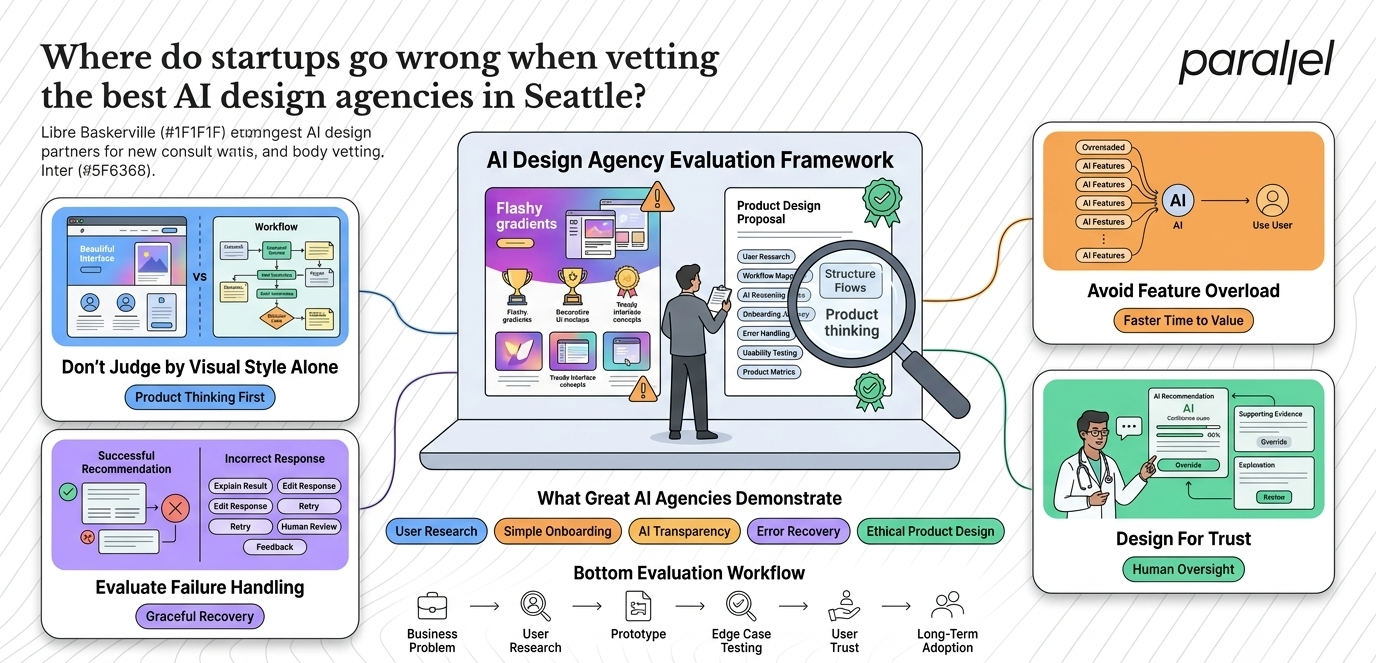
One specific pattern we constantly observe is the overcomplication of the onboarding process. Startups often try to showcase every single capability of their new AI model right away. This overwhelms the user and leads to immediate churn. A strong design partner knows that SaaS onboarding should be about delivering a single core moment of value as quickly as possible.
Another frequent failure point is ignoring edge cases. Generative AI is inherently probabilistic. It will hallucinate, it will return errors, and it will occasionally confuse the user. Agencies that only design for the happy path are setting you up for failure. We worked with a healthtech startup recently that had an AI diagnostic tool designed by a traditional creative agency. The interface was visually stunning. However, it caused massive user anxiety because it offered no explanation for its outputs and no clear way for doctors to override the system.
When you evaluate potential partners, you must look beyond the surface. You are not buying screens. You are buying the ability to clarify complex workflows, manage user expectations, and build ethical AI interfaces that foster long-term retention.
How to properly evaluate the best AI design agencies in Seattle for your startup
Finding the right fit requires asking hard questions about their methodology and their understanding of modern technology. You need a partner capable of running rigorous discovery phases and rapid prototyping cycles.
First, examine their approach to user research. Do they rely solely on standard usability testing, or do they understand how to evaluate AI-specific interactions? A 2026 report by IDEO on AI trust highlights that users require visible feedback loops to feel in control of intelligent systems. Your agency should be able to explain exactly how they test for trust and comprehension, not just visual appeal.
Second, test their product sense. Ask them how they handle latency. AI models often take several seconds to generate a response. A weak agency will simply design a loading spinner. A strong agency will design interactions that engage the user during that wait time or restructure the workflow to make the latency invisible. They should possess a deep understanding of what product sense actually means in the context of machine learning.
Finally, look for their ability to run structured frameworks. We rely heavily on design sprints because they force alignment and rapidly de-risk complex product decisions. Ask potential agencies how they handle ambiguity and how they align divergent stakeholder opinions. If their process sounds like a traditional waterfall handoff, they are not equipped to design dynamic AI products.
Reviewing the top 10 best AI design agencies in Seattle this year
Seattle is a massive hub for technological innovation. With heavyweights like Microsoft and Amazon anchoring the local talent pool, there is a dense concentration of highly skilled practitioners. Here is our breakdown of the top partners you should consider based on your specific product needs.
1) ParallelHQ
We built ParallelHQ because we saw too many early-stage teams struggling with product decisions that should have been simple and clear. We are a product design and strategy partner focused exclusively on clarity in thinking. We do not do surface-level design or chase temporary visual trends. We work closely with founders and product leaders to simplify complex user experiences and drive real business metrics.
Our approach is grounded in deep behavioral psychology and rigorous testing. Whether we are conducting a comprehensive UX audit or defining the core interaction models for a new generative AI tool, we assume the user is smart but busy. We specialize in AI UX design that prioritizes system transparency and user agency.
We have helped teams across the globe, including those looking for UI/UX design services in Seattle, turn ambiguous technology into intuitive, high-activating products. If you need a team that speaks the language of product management and engineering, we are your first call.
2) Blink UX
Blink UX is an institution in the Seattle design community. They are deeply rooted in evidence-driven design and operate some of the most advanced usability labs in the industry. If you are building an enterprise AI platform that requires massive amounts of compliance testing and deep behavioral observation, Blink is an excellent choice.
Their strength lies in foundational research. They excel at mapping out highly complex user ecosystems and delivering detailed qualitative data. They are less focused on rapid startup pivoting and more focused on thorough, validated execution for large-scale organizations.
3) Artefact
Artefact has always pushed the boundaries of responsible technology. They look at product design through a lens of societal impact and long-term outcomes. When it comes to AI, this perspective is incredibly valuable. They are known for their systems-thinking approach, ensuring that new intelligent features do not create unintended negative consequences for the user or the broader community.
Startups working in highly regulated spaces like healthcare, finance, or education benefit greatly from Artefact’s ethical frameworks. They help teams build products that are not only usable but genuinely trustworthy and transparent.
4) Substantial
Substantial operates at the intersection of design and technical delivery. They are a digital product studio that actually builds what they design. This makes them a strong partner for startups that lack internal engineering capacity and need to take an AI concept from a rough idea all the way to a functional prototype.
Because they have deep technical roots, they understand the realities of working with APIs and large language models. They will not design an interface that your backend cannot support. They are practical, fast, and highly collaborative.
5) Intentional Futures
Intentional Futures is a strategy and design studio that excels at navigating extreme ambiguity. They often work with leadership teams to define the long-term vision of a product before a single screen is ever drawn. If your startup is trying to invent an entirely new category of AI software, they have the frameworks to help you map that territory.
Their work is highly conceptual and strategic. They are the team you hire when you need to align a board of directors or map out a multi-year innovation roadmap.
6) Teague
Teague is legendary in the industrial design world, but their digital and interaction design practices are highly relevant for the future of AI. They specialize in the physical-to-digital crossover. If your AI product involves edge computing, IoT devices, or physical environments, Teague is uniquely positioned to help.
They understand how to design voice interfaces, spatial computing environments, and ambient AI systems that live outside of the traditional browser window. They are perfect for hardware-enabled AI startups.
7) Smashing Ideas
Smashing Ideas focuses on digital innovation and legacy transformation. They have a long history of helping established companies modernize their digital offerings. For well-funded scale-ups or mature enterprises looking to integrate AI into an existing, clunky product suite, they offer a very safe and structured pair of hands.
They bring rigorous project management and a highly documented design process, ensuring that complex integrations are handled smoothly across large, siloed teams.
8) UpTop
UpTop is a highly focused UX and UI agency. They are incredibly good at optimizing existing workflows and improving baseline usability metrics. If you already have a functional AI product but users are dropping off because the interface is confusing or visually outdated, UpTop can come in and clean it up.
They are tactical and execution-oriented. They will audit your existing screens, identify the friction points, and deliver a polished, accessible design system that improves the overall user experience.
9) Fell Swoop
Fell Swoop is deeply focused on conversion and growth design. They understand how to build digital experiences that drive user action. If your AI product is struggling with top-of-funnel conversion or user activation during a free trial, they have the analytical chops to identify the drop-off points.
Their approach marries creative design with hard performance data. They are a great fit for D2C AI tools or high-velocity SaaS products where every percentage point of conversion matters.
10) Filter
Filter operates a bit differently than a traditional agency. They specialize in embedding specialized talent directly into your internal teams. If you have a strong product vision and capable engineering leadership but simply lack the hands-on design execution to launch your AI features, Filter can supply the right people.
This model is ideal for startups that want to maintain total control over their daily processes but need to rapidly scale their design output for an upcoming launch.
What is the true ROI of hiring the best AI design agencies in Seattle?
Product design is not a cosmetic expense. It is a fundamental growth lever. When you simplify an overcomplicated product experience, the business metrics shift immediately.
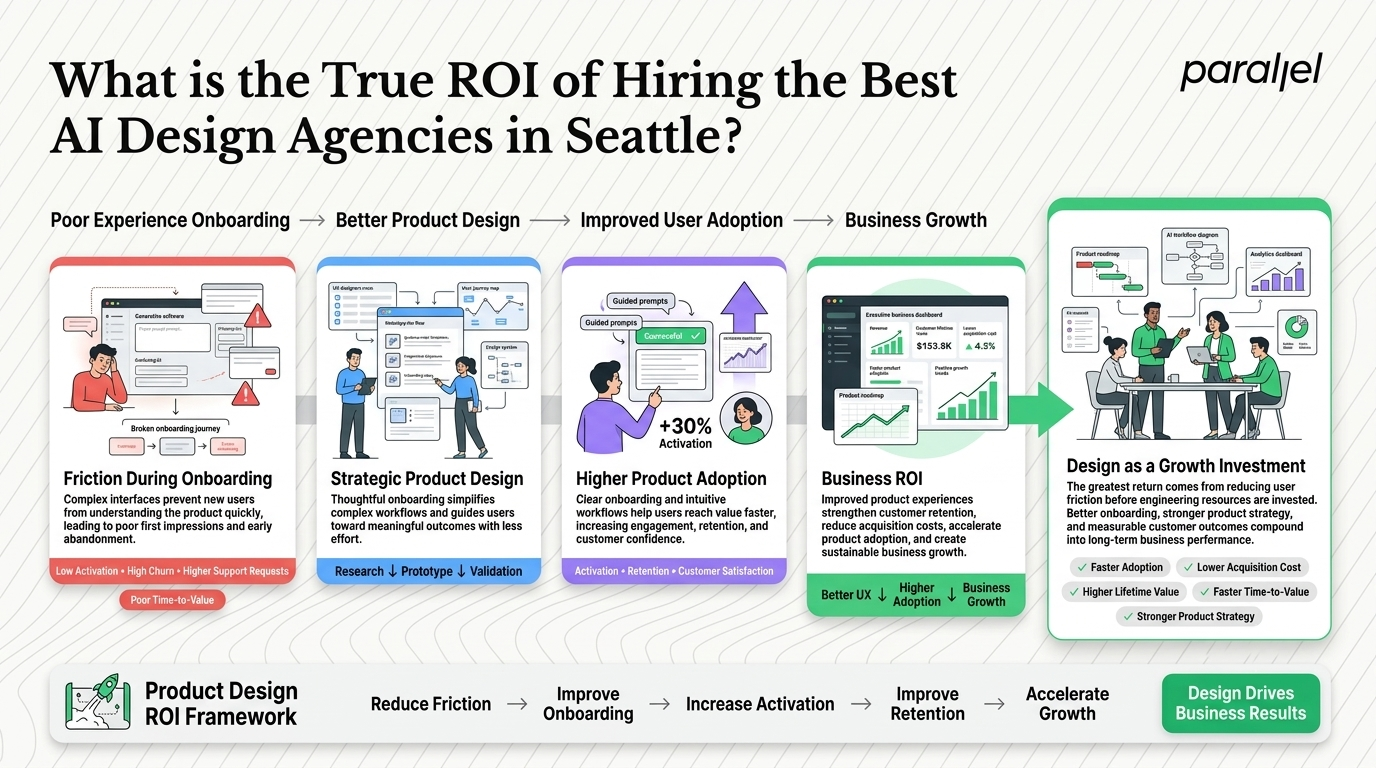
Consider the onboarding phase of a new generative AI tool. If the interface does not clearly explain how to write an effective prompt, the user will get a poor result and churn immediately. We have seen that redesigning these core activation flows to include guided templates and progressive disclosure can increase activation rates by upwards of 30%. That single metric improvement drastically lowers your customer acquisition cost and increases lifetime value.
A 2026 update to the McKinsey Design Index reinforces this reality. Their data shows that companies operating in the top quartile of design maturity adopt and successfully deploy AI features three times faster than their competitors. Good design reduces the time-to-value for your users. It eliminates the friction that prevents people from experiencing the magic of your underlying technology.
Investing in product strategy consulting upfront prevents you from spending months of engineering time building features nobody actually wants. The true return on investment is clarity, speed to market, and a product that users genuinely understand how to use.
Conclusion
Building AI products is inherently chaotic right now. The technology is moving faster than the established design patterns. In this environment, the most dangerous thing you can do is overcomplicate your user experience.
The right partner will act as a forcing function for clarity. They will strip away the hype, focus on actual human behavior, and help you build interfaces that are grounded and intuitive. Stop looking for agencies that promise to make your product look futuristic. Look for the teams that promise to make your product make sense. When you focus on solving real problems simply, the growth takes care of itself.
Frequently asked questions
1) What defines an AI-native design approach?
An AI-native approach means designing the product around the capabilities and constraints of machine learning from day one. It involves moving away from static navigation menus and focusing on dynamic, predictive, and agentic user flows. It requires a deep understanding of designing interfaces for AI products.
2) How do we know if we need a UI agency or a product strategy partner?
If your product logic is perfectly sound and users love the workflow but complain it looks dated, you need a UI agency. If users are confused, failing to activate, or abandoning the product because it is too complex, you have a structural problem. That requires a product strategy partner who can rethink the core experience.
3) How much do AI design services typically cost in 2026?
Costs vary wildly based on the scope and the maturity of the agency. A tactical UI refresh might cost between $20,000 and $50,000. A comprehensive AI product strategy, user research phase, and full interface redesign from a top-tier partner typically ranges from $75,000 to well over $150,000 depending on the complexity of the platform.
4) Should we hire an agency or build an in-house design team?
Early-stage startups usually benefit from agencies because they get immediate access to senior-level product thinkers without the long ramp-up time of hiring. Agencies bring diverse pattern recognition from solving similar problems across multiple industries. Once you find product-market fit and need continuous, daily iteration, transitioning to an in-house team makes sense.
5) How does ParallelHQ differ from traditional design agencies?
At ParallelHQ, we are completely focused on clarity in product thinking. We are not an agency that hands over pretty files and walks away. We operate as embedded product partners. We challenge your assumptions, run rigorous design sprints, and ground every decision in real user behavior to solve complex SaaS and AI challenges.
6) What is the typical timeline for an AI design sprint?
A standard design sprint runs for one to two weeks. It is designed to rapidly align stakeholders, prototype a core concept, and test it with real users. Full product redesigns or the creation of comprehensive AI design systems usually take between two and four months, depending on the scope of the development handoff.
7) How do you design for AI trust and transparency?
Trust is built through visibility. You must design interfaces that clearly explain the system status. Show the user what data the AI is using, provide citations or confidence scores where applicable, and always offer a manual override. If the AI makes a mistake, the interface must make it incredibly easy for the user to correct the output.
8) Is working with a specialized agency right for my early-stage startup?
Yes, if you have funding and are tackling a highly complex technical problem. If you are building a simple wrapper around an existing API, you might survive with freelance help. However, if your core differentiator relies on users understanding and adopting a novel AI workflow, investing in expert product design early will save you from catastrophic pivot costs later.

check out these related blogs








































































.avif)