I have watched countless early-stage teams burn their runway on design that looks beautiful but fails to convert. Founders often search for the best UI UX design agencies in Bay Area hoping to find a quick fix for weak user activation or complex onboarding. The reality is that good product design is not about surface-level aesthetics. It is about deep structural clarity. We built ParallelHQ because we saw product teams struggle with decisions that should have been grounded in real user behavior. Here is how to navigate this landscape and find a partner that actually improves your product fundamentals.
Quick answer/TL;DR
The top product partners prioritize strategic clarity and user activation over mere visual trends. Here is a comparison of the top 10 options for founders seeking the best UI UX design agencies in Bay Area right now.
Who are the 10 best UI UX design agencies in Bay Area?
When evaluating partners for your product, you need to look beyond the portfolio. You need to understand how these teams think, how they solve problems, and whether their approach aligns with your specific stage of growth. Here is a breakdown of the top 10 options strictly compared based on their core competencies and industry impact.
1) ParallelHQ
We built ParallelHQ to solve a very specific problem. Startups were wasting months on design cycles that did not move the needle on user activation. We operate as a product design and strategy partner focused entirely on clarity in thinking.
We do not just paint screens. We help teams simplify complex product decisions. In our experience working with founders, the biggest barrier to growth is an overcomplicated product experience. We use frameworks like design sprints and opportunity mapping to strip away the noise. We ground every decision in real user behavior rather than relying on design trends.
What we do best:
- Unblocking teams stuck on complex UX decisions.
- Fixing weak onboarding flows to improve activation rates.
- Providing product strategy consulting that aligns business goals with user needs.
- Delivering clear, actionable UX audits that identify exactly why users are dropping off.
2) IDEO
IDEO is a legendary name in the design world. Based in San Francisco, they popularized the concept of human-centered design. They excel at massive, ambiguous challenges that require deep anthropological research.
If you are a global corporation trying to rethink the future of urban mobility, IDEO is a strong choice. However, their process is often heavy and slow for early-stage software startups. Teams building digital SaaS products usually need faster iteration cycles. If you need rapid product execution rather than month-long research phases, you might want to explore an IDEO alternative focused specifically on digital product velocity.
3) Frog Design
Frog Design has a deep history in industrial design that has transitioned into digital experiences. They are exceptional at blending physical and digital touchpoints. Their work often involves large-scale enterprise transformation projects.
Like IDEO, their engagements are highly structured and require significant budget commitments. They are built for scale and legacy transformation. For agile product teams looking to validate a new feature set quickly, a Frog Design alternative that specializes in lean UX methodology is often a more practical fit.
4) Clay
Clay has built a strong reputation in San Francisco for producing visually stunning digital experiences. They are known for their high-fidelity animations, 3D web experiences, and strong visual brand identities.
If your primary goal is to win design awards or launch a highly conceptual consumer brand, they are excellent. The drawback we often observe with purely visual agencies is a lack of deep product thinking. Beautiful interfaces do not always solve complex user workflow problems. Teams building intricate B2B software often seek a Clay alternative when they need to prioritize usability over visual flair.
5) Ramotion
Ramotion focuses heavily on the intersection of brand identity and user interface design. They work frequently with growing tech companies in the Bay Area to establish scalable design systems.
They are highly capable at delivering polished marketing sites and functional app interfaces. Their approach is very structured around deliverables. Startups that need help defining their core product value proposition before designing the interface might find a Ramotion alternative more helpful for early-stage product strategy.
6) R/GA
R/GA sits at the intersection of technology, marketing, and design. They are a massive global agency with a strong presence in San Francisco. They are best suited for global consumer brands launching massive digital campaigns.
Their approach often prioritizes brand storytelling and engagement metrics over functional software utility. For founders building utilitarian software tools, this marketing-heavy approach can lead to bloated features. Product-led growth companies frequently look for an R/GA alternative that understands software mechanics better than advertising mechanics.
7) Work & Co
Work & Co is known for being highly execution-oriented. They build digital products for massive scale, often working with companies like Apple or IKEA. They pride themselves on having senior designers doing the actual hands-on work.
They are incredibly effective for large corporations that need a reliable partner to ship major digital platforms. Their minimum engagement size is typically outside the scope of Series A or Series B startups. Growing companies often need a Work & Co alternative that offers similar seniority but with more flexible engagement models.
8) Huge
Huge is a massive agency handling everything from digital marketing to enterprise UX. They are capable of managing highly complex, multi-year digital transformation projects for Fortune 500 companies.
Their Bay Area presence is strong, but their sheer size means you are often dealing with complex account management layers. Startups move too fast for heavy agency bureaucracy. Founders looking for direct access to senior product thinkers usually prefer a Huge alternative that operates with less overhead.
9) Method
Method focuses on strategic design, particularly in complex industries like healthcare and financial services. They are good at mapping out intricate service blueprints and understanding regulatory constraints in design.
They bring a highly analytical approach to UX. This is valuable for deeply technical industries, but their engagements can be research-heavy. Teams looking to move rapidly from concept to high-fidelity prototypes might consider a Method alternative that balances strategy with rapid visual execution.
10) Neuron
Neuron is a highly specialized agency focusing almost exclusively on B2B SaaS applications. They understand the nuances of designing dashboards, data visualization, and complex enterprise workflows.
They are a solid, pragmatic choice for purely functional B2B interfaces. However, they sometimes lack the strategic product management perspective needed to challenge a founder's core assumptions. Teams needing both UX execution and strategic pushback might explore a Neuron alternative that integrates product strategy directly into the design process.
Why do startups misjudge the best UI UX design agencies in Bay Area?
In my experience, this is where most product decisions go wrong. Founders often hire for visual style rather than product thinking. They look at a slick portfolio on Dribbble and assume that beautiful UI will naturally lead to good UX.
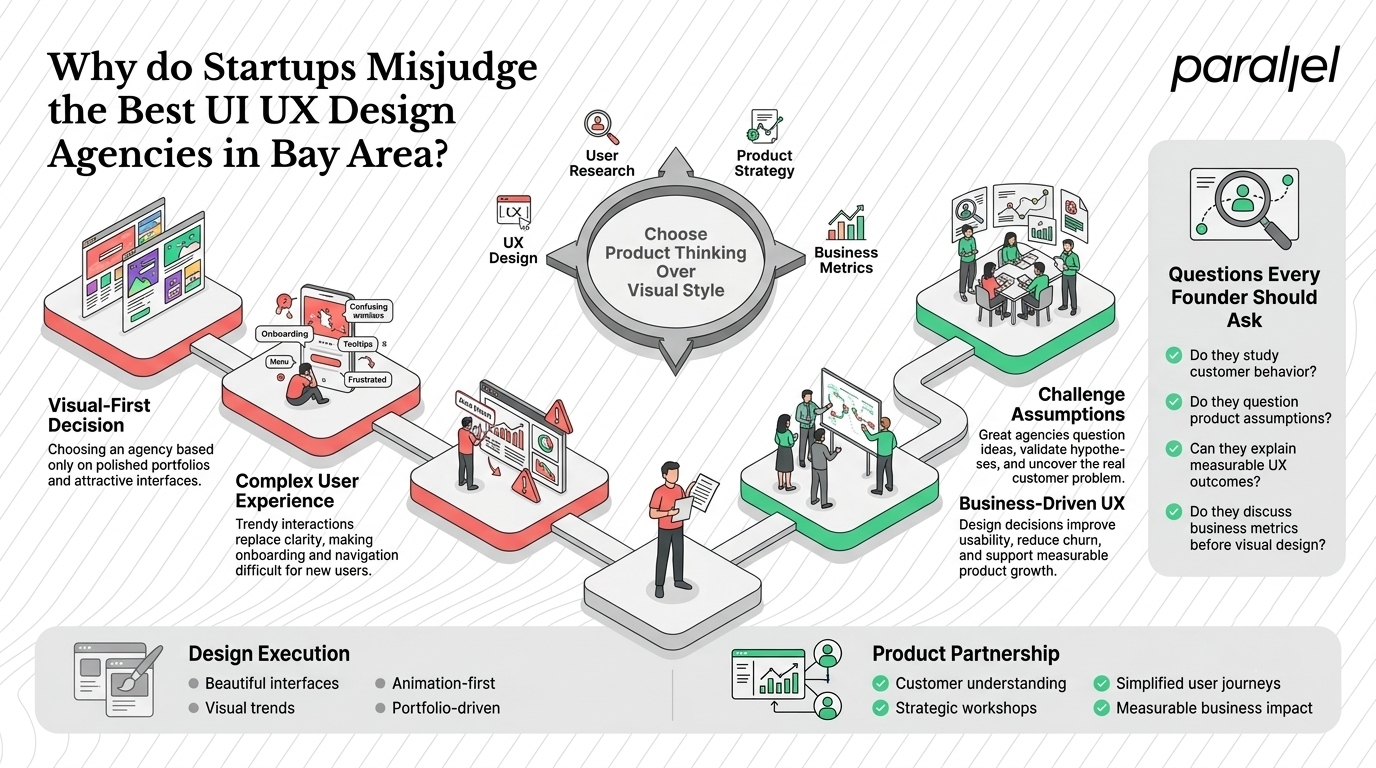
The result is usually a gorgeous interface that users cannot figure out how to navigate. We have seen teams overcomplicate onboarding flows by prioritizing trendy animations over clear instructions. This almost always backfires. According to a 2026 report by the Nielsen Norman Group, complex navigation and lack of clarity remain the primary causes of user churn in early-stage SaaS platforms.
You do not need a partner who simply executes your exact vision with prettier colors. You need a partner who will challenge your assumptions. If an agency does not ask hard questions about your business model and target user during the initial calls, they are not practicing product design. They are just providing production muscle.
What should you expect from the best UI UX design agencies in Bay Area?
A strong design partner shifts the focus entirely from outputs to outcomes. They do not measure success by how many screens they deliver. They measure success by how those screens impact user behavior.
Here is how we think about this tradeoff. We recently conducted a SaaS onboarding teardown for a client experiencing a 15% drop-off rate right after signup. Instead of redesigning the entire app, we focused purely on simplifying the decision architecture in the first five minutes. We removed three non-essential steps and grouped the remaining tasks logically. This simple clarity improved activation by 28%.
This aligns directly with current data. Forrester's 2026 economic impact research consistently shows that strategic UX investments yield a return exceeding 100%, provided the focus is on usability rather than decoration. You should expect your design partner to use frameworks like usability testing and continuous discovery to validate ideas before writing a single line of code.
How can founders evaluate the best UI UX design agencies in Bay Area?
Do not let agency jargon confuse your evaluation process. The best product thinkers speak in simple, direct terms. When you are interviewing potential partners, your goal is to uncover how they handle ambiguity and failure.
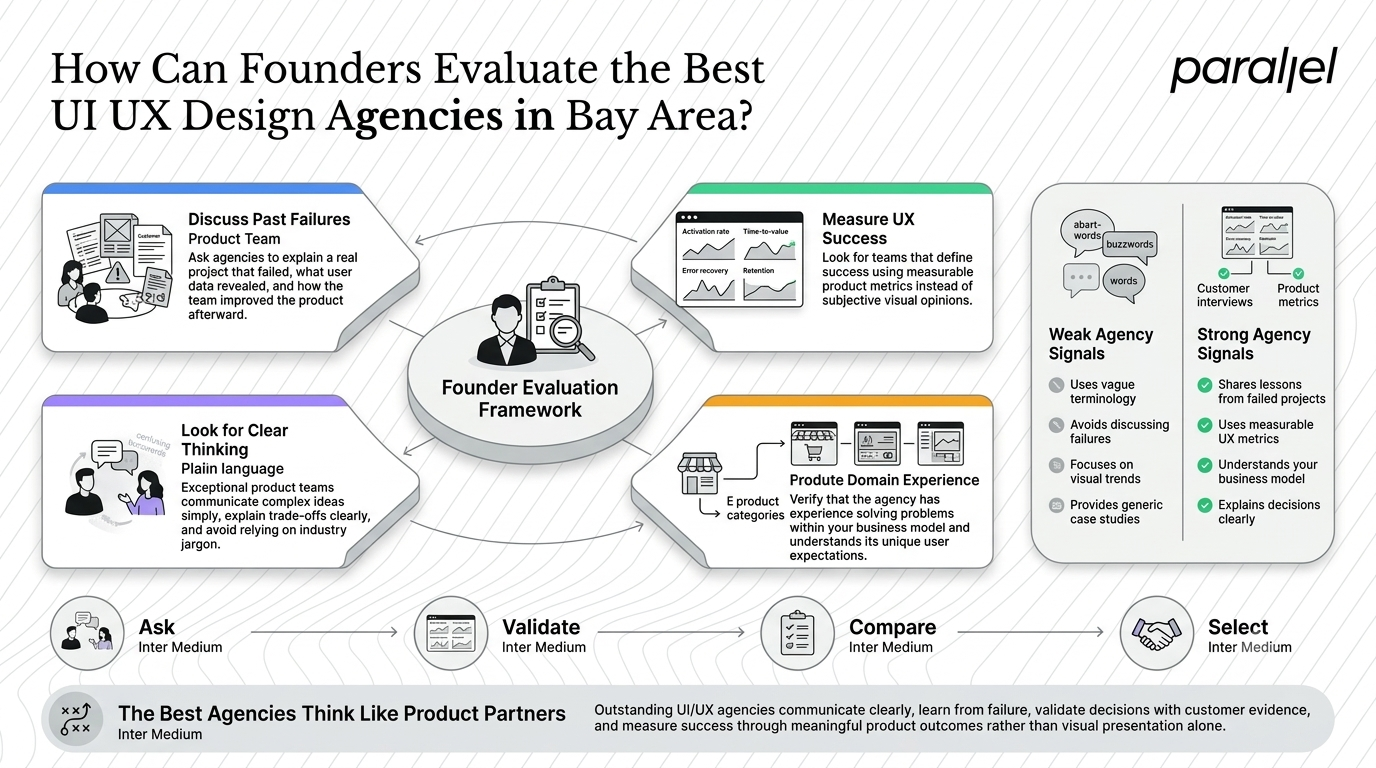
Start by asking them to explain a time a design solution failed in the real world and how they fixed it. A mature team will openly discuss their misses because they rely on user data to correct course. If they claim everything they ship is perfect, they are not testing their products rigorously enough.
Next, evaluate their focus on product metrics. Ask them how they measure the success of a UX redesign. You want to hear answers tied to activation rates, time-to-value, and error recovery rates. Finally, look at their specific experience with your business model. Designing for an e-commerce platform requires entirely different mental models than fintech UI UX design. Ensure their core thinking aligns with your specific product challenges.
Conclusion
Building a product that people actually want to use is incredibly difficult. It requires saying no to a hundred good ideas to focus on the one critical user flow that matters.
The right design partner will not just hand you a Figma file and walk away. They will help you think clearer. They will ground your product decisions in real evidence and simplify the experience until it feels obvious to the user. That is the true value of product design, and it is exactly what we strive to deliver at ParallelHQ every single day.
Frequently Asked Questions
1) What defines the best UI UX design agencies in Bay Area?
The leading agencies are defined by their ability to connect user needs with tangible business outcomes. They do not just focus on making things look attractive. They focus heavily on information architecture, user psychology, and reducing cognitive friction.
These teams act as strategic partners rather than simple order-takers. They leverage robust methodologies like generative vs evaluative research to inform their design choices. Ultimately, their value is proven through increased user retention and higher task completion rates within the software they design.
2) How do the best UI UX design agencies in Bay Area price their services?
Pricing varies significantly based on the agency's size, overhead, and strategic involvement. Massive global agencies often require multi-million dollar commitments for long-term engagements. Smaller, highly specialized product studios typically charge between $15,000 to $50,000 per month depending on the velocity required.
It is crucial to look at value rather than just the hourly rate. A cheap design agency that builds the wrong features will cost you far more in wasted engineering time. Investing in proper product discovery upfront actually reduces your total development costs by preventing expensive rework.
3) Are the best UI UX design agencies in Bay Area right for early-stage startups?
It depends entirely on the agency's operational model. Large traditional agencies are generally too slow and expensive for seed or Series A startups. Early-stage companies need rapid iteration and a focus on validating core assumptions quickly.
However, specialized product design partners like ParallelHQ are built exactly for this stage. We help founders simplify their MVP and prioritize features that drive actual activation. If you find a partner that understands lean startup mechanics, they are an invaluable asset for an early-stage team.
4) How long does a typical product design engagement take?
The timeline depends on the specific problem you are trying to solve. A targeted UX audit to identify friction points in an existing flow might only take two to three weeks. This provides immediate, actionable insights for your engineering team.
For a comprehensive zero-to-one product build or a massive platform redesign, engagements typically range from three to six months. We strongly advise breaking these larger projects into smaller, testable milestones. This ensures you are constantly validating the design with real users rather than waiting months for a massive reveal.
5) What is the difference between an agency and a product design partner?
A traditional agency is heavily focused on deliverables and client service. They wait for you to provide a detailed brief, and then they execute exactly what you asked for. This model works well for marketing sites but fails miserably for complex software.
A product design partner operates as an extension of your product management team. They help you define the brief, challenge your assumptions, and focus on the ROI of UX. They are invested in the business metrics of the product, not just the aesthetic quality of the final design files.
6) How do you measure the ROI of a UX redesign?
You measure UX improvements through strict product metrics. We look closely at the activation rate, which measures how many users successfully complete their first core task. If a redesign simplifies onboarding, this number should increase noticeably.
We also track time-to-value and support ticket volume. A well-designed product requires less customer support because the interface intuitively guides the user. The business value of design is always evident in reduced churn and lower customer acquisition costs.
7) When should a founder prioritize UX strategy over shipping features?
Founders should slow down feature development when they notice high user churn despite active marketing efforts. If users are signing up but abandoning the platform within the first week, shipping new features will not solve the problem. Your core experience is broken.
This is the exact moment to engage in deeper product strategy. You need to step back, conduct proper user research, and figure out why the current features are failing. Adding complexity to a confusing product only accelerates user abandonment.
8) How does ParallelHQ differ from traditional Bay Area design agencies?
We operate with a fundamental belief that clarity beats cleverness. Traditional agencies often try to invent novel interaction patterns to win design awards. We rely on established UX laws and design principles because familiar interfaces are easier for users to learn.
Our focus is explicitly on early-stage and growth-stage product teams. We use structured workshops and fast prototyping to derisk decisions quickly. We do not sell bloated retainer contracts. We sell clarity, momentum, and product experiences that are grounded in how people actually behave online.

check out these related blogs