I have watched early-stage founders and product leaders burn months of runway on design work that looks great but fails to activate users. Finding the best SaaS design agencies in Los Angeles is not about hiring the team with the flashiest visual portfolio. It is about finding partners who understand that design is a business decision. The market has shifted dramatically. The days of raising endless capital to patch over a leaky product bucket are over. Today, efficient growth and net revenue retention are the only metrics that matter. When the average SaaS product loses the majority of its users before they see any value, you do not need decorators. You need product thinkers who can simplify complex workflows, reduce cognitive load, and drive deep user retention.
Quick Answer
Clear product thinking and user activation matter more than pure aesthetics. Here is a quick comparison of the top ten agencies helping SaaS companies build better products and solve complex UX challenges in 2026.
Why are the best SaaS design agencies in Los Angeles focusing on user activation?
Most product teams treat user onboarding as an afterthought or a simple checklist. I see this pattern constantly across the industry. Teams build an exhaustive product tour, force new users to click through seven different tooltips pointing out every button, and then wonder why their day-one retention is entirely flat. They confuse product tours with product value.
The reality is that user onboarding is a highly measurable revenue system. It is the bridge between marketing promises and product reality. According to 2025 benchmark data from Agile Growth Labs, the average SaaS activation rate is sitting at a mere 37.5 percent. That means nearly two-thirds of all signups never experience the core value of the software they just registered to use. They encounter friction, they get confused by the interface, and they simply close the tab.
This metric is exactly why top design partners focus entirely on time-to-value. The faster you get a user to their first meaningful outcome, the more likely they are to stay. Amplitude's 2025 Product Benchmark Report shows that top B2B products retain 15.6 percent of users at the three-month mark, while the median product retains just 2.5 percent. That is a massive gap, and it is entirely dictated by the early user experience. Early value realization and long-term retention move together in lockstep.
Consider the difference between a generic dashboard and a tailored onboarding flow. If you drop a new user into an empty dashboard with no data, you are asking them to do the heavy lifting of figuring out how your product works. A strategic design approach intercepts that user, asks them one critical question about their role, and routes them to a specific action that delivers immediate gratification.
Where do product teams go wrong when hiring design partners?
Many founders hire for aesthetics when they actually have a deep clarity problem. They scroll through agency portfolios filled with beautiful dark mode dashboards, glowing gradients, and perfect typography. They mistakenly assume those visuals will act as a quick fix for their high churn rate and weak user engagement.
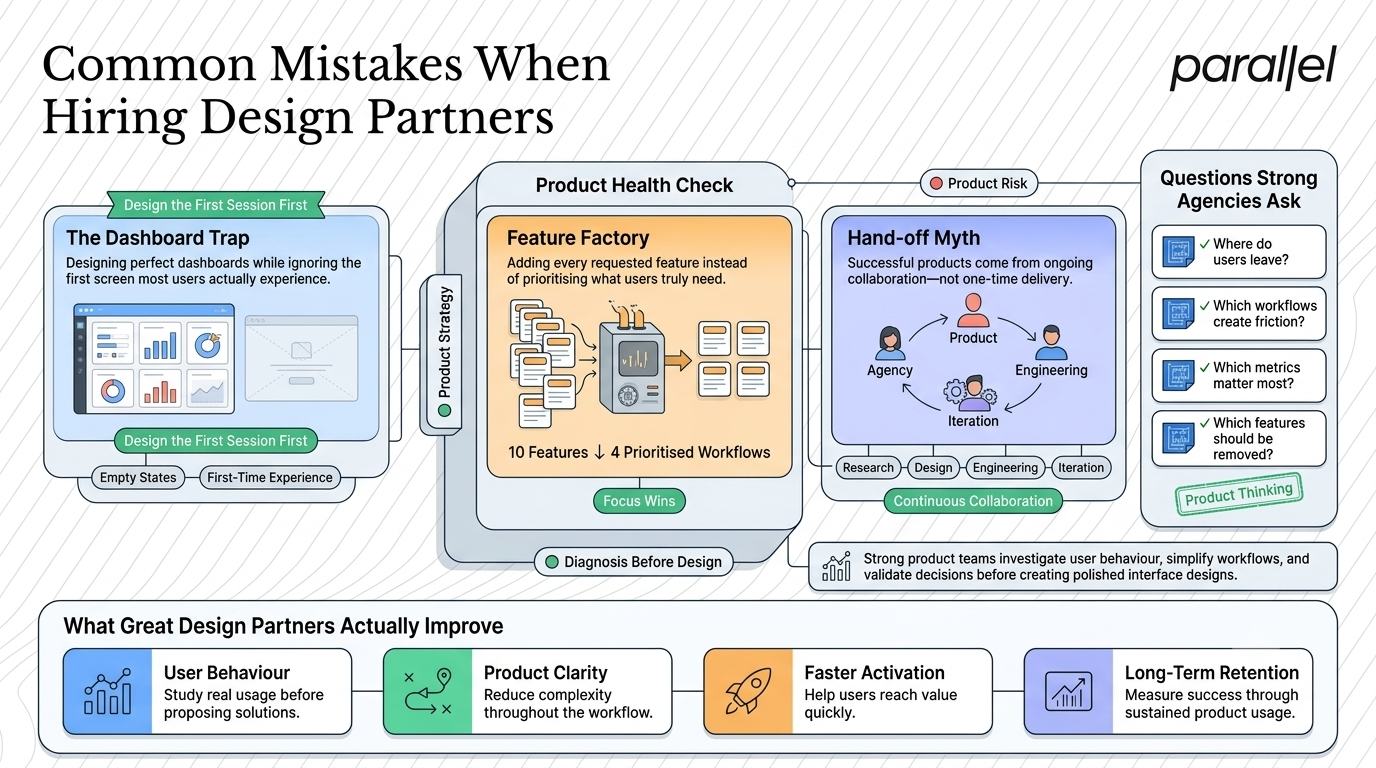
Beautiful user interfaces cannot save a confusing user journey. The best SaaS design agencies in Los Angeles will push back heavily on your feature bloat. They will demand to look at your behavioral analytics, heatmaps, and drop-off rates long before they ever open Figma to draw a wireframe. If an agency immediately starts talking about color palettes or brand vibes instead of asking about your activation metrics, you are sitting in the wrong room.
We consistently observe three distinct anti-patterns when teams engage external design help.
- The Dashboard Trap: Teams spend weeks designing the perfect state of a dashboard fully populated with data, completely ignoring the empty state that 90 percent of new users will actually see on day one.
- The Feature Factory: Product managers hand over a list of ten new features and ask the agency to simply make them fit into the existing navigation. This creates a cluttered, overwhelming interface that paralyzes the user with choice.
- The Hand-off Myth: Treating product design as a strict hand-off process. We have seen teams outsource their entire product thinking to an agency, hoping to receive a finished product in a month. Good design requires deep collaboration and constant iteration based on real user feedback.
How do you choose between the best SaaS design agencies in Los Angeles?
Selecting the best SaaS design agencies in Los Angeles comes down to how they approach problem-solving and ambiguity. You need to evaluate their underlying thinking process, not just their final deliverables. Any agency can make a screen look modern. Very few can map a complex data architecture into an intuitive workflow.
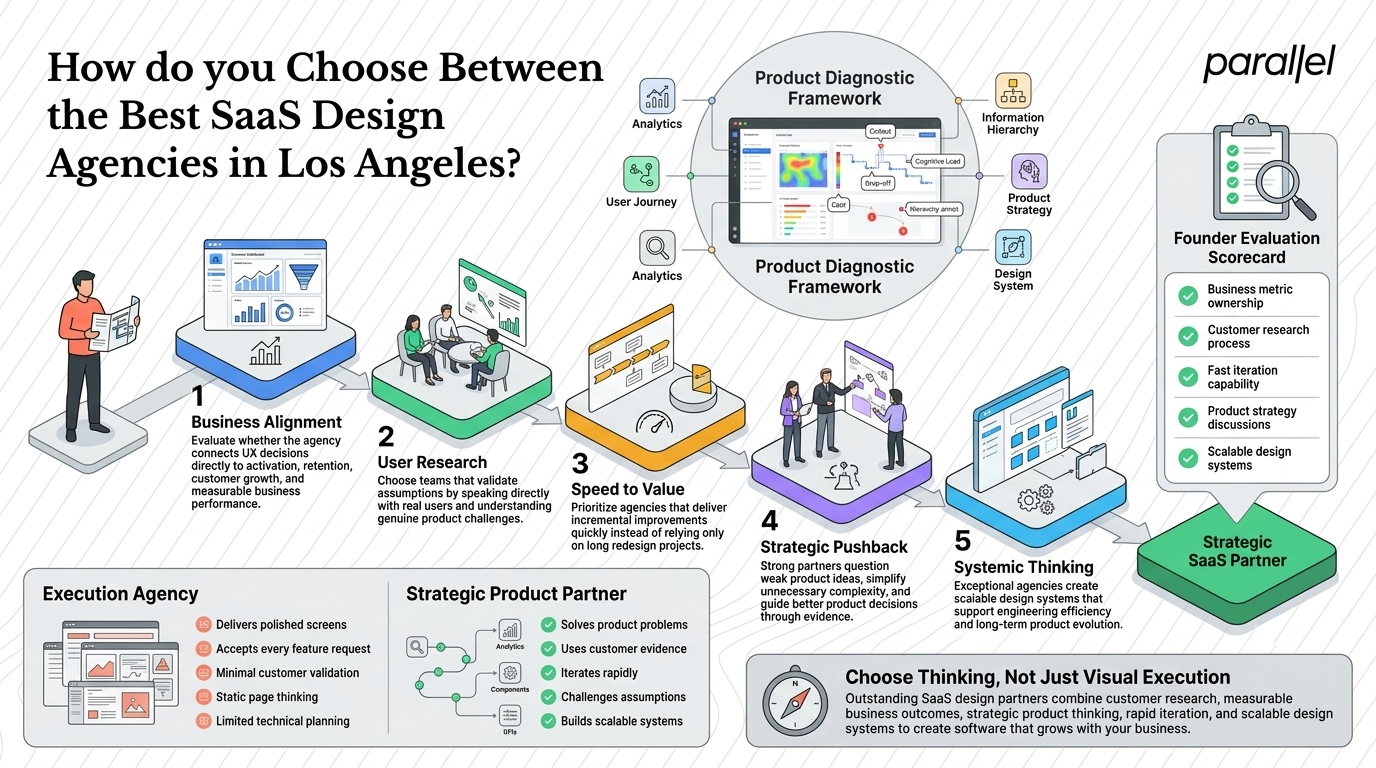
When we run our UX audits at ParallelHQ, we do not just look for interface flaws or inconsistent padding. We map out the exact moments where users are dropping off and analyze why the cognitive load at that specific step is too high. We look for friction in the copy, confusion in the visual hierarchy, and missing context in the user journey. You should demand this exact level of diagnostic rigor from any potential design partner.
Here is the specific evaluation criteria we recommend using during your selection process:
- Business Alignment and Metric Ownership: Do they understand AARRR metrics? Can they clearly explain how a specific UX change will positively impact your net revenue retention?
- User Research Capabilities: Do they insist on talking to your real users, or are they comfortable working entirely off your internal assumptions? A mature agency will always want to validate problems directly with the end consumer.
- Speed to Value and Iteration: Can they ship small iterative improvements that drive immediate results, or do they only operate in massive six-month redesign cycles? In early-stage startups, speed is a critical feature.
- Strategic Pushback: Are they willing to tell you when a feature idea is bad? A true partner acts as a guardrail against bad product decisions, not just a passive receiver for your backlog.
- Systemic Thinking: Do they build scalable design systems, or do they just design isolated screens? You need a foundation that your internal engineering team can build upon efficiently.
Who are the top 10 best SaaS design agencies in Los Angeles for 2026?
If you are ready to invest seriously in your product experience and build software that users actually want to retain, you have several strong options. Here is a structured, detailed comparison of the best SaaS design agencies in Los Angeles based on our industry observations and their core capabilities.
1) ParallelHQ
We built ParallelHQ because we saw too many early-stage teams struggle with design decisions that should have been simple, clear, and grounded in real user behavior. We focus deeply on SaaS design services that align product experiences with business goals. Our approach strips away unnecessary visual noise to improve onboarding, activate users significantly faster, and clarify highly complex workflows. We act as a strategic partner to founders and product leaders. We do not just make things look good on a screen. We make them work better for your bottom line. We prioritize clarity, deep product thinking, and rapid iteration.
2) MetaLab
MetaLab is a recognized global heavyweight with a strong presence across major tech hubs. They are widely known for delivering highly polished interfaces for some of the biggest names in software. Their work is visually stunning and sets industry standards. They are a great fit if you have a massive enterprise budget and need a world-class visual standard to dominate a mature market. However, for early-stage teams looking for a more integrated partner that moves at startup speed, exploring a MetaLab alternative might offer more agility and focused product thinking.
3) Clay
Clay focuses heavily on AI-native user experiences and cutting-edge digital products. As artificial intelligence reshapes how software operates, Clay excels at crafting slick interfaces that feel modern and highly intuitive. They are the ideal agency for startups that are deeply invested in AI capabilities and need to translate complex machine learning models into accessible interfaces. Their aesthetic is distinctively modern and technical.
4) Ramotion
Ramotion specializes in expertly bridging the gap between brand identity and product UI. Many SaaS companies suffer from a disjointed experience where the marketing website looks completely different from the actual software application. Ramotion does excellent work ensuring that the entire user journey feels like one cohesive brand. They are strong in both visual identity and digital product execution.
5) Neuron
Neuron is a highly specialized UX agency with a relentless focus on B2B SaaS environments. They thrive in complex situations. Their core strength lies in simplifying intricate enterprise tools, deep data tables, and complicated dashboards into manageable experiences. If your software requires extensive training for new users to understand, Neuron has the architectural expertise to reduce that learning curve through structural UX improvements.
6) Work & Co
Work & Co integrates deep engineering capabilities directly with high-level product design. They operate on the philosophy that design and code should not be separate phases. They are the right choice for highly technical builds where the design execution and the engineering architecture must be developed in tight lockstep from day one. They are known for shipping highly functional digital products at scale.
7) Huge
Huge is a massive agency that handles large-scale digital transformations. They operate on a global level with extensive resources, making them suitable for massive enterprise corporations that need to completely overhaul their entire digital presence across multiple platforms. They bring deep strategic consulting alongside digital design, suited for Fortune 500 companies rather than nimble startups.
8) R/GA
R/GA has a long history of driving digital innovation and brand disruption. While they are fully capable of handling product design, their true strength lies in creating unique, narrative-driven digital experiences that stand out boldly in crowded markets. They are an excellent choice for consumer-facing SaaS products or brands that need to make a massive cultural splash alongside their software launch.
9) Instrument
Instrument offers a highly holistic view of digital product development and brand building. They excel at building robust digital systems and platforms. They are a great partner for companies looking to redefine their entire digital ecosystem, ensuring that every digital interaction aligns perfectly with the core brand strategy. Their work is thoughtful, systematic, and highly polished.
10) IDEO
IDEO popularized the concept of design thinking and focuses heavily on systemic problem-solving. They are best utilized for tackling broad, ambiguous industry challenges before a specific software product is even fully defined. They excel in deep ethnographic research and conceptual innovation. However, startups needing immediate tactical product design execution to hit an impending launch date often look for an IDEO alternative to move much faster on practical UI deliverables.
When is the right time to bring in an external product design partner?
Partnering with the best SaaS design agencies in Los Angeles makes sense when you need to unblock growth and lack the internal strategic bandwidth to do so. If your engineering team is consistently shipping features but your user retention remains flat, you do not have an engineering problem. You have a product strategy problem.
We typically see founders and product leaders bring in external design help during three highly specific phases of growth.
The first phase is when scaling from a scrappy MVP to a mature market-ready product. During the MVP phase, technical debt accrues rapidly. The resulting user experience often becomes fragmented and confusing as features are bolted on quickly. An agency helps rationalize this architecture.
The second phase is during a period of stagnant activation. This happens when the marketing team is successfully driving thousands of signups, but the onboarding flow is severely leaking users. The top of the funnel is working, but the product is failing to capture the value.
The third phase is when preparing for a major market repositioning. Moving from SMB to Enterprise, or adding a completely new vertical, requires a fundamentally new product strategy.
An external partner brings fresh eyes, deep industry benchmark data, and specialized expertise. They can immediately spot the friction points and cognitive leaps that your internal team has simply become blind to over time.
Conclusion
Building a successful, enduring SaaS product is hard enough without actively overcomplicating the user experience. The most effective, highly retained products I have ever worked on all share one defining trait. They are relentlessly, aggressively simple. They do not hide poor architecture behind clever CSS animations or industry jargon. They profoundly respect the user's time and get them to their desired outcome immediately. Choosing the right design partner is ultimately about finding the team that can help you achieve that precise level of clarity. In product design, the thinking should always speak for itself.
Frequently Asked Questions
1) What makes the best SaaS design agencies in Los Angeles different from traditional digital agencies?
Traditional digital agencies often focus almost entirely on marketing, brand identity, and top-of-funnel web design. They build things to capture attention. SaaS design partners focus heavily on the actual software experience post-login. They prioritize operational metrics like user activation, time-to-value, feature adoption rates, and long-term user retention. Their goal is not just to get a user to click a button, but to build a system that the user relies on daily to do their job better.
2) How do we know if our SaaS product actually needs a UX redesign?
Look closely at your product analytics, not your visual preferences. If your top-of-funnel signups are high but your 30-day active user count is dismally low, your product is failing to deliver value quickly enough. High support ticket volume for basic, routine tasks is another glaring indicator that your user experience needs structural work. If users have to read a manual to complete a core task, the design is failing them.
3) What is considered a healthy activation rate for a B2B SaaS product?
As of 2025, the median activation rate across SaaS products is roughly 37.5 percent. However, this is just a baseline. Top-quartile product-led companies achieve significantly higher rates, often pushing past 50 or 60 percent depending on the complexity of the tool. Your goal should not be to just hit the benchmark, but to constantly identify and reduce the friction between the initial signup and the user's first moment of core value realization.
4) How long does a typical product design engagement take with an agency?
It depends entirely on the scope of the problem. A highly focused tactical engagement, such as a specific onboarding redesign or a targeted UI/UX design sprint, usually takes between four to eight weeks to execute and validate. Full platform overhauls or building an entire product from scratch can take several months. We always strongly recommend working in iterative, agile cycles rather than waiting for a massive, high-risk final reveal.
5) Should we hire an in-house product designer or partner with an agency?
Early-stage startups often benefit immensely from the strategic breadth and varied experience of an agency to set the foundational design system, define the product direction, and establish best practices. An agency brings insights from solving similar problems across dozens of companies. Once the product finds strong market fit and requires daily, highly incremental maintenance and feature updates, building a dedicated in-house team becomes much more practical and cost-effective.
6) How much should we budget for a top-tier SaaS design partner?
Budgets vary wildly based on the agency's size, location, and reputation. You are ultimately paying for the quality and depth of their strategic thinking, not just the raw volume of screens they produce. A purely visual refresh might cost less, but solving deep structural product problems requires senior talent. Prioritize partners who can clearly explain how their fee will translate directly into measurable business value, such as reduced churn or increased expansion revenue.
7) Can a specialized design agency help improve our user onboarding?
Absolutely. In fact, onboarding is frequently the highest-leverage area a design partner can tackle for a SaaS company. A competent agency will rigorously dissect your current flow, remove unnecessary steps, eliminate cognitive load, and restructure the journey around clear, measurable activation milestones rather than just showing off features.
8) Is ParallelHQ the right fit for our early-stage startup?
If you are struggling with overcomplicated product experiences, weak user activation, or a lack of clarity in your UX decisions, we can certainly help. We work closely with founders and product leaders to simplify complex decisions and ground the entire product design process in real user behavior and solid data. We intentionally focus on clarity, strategy, and business outcomes over temporary design hype.

check out these related blogs








































.webp)
























.avif)