You're evaluating design partners for your startup. That means you need a straight answer, not a feature list. This comparison of Clay.global (UX Design Agency) vs ParallelHQ cuts through the positioning and gets to what actually matters: focus, process fit, pricing reality, and which agency will move the needle on your product. I'm Robin Dhanwani, founder of ParallelHQ, and I'll be direct about where we win, where Clay wins, and where the choice is simply a mismatch of context.
TL;DR
- Clay is a full-service branding and UX agency built for companies with $50K+ budgets and a need for brand, web, and product rolled into one engagement.
- ParallelHQ is exclusively a UI/UX and product design partner for early-stage AI and SaaS startups, with a process built around speed, clarity, and reducing product risk.
- If you're a seed-to-Series-B founder who needs to ship a focused, validated product experience, ParallelHQ is the sharper fit.
- If you need brand identity, marketing site, and product design under one roof with enterprise-grade polish, Clay is worth the premium.
What's the Core Difference Between Clay.global and ParallelHQ for Startup UX Design?
These two agencies share real overlap on paper: Figma-based workflows, interaction design, prototyping, design systems, and a stated interest in startups. The difference lives in priorities and depth of specialization.
Founded in 2009, Clay began as a specialist UX design agency focused primarily on mobile applications and enterprise/SaaS software, later expanding to include full-service brand strategy, visual identity creation, and web development in response to client demand. That expansion is both Clay's strength and its tell: they serve a wide client spectrum, from startups to Fortune 100s, and the portfolio reflects that range. Clay has partnered with forward-thinking companies from innovative startups to Fortune 100 corporations, including Meta, Google, Slack, Snapchat, Coinbase, Amazon, Marqeta, Coca-Cola, Sony, T-Mobile, and Uber.
That's a remarkable roster, and it signals something important. Clay's brand equity comes from enterprise-grade polish and marquee logos. If you're a seed-stage startup without a $50K+ budget, you may not unlock the version of Clay those case studies represent.
ParallelHQ works exclusively with early-stage AI and SaaS startups in the US. Every service, from our discovery framework to wireframing and prototyping to design sprints, is calibrated for founders and PMs who need fast, defensible design decisions. We don't do brand identity as a standalone. We don't do marketing site redesigns for enterprise IT firms. That constraint is intentional: deep specialization in startup product design means our process, heuristics, and output patterns are purpose-built for the problems you're actually facing.
The key structural difference: Clay is a full-service creative agency that also does great UX. ParallelHQ is a product design partner that does only that.
How Does Clay.global Compare to ParallelHQ for SaaS Product Design?
For SaaS product design specifically, the comparison is meaningful because this is where both agencies have genuine claims, and where the fit question becomes most revealing. Clay's team handles user research, product strategy, branding, user interface and experience design, usability testing, prototyping, web design, and development. Their SaaS work is real and referenced. Clay is one of the few user experience agencies focusing on enterprise UX design and the digital transformation of legacy business software, with years of experience revitalizing B2B software for Fortune 100 companies like ADP, Amazon, VMware, and Cisco.
That last sentence matters: Clay's SaaS strength is enterprise transformation. Complex, multi-stakeholder, long-cycle engagements where information architecture, design systems, and visual design need to cohere across hundreds of screens. That's genuinely hard work, and Clay does it well.
ParallelHQ's SaaS design work lives in a different part of the product lifecycle. Our sweet spot is the 0-to-1 and 1-to-traction phase: founders with a working MVP who need UX clarity before their next raise, or Series A teams whose onboarding is leaking users. Services like our SaaS onboarding teardown, UX audit, and product strategy consulting are designed to answer specific, high-stakes questions fast, not to execute open-ended creative briefs.
For SaaS startups specifically: if your core challenge is enterprise positioning and design-system scale, Clay is the better call. If your core challenge is "why aren't users activating, and what do we rebuild first," ParallelHQ is built for that question.
Clay.global UX Agency: Honest Review 2026
Clay's reputation is legitimate and earned over 15+ years. Here's an honest read of what they deliver and where the friction lives.
What clients consistently praise:
- Clients consistently praise Clay for their exceptional design and branding capabilities, delivering top-tier visual identities and UI/UX designs that align with client visions and elevate brand presence.
- Clay differentiates itself from large agencies where junior talent typically handles most of the work; at Clay, co-founders lead dedicated, senior-level teams with cross-disciplinary expertise to ensure project success.
- Clients report that Clay iterated quickly, was responsive to feedback, and managed projects very professionally.
Where the constraints show:
- Clay's minimum project size is $50,000+, with an average hourly rate of $150–$199/hr and project costs ranging from $10,000 to $150,000 depending on scope.
- The tradeoffs are real: Clay is expensive, and the senior-led model means partner-level rates for partner-level attention. Smaller budgets may not unlock the full process.
- Some clients experienced communication challenges, particularly with overseas development staff, emphasizing the need for clear and proactive communication throughout projects.
- Based on named projects in their public portfolio, average engagement duration is 3–7 months, with SaaS product design often running 5–7 months.
The honest summary: Clay delivers what premium agencies should deliver at premium prices. The risk for early-stage startups is scope misalignment, Clay's process is optimized for clients with clear brand direction, healthy budgets, and time for a multi-month engagement. If you're still finding product-market fit, that model can work against you.
ParallelHQ vs Clay.global: Pricing Comparison
Pricing transparency matters. Here's how both agencies compare on the dimensions that affect your decision:
Clay offers a blended rate for their services and works with clients to determine what level of support they can provide based on budgetary constraints, with three engagement models: time & materials, fixed fee, and retainer. That flexibility sounds good, but in practice the $50K minimum project size means early-stage founders often can't engage Clay meaningfully at the moments they most need design support.
At ParallelHQ, we've structured our services so a founding team can start with a UX audit or design sprint and expand from there, rather than committing to a multi-month, six-figure engagement before the scope is clear. This isn't about undercutting Clay, it's about matching the engagement model to where your company actually is. A $150,000 redesign that ships in month seven doesn't help a startup that needs to re-engage churning users in month two.
What Do Clients Say About Each Agency? Signals Worth Reading
Client signals reveal the gap between marketing and reality.
Clay client signals:
One client review noted that Clay's work enhanced site traffic by 40%, improved brand recognition and market positioning, and boosted engagement by 30%, customer satisfaction by 35%, and conversion rates by 25%. Those are strong outcomes. Clay's pattern is consistent: premium visual craft, senior-led delivery, measurable results on brand and marketing-facing work. Reviews repeatedly cite project management, weekly check-ins, Gantt-tracked milestones, Slack-first communication, as much as design quality. That's a signal of a mature, process-driven agency. It's also a signal of a relatively formal engagement cadence that works better for established teams than for agile startups iterating weekly.
ParallelHQ client signals:
Founders and PMs who work with ParallelHQ consistently highlight three things: speed to clarity, directness in design rationale, and a partner who understands product trade-offs rather than just delivering deliverables. We don't just hand over Figma files, we explain the thinking behind every interaction design decision so your team can own and evolve the system post-engagement.
Our usability testing and user research services are integrated into design delivery, not sold as separate line items. The result is a process that de-risks decisions before they become expensive engineering rework.
Which UX Design Agency Should You Hire: Clay or ParallelHQ?
This is the only question that matters, and it deserves a direct answer rather than a hedge.
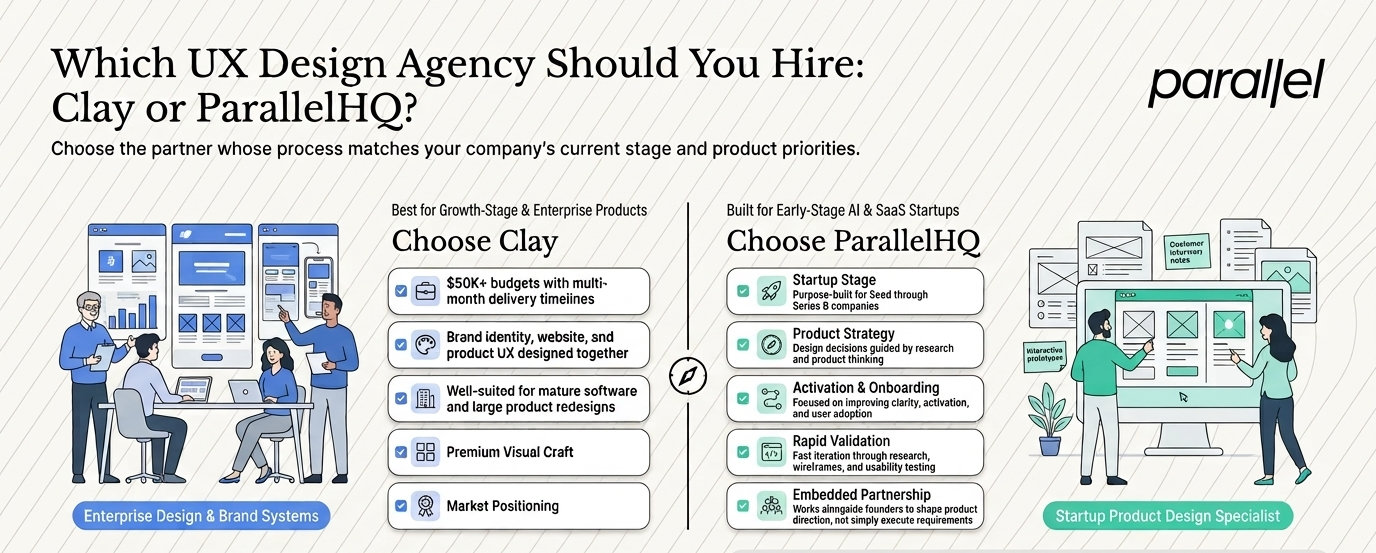
Choose Clay if:
- Your budget is $50K+ and you're ready to commit to a multi-month engagement
- You need brand identity, marketing site, and product UX designed as a unified system
- You're a growth-stage or enterprise company revamping legacy software or preparing for enterprise sales
- Visual prestige and marquee portfolio association matters to your positioning
Choose ParallelHQ if:
- You're an early-stage AI or SaaS startup in the US at seed through Series B
- You need fast, well-reasoned design decisions, not a six-month creative process
- Your immediate challenge is activation, onboarding, or product clarity, not brand identity
- You want a design partner embedded in product strategy, not just a vendor executing a brief
- Services like MVP development design, AI UX design, or a discovery framework match your current phase
The most common mistake I see founders make in this decision is optimising for portfolio prestige when they should be optimising for process fit. Clay's Coinbase and Slack work is genuinely impressive. But Coinbase and Slack aren't your context. Your context is a product that needs to activate users faster, reduce churn, and support a Series A narrative, and that requires a partner who thinks about those problems daily, not occasionally.
Clay is best for companies that want a fresh, digital-first brand built with clear strategy and strong design, particularly fintech, SaaS, and consumer tech that need product, web, and brand to feel like one cohesive system, with senior-led design ensuring quality doesn't drop off after the pitch. That's a real and valuable proposition. It's just not the only proposition worth considering when you're a startup with a specific, time-sensitive problem.
Conclusion
- Clay.global is a world-class full-service agency with a $50K+ floor, a 3–7 month average engagement, and a portfolio that spans startups to Fortune 100. Their strength is brand-plus-product coherence at scale.
- ParallelHQ is a specialist startup design partner focused exclusively on early-stage AI and SaaS, with faster engagement models, integrated product strategy, and a process calibrated for founders making high-stakes decisions under constraint.
- The Clay.global (UX Design Agency) vs ParallelHQ decision is less about quality and more about fit: budget stage, engagement model, and the specific design problem you're solving right now.
- If you're a US-based AI or SaaS founder who needs clear, fast, and strategically grounded product design, start a conversation with ParallelHQ.
Frequently Asked Questions
1) Is Clay.global or ParallelHQ better for early-stage startups?
ParallelHQ is purpose-built for early-stage AI and SaaS startups, with engagement models and pricing calibrated for seed-to-Series-B companies. Clay's minimum project size of $50,000+ places it out of reach for many pre-revenue or seed-stage teams. If budget and speed-to-value matter, ParallelHQ is the stronger fit.
2) What does Clay.global charge for UX design projects?
Clay's minimum project size is $50,000+, with an average hourly rate of $150–$199/hr and project costs ranging from $10,000 to $150,000 depending on scope. Engagements typically run 3–7 months. ParallelHQ offers fixed-scope services that startup teams can engage without committing to that level upfront.
3) Does ParallelHQ offer the same services as Clay.global?
Both agencies cover UI/UX design, prototyping, design systems, and product strategy. Clay additionally covers brand identity, motion design, illustration, and marketing web development. ParallelHQ is narrower by design, specialising in startup product design including SaaS design, mobile app design, and AI software design.
4) How long does a typical project take at Clay vs ParallelHQ?
Clay's average engagement duration is 3–7 months based on named portfolio projects, with SaaS product design typically running 5–7 months. ParallelHQ structures engagements as focused design sprints (weeks) through to ongoing retainers, depending on scope, designed for teams that can't wait half a year for design decisions.
5) What kind of startups does ParallelHQ work best with?
ParallelHQ works with early-stage AI and SaaS startups based in the USA, typically at seed through Series B. Ideal clients are founders or PMs who have a working product and need UX clarity, for activation, onboarding, or fundraising, rather than a ground-up brand build. Services like opportunity mapping and product strategy consulting are particularly relevant.
Q6: Is ParallelHQ worth it compared to Clay.global?
Worth depends entirely on context. Clay's senior-led model commands partner-level rates, and smaller budgets may not unlock the full process. ParallelHQ delivers startup-specific design depth at engagement sizes that match where early-stage companies actually are. If your goal is measurable product improvement in weeks rather than months, ParallelHQ offers better value for your stage.

check out these related blogs









































































.webp)