When you're choosing a design partner, the agency's portfolio is rarely the problem. The problem is fit. Huge vs ParallelHQ is a comparison that comes up frequently among founders and PMs at early-stage AI and SaaS startups, and the answer isn't obvious from the outside. I've put this breakdown together as Robin Dhanwani, founder of ParallelHQ, because founders deserve a straight read, not a sales deck. Let's go through what actually separates these two studios so you can make the right call for your stage.
TL;DR
- Huge is a global enterprise design and technology agency built for Fortune 500 clients, running on retainers and large project budgets.
- ParallelHQ is a startup-focused UI/UX and product design studio that moves at product velocity with senior-level access from day one.
- If you're a Series A or early-stage AI/SaaS company, Huge's systems are not optimized for your engagement size or pace.
- Huge vs ParallelHQ comes down to one question: do you need an enterprise machine or a sharp design partner?
What Is Huge Inc and Who Is It Actually Built For?
Huge is a global design and technology agency founded in 1999 in Brooklyn, New York, specializing in creating personalized, intelligent digital experiences for ambitious brands through services including business strategy, marketing, user experience design, and technology development. That background matters when you're evaluating fit.
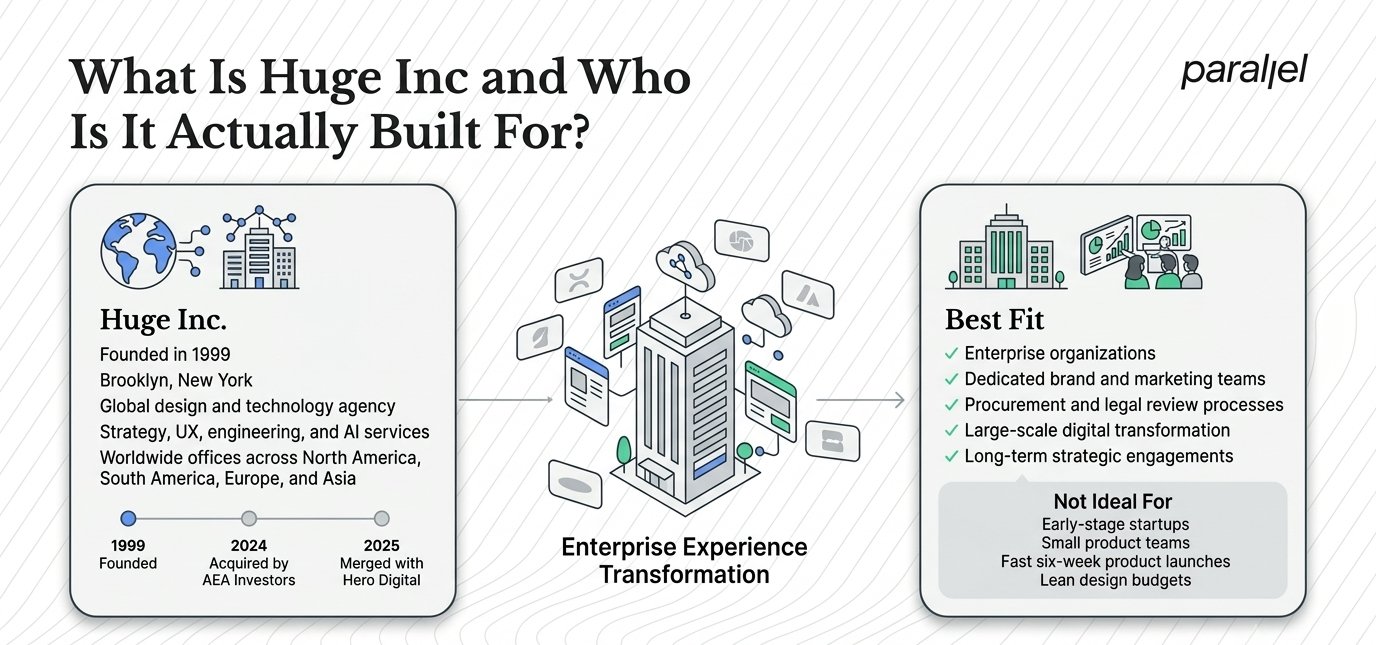
Headquartered in New York City's Flatiron District with a global network across North America, South America, Europe, and Asia, Huge employs approximately 1,000 people and serves major clients such as Google, Amazon, Coca-Cola, and Nike. More recently, in December 2024, Huge was acquired by AEA Investors and subsequently merged with Hero Digital in April 2025, creating one of the largest independent experience transformation businesses globally.
The agency combines strategy, design, engineering, and AI to deliver end-to-end solutions, from website and app redesign to full-scale digital transformation. Clients include Google, McDonald's, NBCU, Android, Hublot, Planet Fitness, UNC Health, LPGA, and Candescent. That client list tells the whole story. Huge is calibrated for enterprises with dedicated brand teams, legal review cycles, and procurement processes.
If you are a Series A startup or a mid-market business, most large studios are not built for you. Their systems are optimized for clients with dedicated brand teams, legal review cycles, and enterprise budgets. For founders evaluating the Huge vs ParallelHQ question, the honest starting point is this: Huge is a world-class agency for enterprise digital transformation. It is not structured to work with a 10-person AI startup that needs to ship in six weeks.
Huge vs ParallelHQ: Head-to-Head Comparison
Here is a direct breakdown of the two studios across the dimensions that matter most to startup founders and product leaders:
Huge charges between $70–$150/hour, meaning that the cost of their services in the United States is around the market average. However, the real cost at an agency of Huge's scale is structural: minimum project scopes, onboarding cycles, and account layers that are simply not calibrated for startups.
At ParallelHQ, our UI/UX design services and product design engagements are scoped specifically for startups, with sprint-level entry points and zero account-manager layers between you and the senior designer doing the work.
Is Huge Agency Worth the Cost Compared to Alternatives?
For enterprise clients, Huge delivers. Huge is a fantastic agency that develops strategic creative and technology to deliver on business objectives, and is truly an extension of the team that consistently delivers flawless solutions, according to a Gartner Peer Insights review. The 12-year partnership with Google, which has grown to 100+ engagements, is the clearest example of Huge's commitment to continuous improvement over one-off projects.
That kind of relationship depth is genuinely impressive. But it also describes the exact engagement model that excludes most startups. A 12-year retainer with 100+ engagements requires the budget infrastructure of a public company, not a seed or Series A team. The cost structure of boutique studios is fundamentally more efficient for startups. Without the overhead of large offices, extensive support staff, and corporate infrastructure, more of your budget goes directly into the actual work.
The question is not whether Huge is good, it's whether what Huge is optimized for matches what you need. For the Huge vs ParallelHQ decision, the cost calculus is not just about hourly rates. It's about what percentage of your budget reaches the actual design work versus the agency's internal machinery.
At ParallelHQ, our design sprints and UX audit services are scoped to deliver specific, measurable outputs without the overhead of enterprise engagement structures.
What Do Companies Say About Working With a Huge Design Agency?
The picture from Huge's clients and former team members is nuanced. Enterprise clients report strong outcomes. Lawrence Montgomery, Chief Marketing Officer for Baptist Health, praised Huge's ability to communicate its tech stack strategy at a level that was "delivered at a level we could learn from." He also recounted a time when Huge prevented a scope issue with a different vendor from derailing a project, taking ownership and fixing it at no additional cost.
That is a genuine signal of a mature, client-oriented operation. Huge is a serious agency. But internal reviews reveal a structural tension that matters for product-focused founders. A former Associate Director of Product Management at Huge noted that "Huge is first and foremost a design agency, and you will find some of the best and brightest designers creating amazing experiences."
However, there is significant overlap between program management and product management, and a lack of action from those at the top to define it clearly leads to conflicts, confusion, and inconsistencies across projects.
For startup founders who need clean, fast product execution, this structural ambiguity is a real risk. When you're trying to hit a fundraising demo date or validate an onboarding flow before a launch, you cannot absorb the friction of overlapping ownership inside an agency. At ParallelHQ, the product strategy consulting and discovery framework engagements are structured so that one senior product designer holds context across strategy and execution from kick-off to delivery.
ParallelHQ Subscription Model vs Traditional Agency Retainer
Huge's engagement model is built around structured ongoing retainers and scaled teams that embed directly into product organizations and operate as a true extension of the client team. For Google or McDonald's, that works. For a 15-person SaaS startup, it's architectural overkill. At a boutique agency, the people doing the work are the people who understand your brand. There is no account manager translating your feedback to a junior designer who has never spoken to you. Strategy and execution stay connected throughout the project.
That is the ParallelHQ model. Here is how the two engagement structures compare in practice for early-stage companies:
Our design systems service is built specifically for startups that need a scalable component library without the governance overhead of an enterprise design system. Speed and agility matter enormously in the startup world, and boutique studios shine here. Without layers of bureaucracy and rigid processes, they can move at startup pace.
Why Are Startups Switching from Big Agencies to ParallelHQ?
The pattern I see repeatedly from founders who previously worked with large agencies comes down to three structural problems: the bait-and-switch on talent, slow feedback loops, and outputs that don't match the startup's actual stage. When you work with a boutique studio, you're working directly with senior designers and strategists from day one. There's no bait-and-switch where the A-team pitches and the B-team executes. The person you talk to in your discovery call is the same person designing your brand identity and building your website strategy.

Large agencies like Huge are built for clients who have the time and budget to absorb those layers. Most startups do not. The Huge vs ParallelHQ comparison crystallizes here: it's not a quality gap, it's a fit gap. What founders switching to ParallelHQ typically need:
- A UX audit that identifies conversion and retention friction in their current product, not a 12-week discovery process.
- Wireframing and prototyping that can be tested with users within days, not months.
- User research scoped to answer one strategic question, not a full ethnographic study.
- MVP development support that stays in sync with the engineering team's actual sprint cadence.
- Opportunity mapping that feeds directly into roadmap decisions, not a deck that sits in a Google Drive folder.
For larger web design studios, it's about standard business processes, while boutique ones are focused on deeper collaboration and the clients' style and identity. For growing businesses, startups, and brands in competitive markets, this model offers control and clarity.
Is Huge Inc Good for UX and Product Design Projects?
On pure design craft, yes. Huge has received recognition for excellence in digital innovation, including 3 Webby Awards for Chrome.com, ChromeBook Plus, Android, and Google Sustainability, 11 Creativepool Awards for projects with McDonald's, Planet Fitness, and Google, and a Fast Company Innovation by Design Honoree award for groundbreaking work with McDonald's.
That's a legitimate creative track record. But award-winning work for Google and McDonald's involves resources, timelines, and stakeholder structures that are incompatible with startup product cycles. Under the leadership of CEO Lisa De Bonis, the agency has accelerated its focus on AI-powered solutions, with 62% of clients now incorporating AI/GenAI projects. Huge's current strategic direction is squarely toward large-scale AI transformation for enterprise clients.
For a founder building an AI SaaS product who needs sharp interaction design, a validated design system, and Figma-ready components in a compressed timeline, Huge is the wrong venue. Their AI-powered LIVE platform is built for post-launch enterprise optimization, not zero-to-one product design. Our AI UX design and AI software design services at ParallelHQ are purpose-built for founders who need to make AI-powered products intuitive, not just functional. If you're evaluating the Huge vs ParallelHQ question for an AI product, this distinction matters most.
Conclusion
- Huge is a legitimate, award-winning enterprise design and technology agency. If you're a Fortune 500 brand with dedicated brand ops and an enterprise budget, they belong in your shortlist.
- ParallelHQ is purpose-built for early-stage AI and SaaS founders who need senior design thinking, product velocity, and clean Figma outputs without enterprise overhead.
- The Huge vs ParallelHQ question resolves quickly once you're honest about your stage: enterprise scale-out or startup scale-up?
- If you need a design partner who ships with you, not around you, ParallelHQ is built for that.
Frequently Asked Questions
1) What is the main difference between Huge and ParallelHQ?
Huge is a global enterprise design and technology agency with approximately 1,000 employees serving Fortune 500 clients. ParallelHQ is a startup-focused UI/UX and product design studio where founders work directly with senior designers from day one, with no account-manager layers and no enterprise minimum scopes.
2) Does Huge Inc work with early-stage startups?
Huge's client roster, which includes Google, McDonald's, Nike, and Coca-Cola, signals clearly that their engagement model is calibrated for enterprise organizations. Their retainer structures, onboarding processes, and minimum project scopes make them a poor fit for seed or Series A startups with lean teams and fast-moving roadmaps.
3) How does ParallelHQ's pricing compare to Huge's agency rates?
Huge's listed rate is $70–$150/hour, but the real cost at enterprise agencies is the structural overhead: long onboarding, multiple account layers, and large minimum scopes. ParallelHQ structures engagements around startup budgets, with sprint-level and defined-deliverable entry points that put budget toward actual design output.
4) What types of projects is ParallelHQ best for?
ParallelHQ specializes in UI/UX design, product design, design systems, design sprints, UX audits, opportunity mapping, and AI product design for early-stage AI and SaaS startups. Founders use ParallelHQ to ship zero-to-one products, improve onboarding flows, build scalable component libraries, and validate product direction with users fast.
5) Is the Huge vs ParallelHQ comparison relevant if I need design systems?
Yes. Both studios offer design systems work, but the approach differs fundamentally. Huge's design systems are built for enterprise governance and multi-team scale. ParallelHQ's design systems service is calibrated for startups that need a clean, scalable Figma-native system without the overhead of enterprise tooling and approval cycles.
6) Why should I consider a boutique design studio over a large agency in 2026?
Boutique studios offer direct senior access, faster iteration cycles, and leaner cost structures that channel more budget into actual design work. For startups specifically, the absence of bureaucratic layers means you get the strategic thinking and execution quality of senior designers without paying for the overhead of a 1,000-person global operation. The Huge vs ParallelHQ choice is ultimately about matching your agency to your company's actual stage and pace.

check out these related blogs


.webp)