I have reviewed hundreds of product requirements over the years. Most of them are just wishlists in disguise. When teams get this wrong, they waste critical months of runway on solutions that look good but fail to solve the actual user problem. Learning exactly how to brief a design agency is the highest leverage action a founder can take before kicking off a project. It sets the baseline for clarity, constraints, and business outcomes.
Quick Answer
A strong design brief defines the business problem, target user, constraints, and success metrics. It should never prescribe the final visual solution. A good brief gives the agency the context they need to explore optimal product decisions.
Why does knowing how to brief a design agency matter so much?
It prevents agency churn and wasted budgets. Many startups hire a partner and expect them to figure out the entire business strategy from scratch. Design partners are experts in user experience and product strategy. They are not mind readers. You need to give them a starting point grounded in reality.
According to the PMI Pulse of the Profession 2025 Report, nearly 30% of project failures are still attributed to inaccurate requirements gathering and poor initial scoping. When you figure out how to brief a design agency correctly, you drastically reduce this risk. You align both teams on the exact metrics that matter.
Good briefs also drive serious business value. Recent 2025 research from Boston Consulting Group (BCG) found that firms leading in AI and design outperform laggards by 1.7x in revenue growth. That kind of growth starts with clear expectations. This is why we often recommend starting with a product strategy consulting phase to ensure alignment before any pixels are pushed.
Where do startup teams go wrong in the briefing process?
Most founders fall into one of three distinct traps when writing their requirements. I see these anti-patterns constantly.
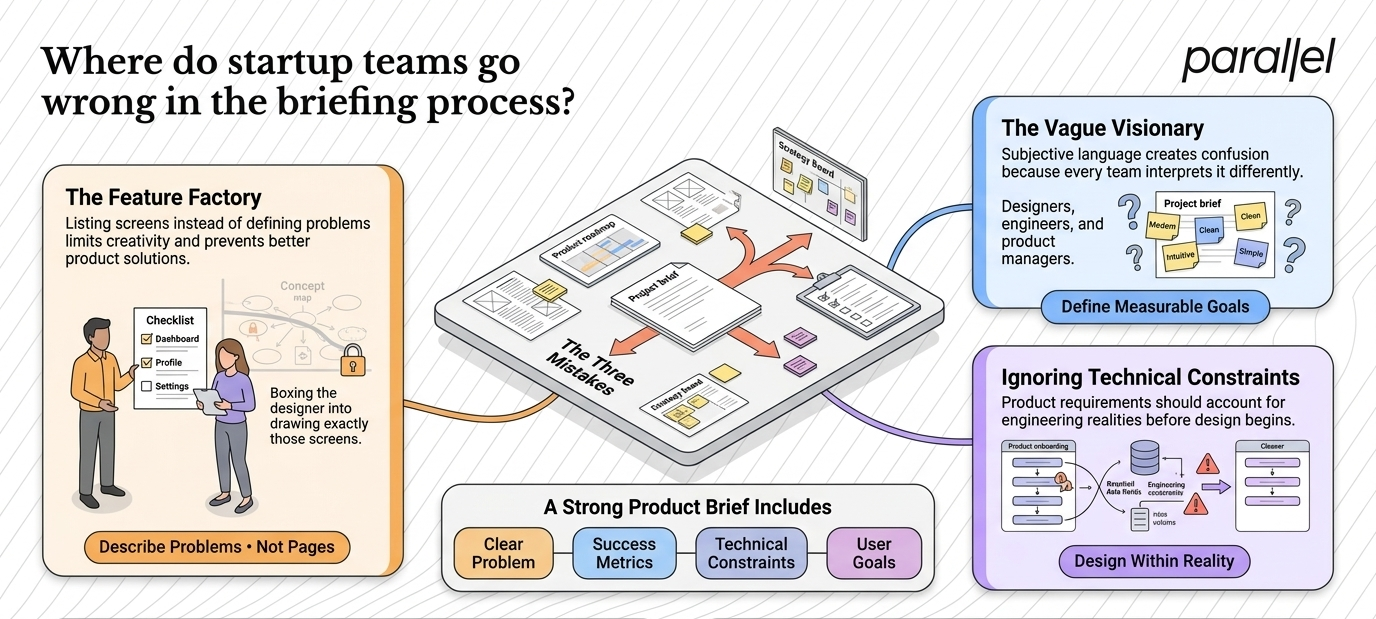
The first trap is the feature factory approach. Founders often list out the specific screens they want designed. They say they need a dashboard, a profile page, and a settings menu. This approach instantly limits the design team.
If you tell an agency to design a faster horse, they will not explore building a car. You want your partner to map opportunities rather than just painting by numbers. If you prescribe the interface, you are just hiring expensive order-takers.
The second trap is the vague visionary approach. This happens when founders use subjective adjectives like clean, intuitive, and modern. These words mean wildly different things to a founder, a developer, and a designer. They are impossible to measure.
The third trap is ignoring technical constraints. We see teams overcomplicate onboarding because their initial brief demanded too many data points upfront. They asked for a fluid onboarding flow but did not define the technical limits of their legacy database. A UX audit usually reveals that these structural problems stem from a complete lack of upfront clarity.
What should your core product design brief actually include?
When founders ask me for advice on scoping, I tell them to focus on five core pillars. These pillars remove ambiguity and force you to think about the product strategically.
- The Business Problem: You must clearly define what is broken today. Be highly specific about the friction points. Do not just say conversions are low. State exactly where users are dropping off in the funnel.
- The Target Audience: Define who we are solving this for. Avoid generic demographics like millennials. Focus on behavioral traits and technical literacy. A fintech tool for seasoned day traders needs a radically different interface than a budgeting app for college students.
- The Current Baseline: Explain what you have already tried. Share previous failures and A/B test results. This prevents the agency from repeating your past mistakes. It gives them a foundation to build upon.
- Technical Constraints: Outline the limits of your stack. Mention legacy APIs and database restrictions. If you are focused on healthtech design services, data privacy limits the user experience. You must document these boundaries early.
- Success Metrics: State how we will know this worked. Define measurable goals. Tie these metrics directly to your company revenue or retention targets.
How to frame the problem instead of dictating the solution
I remember working with a SaaS startup that wanted us to redesign their entire analytics dashboard. Their brief was entirely focused on adding new data visualization charts. We stepped back and looked at the real user behavior.
Users were exporting data to CSV because the existing charts lacked actionable context. The solution was not more charts. The solution was a simpler text-based summary of key insights. We helped them pivot their approach through our discovery framework.
The secret to success here is focusing on user outcomes. Tell the agency that users are exporting data too often. Let the agency figure out the best interface to solve that friction. This is how you unlock real ROI of UX for your business.
How to brief a design agency using our exact template
We use a very specific structure at ParallelHQ to ensure absolute clarity. You can copy this structure directly into a Notion or Google Doc for your next project. We use this same framework when kicking off UI/UX design services.
What should you exclude when learning to brief a design agency?
You should exclude personal aesthetic preferences unless they strictly tie into established brand guidelines. Do not include specific button placements or navigation structures. You are hiring experts to make those structural decisions.
Avoid sending massive folders of unorganized competitor screenshots. While competitive analysis is helpful, dumping 50 screenshots into a brief creates noise. Instead, highlight one or two competitors and explain specifically what business problem their approach solves well.
You should also exclude unrealistic timeline expectations based on development cycles rather than design cycles. According to Nielsen Norman Group data from 2025, testing with just 5 users uncovers 85% of usability problems. You need to leave room in your brief for this validation phase.
How to align your internal stakeholders before sending the brief
Before you even talk to an agency, your internal team needs to agree on the brief. I have seen projects stall for weeks because the CEO and the Product Manager had completely different visions for the product.
You need to lock in alignment early. Get engineering, product, and leadership in a room. Review the success metrics together. Make sure engineering agrees with the technical constraints you have listed.
If you send a brief that lacks internal consensus, the agency will spend their first month just mediating internal arguments. That is an expensive waste of their expertise.
The difference between briefing for an MVP and briefing for a redesign
The context of your product lifecycle changes how you write the brief. If you are building an MVP, your brief needs to be ruthlessly prioritized. You must focus solely on the core value proposition.
For an MVP, the constraints are usually time and capital. You want the agency to help you validate the riskiest assumptions. You are not building for scale yet.
If you are briefing a redesign for an existing product, the focus shifts. You already have a user base. The brief must highlight the current analytics, the technical debt, and the specific usability metrics that are underperforming. A redesign brief for SaaS design services should lean heavily on existing customer support tickets and churn data.
How to communicate budget and timeline constraints
Many founders hesitate to share their budget in the initial brief. They worry that the agency will simply max out whatever number is provided. This is a flawed way of thinking.
If you do not share a budget range, the agency cannot scope the right solution. A twenty-thousand dollar problem has a completely different design process than a two-hundred-thousand dollar problem. By sharing the budget, you allow the agency to propose the most effective methodology within your means.
The same rule applies to timelines. If you have a hard board meeting in three months, state that clearly. A mature agency will tell you exactly what can be achieved in that timeframe. They will help you trim the scope to ensure you hit your critical deadlines.
The role of user research in your initial brief
Your brief should clearly state what you actually know about your users versus what you are guessing. Startups often blur the lines between validated user research and internal assumptions.
If you have already conducted user interviews, summarize the findings and link to the raw data. If your personas are purely hypothetical, admit that in the brief.
When an agency knows your assumptions are untested, they will build a testing phase into the project plan. If they believe your assumptions are facts, they might design a perfect solution for a user that does not exist. We always run a user research phase if the initial data is thin.
Evaluating the agency response to your brief
Once you send the document, pay close attention to the questions the agency asks in return. A mature product design partner will not just say yes to everything. They will push back and challenge your assumptions.
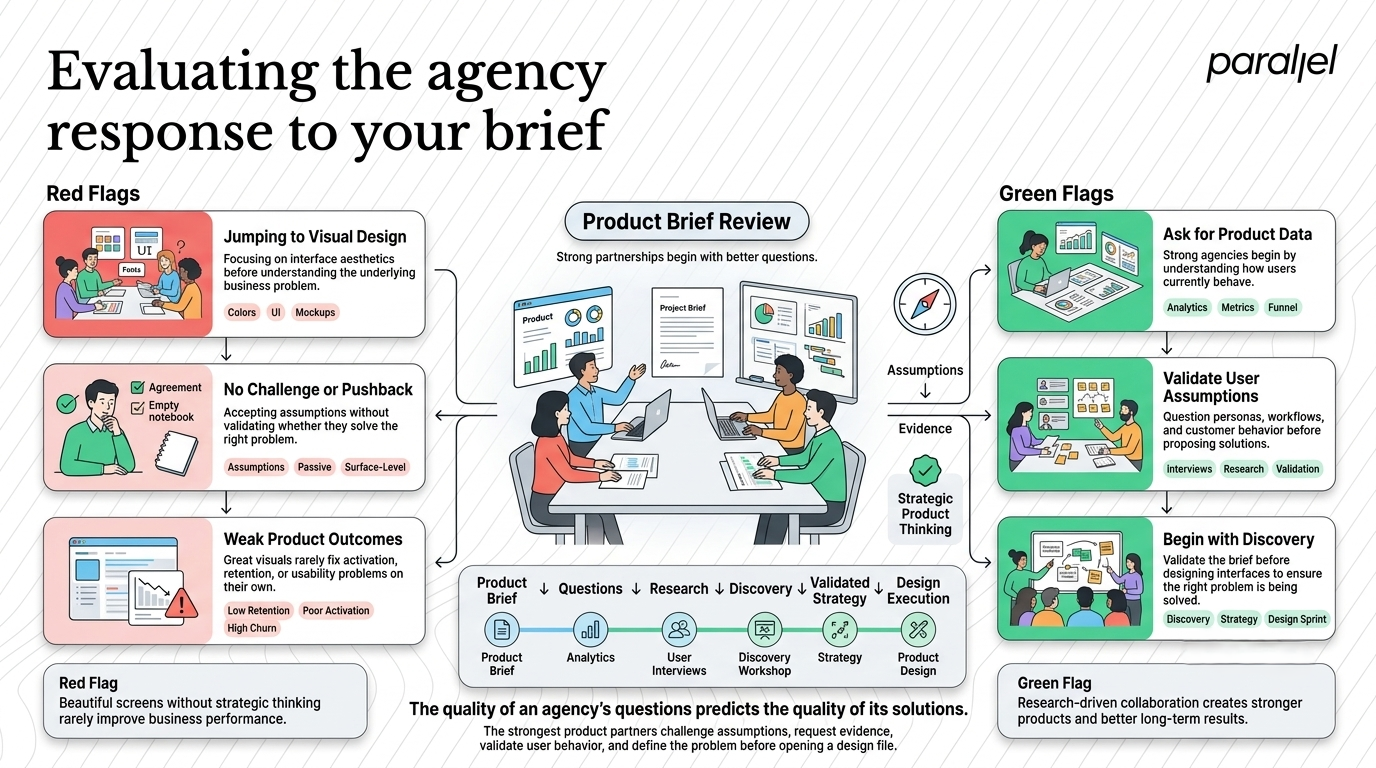
They should ask about your data. They should question your assumptions about the user persona. If an agency immediately starts talking about color palettes after reading a brief about retention problems, you have a massive red flag.
We look for green flags instead. A good partner will ask for access to your analytics dashboard. They will request recordings of user interviews. They want to understand the environment before they propose a solution.
At ParallelHQ, we always prefer to start with a deep discovery phase or a design sprint to validate the brief before opening Figma. This ensures the foundational thinking is bulletproof. You might want to read our guide on how to hire the best UX design firms for more on this evaluation process.
Conclusion
Writing a great brief forces you to confront the gaps in your own product thinking. It is hard work. Doing that work upfront is the only way to ensure your design partner can actually move the needle for your business.
Mastering how to brief a design agency is the highest leverage action you can take to protect your budget and timeline. Focus on the problem. Be honest about your constraints. Let the designers do their job.
Frequently Asked Questions
1) What is the most important step in a design agency brief?
Defining the problem objectively is the most critical step. Do not list features. Focus entirely on where the user is experiencing friction and how that impacts your core business metrics.
2) Should I include technical constraints when learning how to brief a design agency?
Yes. Technical constraints are absolutely critical. They prevent the design team from conceptualizing solutions that your engineering team cannot build within the required timeline.
3) Does ParallelHQ have a preferred format for how to brief a design agency?
We prefer a simple text document focusing on business goals, user personas, and technical constraints. We do not need a highly visual presentation. Clarity of thought is always more important than formatting.
4) How long should a good design brief be?
Aim for one to two pages. If it is longer than that, you are likely over-prescribing solutions. Keep it concise and focused heavily on the macro objectives.
5) Should I include visual references in the initial brief?
You can include references to products with similar interactions or business models. Avoid providing purely aesthetic mood boards unless you are doing a pure visual rebranding project.
6) How do I define success metrics in the document?
Tie them directly to business outcomes. Use metrics like activation rate, churn reduction, or task completion time. Avoid vanity metrics that do not impact your bottom line.
7) What is the difference between a creative brief and a product design brief?
A creative brief focuses on brand feeling, marketing messaging, and visual identity. A product design brief focuses on user behavior, system constraints, and functional product outcomes.
8) Is this structured approach right for me if I am an early-stage founder?
Absolutely. Early-stage founders have the least room for error. A precise brief ensures your limited capital goes toward solving the right problems, rather than just creating pretty interfaces.

check out these related blogs




























































































.avif)


.webp)