Founders often get lost in artificial intelligence jargon. When we build products at ParallelHQ, we see startup teams overcomplicate their user experiences simply because they misunderstand the underlying technology. You do not need to be a machine learning engineer to build a great software product, but you do need absolute clarity on the terminology. That is exactly why I put together this AI design glossary: 40 terms founders should know. If you understand these concepts, you can make better product decisions, avoid building useless features, and design tools that your users will actually trust.
Quick answer / TL;DR
This AI design glossary: 40 terms founders should know breaks down the essential technical, UX, and ethical vocabulary you need to confidently build, design, and scale AI products without relying on hype.
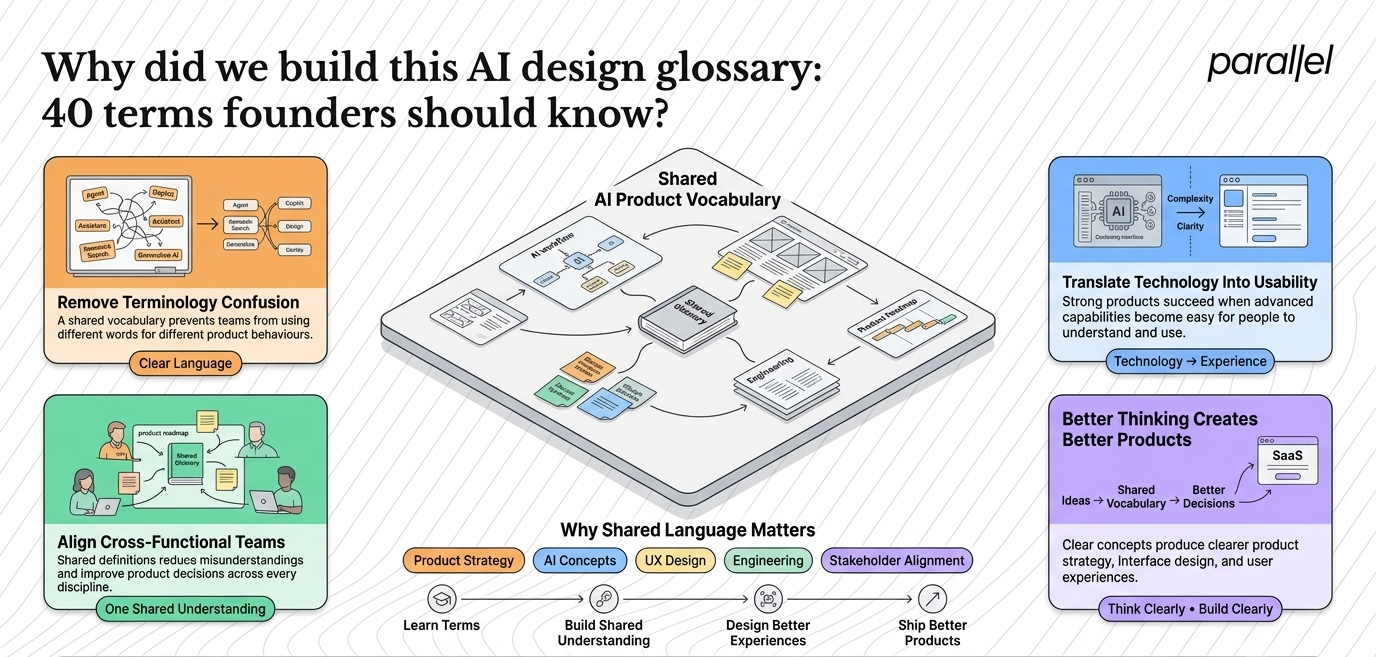
Why did we build this AI design glossary: 40 terms founders should know?
In my experience working with early-stage startups and product leaders, this is where most product decisions go wrong. Teams use terms like agent and copilot interchangeably. They confuse generative text with semantic search. This lack of clarity leads to messy roadmaps and confused users.
According to a 2025 McKinsey State of AI report, 88% of organizations now use AI in at least one business function. Yet, only about 6% capture significant enterprise value from it. Why does this massive gap exist? It happens because the interface fails the user. Startups are building powerful backend engines but failing to translate that power into a usable, intuitive frontend experience.
When we run AI design sprints, we see that a shared vocabulary directly impacts the quality of the user experience. A team that understands the nuanced difference between a conversational interface and an AI-native workflow builds a significantly better product. Good design is just clear thinking made visual, and you need the right words to think clearly. Before diving into the technical weeds, I want to explain why an AI design glossary: 40 terms founders should know is a mandatory tool for your team. It aligns your engineers, your designers, and your stakeholders around a singular vision.
What are the core concepts in this AI design glossary?
The first section of our AI design glossary: 40 terms founders should know covers the foundational technologies driving modern software products. Before you can design a seamless interface, you must understand the engine running beneath it.
1) Artificial intelligence (AI)
- The basic definition: The broad field of computer science focused on creating systems capable of performing tasks that typically require human intelligence.
- How we think about it: We often tell founders to stop thinking of AI as magic. It is just a tool to solve user problems faster. When you strip away the hype, AI is simply a new layer of capability that requires intentional product design.
- The design takeaway: Focus on the user problem first, not the AI capabilities.
2) Machine learning (ML)
- The basic definition: A subset of AI where systems learn from data to improve their performance over time without being explicitly programmed.
- How we think about it: ML is all about pattern recognition. For a product manager, this means your product will change as more people use it. You have to design interfaces that gracefully handle this constant evolution and changing data output.
- The design takeaway: Design for adaptation and continuous learning.
3) Large language model (LLM)
- The basic definition: An AI model trained on vast amounts of text data to understand and generate human language.
- How we think about it: LLMs power most modern chat interfaces, but they are highly unpredictable. We advise teams to treat LLMs like brilliant but easily distracted interns. You must design strict guardrails around their outputs.
- The design takeaway: Always set user expectations about the model's limitations right on the home screen.
4) Generative AI
- The basic definition: AI systems capable of generating new text, images, code, or audio based on user prompts.
- How we think about it: The Stanford AI Index 2026 noted that generative AI reached 53% population adoption in just three years. This speed means your users already have high expectations. If your generative feature is slow or clunky, users will abandon it immediately.
- The design takeaway: Speed and relevance matter more than novelty.
5) Natural language processing (NLP)
- The basic definition: The technology that helps computers understand, interpret, and manipulate human language.
- How we think about it: NLP allows users to speak to software the way they speak to a human. This completely removes the need for complex navigation menus. We use NLP principles to simplify search bars and streamline onboarding flows.
- The design takeaway: Let users use their own words instead of forcing them into rigid dropdown menus.
6) Agentic AI
- The basic definition: AI systems that can make decisions and take actions autonomously to achieve a specific goal.
- How we think about it: This is the next frontier. Gartner projections for 2026 state that 40% of enterprise applications will include task-specific AI agents. Moving from assistants that chat to agents that act requires a massive leap in user trust.
- The design takeaway: Design clear authorization steps so the user feels safe letting the agent execute tasks.
7) Multimodal AI
- The basic definition: AI models that can understand and process multiple types of inputs simultaneously, such as text, images, and audio.
- How we think about it: Multimodal capabilities allow for incredibly rich UI/UX design. Imagine a user uploading a sketch and speaking a command to generate a full website layout. The interface must fluidly handle these mixed inputs without breaking.
- The design takeaway: Do not restrict users to a single input method if the context demands flexibility.
8) Neural network
- The basic definition: A method in AI that teaches computers to process data in a way that is inspired by the human brain.
- How we think about it: You do not need to explain neural networks to your users. Hide the complexity. Founders often want to brag about their tech stack, but users only care if the product solves their pain point quickly.
- The design takeaway: Sell the outcome, not the algorithm.
The interaction layer: Designing the user experience
As you move through this AI design glossary: 40 terms founders should know, you will notice a shift from backend capability to frontend usability. You cannot just slap a chat interface on a legacy product and call it a day. We help teams rethink these interactions from the ground up.
9) AI-native product
- The basic definition: A product built from the ground up assuming AI is the core engine, rather than bolting AI features onto a legacy system.
- How we think about it: We see too many startups adding a generic chatbot and calling it AI. True AI-native products rethink the entire workflow. They anticipate needs rather than waiting for commands.
- The design takeaway: Design around AI capabilities from day one.
10) Conversational UI
- The basic definition: An interface that allows users to interact with software through chat or voice dialog.
- How we think about it: Chat is great, but it places a heavy cognitive load on the user. They have to know exactly what to ask. We try to blend conversational UI with traditional buttons and menus to give users the best of both worlds.
- The design takeaway: Do not force chat if a simple button works better.
11) Prompt chips
- The basic definition: Clickable suggestions or pre-written commands provided in the UI to help users interact with an AI model.
- How we think about it: The blank text box is terrifying for new users. Prompt chips act as training wheels. When we conduct a SaaS onboarding teardown, we use prompt chips to immediately demonstrate the product's core value without forcing the user to type.
- The design takeaway: Always give users a starting point to reduce friction.
12) Co-creation
- The basic definition: A design pattern where the AI and the human user collaborate iteratively to produce a final result.
- How we think about it: Humans want to remain in control of creative tasks. AI should act as a thought partner, offering variations and ideas, rather than just spitting out a finished product that the user cannot easily edit.
- The design takeaway: Build interfaces that allow for easy tweaking and manual overrides.
13) Probabilistic design
- The basic definition: Designing for systems that might give a different output every time, rather than traditional software that always behaves exactly the same way.
- How we think about it: Traditional design is deterministic. AI is probabilistic. You must design error states, regenerate buttons, and feedback loops because the system will inevitably get things wrong on occasion.
- The design takeaway: Always provide an undo or regenerate option.
14) Zero UI
- The basic definition: A design approach where the user interacts with the system through natural means or background context, removing the need for a screen.
- How we think about it: I see many founders default to complex dashboards. Zero UI challenges us to remove the screen entirely. If the AI can run in the background and just deliver the targeted result via a notification, that is usually the superior experience.
- The design takeaway: The best interface is sometimes no interface at all.
15) AI slop
- The basic definition: Poorly integrated, low-value AI features that create clutter without solving real user problems.
- How we think about it: The Nielsen Norman Group 2026 State of UX warned about this exact trend, noting that users are experiencing severe AI fatigue. Users are tired of seeing a sparkly magic wand icon on every single text box. We always ask founders if the feature actually saves time or just looks trendy.
- The design takeaway: If it does not solve a core problem, strip it out of the UI.
16) Progressive disclosure
- The basic definition: An interaction design technique that sequences information and actions across several screens to avoid overwhelming the user.
- How we think about it: AI features can be deeply complex. We use progressive disclosure to hide advanced prompt settings until the user actually asks for them. This keeps the primary interface clean and approachable for beginners.
- The design takeaway: Show only what the user absolutely needs right now.
17) Prompt engineering
- The basic definition: The practice of carefully structuring inputs to get the most accurate and useful output from an AI model.
- How we think about it: Do not force your users to become prompt engineers. That is a sign of lazy product design. We believe the interface should do the heavy lifting, taking simple user inputs and wrapping them in complex, engineered prompts behind the scenes.
- The design takeaway: Abstract the complexity away from the user completely.
What technical terms matter most in this AI design glossary?
You do not need to write code, but this section of the AI design glossary: 40 terms founders should know highlights the backend constraints that shape the final user experience. A highly capable model is useless if a high-latency API destroys the interaction.
18) Context window
- The basic definition: The maximum amount of text or data an AI model can process and remember at one time during a single interaction.
- How we think about it: If a user uploads a massive document that exceeds the context window, the AI will forget the beginning of the text. The UI must clearly communicate these file size limits to prevent frustrating mid-task failures.
- The design takeaway: Visually indicate data limits before the user hits submit.
19) Tokens
- The basic definition: The basic building blocks of data that an AI model processes. Words and images are broken down into tokens.
- How we think about it: Tokens equal cost and processing time. When we conduct a product strategy consulting session, we remind founders that heavy token usage slows down the UX. You have to design interactions that are concise by default.
- The design takeaway: Encourage users to be specific to save system processing time.
20) System prompt
- The basic definition: The hidden set of instructions given to an AI model that dictates its persona, tone, and operational boundaries.
- How we think about it: The system prompt is the invisible UI. It dictates how the AI behaves before the user ever types a word. We spend a lot of time helping teams write system prompts that align with their brand voice so the user feels a consistent personality.
- The design takeaway: Your system prompt is just as important as your visual design.
21) Embeddings
- The basic definition: A way of representing data as numbers so that an AI can understand the relationships and similarities between different concepts.
- How we think about it: Embeddings are what make AI search feel like magic. Instead of matching exact keywords, the system matches meaning. This allows us to design search experiences that are incredibly forgiving of typos and loose phrasing.
- The design takeaway: Design search bars that invite open-ended questions.
22) Vector database
- The basic definition: A specialized database designed to store and query the numerical embeddings used by AI models.
- How we think about it: Think of this as the AI's long-term memory. If you want your app to remember a user's preferences across multiple sessions, you need a vector database. We design personalized dashboards based on this exact underlying technology.
- The design takeaway: Use historical data to make the AI feel highly personalized and context-aware.
23) API latency
- The basic definition: The delay between a user submitting a prompt and the AI model returning the final response.
- How we think about it: This is the biggest UX killer in AI right now. If your product takes ten seconds to respond, the user will leave. You must design skeleton screens, streaming text, or engaging animations to bridge that gap and retain attention.
- The design takeaway: Never leave a user staring at a static loading screen.
24) Retrieval-augmented generation (RAG)
- The basic definition: A technique that grounds an AI model by connecting it to an external database of verified information before generating a response.
- How we think about it: I frequently see startups struggle with model hallucinations. RAG is the most practical fix. During a UX audit, we map out how user data flows into the RAG pipeline. Fetching this external data takes time, so you must design intelligent loading states.
- The design takeaway: Mask technical latency with helpful, transparent UI feedback.
25) Fine-tuning
- The basic definition: The process of taking a pre-trained AI model and training it further on a smaller, highly specialized dataset.
- How we think about it: Fine-tuning gives your product its unique voice and deep expertise. From a design perspective, this means your onboarding flow must effectively gather the specific user data needed to continually refine the model.
- The design takeaway: Build data collection naturally into the user journey.
26) Semantic search
- The basic definition: A search technique that uses AI to understand the searcher's intent and the contextual meaning of terms, rather than just matching text strings.
- How we think about it: We integrate semantic search into enterprise platforms frequently. It allows users to search for "Q3 revenue drop causes" instead of relying on rigid, exact-match financial document titles.
- The design takeaway: Let users search by context and intent.
27) Synthetic data
- The basic definition: Artificially generated data that mimics real-world data, used to train AI models without compromising user privacy.
- How we think about it: When we help enterprise teams build AI tools, data privacy is a massive blocker. Synthetic data allows developers to build and test robust features without risking actual customer data leaks.
- The design takeaway: Use synthetic data to prototype safer products faster.
28) Overfitting
- The basic definition: A modeling error where an AI learns the training data too perfectly, causing it to fail when presented with new, unseen real-world data.
- How we think about it: If a model is overfitted, it becomes rigid. It will only give good answers to the exact prompts it was trained on. In the UI, this looks like an AI that constantly throws error messages when users ask creative questions.
- The design takeaway: Test your features with real users early to break the system before launch.
Trust and safety: The 2026 design mandate
The final category in our AI design glossary: 40 terms founders should know deals with the most fragile metric of all. Adoption does not equal trust. If your AI makes a biased decision or hallucinates a critical fact, your users will churn and never look back. Trust is a core design metric that defines long-term product success.
29) Human-in-the-loop (HITL)
- The basic definition: A system architecture that requires human interaction and explicit approval before the AI can complete a sensitive task.
- How we think about it: This is crucial for high-stakes products. In our healthtech design services, we ensure that AI provides rapid recommendations, but a human doctor always makes the final diagnostic call.
- The design takeaway: Design clear review and approval gates for critical actions.
30) Hallucination recovery
- The basic definition: The UX flow designed to help users identify, correct, and recover from incorrect information generated by an AI.
- How we think about it: Hallucinations will happen. The worst thing you can do is design a UI that presents AI output as absolute fact. We use citations, source links, and clear editing tools to help users verify the data themselves.
- The design takeaway: Make it incredibly easy for users to spot and fix errors.
31) Explainable AI (XAI)
- The basic definition: Methods and techniques that allow human users to understand and interpret exactly how an AI model made a specific decision.
- How we think about it: Black box algorithms scare users. If an AI denies a loan application, the user deserves to know why. In our fintech design services, we prioritize clear, human-readable explanations for every automated financial action.
- The design takeaway: Always show your work to the user.
32) Algorithmic bias
- The basic definition: Systematic and repeatable errors in a computer system that create unfair outcomes, often inherited from flawed training data.
- How we think about it: Bias ruins credibility immediately. Founders must actively test for it during product development. From a UX perspective, you should provide users with a feedback mechanism to flag answers they feel are biased or inappropriate.
- The design takeaway: Give users a voice to report poor AI behavior.
33) AI transparency
- The basic definition: The practice of being completely open with users about when, where, and how AI is being used in a product workflow.
- How we think about it: Never try to trick a user into thinking they are talking to a human. Transparency builds trust. We use subtle UI badges or welcome messages to clearly state that an assistant is powered by AI.
- The design takeaway: Honesty is the best retention strategy.
34) Guardrails
- The basic definition: Programmatic safety measures put in place to prevent an AI model from generating harmful, inaccurate, or off-brand content.
- How we think about it: Without guardrails, your product is a massive brand liability. We map out strict boundary conditions during the discovery framework phase to ensure the AI gracefully declines requests it is not supposed to handle.
- The design takeaway: Design polite, helpful fallback responses for rejected prompts.
35) Trust calibration
- The basic definition: Designing the interface so the user's level of trust matches the AI system's actual real-world reliability.
- How we think about it: If a model is only 80% accurate, the design must reflect that uncertainty. We use confidence scores and clear disclaimers to prevent users from over-trusting the output.
- The design takeaway: Do not present statistical predictions as absolute facts.
36) Data privacy
- The basic definition: The policies and technical systems that dictate how user data is collected, stored, and used to train AI models.
- How we think about it: Users are terrified that their proprietary data will be used to train public models. You must design explicit opt-in screens. If a user feels their data is being harvested quietly, they will leave your platform forever.
- The design takeaway: Make privacy controls obvious and highly accessible.
37) Alignment
- The basic definition: The process of ensuring an AI model's goals, behaviors, and outputs perfectly match human values and the specific intent of the user.
- How we think about it: A misaligned AI will technically answer the prompt, but in a way that is useless or frustrating to the user. Good alignment requires rigorous user research to understand exactly what the user actually wants to achieve.
- The design takeaway: Constantly validate AI outputs with real customers.
38) Model drift
- The basic definition: The degradation of an AI model's accuracy over time as the real-world data it encounters changes from its original training data.
- How we think about it: Your product will break eventually. Product leaders need to establish UX monitoring systems to catch when users start rejecting AI suggestions more frequently. This signals that the model is drifting away from reality.
- The design takeaway: Monitor feature engagement metrics relentlessly.
39) Red teaming
- The basic definition: The practice of rigorously testing an AI system by intentionally trying to break it, bypass its rules, or make it produce harmful content.
- How we think about it: We run red teaming exercises during our internal design jams. You have to think like a malicious user to design a truly robust interface. Finding edge cases before launch saves your brand reputation.
- The design takeaway: Break your own product before the market does it for you.
40) Situational trust
- The basic definition: The concept that a user's trust in AI fluctuates based on the context, stakes, and current workload of a specific task.
- How we think about it: A user might trust AI to draft a casual email, but they will not trust it to automatically send a binding legal contract. You have to design different levels of friction based entirely on the stakes of the action.
- The design takeaway: High stakes require high human oversight.
Conclusion
Building AI products requires an entirely new way of thinking. It is not just about connecting a fast API to a database. It is about understanding how these technologies fundamentally change human-computer interaction and shift the burden of trust. Bookmark this AI design glossary: 40 terms founders should know and share it with your product and design teams today.
At ParallelHQ, we partner with founders to turn complex AI capabilities into clear, highly usable products. We believe that clarity in vocabulary leads directly to clarity in product execution. Stop relying on hype, and start building products rooted in real user behavior.
Frequently asked questions (FAQ)
1) What exactly is an AI design glossary?
It is a curated list of vocabulary that bridges the gap between complex machine learning terminology and practical product design. It helps non-technical founders, product managers, and designers speak a common language to build better software.
2) How do I practically apply these terms in my startup?
Use these definitions to align your team during meetings. When your engineers mention latency, your designers should know to build loading states. When a product manager requests an agent, everyone should understand the required trust guardrails needed for that feature.
3) What is the difference between AI-native and AI-enhanced products?
An AI-enhanced product is a traditional software tool with an AI feature bolted on, like a floating chat widget. An AI-native product is built from the ground up assuming AI is the core engine driving the entire user workflow.
4) Is building an AI-native product right for my company?
It depends entirely on your user's core problem. If their workflow is highly repetitive and data-heavy, AI-native is a massive advantage. If they just need a simple utility tool, forcing AI into the product might just create unnecessary friction.
5) How should my team use this glossary for roadmap planning?
Share it during your next product roadmap planning session. Use it to audit your current features. If your team cannot clearly define what type of AI you are building, you need to step back and rethink your strategy before writing code.
6) How does ParallelHQ help founders with AI design?
We operate as a strategic product design partner for early-stage and growth startups. We run discovery frameworks, UX audits, and design sprints to help you simplify complex AI decisions and build products that actually activate users.
7) Should we hire machine learning engineers before hiring designers?
No. We firmly believe you must define the user problem and the desired interface before writing complex backend code. Hiring a strong product designer first ensures your engineers build something people actually want to use.
8) How do we test if users actually trust our new AI features?
You test trust by measuring adoption, retention, and manual verification behaviors. If users constantly double-check the AI's work manually or abandon the feature after one use, your trust calibration is failing. Run structured usability testing to find those friction points.

check out these related blogs




























.webp)





















































.avif)