I have spent years watching smart founders pour months of engineering effort into features nobody wants. The core problem is rarely a lack of talent. It is a lack of clarity in product thinking. Teams skip validation, rely on assumptions, and overcomplicate their user experience. If you want to stop guessing and start making evidence-backed decisions, you need a structured approach. This is exactly why I wrote this design sprint: complete guide, agenda & costs. In my experience, compressing months of debate into a single week is the highest-leverage move an early-stage product team can make.
Quick answer
A design sprint is a five-day process for answering critical business questions through rapid prototyping and user testing. If you need a design sprint: complete guide, agenda & costs, expect a structured framework costing between $15,000 and $30,000.
Why most teams fail at product validation
Recent 2026 data from IdeaProof shows that roughly 90% of innovative startups fail. The number one reason for this failure is a lack of market need, accounting for 42% of all shutdowns. Teams consistently run out of cash building solutions for problems that simply do not exist.
At ParallelHQ, we see this pattern constantly. Founders rely on gut feeling instead of user evidence. A 2025 report from the Nielsen Norman Group highlights that while experienced leaders might rely on intuition, skipping formal validation is a massive risk. You need accountability and evidence to justify business investments to your board.
Skipping the validation phase can cost startups anywhere from $50,000 to $1.5 million in wasted engineering time. You avoid this trap by testing ideas before writing a single line of code. This methodology is the foundation of our work when providing product strategy consulting to early-stage teams.
Who should read this design sprint: complete guide, agenda & costs?
Before we break down the schedule, we need to talk about the people in the room. The framework falls apart completely if you invite the wrong mix of stakeholders. You cannot run this with just a group of designers. You need cross-functional friction to make it work.
First, you need the Decider. This is usually the founder or product lead. They must have the authority to make final calls when the team disagrees. Without the Decider present, the workshop devolves into a pointless committee meeting.
Next, you need the Facilitator. Their only job is to protect the schedule and manage the room dynamics. We often step into this role when running design sprints for clients. Finally, you need a mix of experts from engineering, customer support, and design. Keep the group to seven people maximum to maintain focus.
The 5-day schedule breakdown
When teams ask me how this process actually works, I point them to a strict five-day schedule. We have refined this across dozens of projects, from fintech design services to complex B2B platforms.
Here is a quick overview of the daily objectives before we dive into the details.
Monday: Map the problem
You cannot solve a problem you do not deeply understand. Monday is entirely about alignment. The team defines a long-term goal and maps out the customer journey.
You bring in internal experts to share insights on where users currently get stuck. By the end of the day, the Decider picks one specific target area on the map. This target becomes the absolute focus for the rest of the week.
Tuesday: Sketch solutions
Group brainstorming rarely produces great ideas because the loudest voice usually wins. Tuesday relies heavily on individual, focused work. Every participant reviews industry inspiration and sketches their own solutions anonymously.
This format prevents groupthink and levels the playing field. The sketches must be self-explanatory. They will be judged entirely on their own merit the following morning.
Wednesday: Decide and storyboard
The team reviews all sketches in silence and votes on the most promising concepts. The Decider makes the final call on which idea moves forward. This is where reading a design sprint: complete guide, agenda & costs pays off, as strict decision-making prevents endless debate.
After the decision is made, the team spends the afternoon creating a detailed storyboard. This storyboard acts as the exact blueprint for the prototype. It details every screen and interaction the user will see.
Thursday: Build the prototype
This is where your UI/UX design experts take over completely. You do not write backend code or build functional databases. You use tools like Figma to build a realistic facade.
The fidelity must be high enough to trigger genuine reactions from users. However, it must be fast enough to finish in a single eight-hour block. Perfection is the enemy of progress on Thursday.
Friday: Test with real users
You put the prototype in front of five target users. Research confirms that testing with just five users uncovers roughly 85% of usability issues. You conduct individual interviews and watch how they interact with the interface.
You look for patterns in their confusion or delight. By Friday afternoon, you will know definitively if your concept is worth building.
What does a design sprint actually cost in 2026?
Let us look at the financial reality of this design sprint: complete guide, agenda & costs. Cost is usually the biggest point of confusion for early-stage founders. You have two main paths for budgeting this process.
If you run it internally, your primary cost is payroll and opportunity cost. You need five to seven key team members locked in a room for an entire week. For a venture-backed startup, the blended hourly rate of a CEO, product manager, lead engineer, and designer makes this a $10,000 to $15,000 internal investment.
If you hire an external agency, pricing varies based on expertise and location. Reputable strategic partners typically charge between $15,000 and $30,000 for a fully facilitated week. This fee includes the strategy, prototype design, user recruitment, and a final actionable report.
- Cost of running a validation week: $15,000 to $30,000
- Average cost of a startup failure: $250,000 to $1,500,000
- The return on investment is immediate risk reduction.
Where do teams usually go wrong?
Having run these for years, I have seen teams make the same mistakes repeatedly. The most common trap is weak facilitation. If you ignore the rules outlined in this design sprint: complete guide, agenda & costs, the team will never finish the storyboard on Wednesday.
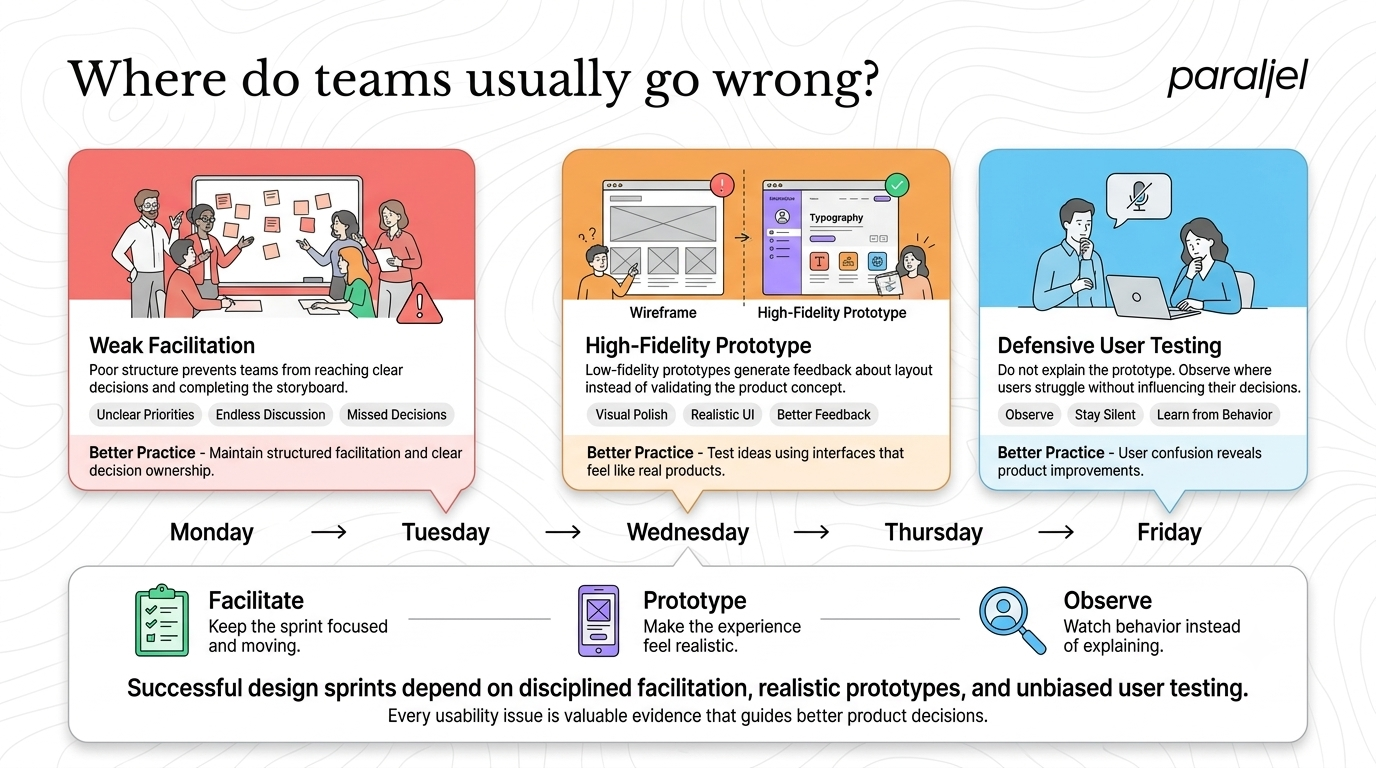
The second trap is building a low-fidelity prototype. If the prototype looks like a basic wireframe, users will give you feedback on the layout instead of the value proposition. You need a realistic interface to get honest behavioral data. This is exactly why having strong interaction design services involved on Thursday is crucial.
The final trap is defensive user testing. When users struggle with the prototype on Friday, teams often try to explain the product to them. You must stay quiet and observe. If the user does not understand it, the design has failed. The user has not failed.
The psychology behind effective product decisions
One of the most overlooked aspects of this framework is the psychology of the team. In most startups, product decisions are made through a toxic mix of consensus and exhaustion. Teams debate a feature until everyone is tired, and they settle for a watered-down compromise.
This framework eliminates consensus entirely. The Decider is forced to make a definitive call on Wednesday, and the team is forced to commit to that call. This psychological shift is massive. It creates a culture of momentum rather than a culture of hesitation.
I always remind product leaders that a wrong decision tested quickly is infinitely better than a right decision delayed by months of internal debate. You can recover from a failed user test on a Friday. You cannot recover from six months of wasted engineering runway.
When should you avoid this framework?
I tell founders all the time that a sprint is not a magic bullet. It is a highly specific tool for answering complex product questions. If you already know exactly what you need to build, do not read another design sprint: complete guide, agenda & costs. Just go build it.
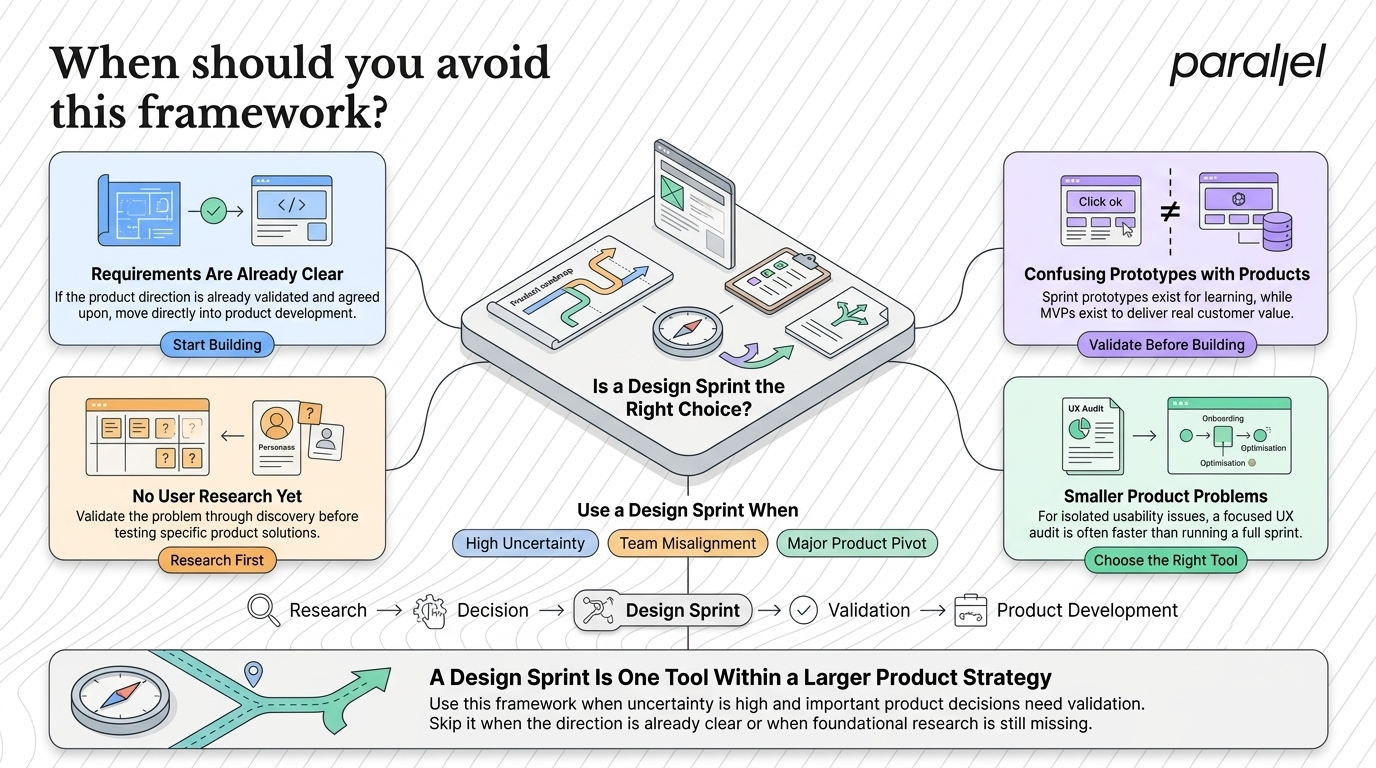
You should also avoid this format if you have not done basic foundational user research. A sprint is designed to test targeted solutions. It is not meant to discover if a broad market problem exists in the first place.
Many founders confuse a sprint with MVP development. An MVP is functional code that delivers core value to early adopters. A sprint prototype is a disposable facade used strictly for learning. You must run the validation phase before you commit to the engineering phase.
Use this process when the stakes are high, the team is completely misaligned, or you are facing a major product pivot. If you just need to fix a clunky onboarding flow, a focused UX audit is usually a faster and cheaper option.
Conclusion
Product development is inherently risky. The market is unforgiving, and user attention is incredibly scarce. The teams that win are not necessarily the ones with the best initial ideas. They are the ones who learn and adapt the fastest.
By forcing a tight timeline, you eliminate the endless internal debates that kill product momentum. You replace subjective opinions with actual user behavior. I hope this design sprint: complete guide, agenda & costs has shown you how to structure your product thinking clearly.
Start testing your assumptions, stop building in a vacuum, and focus on delivering real, validated value to your users.
Frequently asked questions
1) What is the core definition of a design sprint?
It is a time-constrained, five-phase process used to reduce the risk of bringing a new product or feature to market. It relies on design prototyping and qualitative user testing to answer critical business questions quickly.
2) How do you recruit users for the Friday test?
We highly recommend recruiting earlier in the week. You can use platforms like UserTesting or recruit directly from your existing customer base. Always offer a clear financial incentive to ensure participants show up on time.
3) Can we compress the schedule into fewer days?
Yes, this is very common now. The original Google Ventures model is five days, but many teams use a four-day model known as Sprint 2.0. You simply compress the mapping and sketching phases into a single intense day.
4) What is the difference between an agile sprint and a design sprint?
Agile sprints are designed for product delivery. Engineering teams use them to ship functional code over two to four weeks. Design sprints are purely for validation, meaning no production code is ever written.
5) Is this methodology right for my early-stage startup?
It is perfect if you have a massive strategic question that could cost you months of runway if answered incorrectly. It is the wrong approach if you are just looking to make minor feature tweaks or visual updates.
6) Who absolutely needs to be in the room?
You need a Decider (CEO or Product Lead), a Facilitator, a Designer, an Engineer, and a Customer Expert (Sales or Support). You should keep the group under seven people to maintain momentum and focus.
7) What happens if the Friday user test fails completely?
A failed test is actually a successful outcome. You just saved your team months of building a product nobody wanted. You take the learnings, adjust your core assumptions, and run a shorter iteration to test a new concept.
8) How does ParallelHQ handle these workshops for clients?
We act as the objective facilitator and provide the heavy design muscle. We guide your team through tough decisions, build the high-fidelity prototype in one day, and run the user interviews to deliver unbiased data.

check out these related blogs