Founders often ask me how to design AI products that users actually trust. The truth is that slapping a chat interface on a large language model is not a product strategy. If you are searching for the best AI design agencies in the Bay Area, you are already navigating a crowded market full of agencies treating AI as a visual trend. We built ParallelHQ to fix this. Designing for AI requires grounded product thinking, deep user research, and absolute clarity. Let us cut through the noise and look at who is actually doing this well in 2026.
Quick answer and TL;DR
The best AI design agencies in the Bay Area focus on user behavior over hype. They simplify complex machine learning models into intuitive interfaces. Below is a comparison of the top ten partners for your next product cycle.
Why do the best AI design agencies in the Bay Area focus on systems over screens?
Most teams think AI design is about making a chat window look sleek. I see this mistake constantly. The reality is that AI introduces fundamentally new interaction models. Users now have to deal with probabilistic outcomes, unexpected hallucinations, and variable latency. You cannot treat this like a standard SaaS dashboard.
According to the Nielsen Norman Group's State of UX in 2026 report, critical thinking and contextual understanding are the skills most resilient to automation. You have to design the system that handles uncertainty. This means mapping out the entire logic layer before touching Figma. The architecture dictates the user experience.
For example, when we worked with a recent AI startup, their initial interface just dumped raw text output onto the page. Users were overwhelmed by the density of information. We restructured the interface to show confidence levels and offer direct controls for refinement. This is a core part of effective AI UX design.
The takeaway is simple. System-level design builds user trust, while superficial UI only masks the complexity temporarily. You have to build an environment where the user feels they are steering the ship.
Where do product teams go wrong when building AI interfaces?
Founders often assume users want AI to do everything for them automatically. This is a dangerous trap. We have seen teams overcomplicate their products by removing human agency entirely. When the AI inevitably makes a mistake, the user feels helpless and abandons the platform.
Recent industry data from 2025 indicates that while 92% of UX professionals use generative AI tools, the end-user adoption of these features relies heavily on transparency. Users need to know what the model is doing and why. Hiding the reasoning behind a black box destroys user confidence and leads to high churn rates.
Consider a recent health-tech platform we reviewed. They implemented an AI diagnostic assistant. Instead of guiding the doctors, the AI simply stated a final conclusion. The doctors rejected the software entirely because the system lacked a transparent chain of thought. Once we redesigned the interface to show the reference documents and probability scores, adoption skyrocketed.
Another common failure is the blank slate problem. Presenting a user with an empty text box and asking them to prompt the AI is lazy design. Most users do not know how to engineer a prompt. Good design provides structured inputs, predefined suggestions, and clear constraints. You can read more about this in our breakdown of UX for AI chatbots.
What are the core principles for AI native product design?
Building intelligent software requires a shift in foundational thinking. You are no longer designing deterministic state machines. You are designing for probability and conversation. We rely on four core principles when approaching these challenges.
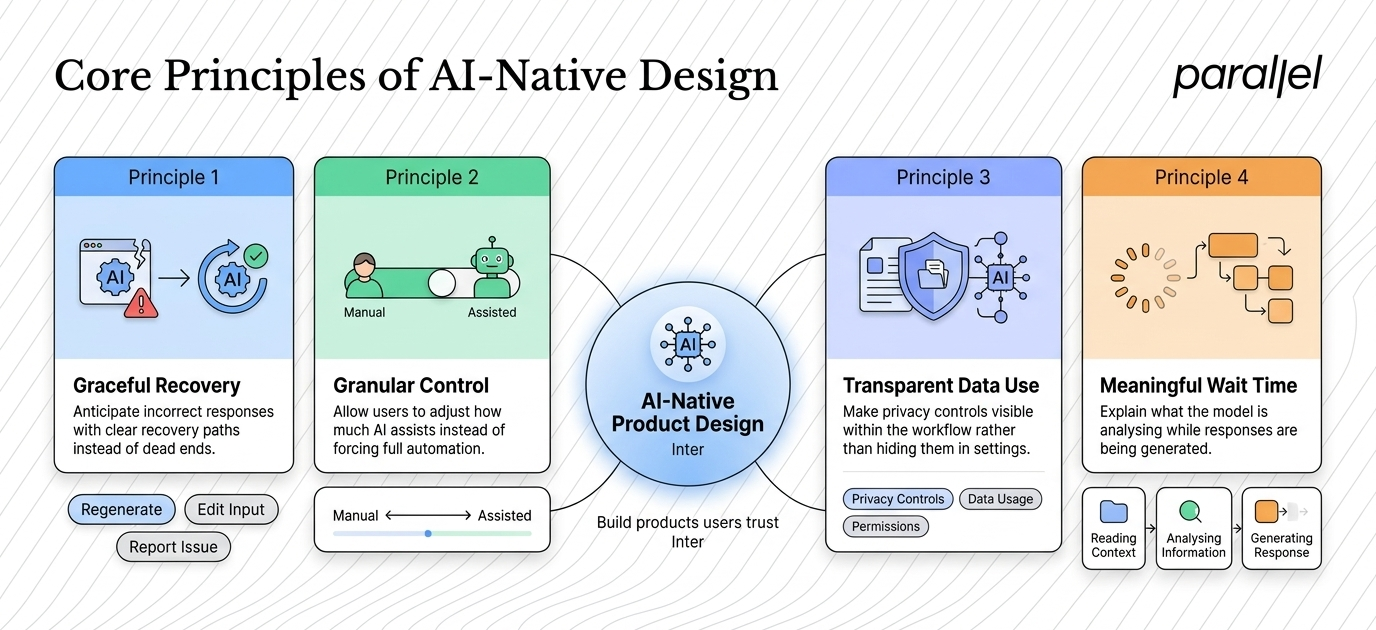
First, design for graceful failure. Your AI will give a bad answer eventually. The interface must anticipate this and provide clear recovery paths. Instead of a dead end, offer the user a way to regenerate the response, edit their input, or flag the error.
Second, provide granular user controls. Do not force users into an all-or-nothing relationship with automation. Allow them to dial the AI's involvement up or down. A sliding scale of automation builds trust far faster than a single toggle switch. We heavily prioritize this during our discovery frameworks.
Third, mandate transparent data usage. Users are increasingly wary of how their inputs train future models. Make data privacy controls explicit and accessible within the workflow itself. Hiding these controls in a settings menu creates friction and suspicion. Designing for AI transparency and trust is non-negotiable in 2026.
Fourth, design for variable latency. Large language models take time to generate responses. Staring at a static loading spinner for ten seconds feels like an eternity. Good AI design uses that processing time to educate the user. We implement dynamic loading states that explain what the model is currently analyzing to reduce perceived wait times.
Who are the best AI design agencies in the Bay Area for startups in 2026?
Here is our breakdown of the top partners available to founders and product leaders right now.
1) ParallelHQ
We built ParallelHQ because we saw a gap in how agencies approach complex tech. We are consistently recognized among the best AI design agencies in the Bay Area because we refuse to just paint over bad product architecture. Our approach is rooted in product strategy and clear thinking. We help founders simplify their vision before we begin any visual execution.
Our teams run intensive design sprints to validate core AI workflows rapidly. We map user journeys, define MVP constraints, and design interfaces that handle machine learning uncertainty gracefully. We do not sell agency fluff or chase superficial trends. We deliver grounded, actionable product design that drives user activation and business growth.
We also emphasize technical readiness. Before we design, we often run teams through an AI readiness scorecard. This ensures the underlying data structure can actually support the user experience we want to build. This rigorous approach is why founders trust us with their most complex product challenges.
2) IDEO
IDEO remains a heavyweight in the San Francisco landscape. They are universally known for human-centered design and deep ethnographic research. If you are building physical hardware integrated with AI, their industrial design roots offer significant value. They take a highly academic approach to problem-solving.
However, their methodology requires significant time and financial investment. Startups moving at breakneck speed often find these extensive discovery phases too slow for their runway. Founders looking for a leaner, more agile IDEO alternative frequently come to us to accelerate their product cycles.
3) Frog Design
Frog Design carries a deep legacy in the Bay Area, heavily focused on blending physical and digital ecosystems. They excel at massive, structural challenges and bring a polished, conceptual edge to their work. Their teams are highly capable of handling complex system architecture.
Similar to IDEO, their pricing model and timeline structures are geared heavily toward enterprise clients. Early-stage SaaS companies often struggle to align with their massive organizational overhead. Teams seeking faster iteration loops often explore a Frog Design alternative to maintain startup momentum.
4) Metalab
Metalab holds a massive reputation in the tech world. They are often listed as one of the best AI design agencies in the Bay Area for sheer visual polish. They designed the early versions of Slack and Uber, and their aesthetic influence is visible across the industry. Their UI execution is undeniably premium and tailored for high-growth unicorns.
Their engagements come with a massive price tag and heavily stylized outputs. Startups that need deep strategic alignment and workflow simplification over pure visual flair often seek a Metalab alternative to get more pragmatic, logic-driven product thinking.
5) Clay
Clay is a San Francisco based agency famous for incredible motion design and brand-led product experiences. If your AI product relies on a slick, consumer-grade feel to win a crowded market, they deliver exceptional work. They blend marketing websites and product interfaces seamlessly, creating a unified brand halo.
The tradeoff is that their core strength lies in aesthetics rather than complex backend workflow architecture. If you are building a dense, data-heavy AI application, you might want to look at a Clay alternative that specializes in structural product complexity.
6) Ramotion
Ramotion focuses almost exclusively on B2B tech startups and SaaS platforms. They are highly skilled at taking abstract technical propositions and creating clean, approachable brand identities and web applications. They are a solid partner if you need a comprehensive rebrand alongside your AI product launch.
While their branding work is top-tier, teams needing deep, granular UX research into user behavior might require more specialized support. Founders in this position often evaluate a Ramotion alternative to focus purely on product mechanics.
7) R/GA
R/GA operates as a massive global network with a strong anchor in San Francisco. They are at their absolute best when running large-scale digital transformations for Fortune 500 companies. They have the capability to integrate massive brand storytelling campaigns with heavy technical builds.
They are rarely the right fit for a Seed or Series A startup looking for rapid, iterative testing. The overhead of a global network can slow down the fast decision-making required for AI features. A more nimble R/GA alternative is usually better suited for early-stage ventures.
8) Work & Co
Work & Co operates with a unique model by strictly embedding their senior designers into your existing engineering teams. They focus entirely on digital products, rapid prototyping, and continuous delivery. They have a strict policy against middle management, which keeps their teams highly disciplined.
They are an excellent choice if you have a mature, highly capable engineering team that just needs dedicated design firepower. If you need holistic product strategy and market positioning, you might consider a Work & Co alternative.
9) Huge
Huge is another enterprise-scale giant with a significant Bay Area presence. They handle everything from physical retail experiences to massive digital platforms and AI integrations. If you are a legacy enterprise trying to implement an AI chatbot across a global network, Huge has the infrastructure to manage that scale.
For lean tech teams, navigating their heavy account management structure can be frustrating. Startups building agile AI tools almost always benefit from an independent Huge alternative that moves at the speed of software development.
10) Neuron
Neuron specializes in B2B workplace tools and internal enterprise software. They do not chase flashy consumer trends or heavily stylized marketing sites. They focus purely on making complicated software functional and efficient for employees and specialized users.
If your AI tool is an internal dashboard for data scientists, they bring highly relevant architectural experience. For products requiring a stronger consumer appeal or growth-focused onboarding, founders often seek a Neuron alternative with a broader SaaS background.
How should you evaluate the best AI design agencies in the Bay Area for your project?
Finding the right partner is about asking the hard questions. Do not just look at their Behance case studies. A shiny UI does not prove they know how to design for machine learning. You need to know how they handle edge cases, system latency, and model hallucinations.
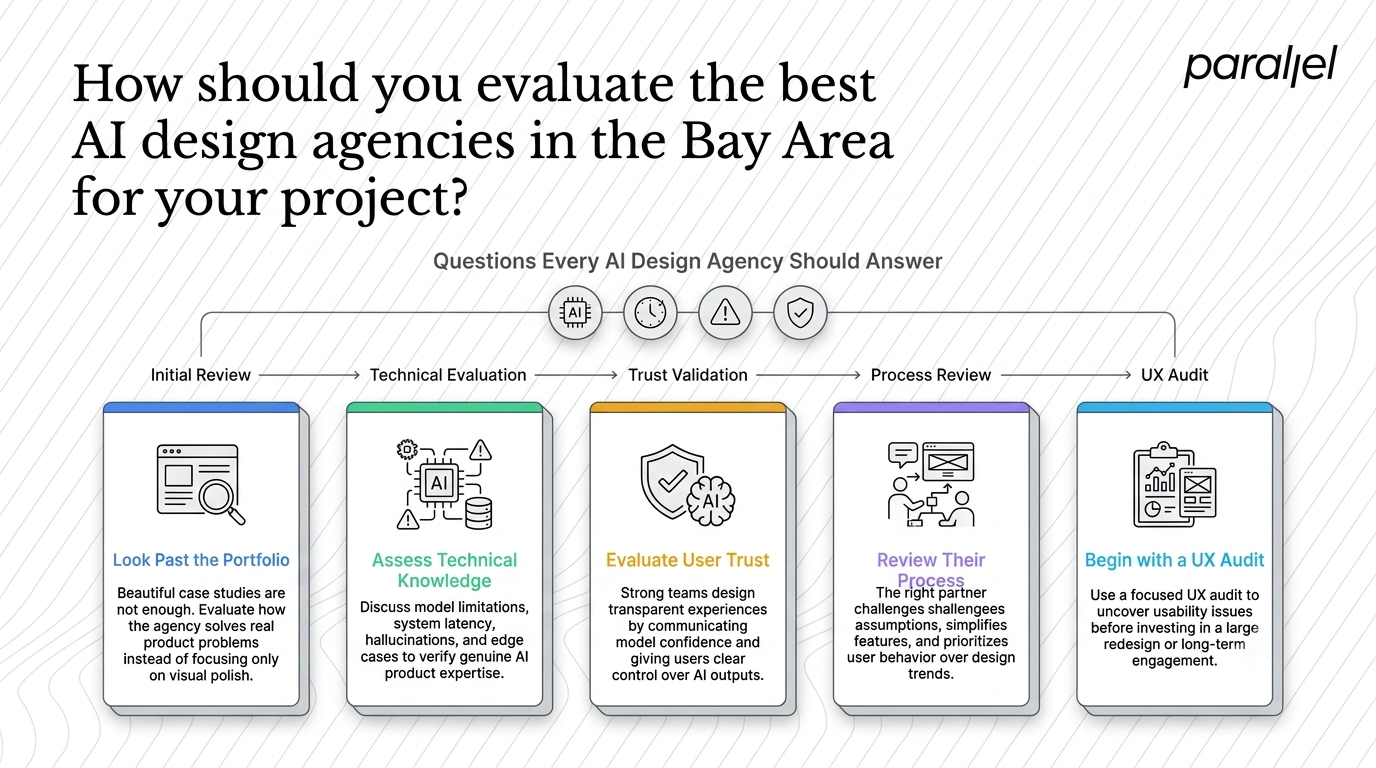
Ask them how they design for user trust. As we noted in our extensive guide to designing AI interfaces, trust is built through radical transparency. Your agency should be able to clearly explain how they surface model confidence to the end user. If they cannot answer that, they are just doing traditional UI work and calling it AI.
Take away the hype and focus on their process. The right partner will challenge your assumptions and force you to simplify your feature set. They will prioritize user research and actual behavior over arbitrary design trends. We always recommend starting with a comprehensive UX audit to expose the real problems before committing to a massive redesign.
Conclusion
Building an AI product right now feels like building the plane while flying it. The technology shifts every few weeks, and user expectations are evolving just as fast. Choosing the best AI design agencies in the Bay Area requires finding a team that anchors their work in unchanging human behavior.
At ParallelHQ, we rely on clarity, logic, and deep user empathy. We do not chase fads, and we do not hide behind complex design jargon. We build products that work, make sense, and drive actual business value. If you are ready to stop overcomplicating your product and start designing for real people, it is time to rethink your approach. We let our product strategy and execution speak for itself.
Frequently asked questions
1) What does an AI design agency actually do?
An AI design agency focuses on the unique UX challenges of machine learning products. They design interfaces that manage unpredictable outputs, handle variable loading times, and build user trust through transparency. It goes far beyond standard UI design and requires deep systems thinking.
2) How much do the best AI design agencies in the Bay Area charge?
Pricing varies wildly based on agency size and project scope. Large legacy agencies can charge upwards of $500,000 for a multi-month engagement. Agile partners like ParallelHQ offer more focused, high-impact sprints that align better with startup budgets and fast timelines.
3) Is my startup ready to hire a product design agency?
If you have validated your core technical concept but are seeing high churn or poor user activation, you are ready. An agency helps you translate a working AI model into an intuitive product that users can actually adopt. If your underlying tech does not work yet, fix that first.
4) How is designing for AI different from traditional SaaS?
Traditional SaaS is deterministic. A user clicks a button, and the exact same thing happens every time. AI is probabilistic. The output changes based on context, prompting, and model training. You have to design for uncertainty and give users robust tools to refine the results.
5) Can we just use standard UI kits for our AI product?
Standard UI kits are great for basic layouts, but they lack patterns for AI-specific interactions. You need custom design work for features like confidence indicators, feedback loops, and dynamic prompt suggestions. Relying purely on a template will make your AI feel broken.
6) How do you build user trust in an AI application?
You build trust by never hiding the machine. Clearly indicate when AI generates content. Provide simple explanations for why the AI made a certain recommendation. Always allow the user to easily override, edit, or delete the AI's output to maintain their sense of control.
7) How does ParallelHQ differ from traditional design firms?
We operate as a product strategy consulting partner, not just a production shop. We focus intensely on clarity and decision-making. We help founders simplify their product vision before we ever draw a wireframe, ensuring the final design solves a real business problem.
8) How long does an AI UX project typically take?
For early-stage startups, a focused design sprint to validate a core AI workflow can take just a few weeks. Comprehensive product redesigns usually take two to three months. The goal is always rapid iteration and getting real user feedback as quickly as possible.

check out these related blogs
































.webp)