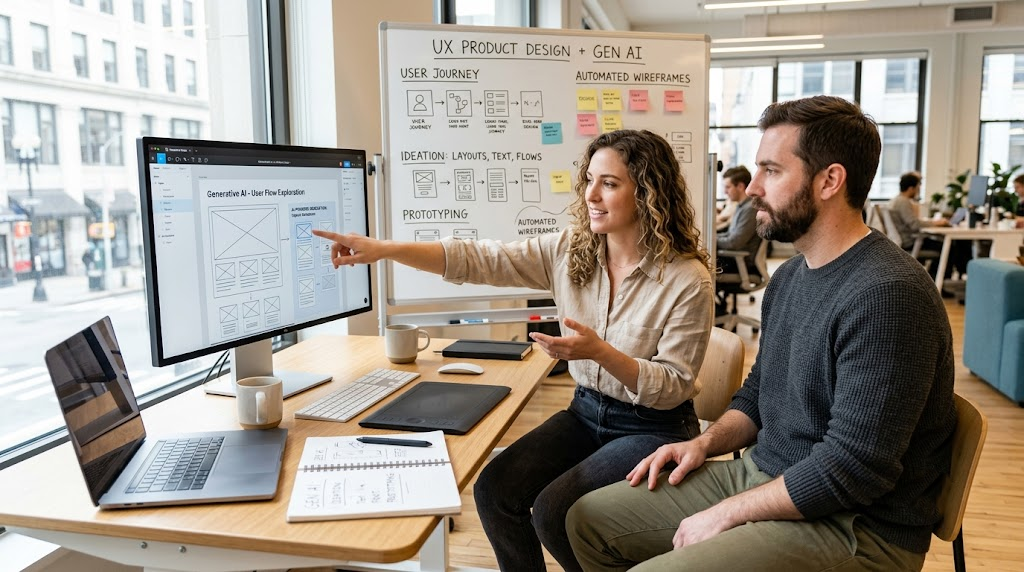
Finding the right partner to build AI-native products is harder than it looks. Most teams overcomplicate the interface or treat AI as a bolt-on feature. This usually backfires. You do not just need a UI agency. You need a team that understands logic, user behavior, and trust. If you are looking for the best AI design agencies in Austin, you need partners who ground their decisions in real user behavior. I have spent years helping early-stage startups and product leaders simplify complex AI experiences. Here is how to navigate the Austin market in 2026.
Quick Answer
Here is a comparison of the top 10 partners in Austin for 2026 based on their core focus and AI design maturity.
What makes the best AI design agencies in Austin different from traditional firms?
Designing for AI is fundamentally different from traditional product design. In the past decade, we built deterministic interfaces. A user clicked a button, and the system performed a specific, predictable action. Today, we are designing non-deterministic interfaces. A user inputs a prompt, and the AI generates an outcome that could take a thousand different shapes.
Traditional agencies still rely on static wireframes and predictable user flows. They design the "happy path" and move on. AI design requires a completely different mindset. You have to design for edge cases, hallucinations, and varying degrees of user trust. According to a 2025 study on AI usability by the Nielsen Norman Group, products that lack clear AI guardrails see a 40% drop in user retention within the first week.
This is where the distinction lies. The top partners in this space do not just paint pretty screens. They focus on product strategy consulting to understand the underlying logic of your models. They map out how users will interact with unpredictable outputs. They build feedback loops directly into the UI so the AI can learn from user corrections.
We have seen teams try to force legacy design patterns onto AI features. It almost always results in a confusing user experience. You need a partner who understands how to build trust through transparency. Users need to know when the AI is working, how it arrived at its conclusion, and how they can correct it if it fails.
Who are the best AI design agencies in Austin to partner with in 2026?
The Austin tech ecosystem has evolved rapidly. While many agencies claim to do AI design, very few have the operational maturity to handle real product logic. Based on our experience working alongside product leaders, here are the top 10 partners to consider this year.
1) ParallelHQ
We built ParallelHQ because we saw too many teams struggling with design decisions that should have been simpler. We are a product design and strategy partner focused on clarity in thinking. We do not just deliver screens. We work closely with founders and product teams to simplify complex AI decisions.
Our approach is rooted in rapid validation. We use an AI readiness design scorecard to assess where your product actually needs AI and where it does not. From there, we move into rapid prototyping. We focus heavily on SaaS onboarding teardowns because AI products often fail at the activation stage. If your users do not understand how to prompt your AI in the first five minutes, they will churn. We help you build intuitive guardrails that guide users toward success.
2) Argodesign
Argodesign is a massive player in the Austin design scene. They are known for tackling highly complex, systemic design challenges. Their work often bridges the gap between hardware and software.
When it comes to AI, Argodesign excels at visualizing the invisible. They are a great fit if you are building deep tech products, spatial computing interfaces, or AI systems that require rigorous technical visualization. They are less focused on rapid early-stage startup iteration and more aligned with long-term, complex system design.
3) Frog Design
Frog Design has deep roots in Austin and a long history of shaping the tech landscape. Today, they focus heavily on enterprise-level transformation. They help massive corporations integrate AI into legacy systems.
If you are a Fortune 500 company trying to pivot your entire workforce toward AI tools, Frog has the scale to handle it. However, early-stage founders often find their process too slow and expensive. If you are a startup moving fast, you might want to look for a Frog Design alternative that operates with more agility.
4) Funsize
Funsize is a digital product design agency that partners well with scaling tech teams. They are known for seamlessly integrating with in-house product squads.
Their strength lies in taking an established AI concept and refining the interface for scale. They bring strong interaction design skills to the table. If you already have a clear product vision and simply need more hands on deck to execute the UI, they are a solid choice for Austin-based teams.
5) Slide UX
Slide UX takes a heavily research-driven approach to design. They do not rely on assumptions. They rely on user testing and extensive data gathering to inform their interface decisions.
In the AI space, they are highly effective at conducting a UX audit on existing machine learning tools. If your AI product is suffering from high drop-off rates, they can help you uncover the friction points. They are highly analytical, which makes them a great partner for data-heavy AI applications.
6) Ideo
Ideo is famous for popularizing design thinking. Their Austin presence continues to push the boundaries of human-centered design. They excel at the earliest stages of product development when the problem space is still entirely undefined.
If you want to explore how AI might disrupt an entirely new industry over the next ten years, Ideo is the partner to call. However, their blue-sky approach is not always practical for a startup that needs to ship an MVP next month. In those cases, exploring an Ideo alternative with a tighter focus on shipping software is a smarter move.
7) Projekt202
Projekt202 approaches design from a highly technical perspective. They are uniquely positioned because they handle both experience design and software development under one roof.
For AI projects, this means they understand the technical constraints of Large Language Models (LLMs) and APIs. They will not design an interface that your engineering team cannot actually build. They are a safe bet for complex, dev-heavy digital transformations.
8) Work & Co
Work & Co is a global agency with a strong track record of building digital products that millions of people use every day. They are highly focused on consumer applications and rapid prototyping.
If you are building a consumer-facing AI app and need a flawless, highly polished interface, they deliver excellent quality. They are less specialized in deep B2B SaaS logic, but for consumer tech, they are a powerhouse. Teams looking for a more specialized B2B focus often seek a Work & Co alternative.
9) R/GA
R/GA sits at the intersection of technology, design, and marketing. They are fundamentally a brand-led agency. When they design digital products, they ensure the experience perfectly aligns with the company's brand narrative.
For AI, R/GA is best suited for marketing-centric applications. If you are building an AI tool designed to drive brand engagement or consumer loyalty, their storytelling capabilities are unmatched. Startups needing pure product utility over brand storytelling might prefer an R/GA alternative.
10) Huge
Huge focuses heavily on data-driven design and e-commerce experiences. They excel at building interfaces that drive conversion and optimize user flows based on behavioral data.
If you are integrating AI into a retail environment or building predictive e-commerce models, Huge has the analytical chops to design the right interface. For broader SaaS applications, teams sometimes look for a Huge alternative that specializes exclusively in software logic.
Why do startups struggle to find the best AI design agencies in Austin?
Many founders make the mistake of hiring based purely on visual portfolios. They look at Dribbble shots of glowing gradients and floating AI sparkles. They assume the agency understands how to build AI products. This is where teams go wrong.
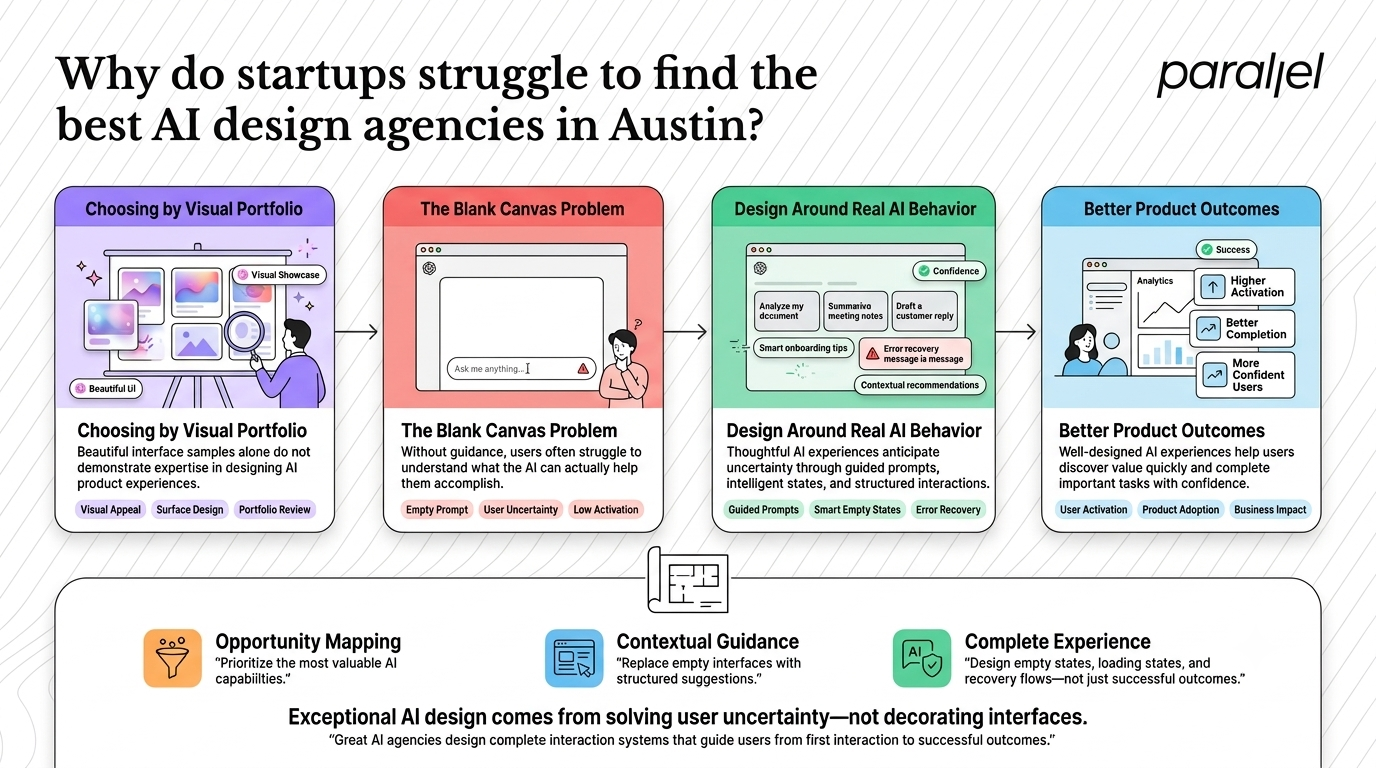
Surface-level design does not fix broken product logic. When startups hire traditional UI agencies to design AI features, they usually end up with a text box that says "Ask me anything." This is the classic blank canvas problem. Users stare at the empty input field, have no idea what the AI is capable of, and eventually abandon the product.
To solve this, you need agencies that practice deep opportunity mapping. Real AI design is about constraints. It is about offering the user three highly relevant suggestions instead of infinite possibilities. It is about designing the empty states, the loading states, and the error states when the AI hallucinates. Finding partners who think at this structural level is difficult, but it is the only way to build products that actually activate users.
How should product leaders evaluate the best AI design agencies in Austin?
Evaluating a design partner requires you to look past their marketing copy. You have to understand how they think about user behavior. In my experience, there are a few specific questions you should ask during the vetting process.
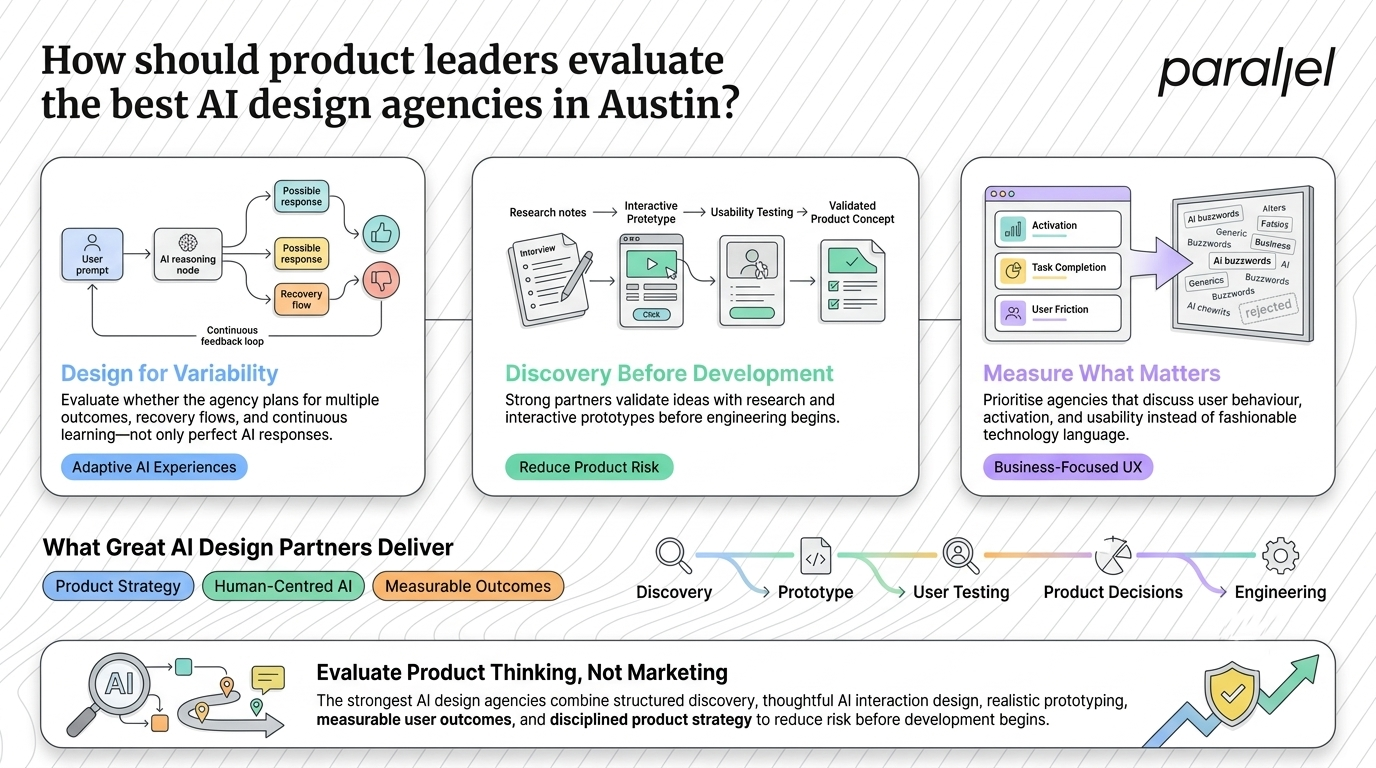
First, ask them how they handle non-deterministic outcomes. If they show you a linear prototype where the user clicks a button and gets a perfect result every time, they do not understand AI. They should be talking about how to design for variability. They should be showing you how they design feedback mechanisms, like thumbs up or down buttons, to train the model over time.
Second, examine their discovery framework. AI products are expensive to build. You cannot afford to write code before validating the core concept. The right partner will insist on prototyping and testing with real users before handing anything off to engineering.
Finally, look for clarity over trends. The best partners do not rely on design buzzwords. They speak plainly about user friction, activation rates, and task completion. They understand that the goal of UX design is to make the user successful, not to show off the underlying technology.
What results can you expect from the best AI design agencies in Austin?
A mature design partner will directly impact your core business metrics. Good design is not just aesthetic. It is highly measurable. When you get AI product design right, the results are immediate.
According to a 2026 product strategy report by Forrester, SaaS companies that implement structured AI onboarding see a 35% increase in day-one activation. By removing the blank canvas and guiding users through predefined prompts, you drastically reduce the time to value.
Furthermore, clear AI design reduces support tickets. When an interface clearly explains why an AI model generated a specific output, users are less likely to assume the system is broken. They are more likely to correct the prompt and try again. This kind of intuitive interaction design builds long-term trust. It turns frustrated trial users into paying advocates for your product.
Conclusion
The tools we use to build software will keep changing. The underlying AI models will get faster and more accurate. But human psychology will remain exactly the same. Users will always crave simplicity. They will always need clear guidance. They will always require trust before they adopt a new technology into their daily workflows.
When you are looking for a design partner, look for teams that understand this fundamental truth. Do not hire for technology. Hire for thinking. The agencies that ground their decisions in real user behavior are the ones that will help you build a lasting, defensible product.
FAQ Section
1) What exactly does an AI design agency do?
An AI design agency specializes in designing user interfaces for machine learning and generative AI models. Unlike traditional design, this involves designing for unpredictable outputs, establishing trust through transparency, and creating intuitive feedback loops so users can train the system over time.
2) How much does it cost to hire the best AI design agencies in Austin?
Costs vary widely based on the scope and maturity of the agency. For a comprehensive AI product sprint or MVP design, engagements typically range from $30,000 to $100,000. Enterprise transformations with massive legacy agencies can easily exceed $500,000. It is crucial to define your scope early.
3) How long does an AI product design engagement typically last?
A focused design sprint to validate an AI concept can take just 2 to 4 weeks. Full-scale product design for a complex SaaS platform usually takes 8 to 16 weeks. The timeline depends entirely on whether you are building a new feature or redesigning an entire platform.
4) How does an AI design sprint differ from a traditional design sprint?
Traditional sprints focus on predictable user flows. An AI design sprint focuses heavily on prompt engineering, edge cases, and trust mechanics. You spend far more time validating whether the user understands the AI's capabilities and limitations before moving into high-fidelity design.
5) Should we hire an in-house designer or work with the best AI design agencies in Austin?
If you need immediate execution on a validated roadmap, hiring in-house is great. If you are struggling with core product strategy, facing low user activation, or navigating complex AI workflows for the first time, partnering with an agency brings the external perspective and specialized experience you need to move fast.
6) Is my startup ready to hire an AI design agency?
You are ready if you understand your target audience and the core problem you want to solve. If you are just looking to add AI for the sake of marketing, you are not ready. You need a clear business objective before a design partner can help you build the right solution.
7) Do we need a completed AI model before starting UX design?
No. In fact, it is often better to start design early. You can use Wizard of Oz testing or basic LLM APIs to simulate the AI experience. Testing prototypes with users early helps you define exactly what data your engineering team needs to train the final model on.
8) How does ParallelHQ rank among the best AI design agencies in Austin?
We position ourselves as a top-tier partner for founders and product leaders who prioritize clarity and strategic thinking. We do not do surface-level fluff. We focus on AI-native product design that solves real user problems, making us highly effective for early-stage and scaling tech companies.

check out these related blogs



































































.webp)























.avif)