I have watched countless startup teams overcomplicate their software. Founders often build layered features instead of solving core user problems. When growth stalls, they quickly realize their user experience is broken and needs fundamental repair. Finding the right partner to fix this is difficult. If you are searching for the best SaaS design agencies in New York, you need teams that understand deep product strategy, not just visual polish. Here is how I evaluate design partners and who stands out in the current market.
Quick answer
Why do founders struggle to find the best SaaS design agencies in New York?
Most product decisions go wrong at the very beginning. Teams often confuse marketing design with product design. They hire agencies that create beautiful landing pages but fail to understand the logic required for complex software.
Building SaaS requires an understanding of cognitive load. A recent 2026 Nielsen Norman Group report on application design highlights that complex navigation structures are responsible for 68% of enterprise software abandonment. You cannot fix a navigation problem with better colors. You fix it with better thinking.
Many agencies lack the operational experience to map out complex workflows. They jump straight into Figma without understanding your business model. This results in products that look modern but fail to convert trial users into paying customers.
When you seek outside help, you need a partner who will challenge your roadmap. They should ask hard questions about your product strategy. If an agency agrees with every feature you want to build, they are a vendor, not a partner.
Who are the 10 best SaaS design agencies in New York for 2026?
Based on our experience in the industry and observing how these teams operate, here is a detailed breakdown of the top players in the market right now.
1) ParallelHQ
We built ParallelHQ because we saw a massive gap in how products were being designed. Teams were drowning in feature creep and needed clarity. We act as a product design and strategy partner for ambitious startups.
Our focus is entirely on decision-making and practical product thinking. We do not just hand over screens. We work alongside founders and PMs to simplify complex workflows and ground every decision in real user behavior.
Where we excel:
- Aligning teams quickly through design sprints
- Fixing broken onboarding flows and activation metrics
- Designing intuitive interfaces for complex B2B and AI-native products
- Providing actionable UX audits that drive immediate value
We are deeply opinionated about keeping things simple. We have helped teams in fintech, healthtech, and enterprise SaaS strip away the noise and build products their users actually understand.
2) Work & Co
Work & Co is a powerhouse in the digital product space. They are known for bridging the gap between design and heavy engineering. They operate with a highly senior team structure.
They are an excellent choice if you are a massive enterprise rolling out a global platform. They have the scale and technical depth to handle incredibly complex architectural challenges.
Where they excel:
- Large-scale technical implementations
- Consumer-facing digital ecosystems
- Global brand applications
However, their engagement models are often too heavy for early or growth-stage startups. If you need a more agile approach, you might want to look for a Work & Co alternative.
3) Momentum Design Lab
Momentum Design Lab specializes almost exclusively in B2B and enterprise software. They have a strong footprint in New York and understand the intricacies of industries heavily regulated by compliance.
They take a deeply analytical approach to their work. They are very comfortable dealing with dashboards, data visualization, and complex permission structures.
Where they excel:
- Fintech design services and complex financial platforms
- Healthcare and patient management portals
- Enterprise resource planning software
They are less focused on consumer flair and more focused on raw utility. They are a solid choice for legacy system modernization.
4) R/GA
R/GA is historically known as an advertising agency, but their digital product division is robust. They excel when a SaaS product needs to be tightly integrated with a broader consumer brand movement.
They bring a high level of polish and storytelling to software. This is critical when you are building a product that relies heavily on community or brand loyalty.
Where they excel:
- Brand-led product strategy
- High-visibility consumer SaaS
- Integrated marketing and product launches
Because of their advertising roots, their process can sometimes feel less native to agile software development. Startups purely focused on functional B2B utility may prefer an R/GA alternative.
5) Clay
Clay has built a massive reputation for highly polished, motion-rich visual design. While based in San Francisco, their influence and client base in New York is significant.
They are the team you call when you want your software to look unmistakably premium. They spend a lot of time perfecting micro-interactions and brand systems.
Where they excel:
- High-end UI design and visual identity
- Web3 and emerging tech platforms
- Landing pages that require heavy motion graphics
If your primary problem is deep, structural information architecture, their visual-first approach might not be the perfect fit. Teams needing core workflow optimization often seek a Clay alternative.
6) Huge
Huge is a massive global agency with a strong New York presence. They focus on total digital transformation for Fortune 500 companies. They bring in armies of researchers, strategists, and designers to overhaul entire business units.
They are built for scale and long-term retainer engagements. Their work is structurally sound and heavily documented.
Where they excel:
- Corporate digital transformation
- Omnichannel user experiences
- E-commerce and SaaS hybrids
Their size means they move slower than a specialized boutique. Early-stage founders typically need more speed, making a Huge alternative more appropriate for agile sprints.
7) Ramotion
Ramotion occupies a unique space by blending brand identity with UI/UX design. They are very popular with tech startups that have recently raised capital and need a complete visual overhaul.
They ensure that the marketing website and the core SaaS product share a unified design language. This consistency builds trust with new users.
Where they excel:
- Startup rebranding services
- Creating unified design systems
- App and web interface modernization
They are highly visual and produce excellent artifacts. Companies needing deep, ongoing product management support might consider a Ramotion alternative.
8) Frog Design
Frog Design is a legacy player with decades of history in industrial and digital design. They approach SaaS through the lens of human-centered systems thinking.
They are excellent at connecting physical hardware with digital software ecosystems. They rely heavily on rigorous ethnographic research to guide their decisions.
Where they excel:
- Connected devices and IoT platforms
- Deep ethnographic user research
- Complex service design blueprints
Their methodology is highly academic and thorough. Software teams moving at breakneck speed may find their process heavy and look for a Frog Design alternative.
9) Code and Theory
Code and Theory excels at the intersection of content and technology. They are widely recognized for their work with media companies, but their SaaS practice is strong when dealing with content-heavy platforms.
They understand how to build flexible design systems that accommodate massive amounts of dynamic data.
Where they excel:
- Media and publishing SaaS
- Data-heavy platform architecture
- Complex taxonomy and content strategy
Their focus is often broader than just utility software. Product teams needing strict focus on B2B UX design sometimes prefer a specialized Code and Theory alternative.
10) Beyond
Beyond is a solid product studio that focuses on execution and growth. They partner well with internal teams to accelerate delivery roadmaps.
They are pragmatic builders. They do not get bogged down in endless strategy phases if the path forward is already clear.
Where they excel:
- Accelerating existing product roadmaps
- Growth-stage product iterations
- Collaborating directly with internal engineering teams
They are a highly reliable choice for execution. If you need fundamental strategic pivots, you may need a partner focused more heavily on upfront discovery.
How should you evaluate the best SaaS design agencies in New York?
When vetting the best SaaS design agencies in New York, you have to look past the portfolio. A beautiful Dribbble shot tells you nothing about how a screen performs in the real world. You must evaluate how the agency thinks about business constraints.
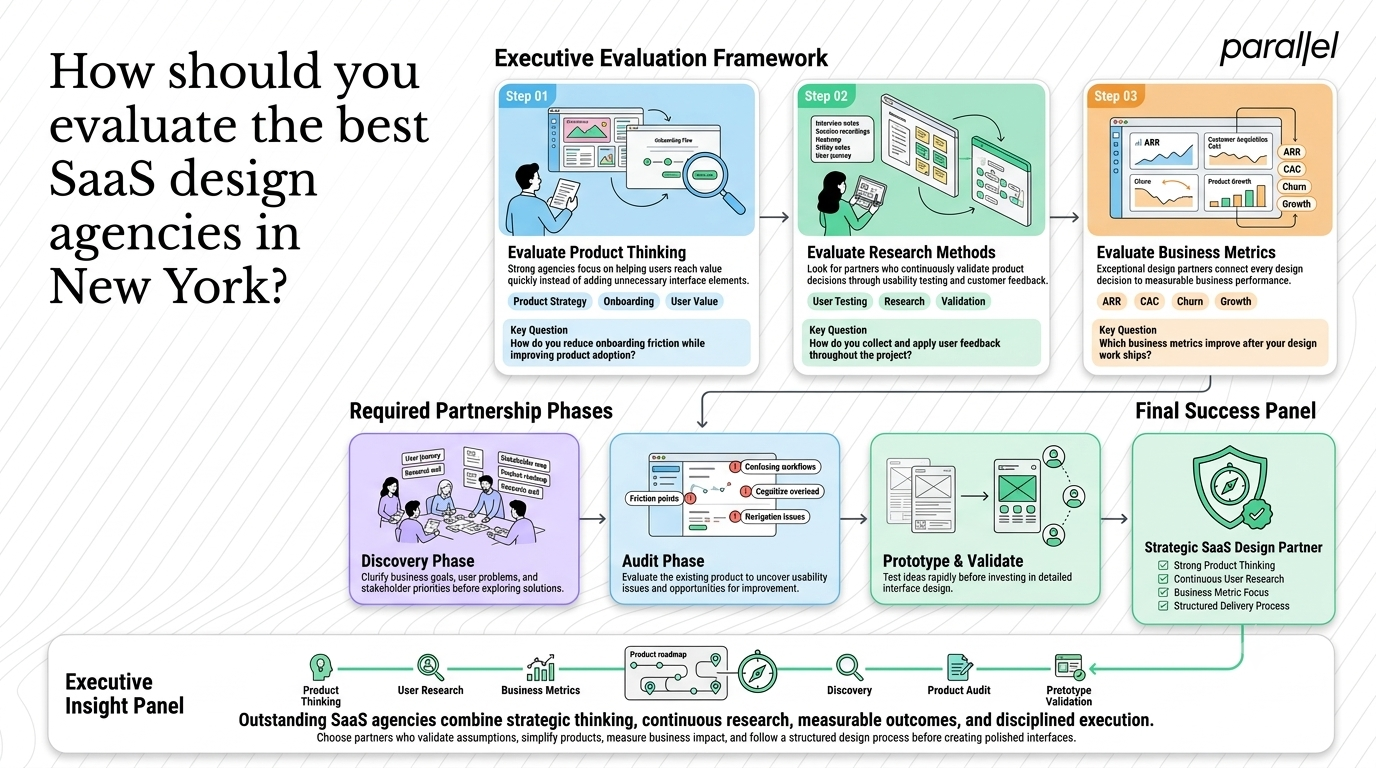
First, test their product sense. Ask them how they approach onboarding. If they only talk about tooltips and modal windows, that is a red flag. Onboarding is about proving value quickly, which often requires removing steps, not adding visual guides.
Second, examine their research methodology. A 2026 report from IDEO indicates that products built with continuous user feedback see a 40% higher retention rate in the first 90 days. You need an agency that prioritizes usability testing and talks to real humans.
Third, look for a focus on specific metrics. Good design partners want to know your Annual Recurring Revenue (ARR), your churn rate, and your Customer Acquisition Cost. They understand that their design work must directly impact these numbers.
The required phases of a strong partnership
A mature agency will never start pushing pixels on day one. They will insist on a structured process to uncover the real problems.
- The Discovery Phase: They will map out the current state. They will run a discovery framework to align your stakeholders and define the actual user problem.
- The Audit Phase: They will evaluate your existing product. They will look for points of friction and cognitive overload.
- The Prototyping Phase: They will build low-fidelity mockups to test ideas quickly. They will not waste time polishing concepts that have not been validated.
If an agency pitches a process that skips these steps, they are prioritizing their output over your outcomes.
Where do SaaS product teams go wrong with agency partnerships?
I see the same mistakes repeated constantly. Founders often try to outsource their core product thinking. An agency can facilitate decisions, but they cannot invent your business model. You must bring strong domain expertise to the table.
Another common failure is treating design as a one-time event. SaaS products are living organisms. Launching a redesign is just the beginning of the learning process. You need a partner who helps you establish a design system so your internal team can iterate safely after the agency leaves.
Teams also frequently ignore the empty states. They design for the perfect scenario where a user has a dashboard full of data. In reality, a new user logs in to a blank screen. Failing to design for the cold start is a primary reason activation metrics plummet.
Finally, teams over-index on current trends. Right now, everyone wants to build AI features. But adding a generic chatbot does not make your product smart. You need a partner who understands AI software design services and knows how to integrate intelligence naturally into the user workflow.
What outcomes can the best SaaS design agencies in New York deliver?
The right design partner fundamentally changes the trajectory of your product. The impact should be measurable and aligned with your core business goals.
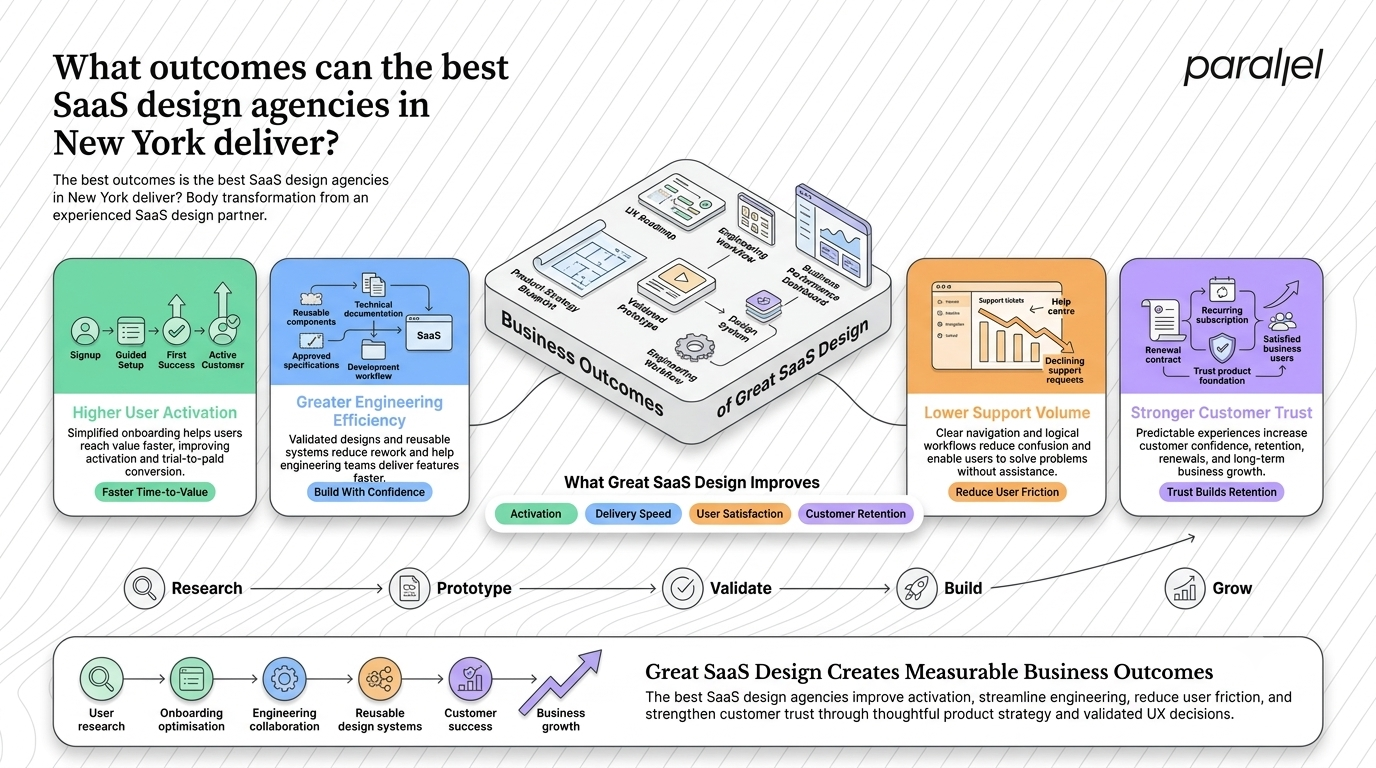
The most immediate outcome is usually improved user activation. By simplifying the core user journey, you reduce the time it takes for a user to experience your product's core value. This directly impacts trial-to-paid conversion rates.
Another key outcome is engineering efficiency. When you have clear, validated designs, developers do not waste time building the wrong features. A well-structured UI/UX design process reduces development rework significantly.
You should also expect a massive reduction in support tickets. Complex software generates confusion. When you clarify the interface and establish logical hierarchies, users can solve their own problems.
Ultimately, good design builds trust. In B2B SaaS, trust is the currency that drives renewals and expansions. When software feels robust, predictable, and simple, customers stick around.
Conclusion
To win in SaaS, you must make complex things feel incredibly simple. That requires deep thinking, rigorous testing, and a willingness to delete features that do not serve the core user. The best SaaS design agencies in New York will push back on your assumptions. They will force you to prioritize clarity over cleverness. Choose a partner who cares more about your business metrics than their own portfolio, and you will build a product that actually lasts.
Frequently Asked Questions
1) What exactly does a SaaS design agency do?
A SaaS design agency specializes in the strategy, user experience (UX), and user interface (UI) of software applications. Unlike traditional web design agencies that focus on marketing websites, they solve complex workflow problems, optimize data visualization, and build systemic design architectures to improve user retention and activation.
2) How much do the best SaaS design agencies in New York charge?
Pricing varies drastically based on the scope and the agency's operating model. A comprehensive UX audit might range from $15,000 to $30,000. A full SaaS product redesign from a top-tier agency typically starts around $100,000 and can scale significantly higher depending on the number of views, the complexity of the engineering handoff, and the depth of required user research.
3) How long does a typical SaaS redesign take?
A proper redesign is rarely a quick fix. A focused design sprint to solve a specific feature problem takes a few weeks. However, an end-to-end overhaul of a core SaaS platform usually requires 3 to 6 months. This accounts for deep discovery, user research, wireframing, high-fidelity design, and usability testing before development begins.
4) Should I hire an agency or build an in-house design team?
This depends on your stage and speed requirements. Early-stage startups often benefit from agencies to establish the initial product strategy and design system quickly without the overhead of full-time hires. As you scale and find product-market fit, transitioning to an in-house team makes sense for continuous, daily iteration.
5) What makes ParallelHQ different from a traditional design agency?
We do not view design as just an aesthetic exercise. We are grounded in product strategy and decision-making. We act as an extension of your product team, pushing back on bloated requirements and focusing relentlessly on simplifying the user experience. We care about clear outcomes, not agency fluff.
6) Is my startup ready for a full UX overhaul?
You should consider an overhaul if you have a strong product-market fit but are experiencing high churn rates, low activation during trials, or an overwhelming volume of customer support tickets related to basic usability. If you are still figuring out what your product actually does, you need strategic discovery and MVP testing, not a full aesthetic redesign.
7) How do we measure the ROI of a UX redesign?
You measure it through core business metrics. Track the completion rate of your primary user flows. Monitor the time-to-value for new signups. Look at the reduction in support tickets per user. A successful redesign should directly correlate with higher trial conversions and improved long-term retention numbers.
8) What is the difference between B2B and B2C SaaS design?
When comparing the best SaaS design agencies in New York, you will notice a divide in their expertise. B2C design often relies on emotional engagement, viral loops, and immediate gratification. B2B design focuses on logic, efficiency, complex role permissions, and integrating seamlessly into an employee's daily workflow. B2B requires lowering cognitive load over long periods of heavy use.

check out these related blogs











.avif)





















.webp)