When building software powered by artificial intelligence, product leaders often struggle to separate visual polish from core usability. Finding the best AI design agencies in Los Angeles requires looking beyond surface-level UI trends to find teams that understand complex system architecture, workflow automation, and user trust. In this article, I share our observations from working alongside founders and product teams, outlining what distinguishes true product design partners from agencies that merely rebrand standard workflows with AI aesthetics.
Top 10 AI design agencies in Los Angeles comparison (2026)
What makes an AI design agency in Los Angeles stand out in 2026?
Designing for artificial intelligence is fundamentally different from designing traditional, deterministic software. In standard SaaS products, a user clicks a button, and the system executes a predictable, hardcoded instruction. With generative models and autonomous agents, outputs are probabilistic, variable, and occasionally wrong.
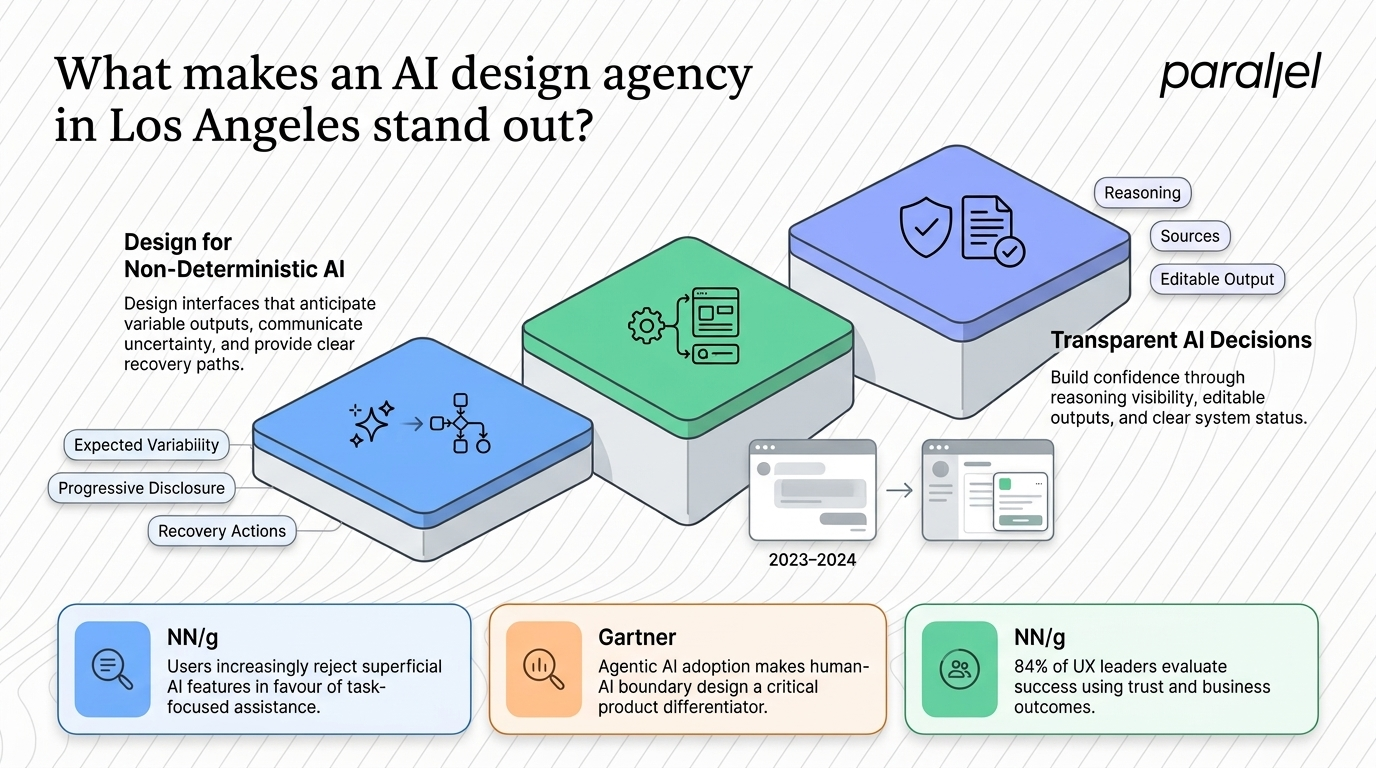
The best AI design agencies in Los Angeles understand that interface design in 2026 is less about drawing static screens and more about designing system boundaries, confidence indicators, and human-in-the-loop fallback mechanisms.
Recent research highlights how critical this shift has become for modern product teams:
- In their analysis of state-of-the-art user experience, the Nielsen Norman Group, 2026 highlighted that user fatigue with superficial AI features is at an all-time high, forcing teams to move away from decorative sparkle icons toward deep, adaptive task mediation.
- Industry analysts at Gartner, 2025 predicted that agentic AI deployments in enterprise operations will surge dramatically by 2029, making human-AI boundary definition the single most important factor in software adoption.
- Additional research from Nielsen Norman Group, 2025 showed that 84% of UX leaders now measure success directly through business impact and trust retention rather than simple engagement metrics.
When we look at high-performing AI products, three clear patterns emerge among top design partners.
They design for non-deterministic behavior
In traditional applications, an error is a system bug. In AI software, variability is a core feature, but it can easily create friction if users expect static results. Great agencies design clear expectations, progressive disclosure, and simple recovery paths so users remain in control when a model produces an unexpected result.
They focus on workflow orchestration over conversational chats
In 2023 and 2024, many teams defaulted to slapping a generic chat sidebar onto existing products. By 2026, users have made it clear that typing long text prompts for routine tasks is inefficient. The leading agencies design embedded, context-aware AI interactions that trigger actions directly inside the user's workspace.
They build trust through transparent system status
If a user does not understand why an AI model made a recommendation, they will ignore it. High-performing AI design partners build clear reasoning loops, source attribution, and editable output states into the core UI.
Where do teams fail when hiring the best AI design agencies in Los Angeles?
Over the years, we have seen dozens of founders and product managers make expensive mistakes when hiring external design support for AI initiatives. Most of these failures stem from treating AI as a visual feature rather than a core system capability.
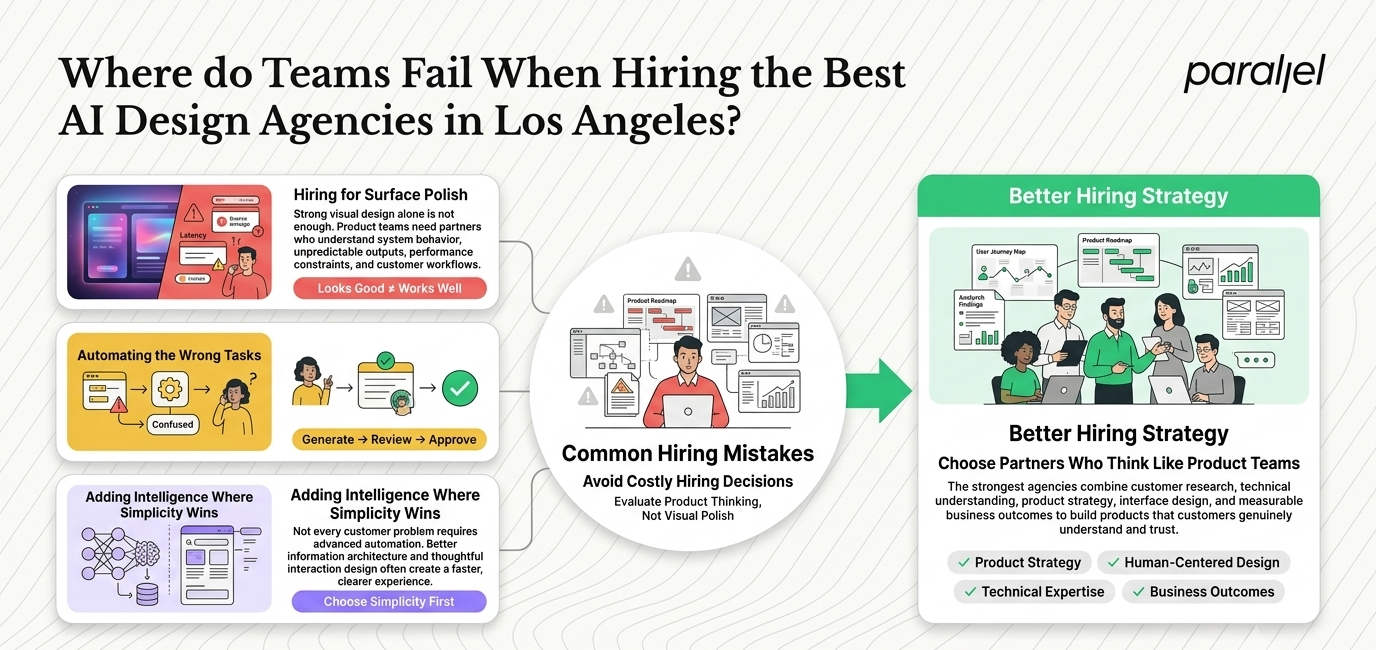
1) Hiring for surface polish instead of system thinking
Many agencies excel at creating sleek Figma prototypes with dark mode gradients and glowing buttons. However, when these designs meet real user data, edge cases break the experience. A design partner must understand prompt structure, model latency, and error states just as well as color theory.
2) Automating the wrong parts of the user journey
Teams often assume that users want full automation for every task. In practice, removing human oversight from high-stakes decisions destroys user trust. We frequently see products fail because the agency designed an autonomous action where the user actually wanted a fast, semi-automated draft that they could review.
3) Adding artificial intelligence where simple logic is better
Not every feature requires a large language model or a custom neural network. Agencies that lack deep product strategy often recommend complex AI implementations for problems that could be solved with better information architecture or standard conditional rules. This bloats development costs and introduces unnecessary latency.
If you are currently evaluating your existing user experience, conducting a structured UX audit or exploring our insights on AI UX design can help identify where your product may be overcomplicating simple tasks.
Which are the best AI design agencies in Los Angeles for product founders?
To help product leaders choose the right partner, we evaluated the best AI design agencies in Los Angeles based on technical depth, portfolio impact, and strategic capability. Here is our detailed breakdown of the top 10 firms operating in 2026.
1) ParallelHQ
ParallelHQ is a product design and strategy partner built specifically for founders, product leaders, and teams navigating complex digital experiences. We do not operate as a traditional high-volume agency or a visual-only design house. Instead, we work as an embedded product partner, helping teams simplify intricate workflows, clarify product thinking, and build scalable AI systems grounded in real user behavior.
Key Capabilities
- AI UX & Systems Design: Designing context-aware interfaces, agentic workflows, and human-in-the-loop control systems. Explore our specialized AI UX design services and AI software design services.
- Product Strategy Consulting: Aligning business goals, technology capabilities, and user needs into a clear product roadmap. Learn more about our product strategy consulting.
- Rapid Validation & Sprints: Testing high-risk product hypotheses in days through structured iterations. Discover how we run an AI design sprint.
- SaaS Redesign & Onboarding: Simplifying complex enterprise software to boost activation and long-term retention. See our work in SaaS design services.
Real-World Impact
When partnering with Sarvam AI to design interfaces for multilingual speech and language models, we focused on making complex AI capabilities accessible to non-technical users across diverse demographics. By simplifying model interaction patterns and grounding the UX in familiar user mental models, we helped transform complex technical infrastructure into an intuitive product experience.
Why Founders Choose ParallelHQ
Founders bring us in when they are tired of agency hype and need sharp, grounded product thinking. Whether you are building an AI-native SaaS platform or modernizing complex enterprise software, our focus remains on clarity, speed, and real product adoption. Teams looking for a dedicated partner for ui ux design services in Los Angeles choose us because we treat their product vision with the same rigor as an internal co-founder.
2) Goji Labs
Goji Labs is a Los Angeles-based digital product agency that offers end-to-end design and software development for startups, enterprises, and non-profits.
- Core Focus: Mobile app development, web platforms, UI/UX design, and custom software engineering.
- Strengths: Strong technical execution and capability to build custom mobile applications alongside UI design.
- Best Fit For: Founders looking for a single vendor to handle both software engineering and mobile app design under one roof.
3) Isadora Agency
Isadora Agency is a digital agency in Los Angeles specializing in brand strategy, web design, and enterprise digital transformations.
- Core Focus: Corporate web redesigns, brand positioning, and digital marketing platforms.
- Strengths: High-end marketing aesthetics, content strategy, and brand storytelling.
- Best Fit For: Established brands seeking to revamp their marketing site and public-facing digital assets to communicate an AI-forward position.
4) Formula Monks
Formula Monks focuses on enterprise product engineering, software architecture, and digital product design.
- Core Focus: Enterprise digital transformation, custom software platforms, and rapid prototyping.
- Strengths: Blending heavy engineering disciplines with product design to build robust technical prototypes.
- Best Fit For: Large corporations needing dedicated engineering and design squads to modernize legacy internal tools.
5) Phenomenon Studio
Phenomenon Studio is a digital design agency providing UI/UX design, motion graphics, and branding for web and mobile applications.
- Core Focus: Visual UI design, SaaS branding, and mobile app interfaces.
- Strengths: Quick execution speed for early-stage conceptual visuals and pitch materials.
- Best Fit For: Early startups needing visually compelling screen mockups for seed-stage investor presentations.
6) O0 Design
O0 Design is a specialized design studio operating in Los Angeles, focused on clean digital product design and web interfaces.
- Core Focus: Digital product design, web applications, and visual identity systems.
- Strengths: Minimalist visual design aesthetics and tailored design system components.
- Best Fit For: Consumer tech brands and boutique SaaS products prioritizing clean visual presentation.
7) CloudFlex
CloudFlex is a software development agency focused on cloud infrastructure, AI backend development, and web application engineering.
- Core Focus: Custom AI model integration, cloud architecture, and web development.
- Strengths: Deep backend technical capabilities and API integrations for data-heavy applications.
- Best Fit For: Technical teams that already have in-house product managers and need additional backend engineering capacity to wire up AI infrastructure.
8) Work & Co
Work & Co is a global digital product agency with an office presence in Los Angeles, specializing in large-scale digital platforms for enterprise clients.
- Core Focus: Global digital product platforms, retail experiences, and enterprise app ecosystems.
- Strengths: Scale, extensive cross-functional teams, and deep enterprise governance experience.
- Best Fit For: Fortune 500 corporations with significant budgets looking for a global agency to manage multi-year digital transformations. You can read our comparative perspective on Work & Co alternatives.
9) Ramotion
Ramotion is a digital product studio focusing on tech startups, delivering brand identity, design systems, and mobile UI/UX design.
- Core Focus: Visual identity, marketing websites, design systems, and app interfaces.
- Strengths: Premium typography, crisp visual polish, and cohesive brand-to-product transitions.
- Best Fit For: Well-funded startups wanting a unified, highly polished visual identity across their marketing site and mobile application. Read more in our guide on Ramotion alternatives.
10) Clay
Clay is a San Francisco and Los Angeles-facing digital agency known for high-end web design, branding, and digital product strategy.
- Core Focus: Brand strategy, enterprise web redesign, and digital product experiences.
- Strengths: Interactive web animations, modern visual layouts, and brand experience design.
- Best Fit For: Late-stage startups and enterprise tech companies looking for a striking visual redesign of their marketing web presence. Compare approaches in our overview of Clay alternatives.
How should founders evaluate the best AI design agencies in Los Angeles?
Selecting a design partner is one of the most critical decisions an early-stage or growth-stage founder can make. A bad choice leads to months of wasted engineering effort, confusing user experiences, and burnt capital.
When interviewing candidate teams, ask these four practical questions to uncover their true capabilities.
Question 1: "How do you design for latency and non-deterministic output?"
If an agency answers purely in terms of loading spinners or skeletal animations, they lack deep AI experience. Look for partners who discuss progressive rendering, optimistic UI updates, background task queues, and context-aware error handling.
Question 2: "Can you show us a time you simplified a complex feature by removing AI?"
Great product designers know when not to use artificial intelligence. A mature partner will share examples where they advised a client to replace an unpredictable AI model with a simple, deterministic user control to improve speed and user confidence.
Question 3: "How do you test designs with real data before engineers write production code?"
Static Figma frames populated with perfect dummy text never represent real-world AI usage. Ask the agency how they prototype with dynamic inputs, edge cases, and messy user data early in the design cycle.
Question 4: "What specific user metrics do you track to validate design success?"
Design should drive business outcomes. A strong agency focuses on activation rates, task completion time, feature adoption, and retention rather than purely subjective visual preferences.
To dive deeper into how modern teams approach this shift, read our complete guide on an AI native design agency and explore designing interfaces for AI products.
Conclusion
Choosing from the best AI design agencies in Los Angeles is ultimately a decision about how your team approaches product clarity. Artificial intelligence is shifting software from passive tools into active partners, making intuitive interface boundaries, prompt orchestration, and user trust more essential than ever.
As you evaluate potential partners, look past slick portfolio showcases and buzzword-heavy agency pitches. Focus on finding a team that asks hard questions about your users, respects system constraints, and designs simple, grounded experiences that turn complex technology into everyday utility.
Frequently asked questions
1) What is an AI design agency and how does it differ from a traditional UX agency?
An AI design agency specializes in creating user interfaces and interaction models for software powered by artificial intelligence. Unlike traditional UX agencies that design for deterministic, predictable user flows, AI design agencies focus on probabilistic outputs, agentic workflows, model latency, error recovery, and user trust calibration.
2) How do AI design agencies design for non-deterministic model outputs?
Designers handle non-deterministic outputs by creating flexible interface states, progressive disclosure patterns, confidence indicators, and human-in-the-loop review controls. Instead of presenting AI outputs as absolute facts, the UI guides users to inspect, edit, or approve generated suggestions effortlessly.
3) Should a startup hire a specialized AI design agency or build an in-house design team?
Early-stage startups often benefit from partnering with a specialized AI design agency to establish core product strategy, interaction patterns, and design systems quickly without the overhead of full-time hiring. Once product-market fit is established, startups can bring in foundational full-time designers to maintain and iterate on the system built with their external partner.
4) Is hiring an external AI design partner right for early-stage startups?
Yes, provided the external partner works as a collaborative, embedded team rather than a distant vendor. Early-stage startups need fast validation, clear product thinking, and sharp execution to avoid spending scarce engineering cycles on unvalidated features.
5) How long does an AI product design engagement typically take?
Engagement lengths vary based on product scope. A focused sprint to validate a specific AI feature or workflow often takes 2 to 4 weeks. A full product strategy, core interface redesign, and design system creation typically ranges between 8 to 16 weeks depending on product complexity.
6) What is the difference between designing traditional SaaS workflows and agentic AI systems?
Traditional SaaS workflows require users to navigate menus, click buttons, and perform manual data entry step by step. Agentic AI systems perform tasks semi-autonomously based on user intent. Designing for agentic systems requires defining boundary parameters, approval triggers, fallback states, and clear audit logs so users feel confident delegating complex tasks to software.
7) How does ParallelHQ approach AI UX design compared to traditional Los Angeles agencies?
At ParallelHQ, we reject agency fluff, trend-chasing, and surface-level decoration. We approach AI software design services from a foundational product strategy perspective, working closely with founders and product teams to simplify complex system logic, streamline onboarding, and build intuitive products grounded in actual user behavior.
8) How can teams measure the ROI of hiring an AI design agency?
ROI should be measured using tangible product and business metrics. Key indicators include increased user activation rates, reduced time-to-value during onboarding, higher feature adoption for AI capabilities, decreased user error rates, and lower customer churn.

check out these related blogs






















.avif)