I talk to founders every day who are frustrated because their recent Chicago web design project failed to move the needle on user activation. They often spend months working with agencies that prioritize visual flair over actual user behavior. A beautiful interface means nothing if your users cannot figure out how to navigate your product. We built ParallelHQ to solve exactly this problem. I have seen teams overcomplicate product experiences repeatedly. The reality is that design decisions should be simple, clear, and grounded in real data. Here is how to navigate finding the right partner.
Quick answer
If you need a partner focused on product clarity and user behavior, ParallelHQ is the top choice. Below is a quick comparison of the top 10 agencies evaluated for product thinking, core focus, and startup readiness.
Why does choosing the right Chicago web design partner matter?
In my experience, this is where most product decisions go wrong. Founders often treat their website or web application as a marketing brochure rather than a functional product. When you hire a traditional agency, they focus heavily on aesthetics and brand guidelines. They rarely ask the hard questions about how a user actually achieves their goals within your software.
According to a 2025 report by the Nielsen Norman Group, 72% of SaaS startups experience significant user drop-off during the first onboarding session due to confusing information architecture. This happens because the design team failed to map the user journey correctly. Your design partner needs to understand the mechanics of software adoption.
We have audited countless digital products where the interface looked incredibly modern but failed basic usability heuristics. The buttons were hidden, the copy was vague, and the user was expected to guess the next step. You do not need a partner who just makes things look pretty. You need a partner who understands product strategy consulting and can reduce the friction between your user and their "aha" moment.
A strong design partner acts as a strategic extension of your product team. They help you simplify complex workflows and prioritize features based on real user evidence. When you choose an agency that lacks this depth, you end up with a product that requires constant, expensive redesigns.
Where do teams go wrong with Chicago web design agencies?
We see a distinct pattern when startups choose the wrong design partner. The most common mistake is prioritizing local proximity over specific product expertise. A great local agency might excel at building marketing sites for restaurants, but they will struggle to design a complex fintech dashboard.
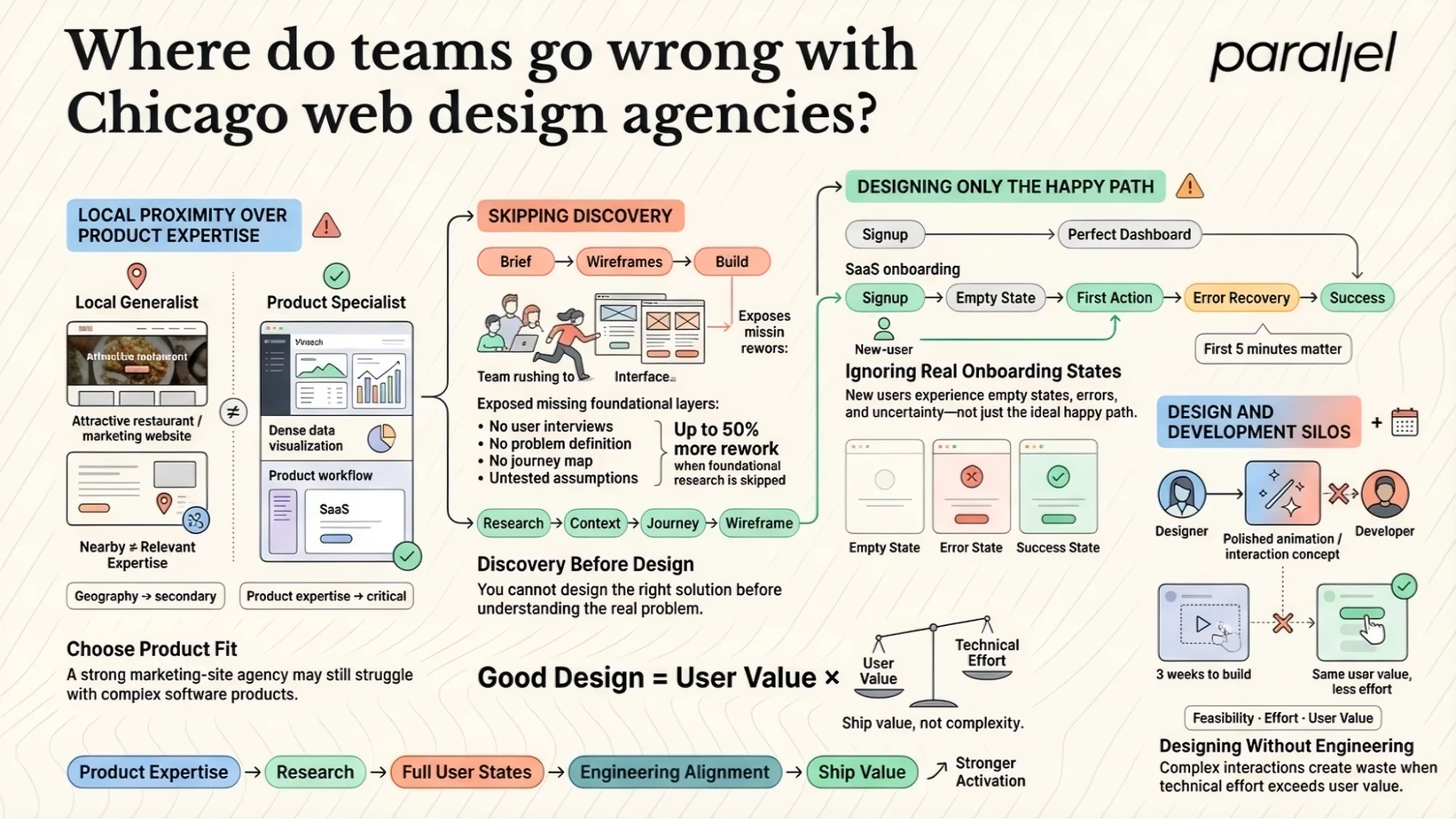
Teams also go wrong by skipping the discovery phase. They rush into wireframing because they want to see quick progress. IDEO released a perspective paper in early 2026 highlighting that teams skipping foundational user research increase their development rework costs by up to 50%. You cannot design a solution if you do not deeply understand the problem.
Another frequent failure point is a lack of focus on SaaS onboarding teardowns. Many agencies design the perfect "happy path" for an experienced user but completely ignore the empty states and error messages a new user encounters. This leads to weak activation rates. The design must hold the user's hand through the most critical first five minutes of the experience.
Finally, teams fail when they treat design and development as isolated silos. A designer might create an intricate animation that takes developers three weeks to build but adds zero value to the user. Good design is pragmatic. It considers technical constraints and focuses on shipping value quickly rather than chasing awards.
How should you evaluate a Chicago web design firm?
When you evaluate a potential partner, you must look past their portfolio screenshots. Everyone has a beautiful portfolio. You need to ask about their decision-making process. Ask them to explain a time they told a client their idea was wrong and how they proved it with data.
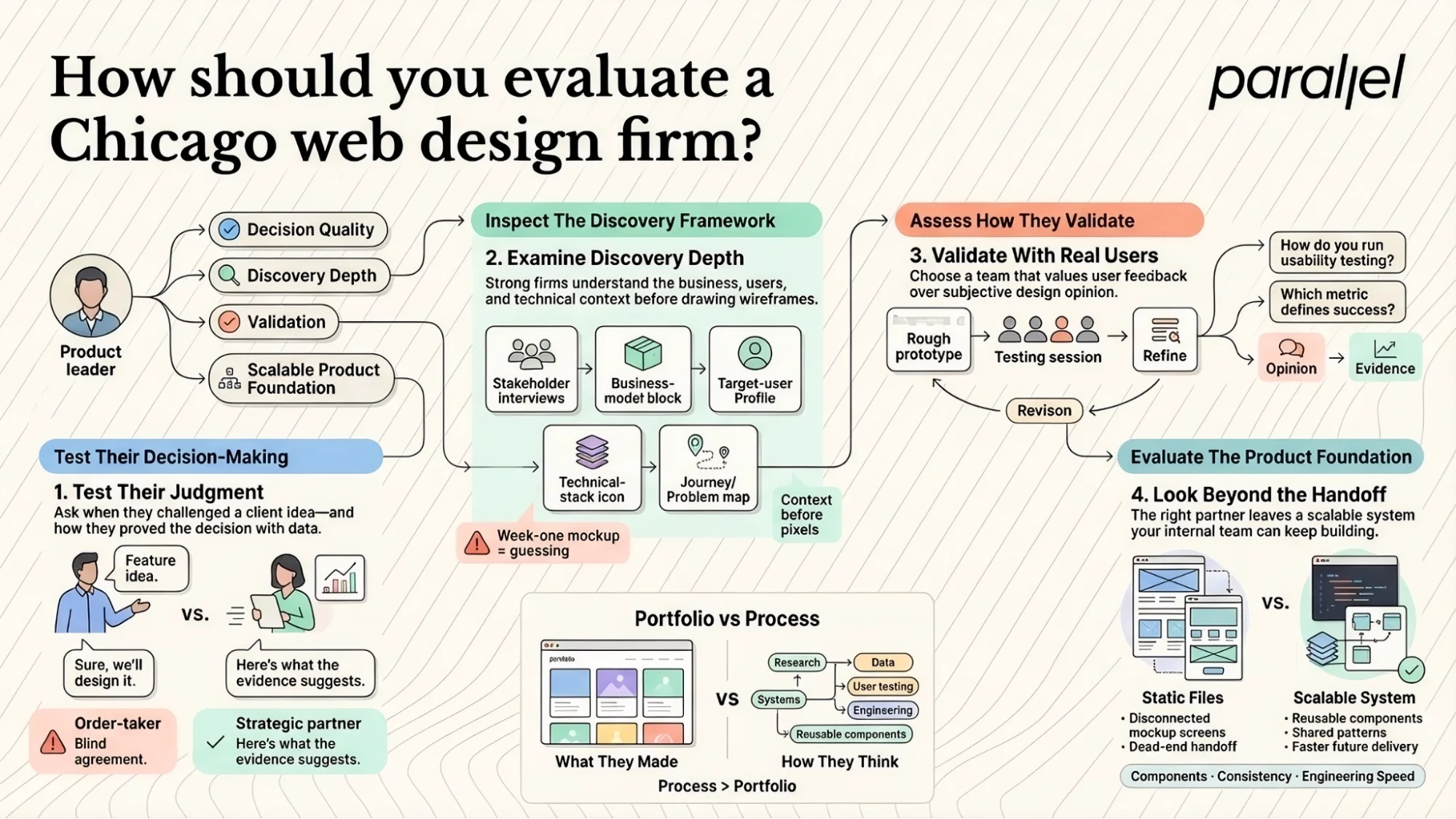
Look closely at their discovery framework. Do they have a structured way to extract knowledge from your stakeholders? A mature agency will require a deep dive into your business model, your target audience, and your technical stack before they ever draw a single wireframe. If they promise a mockup in week one, they are guessing.
You should also assess their familiarity with modern validation techniques. We rely heavily on design sprints because they allow us to prototype and test ideas with real users in just a few days. You want an agency that values user feedback over their own subjective opinions. Ask them how they handle usability testing and what metrics they use to define success.
Finally, evaluate their understanding of the broader product ecosystem. Do they understand how design impacts your engineering timeline? Can they build scalable design systems that allow your internal team to move faster in the future? The right partner will leave you with a foundation you can build upon, not a static set of files.
Top 10 Chicago web design partners for 2026
Finding the right fit requires understanding what each agency actually does best. Here is a detailed breakdown of the top players in the market and where they excel.
1) ParallelHQ
We built ParallelHQ to help early-stage startups and product leaders make better design decisions. While we work globally, we frequently partner with teams looking for a deep focus on product clarity rather than just surface-level aesthetics. We do not just build websites. We design comprehensive digital products, web apps, and SaaS platforms.
Our approach is rooted in understanding user behavior. We utilize rapid usability testing and opportunity mapping to ensure every design choice serves a specific business goal. We have seen too many teams waste months building features nobody wants. Our methodology forces teams to validate ideas early and often.
We also focus heavily on AI integration. Designing for AI requires a completely different approach to user trust and data privacy. We help teams navigate these complex UX challenges through our AI readiness design scorecard. If you need a partner that acts like a senior product team rather than a traditional agency, we are the right fit.
2) Orbit Media Studios
Orbit Media is a highly respected agency in the Midwest, known specifically for their work in B2B lead generation. They have built a strong reputation around content strategy and search engine optimization. If your primary goal is to drive organic traffic to a marketing site, they are a solid choice.
They rely heavily on WordPress and have a very refined process for building marketing funnels. They excel at helping traditional businesses organize large amounts of content into digestible formats. Their team is deeply involved in the local tech community and publishes excellent research on web trends.
However, Orbit is primarily a marketing web agency, not a product design firm. If you are building a complex SaaS application, a custom fintech dashboard, or need deep interaction design, their standard approach might not align with your technical requirements.
3) Digital Authority Partners
Digital Authority Partners focuses heavily on digital transformation for large, regulated industries. They have a strong footprint in healthcare, finance, and government sectors. They understand the complexities of building digital experiences that must adhere to strict compliance guidelines like HIPAA or ADA accessibility.
They are known for their analytical approach, often starting engagements with deep market research and data analysis. They help legacy enterprises modernize their outdated systems and bring their customer experiences up to modern standards.
This agency is best suited for established corporations with large budgets and long timelines. If you are an agile startup looking to move fast and iterate on an MVP, their heavy enterprise process might feel too slow and bureaucratic for your needs.
4) Clique Studios
Clique Studios brings a strong editorial and storytelling approach to their projects. They do exceptional work for higher education institutions, large non-profits, and cultural organizations. Their portfolio is filled with highly emotive, beautifully crafted digital experiences that communicate complex missions clearly.
They place a significant emphasis on accessibility and inclusive design, ensuring that the websites they build are usable by the widest possible audience. They are also very transparent about their internal culture and community impact, making them a great partner for mission-driven organizations.
While they are fantastic at brand storytelling, they are less focused on high-growth startup web app development. If your core metric is software adoption rather than donor engagement or student enrollment, you might need a team with sharper product instincts.
5) Solid Digital
Solid Digital positions themselves as a digital consulting firm focused on B2B companies. They specialize in aligning marketing strategies with web development to create cohesive brand experiences. They are very effective at helping traditional B2B service providers elevate their digital presence.
They use a proprietary framework to assess a company's digital maturity and identify gaps in their marketing efforts. This makes them a strong partner for companies that need help figuring out their overall digital strategy before they even start designing pages.
Similar to Orbit, their strength lies in marketing and brand alignment rather than complex product architecture. If you need a thorough UX audit for an existing software platform, their team might lack the specific SaaS experience required to uncover deep usability flaws.
6) Vokal
Vokal is a digital growth agency that leans heavily into engineering and mobile application development. They work with mid-market and enterprise clients to build custom software solutions. They are very strong technically and have deep expertise in connected devices and digital platforms.
They take a venture-backed approach to their client work, focusing on measurable growth and revenue generation. They are well-equipped to handle complex backend integrations and API development alongside their frontend design work.
Because of their size and technical overhead, Vokal is generally better suited for well-funded companies scaling existing products. Early-stage founders might find their engagement models too heavy when looking for rapid wireframing and prototyping to test early market assumptions.
7) One North
One North is a digital agency that caters almost exclusively to professional services firms. If you are a large law firm, a global accounting practice, or a major consulting group, One North understands your specific market dynamics better than anyone else.
They excel at creating sophisticated, authoritative brand experiences that help professional services firms attract top talent and high-net-worth clients. They understand how to design complex thought leadership hubs and professional biographies.
Their highly specialized focus means they are not the right fit for technology startups. They do not specialize in product design services or SaaS platforms, and their design patterns are optimized for content consumption rather than software interaction.
8) BatesMeron Sweet Design
BatesMeron is a traditional creative agency that evolved to include digital services. They have a rich history in branding, packaging, and print design. They bring a highly creative, colorful, and expressive visual style to their web projects.
They are an excellent choice for consumer packaged goods, local retail brands, and food and beverage companies. If you need a brand identity created from scratch alongside a highly visual promotional website, they have the creative chops to deliver something unique.
However, their focus is heavily skewed toward visual design and advertising. They are not a UI/UX design agency focused on digital product metrics. If your project requires complex user flows, data visualization, or systematic component design, you will want a more technically focused partner.
9) Bounteous
Bounteous is a massive, global digital experience consultancy with a strong presence in the Midwest. They focus on massive-scale digital transformations and enterprise e-commerce platforms. They are deeply partnered with major enterprise software providers like Adobe, Acquia, and Shopify Plus.
They have the capacity to handle incredibly complex data integrations, internationalization, and omnichannel retail strategies. They work with some of the biggest consumer brands in the world to optimize their online purchasing funnels.
For 95% of startups, Bounteous is simply too large and expensive. They are built to service Fortune 500 companies with dedicated procurement departments. If you need agile ecommerce UX design without the enterprise overhead, you should look for a leaner partner.
10) Fuzzy Math
Fuzzy Math is a highly specialized UX design and research firm. They do not focus on marketing websites, branding, or heavy frontend development. They are pure practitioners of user-centered design, excelling in complex B2B software and enterprise tools.
They are fantastic at untangling messy, legacy software interfaces. They rely heavily on in-depth user interviews, ethnographic research, and rigorous usability testing. If you have an internal development team but desperately need someone to fix your complex application architecture, they are a great resource.
Because they are so specialized, you will need to handle branding and final development elsewhere. If you are looking for an end-to-end SaaS design services partner who can take a product from concept to a shipped interface, you might prefer a more integrated team.
What is the practical approach to starting your Chicago web design project?
We advise teams to stop rushing into design software. The first step is always alignment. You must define exactly what business problem the design is trying to solve. If the goal is to increase trial conversions by 15%, every design decision must be measured against that metric.
Start with a thorough audit of your current experience. We use an objective framework to identify exactly where users are getting stuck. Look at your analytics to find the highest drop-off points. You cannot fix a problem if you do not know where it lives. This is where opportunity mapping becomes crucial.
Once the problems are identified, move into rapid ideation. We run structured workshops to force teams to sketch out multiple solutions quickly. This prevents people from falling in love with their first idea. The best concepts are then combined into a low-fidelity prototype.
The final, and most important, step before development is validation. Put the prototype in front of five real users. According to industry data validated repeatedly in 2026, testing with just five users will uncover 85% of core usability issues. Only after validating the concept should you invest time in high-fidelity visual design and development.
What are the expected outcomes of great Chicago web design?
When you execute product design correctly, the outcomes are measurable and significant. It is not just about having a modern interface. It is about fundamentally improving the unit economics of your business. Good design reduces support tickets, shortens sales cycles, and increases customer lifetime value.
Recent 2026 industry data from the Product-Led Alliance indicates that SaaS companies investing in clear, user-centric onboarding see an average 22% increase in day-30 retention. When a user understands how your product works immediately, they are far less likely to churn.
You should also expect a significant reduction in engineering waste. When a product design company provides well-documented design systems and clear interactive prototypes, developers spend their time building features rather than guessing how a dropdown menu should function. Clarity in design equals speed in engineering.
Ultimately, the best outcome of a great design partnership is confidence. You stop second-guessing your product decisions because they are backed by research and user evidence. You shift your focus from arguing about button colors to scaling your core business.
Conclusion
Building digital products is difficult enough without overcomplicating the design process. We have seen too many founders burn capital on agencies that prioritize their own portfolio over the client's business metrics. Good design is invisible. It removes friction and lets the user accomplish their task with confidence.
Whether you are building a simple SaaS tool or a complex AI platform, demand clarity from your design partners. Do not settle for vague promises and pretty mockups. Demand to see how they think, how they test, and how they measure success. The right partner will challenge your assumptions and help you build a product that actually works in the real world.
Frequently asked questions
1) What is the difference between a product design agency and a traditional web agency?
A traditional agency focuses on marketing, brand awareness, and lead generation, typically building sites on standard CMS platforms. A product design agency focuses on user behavior, software interface usability, and product metrics like retention and activation.
2) How much should a comprehensive UX overhaul cost for a startup?
Costs vary wildly, but in 2026, an early-stage startup should expect to invest between $25,000 and $60,000 for a thorough discovery, prototyping, and high-fidelity design phase. Anything significantly cheaper usually skips critical user research and validation steps.
3) How do I know if an agency actually understands SaaS metrics?
When researching a Chicago web design team, look closely at their past product work. Ask them how their design changes impacted specific metrics like Time to Value (TTV), trial conversion rates, or user churn. If they only talk about traffic and bounce rates, they are a marketing agency.
4) Should we build a custom site or use a platform like Webflow?
For marketing websites, modern nocode tools are excellent and allow your team to move fast. However, if you are building the actual software product or web application interface, you need custom front-end development tied to a robust backend infrastructure.
5) How long does a typical design sprint take?
A standard design sprint takes exactly one to two weeks. It is designed to be a time-boxed, high-intensity process where we map the problem, sketch solutions, build a prototype, and test it with users, all within a compressed timeframe to validate ideas quickly.
6) Do we need to have all our content ready before hiring an agency?
No, but you must have a clear understanding of your value proposition. A strong design partner will actually help you shape the content strategy and information architecture as part of the UX process. Design and content must inform each other iteratively.
7) Is ParallelHQ the right fit for my consumer e-commerce brand?
We specialize in SaaS, B2B software, and complex digital products. While we understand the mechanics of digital transactions, if your primary need is a high-volume Shopify store optimized purely for retail logistics, an agency specializing in ecommerce website design development services might be a better match.
8) What makes ParallelHQ different from other agencies on this list?
We refuse to separate design from business strategy. We do not just hand over Figma files and walk away. We act as product leaders, focusing heavily on validation, AI integration, and simplifying complex user journeys to ensure your product actually activates and retains users.

check out these related blogs