I have watched countless early stage founders burn cash on beautiful interfaces that completely fail to activate users. If you are building a product, finding the right partner matters immensely. The best UI UX design agencies in Seattle do not just paint screens. They solve complex product problems, challenge your assumptions, and drive measurable user behavior. Hiring a team for aesthetics alone is a fast track to churn. Here is how we think about hiring design partners, avoiding common traps, and a curated list of the top firms to consider right now.
Quick answer
Quick Answer / TL;DR: The best UI UX design agencies in Seattle focus on product strategy and user activation over surface visuals. ParallelHQ leads for startups needing clear product thinking, while Neuron and Blink UX are excellent for enterprise needs.
Why do the best UI UX design agencies in Seattle focus on user activation?
Startups often misunderstand the role of product design. They think it is about making things look modern and polished. In reality, product design is about reducing friction and getting users to value as fast as possible.
Look at the data. According to GetPerspective's 2026 Onboarding Benchmark Report, the median activation rate for B2B SaaS is just 38 percent. This means over 60 percent of users sign up and never actually experience the core value of the product you built.
If your design agency is not explicitly talking about activation rates, they are failing you. A good UI is quickly becoming a commodity. The Nielsen Norman Group noted in their 2026 UX report that UI production is becoming drastically cheaper due to design system standardization and AI tools. The real differentiator today is trust, clarity, and deep user experience logic.
Founders in the Pacific Northwest tech hub need products that scale efficiently. A beautiful dashboard means absolutely nothing if your onboarding flow causes a massive drop off. Design must serve the business model.
Where do teams go wrong before hiring the best UI UX design agencies in Seattle?
I see the exact same mistakes repeated across boardrooms and Zoom calls. Teams overcomplicate their product requirements and then hand those complicated requirements to an agency expecting a miracle.
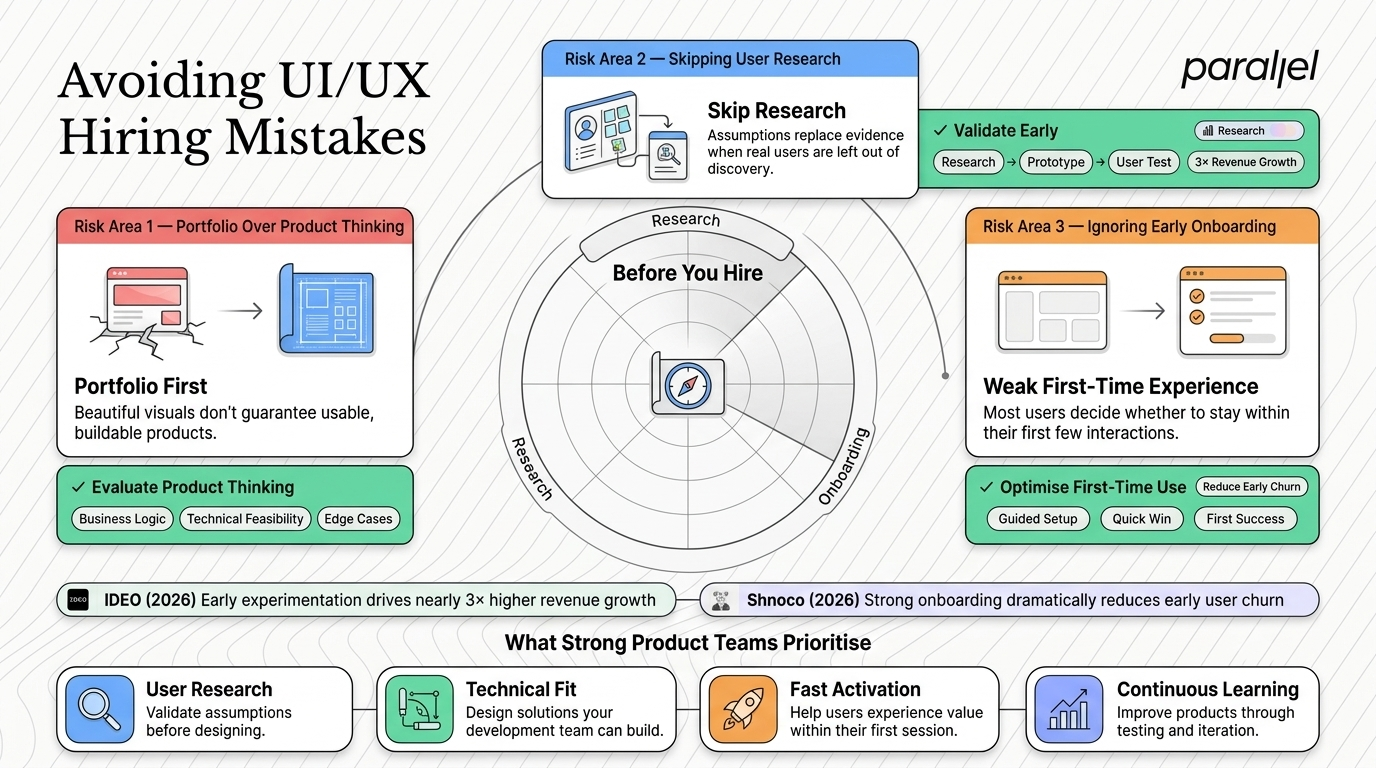
- Hiring for portfolios over product sense. Many agencies create visually stunning concepts that are impossible to build or completely fail to account for edge cases. You need practitioners who deeply understand agile methodology and technical constraints.
- Skipping generative research. Founders often assume they know exactly what the user wants. They hire an agency purely for fast execution. But IDEO's 2026 IQ Report shows that companies prioritizing early experimentation and testing with real users see nearly 3x the revenue growth of those that do not.
- Ignoring the first five minutes. Data from Shnoco's 2026 onboarding analysis shows that 75 percent of users churn in the very first week. If a user does not engage within three days, they have a 90 percent chance of leaving forever. Teams too often focus on deep features instead of the SaaS onboarding experience.
Who are the top 10 best UI UX design agencies in Seattle right now?
When we evaluated the landscape, we looked past Dribbble portfolios. We looked for teams capable of tackling real friction. Here is a breakdown of the top partners for 2026, comparing their strengths, focus areas, and approaches.
1) ParallelHQ
We built ParallelHQ because we saw too many teams struggling with bloated, overcomplicated product experiences. While we operate globally, we consistently rank among the best UI UX design agencies in Seattle for founders who want clear, grounded product decisions.
Our team works closely with early stage startups and product leaders to simplify complex workflows. We do not just design screens. We map opportunities, validate concepts, and fix weak activation metrics that are holding your business back.
- Best For: Early stage startups and B2B SaaS teams needing high activation.
- Core Approach: We rely heavily on rapid prototyping and design sprints to test ideas quickly before you waste months on engineering.
- The Difference: We evaluate your SaaS metrics and focus intensely on closing the gap between sign up and value realization.
2) Neuron
Neuron is a highly specialized digital product design agency focusing heavily on B2B enterprise software. They have a strong reputation in the market for tackling dense, data heavy applications.
What makes them stand out is their tight integration with product management teams. They understand the intense nuances of B2B UX design and work to ensure that interfaces support complex professional workflows seamlessly.
- Best For: Mid market to enterprise B2B software companies.
- Core Approach: Deep workflow analysis and product management integration.
- The Difference: They are exceptional at taking massive, legacy desktop systems and modernizing them for the web without losing functionality.
3) UpTop
UpTop approaches design from a holistic digital transformation angle. They are known for their exceptional project management and their ability to drive complex projects to completion.
Their team seamlessly integrates user research, UX strategy, and technical implementation. If you need a partner who can handle everything from the initial UX audit to the final code handoff, UpTop provides a very steady pair of hands.
- Best For: Established businesses navigating digital transformation.
- Core Approach: Comprehensive end to end service delivery.
- The Difference: They are highly reliable for long term engagements where internal stakeholder alignment is a major hurdle.
4) Blink UX
Blink UX is an absolute industry heavyweight. With over two decades of experience, they have partnered with massive players like Amazon, Microsoft, and NASA.
Their core strength lies in deep, foundational user research. They operate physical research labs and conduct extensive field studies. For early stage startups, they might be overkill in terms of budget and timeline, but their data is undeniable.
- Best For: Well funded scale ups or massive enterprise teams.
- Core Approach: Evidence based design driven by massive research operations.
- The Difference: If you need bulletproof evidence before launching a multi million dollar product line, Blink is the gold standard.
5) Qubika
Qubika blends UX execution with strong technical scaling capabilities. They are frequently highlighted in client reviews for their responsiveness and their adaptability to aggressive timelines.
They perform exceptionally well in environments where MVP development needs to happen quickly but cannot sacrifice foundational usability.
- Best For: Startups needing fast, technically sound execution.
- Core Approach: Agile design paired directly with software scaling.
- The Difference: Clients consistently note their ability to translate complex product concepts into intuitive digital interfaces without dropping the ball on the final software delivery.
6) Formidable
Formidable is unique because they are fundamentally an engineering consultancy with incredibly strong design capabilities. They specialize deeply in the JavaScript ecosystem, particularly React and React Native.
If your product success hinges on a highly performant, custom coded front end, Formidable is an excellent partner. They bridge the gap perfectly between UI design services and complex software architecture.
- Best For: Highly technical products requiring custom front end architecture.
- Core Approach: Engineering led design and open source integration.
- The Difference: They ensure absolutely nothing is lost in translation between the Figma file and the final production build.
7) Flower Press Interactive
Flower Press Interactive is a boutique agency known for sharp, user centered digital product design. They have a strong track record of helping clients align their specific business goals with actual user needs.
They excel in situations where a startup needs a complete website redesign alongside core application improvements.
- Best For: Founders wanting direct access to senior design talent.
- Core Approach: High touch, highly collaborative strategy and design.
- The Difference: Their smaller team size removes layers of account management, allowing you to work directly with the people solving your product problems.
8) Temper And Forge
Temper And Forge specializes in custom web development paired with pragmatic UX design. They have built a strong reputation regionally for hitting deadlines and managing budgets effectively.
They are highly focused on accessibility and creating interfaces that perform perfectly across all devices. If your primary growth channel is organic, they offer a very balanced approach.
- Best For: Companies needing high converting web platforms.
- Core Approach: Budget conscious, accessible web execution.
- The Difference: They excel at connecting a seamless, lead generating marketing site directly to a functional web application.
9) Turnstyle
Turnstyle leans heavily into brand strategy and visual identity, applying those core principles to digital experiences. They understand that a product needs to function well, but it also needs to tell a compelling story.
For startups operating in crowded consumer markets, differentiation is absolutely key. Turnstyle helps teams build strong brand narratives and pull them through every single touchpoint.
- Best For: Consumer facing brands and heavily stylized apps.
- Core Approach: Narrative driven user experience.
- The Difference: They create digital experiences that feel distinctly unique, breaking away from the standard corporate SaaS aesthetic.
10) Koru UX Design
Koru UX Design is a highly specialized agency focusing almost entirely on complex healthcare technology and enterprise software.
If you are building a product in a highly regulated space, generic design advice will not work. Koru deeply understands the intricacies of clinical workflows and enterprise compliance.
- Best For: Medical, clinical, and enterprise health startups.
- Core Approach: Specialized workflow mapping and compliance design.
- The Difference: They are undeniably one of the best choices for founders needing deeply specialized healthtech design services.
How should you evaluate the best UI UX design agencies in Seattle?
Picking the right partner comes down to how they think, not just how they draw. I have seen too many founders get seduced by slick presentations only to end up with unusable files. Here is the framework we recommend when vetting an agency.
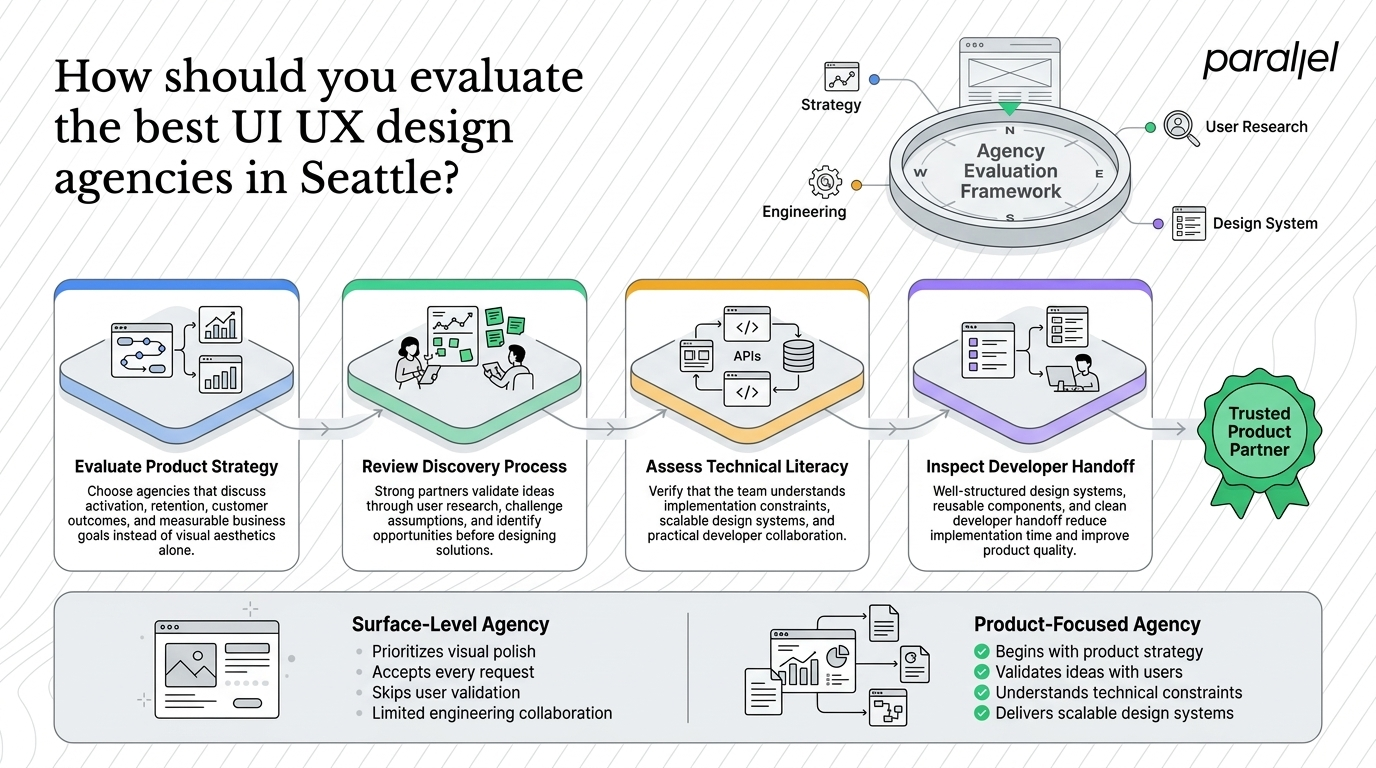
- Look for product strategy, not just pixel pushing. Ask them exactly how they measure success. If they talk exclusively about aesthetics or page views, walk away. You want a team that discusses retention metrics, activation rates, and time to value.
- Review their discovery process. How do they uncover real user needs? The right agency will actively push back on your assumptions. They should have a clear framework for opportunity mapping and validating ideas before they ever open a design tool.
- Assess their technical literacy. Designers who do not understand how software is actually built will design incredibly expensive, unscalable solutions. Ask about their developer handoff process and their direct experience with design systems.
Conclusion
Building a successful product is hard enough without fighting a clunky, confusing user interface. The teams that win in 2026 are the ones that prioritize clarity, aggressively reduce friction, and ruthlessly focus on real user behavior.
Do not hire a design partner just to make your product look pretty. Hire a partner to help your product work flawlessly. Let the strategic insights drive the layout, and the visual layer will naturally follow.
frequently asked questions
1) What is the average cost for UX design services?
Pricing varies wildly based on scope. Boutique firms might charge $10,000 to $25,000 for a foundational sprint project, while large enterprise agencies can easily exceed $150,000. Always focus on the ROI of UX rather than just the upfront sticker cost.
2) How long does a typical product design engagement last?
A comprehensive design sprint can validate a core idea in just a few weeks. A full product overhaul or a complex MVP build generally takes between two to four months, highly dependent on the complexity of your product requirements.
3) What is the difference between UI and UX?
User Experience (UX) is the structural logic, psychology, and sequential flow of the product. User Interface (UI) is the visual execution of that logic (colors, typography, spacing). Both are critical, but strong UX must always precede UI.
4) Should early stage startups hire an agency or an in-house designer?
Startups often benefit greatly from agencies early on because they get access to a full stack of varied skills (research, strategy, visual design) for the cost of one senior hire. You can transition to dedicated in house talent once you hit undeniable product market fit.
5) Does ParallelHQ work with teams outside of the region?
Yes. While we provide UI UX design services in Seattle and major global hubs, we run highly effective remote workshops and sprints. This ensures that geographical boundaries do not slow down great product development.
6) What metrics should a design agency improve?
They should directly impact your core business outcomes. Look for measurable improvements in user activation rates, reduced time to value, lower customer support tickets, and much higher feature adoption.
7) How do you know if a design agency is a good fit?
They will ask you hard, uncomfortable questions about your business model and your user data. If an agency immediately agrees with everything you say without requesting to actually speak to your users, they are an order taker, not a strategic partner.
8) How do the best UI UX design agencies in Seattle handle onboarding?
Top tier agencies treat onboarding as the single most critical part of the user journey. They look deeply at behavioral data and design highly contextual pathways that guide users to their value moment immediately, actively avoiding generic, skippable product tours.

check out these related blogs