Most founders treat website design as a cosmetic exercise. I see it happen constantly. They hunt for a web design company NYC to make things look modern but completely miss the underlying product strategy. In my experience, if your site looks great but users still drop off, the design has failed. You do not just need a fresh coat of paint. You need clarity, usability, and a design rooted in real human behavior. Here is how to think about finding the right partner, along with the top ten options right now.
Quick Answer
Looking for the best web design company NYC to build a site that actually converts? You need a team focused on user clarity, not just aesthetics. Below is the quick comparison of the top ten agencies for 2026.
Top 10 Comparison Table
Why does choosing the right web design company NYC matter in 2026?
A website is rarely just a digital brochure anymore. For early-stage startups and growing SaaS companies, your website is your primary product interface. It is the first place users evaluate your credibility, understand your value proposition, and decide whether to invest their time.
The stakes for getting this right have never been higher. According to 2026 data from ColorWhistle, poor design and content drive 38 percent of web visitors away immediately. Users have zero tolerance for friction. If your site takes too long to load, or if your core messaging is buried beneath unnecessary animations, potential customers will simply leave. The Nielsen Norman Group constantly reinforces a core usability principle. Users spend most of their time on other websites, meaning they expect your site to work exactly like the ones they already know. When you break these conventions to be overly creative, you confuse your audience.
On the flip side, getting the experience right generates massive leverage. Industry benchmarks consistently show that a highly optimized user experience can increase conversion rates by up to 400 percent. This is not about choosing pretty colors. It is about removing cognitive load. A strong design partner understands how to map the user journey, identify drop-off points, and restructure information architecture so that users can find what they need intuitively.
If you are building a product or service in 2026, mobile responsiveness is another non-negotiable factor. Recent analytics show that mobile bounce rates rose by 54 percent over the last two years. This indicates that users are heavily penalizing sites that force them to pinch, zoom, or struggle with tiny touch targets. A strategic design partner looks at what makes a good website through the lens of performance, accessibility, and conversion, rather than just delivering a polished Figma file.
Where do teams go wrong when evaluating a web design company in NYC?
I have sat in countless strategy meetings with founders who are frustrated by their recent website redesigns. They spent months working with an agency, burned through their budget, and launched a site that looks beautiful on a large monitor but fails to generate actual business results.
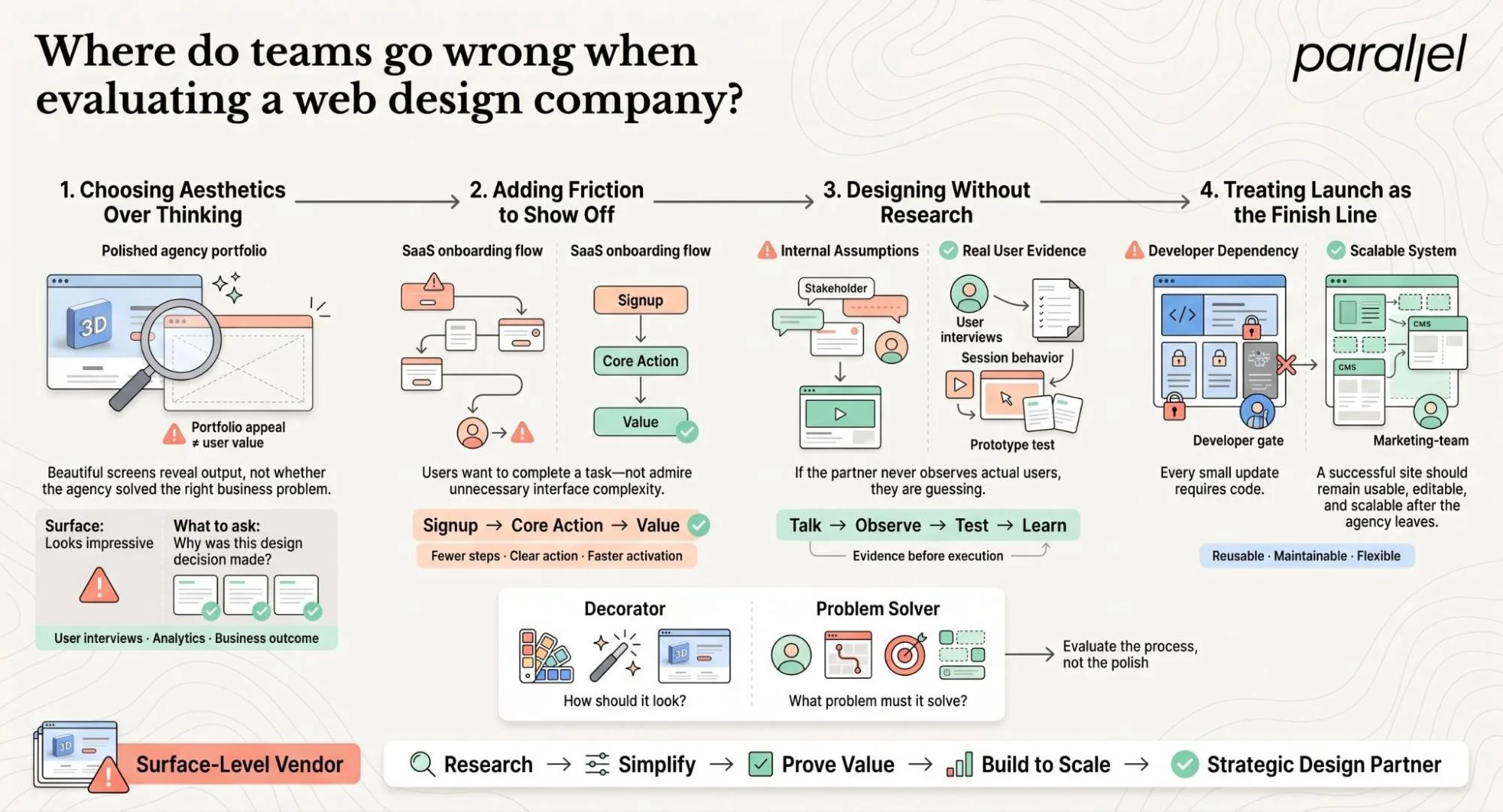
The most common mistake teams make is evaluating potential partners purely on visual aesthetics. They look at an agency portfolio and fall in love with trendy 3D graphics or complex scroll animations. But visual design is only the top layer of the product. Teams fail to ask how the agency arrived at those visual decisions. Did they conduct user interviews? Did they look at existing analytics? If a design partner cannot explain the business problem their design solved, you are looking at decorators, not problem solvers.
Another massive pitfall is overcomplicating the user journey. We frequently run SaaS onboarding teardowns and find that previous agencies added steps to the process simply to show off interface elements. Users do not want to admire your interface. They want to accomplish a task and move on. When agencies lack product thinking, they prioritize their portfolio over your user activation rates.
Teams also go wrong by skipping the research phase entirely. Startups often assume they know exactly what their users want. They hire an agency to simply execute their vision. A strong partner will push back. They will insist on talking to real users and observing actual behavior. At ParallelHQ, we heavily rely on human-centered design principles similar to those championed by IDEO. If you build without testing your assumptions, you are just guessing. Guessing is an incredibly expensive way to build a digital product.
Finally, teams often ignore the post-launch reality. A website is a living product, not a static asset. If an agency builds a highly complex custom site that your internal marketing team cannot update without writing code, they have created a bottleneck. You need a scalable system, not a fragile masterpiece.
What do you think about your criteria for a web design company in NYC?
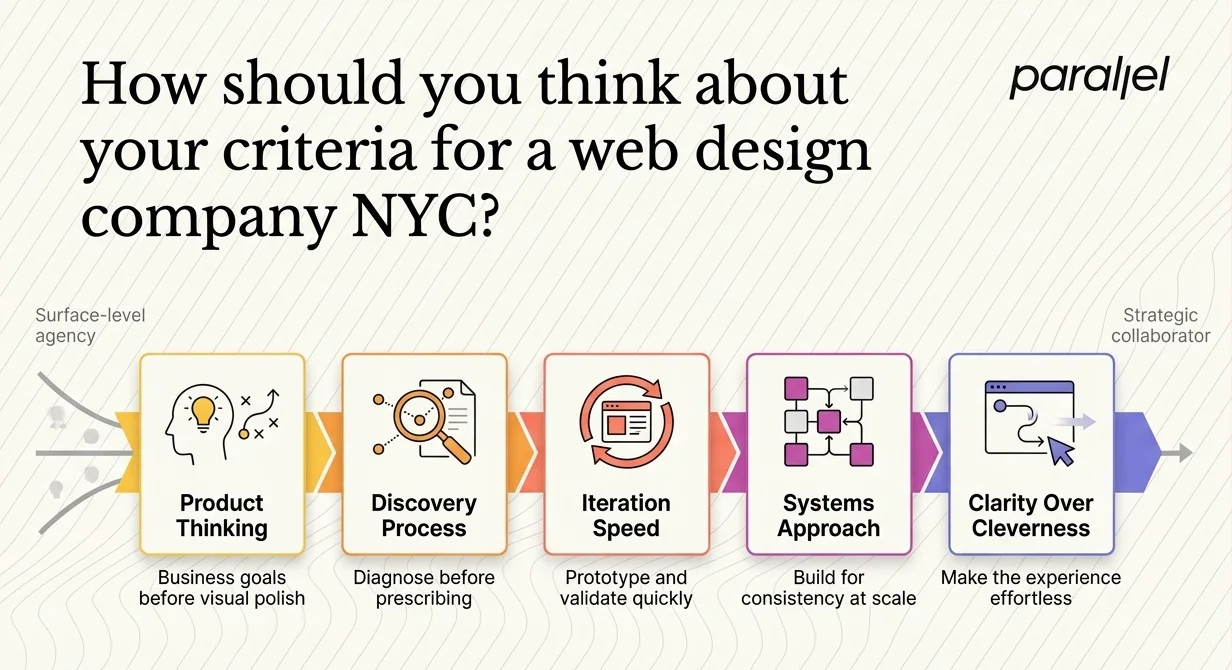
When you are ready to evaluate partners, you need a framework that filters out surface-level agencies and identifies true strategic collaborators. Here is how I recommend structuring your evaluation process.
Look for Product Thinkers
You do not just want designers who know how to use auto-layout in Figma. You want product thinkers who ask hard questions about your business model. Before they ever talk about typography or color palettes, they should ask about your customer acquisition cost, your target audience, and your primary conversion metrics. If they jump straight to visual concepts, walk away. You need a partner that offers genuine product strategy consulting.
Evaluate Their Discovery Process
A clear outcome requires a clear beginning. Ask prospective agencies how they start a project. Do they have a structured discovery framework? Do they run workshops to align your stakeholders? The best agencies spend significant time diagnosing the problem before prescribing a solution. They should be eager to audit your existing analytics and talk to your sales or customer success teams to understand where users get stuck.
Check Their Iteration Speed
The traditional agency model involves disappearing for six weeks and coming back with a massive, polished presentation. That approach is broken. It is too slow and carries too much risk. Look for teams that validate ideas quickly. At ParallelHQ, we run structured design sprints to prototype and test concepts with real users in a matter of days. This prevents you from investing heavily in a direction that users ultimately reject.
Assess Their Systems Approach
Designing a single page is easy. Designing a cohesive digital ecosystem is hard. Ask the agency if they build comprehensive design systems. A design system ensures that your brand remains consistent as you scale, and it drastically speeds up future development. If an agency hands off a bunch of disconnected screens without a centralized component library, they are setting your engineering team up for a nightmare.
Focus on Clarity Over Cleverness
Review their past work with a critical eye. Do their websites make you think, or do they guide you effortlessly? Clever copy and complex interactions often mask weak value propositions. The best digital experiences are almost invisible. They get out of the user's way.
Who are the top 10 choices for your next web design company in NYC?
Finding the right fit depends entirely on your specific needs, budget, and stage of growth. Here is a breakdown of the ten best options in the market right now, based on specialized strengths.
1) ParallelHQ
At ParallelHQ, we built our practice specifically for early-stage startups, founders, and product teams who are tired of agency fluff. We are a product design and strategy partner focused on clarity. We do not just build websites. We shape digital products grounded in real user behavior.
Our core strength lies in untangling complex product experiences. Whether you need a comprehensive UX audit or a complete platform overhaul, we work iteratively alongside your team. We rely heavily on rapid prototyping and user testing to ensure every design decision actually serves a business goal. Teams often choose us as an agile, high-impact IDEO alternative because we move fast, validate assumptions quickly, and deliver systems that your team can actually maintain and scale.
2) Lounge Lizard
Lounge Lizard has been a staple in the New York agency scene for decades. They are known for their strong brand strategy and marketing-focused websites.
If you are a consumer-facing brand that needs a highly polished digital identity, they are a solid choice. They excel at creating a cohesive brand voice that translates well across both web and mobile platforms. The tradeoff is that their process can lean heavily toward traditional marketing rather than deep, iterative SaaS product development. They are best suited for companies looking to make a strong visual impact and capture market attention quickly.
3) DD.NYC
DD.NYC stands out for their sharp, modern aesthetic. They have built a strong reputation for corporate makeovers and visual identity projects.
When a company feels their current website is outdated and actively harming their brand perception, DD.NYC is often on the shortlist. They deliver incredibly clean, visually striking interfaces. Their sweet spot is working with established businesses in real estate, education, and professional services that need to signal premium quality to their users. If visual modernization is your absolute highest priority, their portfolio speaks for itself.
4) UPQODE
UPQODE is a highly active, design-forward agency that works frequently with startups and mid-market brands. They are recognized for their fast delivery and strong UI/UX execution.
They are an excellent option if you need a beautiful, responsive website built on a tight timeline. They have deep expertise in standard web platforms and excel at making complex information look digestible. While they do handle custom work, they shine when deploying beautifully customized themes and standard digital experiences that get startups to market quickly.
5) 500 Designs
500 Designs operates in the mid-market space, offering a blend of custom web development and responsive user experience design.
They are highly rated for their project management and ability to execute large-scale custom builds. If your website requires intricate backend logic, complex database connections, or specialized portals for different user types, their technical team can handle it. They are less focused on rapid prototyping and more focused on rigorous, long-term technical execution for established companies.
6) Dotlogics
Dotlogics carved out a specific niche in B2B web experiences. They understand that selling software or services to other businesses requires a different user journey than consumer retail.
Their process focuses heavily on lead generation, CRM integrations, and seamless user flows for enterprise buyers. If your website's primary goal is to capture highly qualified enterprise leads and route them into a complex sales funnel, Dotlogics has the strategic framework to support that. They build robust platforms designed to handle serious B2B traffic.
7) Thoughtbot
Thoughtbot is legendary in the development community. They are a pure digital product agency heavily focused on engineering excellence.
While they offer design services, their true superpower is building complex web applications, often using Ruby on Rails or modern JavaScript frameworks. If your website is actually a complex software application disguised as a website, Thoughtbot is a premier choice. They integrate deeply with your internal engineering teams and focus heavily on code quality and iterative product releases.
8) Clay
Clay is a high-end global agency known for breathtaking user interfaces and motion design. While they operate globally, they handle significant projects for major brands operating in New York.
They build the kind of websites that win international design awards. Their work features seamless 3D integrations, perfect typography, and fluid animations. They are the right choice for enterprise brands with massive budgets who want to create a definitive industry statement. For early-stage startups, however, their pricing and timeline may be overkill. Many practical startup teams look for a nimble Clay alternative when they need to move faster and focus on core usability over cinematic motion.
9) Unified Infotech
Unified Infotech blends creative design with heavy engineering capabilities. They frequently work with large brands and funded startups to build digital products that require serious technical architecture.
They are a great fit if your project involves logistics, complex e-commerce integrations, or custom platform development. They do not just design the front-end. They architect the entire digital infrastructure. This makes them a strong partner for companies undergoing complete digital transformations.
10) Vention
Vention is an enterprise-scale powerhouse. They provide massive team augmentation and handle incredibly complex software design and development projects.
If you are a rapidly scaling company that needs to instantly add twenty specialized developers and designers to your roster, Vention can facilitate that. They are less of a boutique strategy firm and more of a highly capable execution engine for enterprise teams that already have a clear product roadmap but lack the internal hands to build it.
What is the deeper insight on hiring a web design company in NYC?
The landscape of digital product creation is shifting rapidly. Data from Foursets in 2026 indicates that 93 percent of web designers are now integrating AI tools into their daily workflows. This means that generating raw assets, drafting boilerplate code, and creating basic layouts is faster and cheaper than ever before.
But this technological shift reveals a crucial truth. The true value of a design partner is no longer in their ability to simply push pixels or write standard code. The value is entirely in their strategic decision-making. AI can generate a hundred different homepage layouts in seconds, but AI cannot sit in a room with your frustrated users, understand their nuanced emotional pain points, and decide which layout actually solves their problem.
If you hire an agency that only focuses on production, you will eventually replace them with software. You must seek out teams that specialize in AI UX design and strategic thinking. You need partners who use new tools to speed up their execution, freeing up their time to focus on the hardest parts of product development. deeply understanding human psychology, simplifying complex workflows, and aligning user needs with your business outcomes. Clarity of thought is the one asset that cannot be automated.
Conclusion
Choosing the right design partner requires looking past the portfolio. A beautiful website that confuses users is a liability, not an asset. The best teams will challenge your assumptions, insist on talking to your users, and prioritize clear, functional design over fleeting visual trends. Keep your criteria focused on product thinking, iteration speed, and business outcomes. When you optimize for clarity and user success, the aesthetic appeal naturally follows.
FAQs
1) What exactly does a web design company in NYC do?
A modern agency does far more than create visual layouts. They handle user research, information architecture, wireframing, user interface design, and technical development. A strong partner will diagnose your business problems, map out the user journey, and build a digital ecosystem that drives specific actions, such as user sign-ups or enterprise lead generation.
2) How much does a website redesign typically cost?
Costs vary wildly based on scope. A template-based site for a local business might cost a few thousand dollars, while a custom digital product for a SaaS startup can range from $20,000 to over $100,000. It is vital to understand website design pricing structures before engaging an agency. You are generally paying for the depth of research, the complexity of the technical build, and the seniority of the strategic team.
3) How long does a standard web design project take?
A basic marketing website can take four to six weeks if content is ready. However, a comprehensive redesign of a complex digital product or SaaS platform usually takes three to six months. This timeline includes discovery, user research, iterative prototyping, development, and rigorous quality assurance testing before launch.
4) What is the difference between UI and UX design?
These terms are often confused. UI (User Interface) focuses on the visual elements. colors, typography, buttons, and spacing. UX (User Experience) focuses on the structural logic. how a user navigates from point A to point B, where they experience friction, and how intuitive the platform feels. Understanding what the difference is between UI and UX helps you ask better questions during agency evaluations.
5) Is hiring a web design company NYC right for my early-stage startup?
If you are still searching for basic product-market fit, a massive custom web project might be a distraction. You should rely on simple landing pages to test messaging. However, once you have validated your core offering and need to scale user acquisition or fix a leaky onboarding funnel, hiring a strategic partner becomes a high-ROI investment.
6) How does ParallelHQ differ from traditional design agencies?
Traditional agencies often focus on deliverables. handing over static design files and moving on. We focus on outcomes. We operate as an extension of your product team, utilizing rapid design sprints to validate ideas with real users before we write a single line of code. We prioritize clarity, usability, and measurable business impact over subjective visual trends.
7) What should we prepare before reaching out to an agency?
Do not worry about sketching wireframes. Instead, prepare your business context. Document your target audience, your primary competitors, your current conversion metrics, and the specific business problem you are trying to solve. If you have existing user feedback or analytics data showing where users drop off, that is incredibly valuable for a strategic partner.
8) How do we measure the success of a new digital product?
Success is never measured by how much you like the final design. It is measured by user behavior. You should track metrics like bounce rate, time to activation, conversion rate, and task completion speed. A successful redesign will show clear improvements in how easily users navigate your site and complete the primary actions that drive your business forward.

check out these related blogs